By Qorder Team
Over the past two years, Large Language Models (LLMs) have fundamentally reshaped software development workflows. Paradigms like Agentic Coding now allow developers to rapidly generate repo-level code from high-level directives, significantly accelerating development velocity. However, a growing sentiment in the developer community characterizes this shift as the rise of the "AI Cleanup Engineer": while Agentic Coding can swiftly automate the initial 80% of a task, the remaining 20%—involving logical calibration, boundary handling, cross-module coordination, and engineering refinement—often requires manual human intervention.
Despite this evolution, traditional code completion tools remain confined to the Fill-In-the-Middle (FIM) paradigm. These models typically operate by predicting a contiguous code span at the cursor position based solely on local context, lacking a holistic understanding of editing intent. This single-step, static approach falls short in real-world scenarios—such as multi-line modifications, function refactoring, or cross-file dependency adjustments—and fails to support coherent, structured sequences of development actions.
To address this limitation, we introduce an end-to-end framework built on three pillars:
Traditional FIM training typically involves randomly masking spans of code and prompting the model to reconstruct them. While effective for simple completion, this method captures only the static probability distribution of code, not the dynamic logic of software modification.
Qoder NEXT moves beyond random masking. Instead, we leverage Abstract Syntax Trees (ASTs) to reverse-engineer realistic edit trajectories, enabling the model to learn how edits unfold—not just what the final code looks like..
In practice, a single developer intent typically triggers a cascade of coordinated changes. Using an AST parser (like Tree-sitter), we mine high-quality repositories to automatically reconstruct these operation chains.
Consider identifier renaming —a canonical example of a structured edit that differs fundamentally from a naive find-and-replace:
[Edit Action 1] -> [Edit Action 2] -> ...
Beyond renaming, Qoder NEXT’s cold-start corpus includes diverse, advanced editing patterns that teach the model complex structural transformations:
● Signature Change: Adding a parameter to a function definition triggers automatic updates at all call sites—inserting placeholders or inferring compatible local variables.
● Logic Extraction: A code block is refactored into a new function or variable, and the original segment is replaced with an invocation.
● Type Refinement: Transitioning from an abstract interface to a concrete implementation.
● Method Override: When a new method is added to a superclass or interface, the model synthesizes valid overrides in relevant subclasses.
● Error Refactoring: Code flagged as erroneous by the Language Server Protocol (LSP) is automatically corrected into a logically valid alternative.
● Automatic Import: Unimported types, functions, or constants trigger the insertion of appropriate import statements, respecting project-specific conventions.
Through this rigorous AST-based simulation, Qoder NEXT learns causally dependent edits during pre-training—laying a foundation for multi-line, semantically aware editing.
While static simulation effectively addresses the cold-start problem (the "zero-to-one" phase), real-world development environments exhibit stochasticity and nuance that synthetic data alone cannot replicate. Understanding long-horizon edit trajectories—and, critically, why developers reject certain suggestions—requires authentic user interaction data.
We integrated the Qoder NEXT prototype into an IDE component that performs continuous inference. As the developer edits, the model predicts the next likely action and proactively surfaces potential follow-up edits. This design yields high-fidelity behavioral logs (collected under strict privacy protocols), categorized into three feedback signals:
● Explicit Accept: User accepts the full suggestion sequence (via the Tab key).
● Partial Edit: User accepts theinitial actions but manually modifies later steps.
● Explicit Reject: User dismisses the suggestion (using Esc) or ignores it.
Interaction logs are annotated into structured tuples:
(Context, Response_Accepted 1, Response_Accepted 2, ..., Response_Rejected 1, Response_Rejected 2, ...)
Unlike conventional approaches that overfit to positive examples, Qoder NEXT treats rejection signals as high-value data. For instance, if the model suggests obj.getName() but the user corrects it to obj.getDisplayName(), this reveals a gap in the model’s understanding of domain-specific semantics. Capturing such preference divergences is essential for aligning the model with human intent.
Traditional Reinforcement Learning from Human Feedback (RLHF) algorithms suffer from critical flaws when applied to sequential editing. Positive and negative trajectories are often highly entangled, requiring a more granular approach to loss computation.
In code editing, accepted y^wand rejected y^l trajectories frequently share long, identical prefixes. Consider:
● Context: user = User.find(id)
● User’s intent yw: user.update(name: "New"); user.save(); print("Done");
● Model’s prediction yl: user.update(name: "New"); user.delete(); print("Done");
Only the second action diverges (.save() versus .delete()); the rest is correct.
● Limitation of Naive Alignment: Treats yl as a monolithic bad sequence, penalizing even its correct parts.
● Consequence: The model becomes overly conservative, suppressing valid sub-actions out of fear that a downstream error might invalidate the whole trajectory—a phenomenon we call “Over-Suppression.”
To address this, we propose ActionRL, an alignment algorithm designed specifically for sequential editing. Its core innovation: shift the learning objective from ranking full trajectories to optimizing the decision boundary at the first point of divergence.
Given a preference group (one accepted trajectory, multiple rejected ones), ActionRL aligns all sequences action-by-action to identify the Behavioral Divergence Point (BDP)—the first step where choices differ. Since the context before the BDP is identical, any performance gap stems solely from the action taken at that point.
Instead of computing loss over the entire sequence, ActionRL localizes optimization to the conditional distribution at the BDP. It maximizes the margin between the chosen action  and rejected alternatives
  , conditioned on the shared history, while detaching gradients for all subsequent tokens. This ensures learning signals target only the critical decision node.
Rejected trajectories often contain syntactically valid suffixes after the error. ActionRL eliminates this noise by strictly truncating loss computation at the BDP. This guarantees:
● Divergence-point penalty: The shared prefix y<t* is neutral (or masked); only the erroneous action is penalized.
● Noise Filtration: Actions after t*—even if valid—are excluded from loss calculation, preventing misleading negative signals.
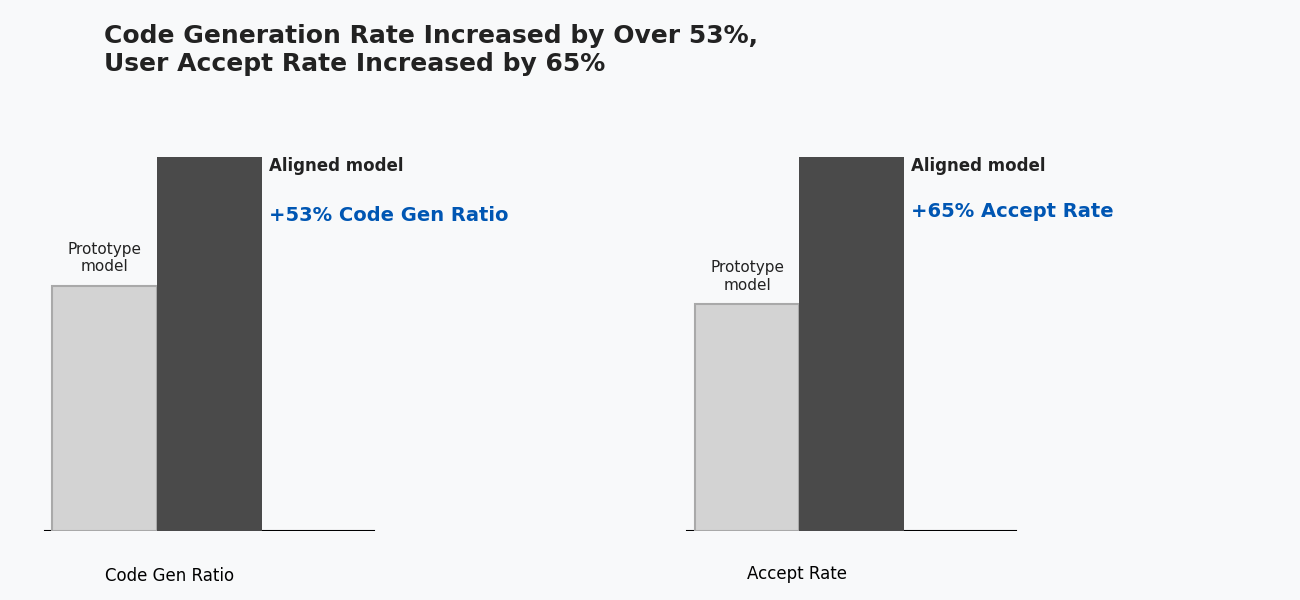
In practice, Qoder NEXT demonstrates significantly enhanced adaptability. After ActionRL alignment, key metrics show marked improvement:
● >53% increase in code generation ratio.
● Strong execution consistency: The model now treats refactoring as an atomic process—once an edit chain begins, it completes it reliably, drastically reducing “half-finished” suggestions.
These technical gains translate directly into user value:
● 65% higher acceptance rates
● Steady improvement in fine-grained inference accuracy
This confirms Qoder NEXT’s reliability in handling the nuanced demands of professional software development.
Baseline models trained with naive alignment showed only marginal gains in first-action accuracy but suffered reduced scenario coverage—they became risk-averse, suppressing predictions to avoid errors.
In contrast, ActionRL maintains high accuracy while boosting both prediction activeness and coverage, effectively counteracting the global conservatism induced by coarse-grained penalties.
Qoder NEXT’s data flywheel operates on a 24-hour cycle:
This rapid iteration enables measurable performance improvements in the live environment within 24 hours, creating a self-evolving system.
Qoder NEXT marks a pivotal shift—from “Code Completion” to “Intelligent Edit Suggestion.” It doesn’t just help write code; it understands the causal logic behind code modifications.
By combining AST-based trajectory simulation with fine-grained ActionRL alignment, we are building a system that reasons about “what’s next” with human-like intuition. As its capabilities mature, Qoder NEXT will evolve into a comprehensive development partner, automating end-to-end workflows—from feature implementation and testing to code commits and post-merge remediation.
Alibaba Cloud Named a Leader in Omdia’s Global Enterprise-Level MaaS Market Report
Ant Digital Technologies Earns Industry Recognition in AI-Driven Digital Identity Proofing

1,539 posts | 516 followers
FollowAlibaba Cloud Community - July 13, 2026
Alibaba Cloud Community - July 10, 2026
Alibaba Cloud Community - July 23, 2026
Alibaba Cloud Community - August 28, 2026
Alibaba Cloud Community - July 28, 2026
Alibaba Cloud Native Community - November 24, 2025
1,539 posts | 516 followers
Follow QwenWork
QwenWork is dedicated to helping employees strengthen their professional competitiveness in the AI era and to enabling enterprises to improve organizational effectiveness.
Learn More Token Plan
Build more, spend less. One plan, every modality.
Learn More
Alibaba Cloud Model Studio
A one-stop generative AI platform to build intelligent applications that understand your business, based on Qwen model series such as Qwen-Max and other popular models
Learn More Qwen
Qwen
Full-range, open-source, multimodal, and multi-functional
Learn MoreMore Posts by Alibaba Cloud Community

