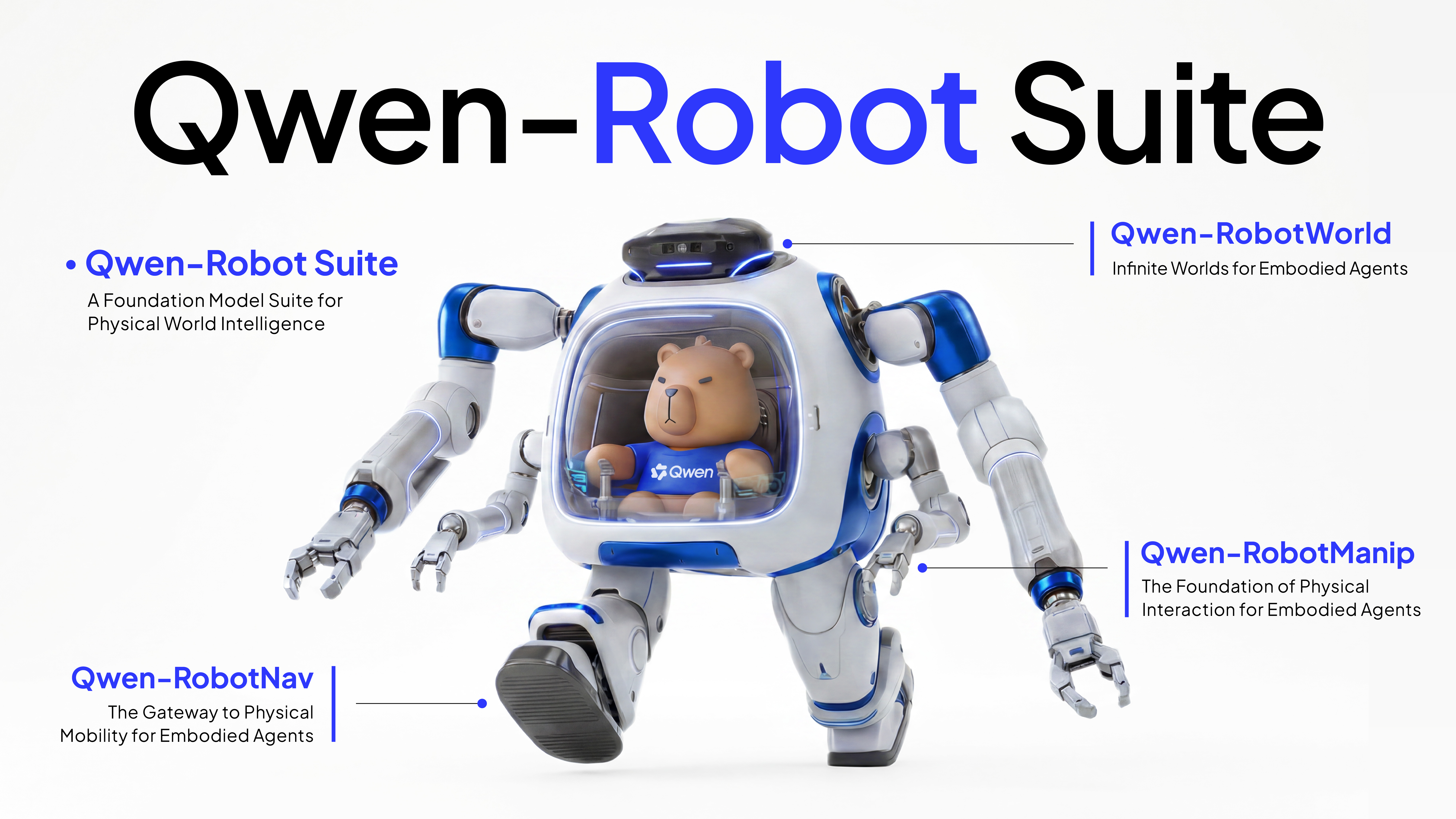
For years, large multimodal models have excelled at understanding digital data, such as text, speech, and images. However, translating this general intelligence into precise physical actions across diverse environments has remained a major bottleneck. Traditional robots often struggle in unfamiliar settings or with new instructions because they cannot dynamically map language commands to physical movements.
To address this challenge, Alibaba has officially launched its first suite of Qwen-based foundational robotics models: Qwen-Robot Suite. The suite comprises three core models:
Qwen-RobotManip: a generalizable Vision-Language-Action (VLA) model; Qwen-RobotNav: A scalable Vision-Language-Navigation (VLN) model; and Qwen-RobotWorld: A video world model designed for embodied intelligence.
By addressing distinct facets of physical interaction—from mobility and manipulation to world dynamics—the Qwen-Robot Suite enables real-world robots, whether industrial arms, delivery bots, or robotic dogs, to dynamically perceive, reason, and act in real time. Crucially, the suite’s strong generalization capabilities allow these models to handle unseen tasks and instructions adaptively. They can operate smoothly in unfamiliar environments and interact with novel objects while strictly adhering to physical laws and following natural language commands.
This debut represents a pivotal milestone as Alibaba extends its Qwen architecture from the digital realm into physical AI. As a frontrunner in the agentic AI era, the tech giant is actively shifting its focus from simple chatbots to autonomous agents built to manage real-life complex tasks in both the digital world and, increasingly, the physical space.
The three models have demonstrated industry-leading performance across dozens of authoritative robotics benchmarks, including RoboChallenge, a large-scale benchmark for embodied intelligence using real robots. The Qwen-Robot Suite has already entered pilot testing with selected Alibaba Cloud enterprise customers in the robotics sector.
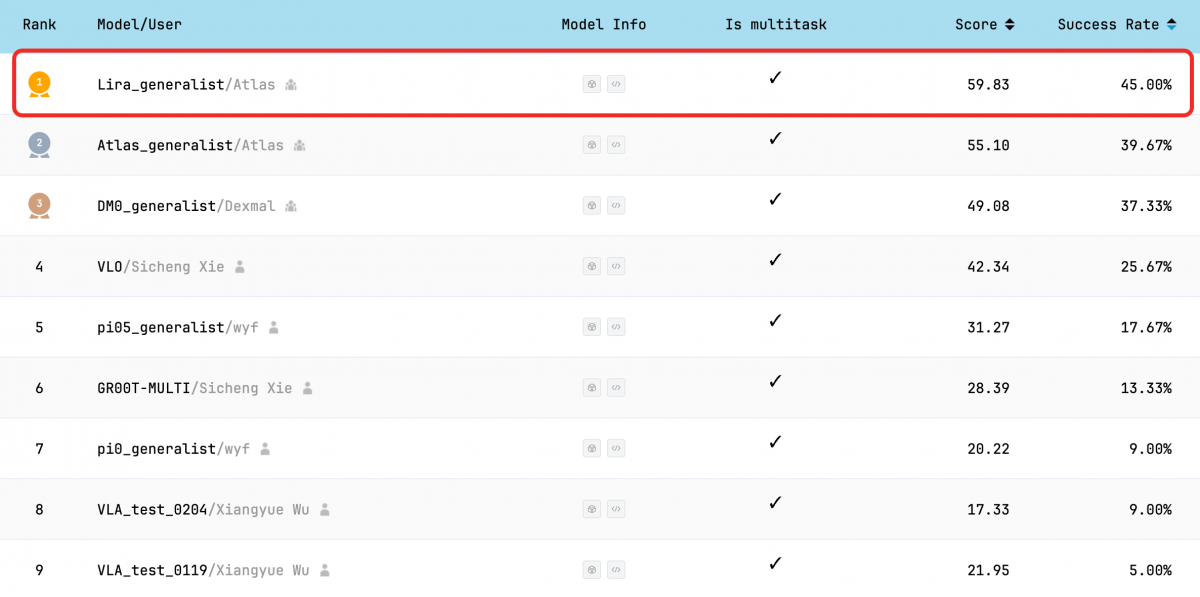
Qwen-RobotManip (codename Lira and Atlas) tops RoboChallenge, a large-scale real-robot-based benchmarking of embodied intelligence
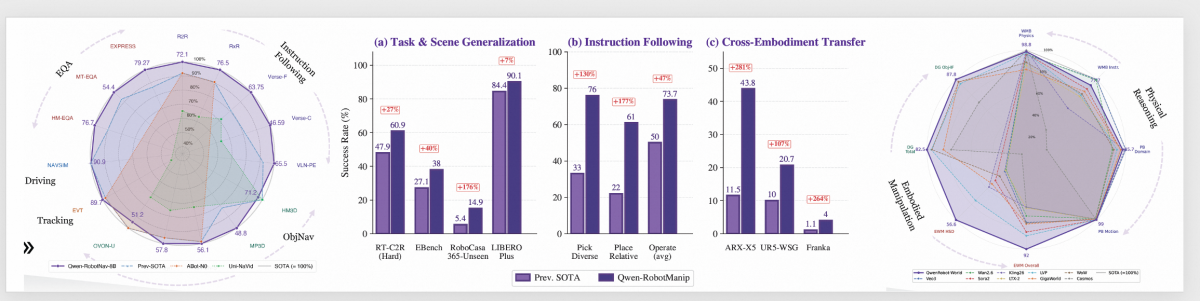
The Qwen-Robot Suite demonstrates industry-leading performance across robot evaluation benchmarks
The Qwen-Robot Suite unlocks the potential to transition general AI models into practical agents within physical space. General-purpose Qwen models can compose directly with the robotic models, utilizing them as specialized tools to bridge the gap between general intelligence and physical action. For instance, in an agentic workflow handling an open-ended request like “check whether a green umbrella was left at Cotti Coffee,” an agentic system that utilizes a general-purpose Qwen model as an upper-level strategic planner and Qwen-RobotNav as the tool for real-time execution can autonomously navigate the physical venue to return an evidence-grounded answer.
Looking ahead, Alibaba plans to integrate the Qwen-Robot Suite into a wider ecosystem of physical agents, empowering them with highly autonomous perception, spatial decision-making, and long-horizon execution in dynamic real-world environments.
This article was originally published on Alizila written by Crystal Liu.
Introducing Qoder 1.0: From AI IDE to Autonomous Development Desktop
Qwen-Robot Suite: A Foundation Model Suite for Physical World Intelligence

1,532 posts | 515 followers
FollowAlibaba Cloud Community - June 17, 2026
Alibaba Cloud Community - June 17, 2026
Alibaba Cloud Community - June 17, 2026
Alibaba Cloud Community - June 17, 2026
Alibaba Cloud Community - July 29, 2026
Alibaba Cloud Community - September 30, 2025
1,532 posts | 515 followers
Follow Alibaba Cloud Model Studio
A one-stop generative AI platform to build intelligent applications that understand your business, based on Qwen model series such as Qwen-Max and other popular models
Learn More QwenWork
QwenWork is dedicated to helping employees strengthen their professional competitiveness in the AI era and to enabling enterprises to improve organizational effectiveness.
Learn More
Token Plan
Build more, spend less. One plan, every modality.
Learn More Qwen
Qwen
Full-range, open-source, multimodal, and multi-functional
Learn MoreMore Posts by Alibaba Cloud Community

