Alibaba Cloud's RDS AI Application Marketplace is now the first database-native AI agent service to support both the OpenClaw and Hermes Agent frameworks..
Hermes Agent is a next-generation AI agent framework open-sourced by Nous Research. In less than six months since launch, it has earned 90k+ GitHub stars and is widely recognized as "the only agent with a built-in learning loop." It and OpenClaw represent two fundamentally different philosophies for building agents — and offer enterprises distinctly different capability profiles.
RDSHermes is a database-native AI agent service built on the open-source Hermes Agent. It gives enterprises an AI agent that can evolve autonomously while remaining secure, controllable, and observable — a better Hermes.
For RDS users, this opens up an important choice: you can pick the agent framework that best fits your business scenario to drive intelligent automation. Below, we break down the architectural similarities and differences to help you decide.
| Dimension | OpenClaw | Hermes Agent |
|---|---|---|
| Core philosophy | "Become the automation layer of your life" — integration first, broad coverage | "An Agent that grows with you" — self-evolution first, continuously getting smarter |
| Design philosophy | Consumer-product mindset, emphasizing out-of-the-box usability and ecosystem richness | Research-driven mindset, emphasizing the learning loop and long-term intelligence accumulation |
| Skill system | Static SKILL.md files, manually written and maintained | Autonomously creates skills, self-improves during use, skills continuously evolve |
| Memory mechanism | File-based memory (MEMORY.md + daily logs), depends on correct log entries | Autonomous memory (FTS5 index + periodic reflection + dialectical user modeling), accumulates automatically |
| Model support | Multi-provider support, requires manual model provider configuration | 200+ models switchable across multiple providers (including OpenRouter, Nous, Anthropic, Mistral, etc.) |
From a design philosophy perspective: OpenClaw is a "capable all-round executor," while Hermes Agent is a "learner that gets smarter over time."
Let's look at how the core modules differ in design and implementation.
OpenClaw's memory mechanism is based on MEMORY.md files and daily logs. Memory quality depends entirely on "what gets written" — if critical information is not correctly recorded in the file, the next conversation has nothing to draw on. This is passive memory: reliable, but dependent on manual maintenance. Hermes Agent employs an autonomous memory architecture: FTS5 full-text-indexed conversation storage, periodic reflection where the agent revisits past sessions to consolidate insights, and dialectical user modeling that builds a nuanced, evolving profile of the user's preferences and working style.
OpenClaw's skills are static Markdown files, manually authored and installed. Skill quality and coverage depend on community contributions and team maintenance. Hermes Agent's skill system is dynamic: after completing a complex task, the agent suggests the user crystallize the solution into a new skill. In subsequent use, if the agent identifies room for improvement, it can modify and refine the skill through tool calls during normal operation.
OpenClaw typically runs as a single process requiring a dedicated server deployment. The setup process is relatively heavy (30-60 minutes) and is geared toward a "set up once, use long-term" model. Hermes Agent offers six terminal backends (local, Docker, SSH, Daytona, Singularity, Modal), with Daytona and Modal supporting serverless persistence — meaning the agent can scale down to zero cost when idle and resume state on demand.
A distinctive capability unique to Hermes Agent is its research infrastructure: the built-in Atropos reinforcement learning environment supports batch trajectory generation and trajectory compression, which can be used to train next-generation tool-calling models. This means Hermes Agent is not just a tool — it is a research platform capable of producing training data. For enterprises with AI R&D teams, this is a unique value proposition.
Advantages of OpenClaw
• Higher ecological maturity: ClawHub already has a large number of community-contributed skills covering a wide range of scenarios.
• Predictable behavior: Static skills mean consistent, reproducible behavior — friendlier for scenarios requiring strict standardization.
• Broader enterprise adoption: As the earlier framework, it has extensive enterprise deployment cases and established best practices.
Limitations of OpenClaw
• Memory relies on manual maintenance: If critical information is not written to MEMORY.md, it is lost.
• Skills cannot self-evolve: Skill updates depend entirely on manual editing and community maintenance.
• Heavy initial configuration: Requires manual configuration of openclaw.json, workspace files, and memory settings.
Advantages of Hermes Agent
• Self-evolution: The only agent with a built-in learning loop — both skills and memory grow autonomously.
• Ultimate model flexibility: 200+ models switchable with one click, significantly reducing inference costs.
• Deployment flexibility: Six backends plus serverless persistence, adapting to a wide range of infrastructure environments.
• One-click migration: The hermes claw migrate command automatically imports all OpenClaw data.
Limitations of Hermes Agent
• Young ecosystem: Less than six months since launch; the volume and quality of community-contributed skills are still ramping up.
• Unpredictability of self-evolution: Autonomous skill modification by the agent can introduce unexpected behavior, requiring stronger observability as a safety net.
• Decision cost of model selection: The flexibility of 200+ models also means time spent finding the optimal configuration.
RDSHermes provides seamless integration with Lark, QQ, WeCom, and WeChat. Binding to a personal WeChat account is as simple as scanning a QR code.
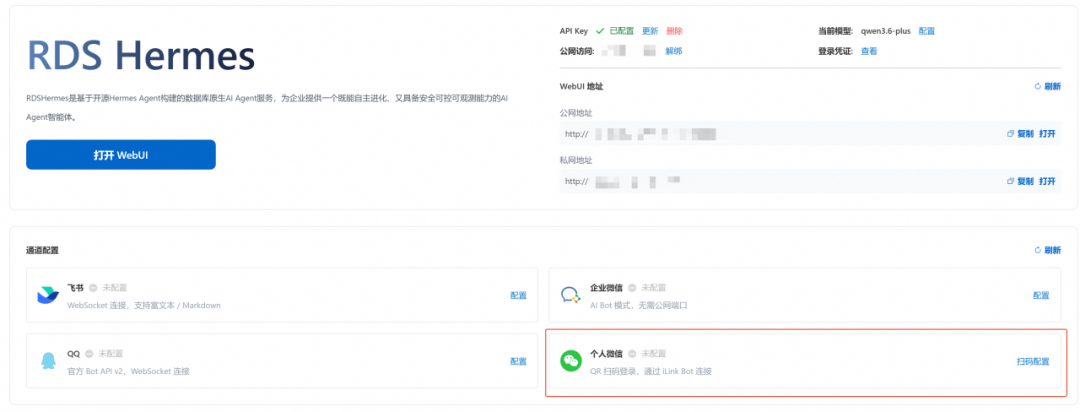
Unlike the open-source edition's CLI-first approach, RDSHermes additionally provides the community's Hermes-WebUI entry point, allowing users to interact with Hermes through a WebUI conversation interface — the same way they would with OpenClaw.
🔗Hermes- WebUI: https://github.com/nesquena/hermes-webui
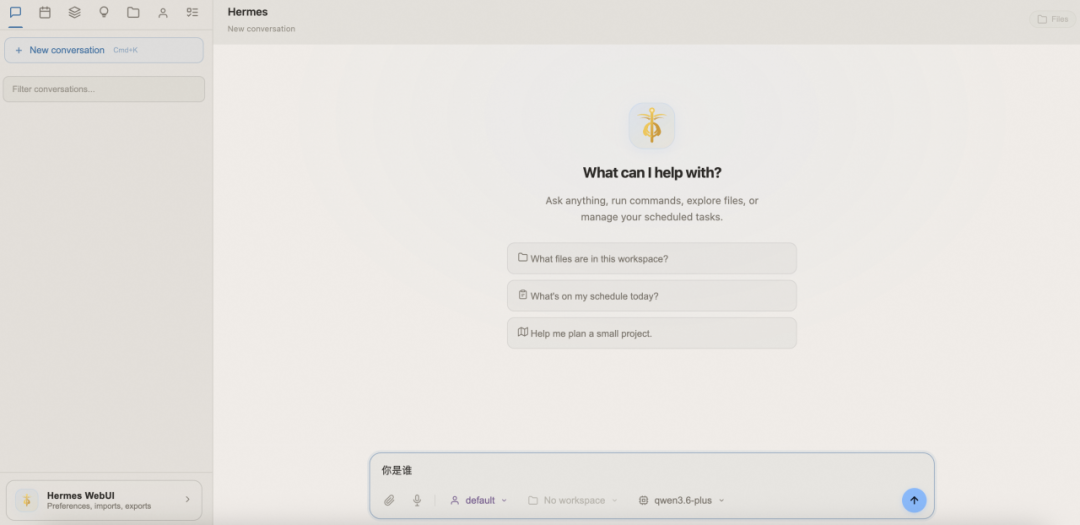
For enterprise users, the most important point is that whether you choose OpenClaw or Hermes Agent, the core capabilities provided by RDS AI applications remain consistent.
| RDS core capability | Framework-independent |
|---|---|
| Database secure management | Secure database access powered by the data encryption capability of RDS, supporting MySQL, PostgreSQL, SQL Server, and MariaDB. Database instances are automatically identified and can be set to read-only or read/write. |
| Security authentication | AK/SK encrypted and hosted by the RDSHermes plugin; RDSHermes automatically masks sensitive information to prevent leaks. |
| Skill Hub | Built-in RDS Copilot with intelligent health checks, slow SQL diagnostics, index optimization, and other professional database skills — callable from both agent frameworks. |
| End-to-end monitoring and auditing | Session tracing, security event management, token consumption monitoring, and log archiving powered by the RDS data foundation — providing the observability guardrail for Hermes Agent's self-evolution. |
One point worth highlighting: Hermes Agent's self-evolution capability — autonomously creating skills and modifying its own behavior — delivers intelligence growth but also introduces behavioral unpredictability. The RDS observability service and 4-layer security system provide exactly the enterprise-grade safety rails for this "freedom" — the agent can evolve, but every action stays within security boundaries and on the audit trail.
OpenClaw and Hermes Agent represent two different evolutionary paths in the AI agent space — one pursuing breadth and stability of ecosystem, the other pursuing depth and self-growth of intelligence.
The value of the RDS AI Application Marketplace lies precisely in the fact that it does not bind to any single framework. Instead, it provides enterprise-grade AI agent connectivity, security auditing, and observability for all frameworks. No matter how the agent ecosystem evolves, the enterprise need for secure database access, intelligent operations, and compliance auditing remains constant — and that is the long-term value of RDS AI as the data foundation of the agent era.
Frameworks change. The data foundation does not. Choosing RDS AI is choosing the balance of flexibility and security in the agent era.
RDSClaw Database Management: Let AI Agent Securely Take Over Database
Cross-Account Intelligent Database Operations: Integrating DAS Agent, MCP Server, and Dify
ApsaraDB - June 4, 2026
Alibaba Cloud Indonesia - March 20, 2026
ApsaraDB - May 11, 2026
ApsaraDB - September 2, 2026
Alibaba Cloud Community - June 1, 2026
Alibaba Cloud Native Community - May 9, 2026
 QwenWork
QwenWork is dedicated to helping employees strengthen their professional competitiveness in the AI era and to enabling enterprises to improve organizational effectiveness.
Learn More Token Plan
Build more, spend less. One plan, every modality.
Learn More
Alibaba Cloud Model Studio
A one-stop generative AI platform to build intelligent applications that understand your business, based on Qwen model series such as Qwen-Max and other popular models
Learn More ApsaraDB RDS for MySQL
An on-demand database hosting service for MySQL with automated monitoring, backup and disaster recovery capabilities
Learn MoreMore Posts by ApsaraDB


