By Alibaba Cloud AIDBS Team
A consumer brand had 48 hours left before a product launch when the customer service queue started showing a cluster of similar feedback: someone questioning an ingredient, someone sharing a screenshot of a "test report," someone threatening to post on social media.
The topic hadn't trended. No KOL had weighed in. The media was silent. It could have been a handful of routine inquiries — or the beginning of a public-sentiment crisis.
Which one was it?
No one could say for certain. The team quickly proposed three courses of action:
• Defensive: postpone the launch immediately and wait for further investigation results.
• Aggressive: proceed as planned while proactively publishing the testing materials to confront the doubts head-on.
• Silent: hold off on any response to avoid escalating the situation.
Each option had its logic and its risks.
The real difficulty was this: once a move was made, no one could guarantee how consumers would react, whether the media would follow, which side KOLs would take, or what regulators and distribution channels would do.
This time, instead of debating from experience, the team fed all three plans into the Forecast Agent within Alibaba Cloud's AI-Native Database Service (AIDBS) and let the future play out first in a digital sandbox.
Data Agent for Forecast (Forecast Agent for short) is an agent capability in the data application layer of Alibaba Cloud's AIDBS, built on top of an enterprise's own data and powered by Alibaba Cloud's Model Studio for inference. What sets it apart from conventional sentiment tools is this: it doesn't stop at "counting data" — it performs multi-role insight analysis grounded in enterprise data.
Traditional sentiment tools excel at monitoring what has already happened. When metrics spike or dip, or sentiment shifts, they tell you first. But for enterprises, the truly critical decision window usually opens before sentiment crystallizes: by the time the system fires an alert, many choices have already been foreclosed.
Forecast Agent targets precisely that "most critical window."
The team uploaded customer service records, product documentation, consumer profiles, historical sentiment data, and media coverage into the system. Forecast Agent processed the enterprise data through Model Studio to identify key roles, relationships, and stances, then constructed role-based agents representing consumers, media, KOLs, regulators, and corporate management.
These agents are not stamped from the same mold — each has its own identity, memory, viewpoint, and behavioral tendencies. Placed in the simulation environment, they read information, post, comment, share, and even argue with one another. Some choose to watch without speaking.
As interactions continue, opinions diverge and influence migrates. A minor complaint can ignite when a key figure amplifies it; a timely response can spark a new round of speculation if the wording misses the mark.
What the enterprise sees is no longer a vague "high risk" or "low risk" label, but the specific pathways along which risk may unfold — and which actions can alter its trajectory.
Returning to the brand case, each of the three plans was injected into the sandbox and produced a distinctly different evolution:
▶︎ Plan 1: Postpone the launch
The safety concerns were indeed contained, but speculation — "is something seriously wrong?" — began to surface. Without a clear explanation of the investigation scope, "caution" itself became a new sentiment signal.
▶︎ Plan 2: Proceed as planned + publish testing materials
Early skepticism persisted, but as third-party evidence entered the information flow, the discussion gradually returned to factual ground. Rational voices gained momentum over time.
▶︎ Plan 3: Stay silent
In the short term, there was little to discuss. But once a high-influence account entered the conversation, the enterprise lost the ability to define the narrative — forced to respond reactively at the emotional peak.
The Forecast Agent simulation didn't make the decision for the brand. What it did was expose the hidden cost of each option before anyone had to pay it. Based on these insights, the team supplemented the testing documentation, adjusted customer service scripts, prepared media Q&A materials, and pre-set response plans at several critical inflection points.
This was not a post-crisis debrief. It was a zero-risk rehearsal provided by Forecast Agent before the crisis ever formed, grounded in the enterprise's own data.
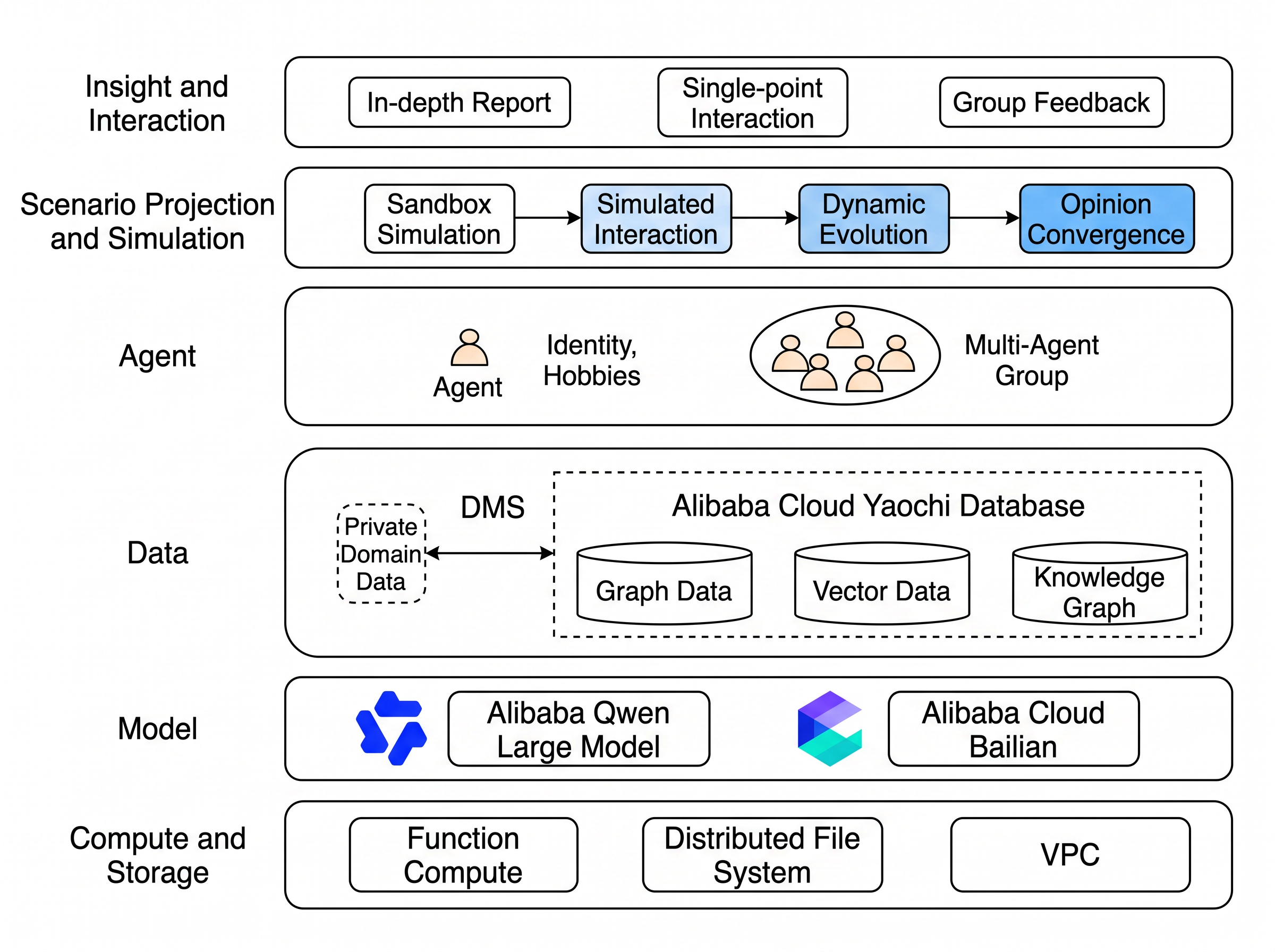
Setting aside the technical jargon, Forecast Agent's core capabilities reduce to three things.
1. Agents grown from real materials
The system can identify people, events, and relationships from news, reports, user feedback, and enterprise private-domain data, generating agents with distinct backgrounds, stances, and behavioral logic — every character is supported by source material, not improvised for the sake of filling seats. The system also ships with pre-built agent groups for sentiment crises, product launches, consumer insight, and investment decisions — ready to simulate out of the box.
2. Dynamic social interaction modeled on real diversity
Each person sees different information, trusts different sources, and has different willingness to speak. Forecast Agent simulates precisely this kind of diversity — how information propagates, how opinions collide, how relationships shift, where groups cluster, and how influence migrates. Users can inject new variables at any time (a statement, a survey result, an executive response) and immediately observe how the trajectory changes.
3. Reports that are traceable and open to further inquiry
After the simulation, the system outputs key turning points, risk pathways, and intervention windows. Every judgment traces back to source material and specific simulation events — no opaque conclusions without verification. Decision-makers can continue to probe: "Why were these consumers the least trusting of the brand?" "Which agent drove the sentiment reversal?" — and even hold one-on-one conversations with individual agents or deploy targeted surveys to specific groups, drilling from aggregate trends all the way down to individual motivations.
Stretching the timeline, prediction technology has evolved through: statistical forecasting → machine learning → knowledge graphs → large-model multi-agent simulation.
Forecast Agent takes one more half-step forward by bringing "how people interact and how interaction changes outcomes" into the model. What distinguishes it from a standard AI discussion or one-off report:
• Characters have provenance: every agent is grounded in real materials and relationships.
• Groups evolve: opinions, relationships, and influence shift continuously through interaction.
• The process is auditable: key judgments are traceable, comparable, and re-verifiable.
For data-sensitive enterprises, Forecast Agent also supports workspace isolation and VPC-based deployment, ensuring that raw materials, agent memories, simulation records, and reports all remain within the customer's own environment.
🔸 Before a product launch: test concepts, pricing, packaging, and marketing messages to identify the real friction points across different consumer segments.
🔸 During an investment decision: have management, investors, industry experts, legal, and regulatory agents debate simultaneously, stress-testing valuations, terms, and integration plans under multiple scenarios.
🔸 For policy and organizational change: high-uncertainty topics where stakeholders pull in different directions — rehearse them in the digital world first.
What Forecast Agent offers is a new way of facing uncertainty:
• Before taking real action, see more possibilities.
• Before risk spreads, locate the critical variables.
• When everyone can only argue from experience, let different plans run their course first.
If you are preparing for a product launch, evaluating a major investment, or building contingency plans for potential sentiment events — bring your real materials, bring the one question you most want to test, and start your first simulation.
Let the future happen first in the digital sandbox, then decide what comes next in the real world.
Forecast Agent provided by AIDBS — a million simulated futures in the digital world, anchoring your winning move.
For more information on AIDBS Forecast Agent, please refer to the documentation:
https://www.alibabacloud.com/help/en/aidbs/user-guide/forecast-agent-introduction
Open Source: ApsaraDB MCP Server — An Out-of-the-Box Database "AI Collaborator"
MemOS × PolarDB All-in-One Memory Management Solution: Giving AI Unbroken Memory
Alibaba Cloud Community - December 16, 2024
Alibaba Cloud Blockchain Service Team - January 17, 2020
Iain Ferguson - May 25, 2022
Alibaba Cloud Community - August 3, 2026
Alibaba Clouder - March 13, 2020
Alibaba Cloud Community - June 17, 2026
 QwenWork
 is dedicated to helping employees strengthen their professional competitiveness in the AI era and to enabling enterprises to improve organizational effectiveness.
Learn More Qwen
Full-range, open-source, multimodal, and multi-functional
Learn More Qoder
From Assisted to Autonomous — Adapting to Every Programming Need
Learn More Wan3.0
Unleash Your Creativity Try Wan 3.0 now — longer narratives, greater control, endless creativity.
Learn MoreMore Posts by ApsaraDB


