By Sun Chuan (Hualuo)
In the agent era, what is needed is a data workspace agents can connect to, remember with, search, experiment in, roll back, trace, and run elastically. PolarDB for MySQL, the cloud-native database from Alibaba Cloud ApsaraDB, is becoming the full-stack data foundation behind that workspace.
For the past two years, the dominant form of LLM application has been the chatbot: the user asks, the model answers, and a layer of retrieval-augmented generation (RAG) supplies extra context along the way. The boundaries were clear. Entering 2026, a far more production-oriented form is taking its place — the agent. The heart of an agent is no longer “conversation” but “action”: it has to understand a goal, break it into tasks, invoke tools, read and write files, query databases, generate intermediate artifacts, validate plans, correct its own errors, and keep accumulating memory and experience across multiple rounds of execution.
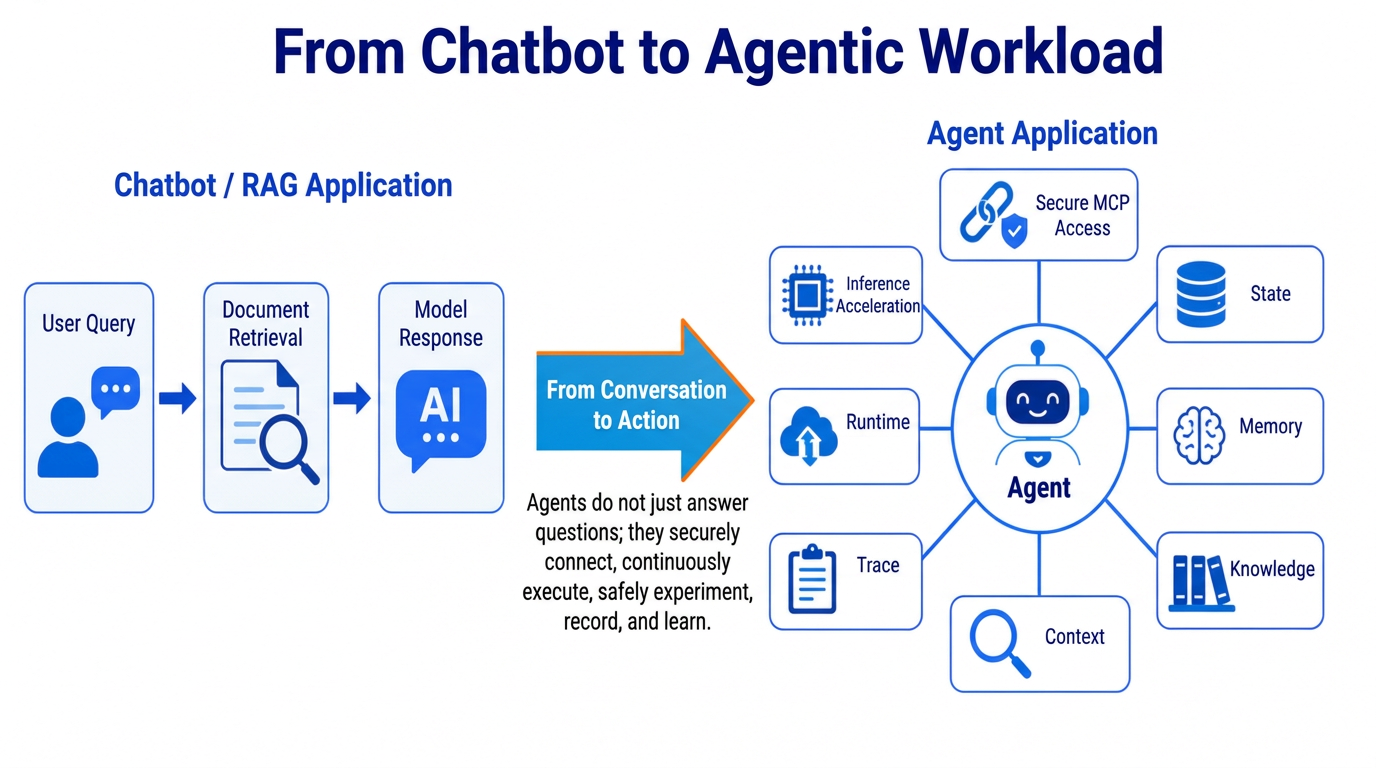
This shift places demands on data infrastructure that go far beyond traditional RAG. An enterprise-grade agent needs a full set of production-grade capabilities: secure access to databases; reliable storage of task state and business facts; preferences and organizational experience that persist across sessions; unified context recall over structured and unstructured data; isolated experimentation on real data; complete records of reasoning and invocation traces; on-demand elastic execution of short-lifecycle tasks; and latency and cost optimization for high-frequency inference.
Put simply, the database in the agent era is no longer just “a table in the application backend.” It is the state plane, memory plane, context plane, and workspace plane on which an agent runs.
The common industry practice is to introduce a separate system for each capability — a vector database for retrieval, a Memory service for memories, object storage for files, a logging platform for Trace, a relational database for business data — then string them together with piles of glue code. That works at the prototype stage. In production, the problems surface all at once: credentials enter the agent context and the security boundary is lost; scattered data leaves the agent without a consistent context; permissions, auditing, and tenant isolation have to be rebuilt in every system; bursty short-lifecycle workloads make the per-instance capacity reservation cost model wasteful; the risk of letting an agent experiment directly on production data is unacceptable; and context, memory, knowledge, and Trace never close the loop.
PolarDB Agentic Data Foundation is the unified data infrastructure that Alibaba Cloud ApsaraDB has built for LLM agents. With PolarDB for MySQL as its single foundation, it provides sub-capabilities such as Context, Memory, enterprise knowledge space, Vector, Search, Branch, In-Memory Column Index (IMCI), Serverless, and KVCache within one product system, plus a unified Gateway for protocol adaptation and secure access.
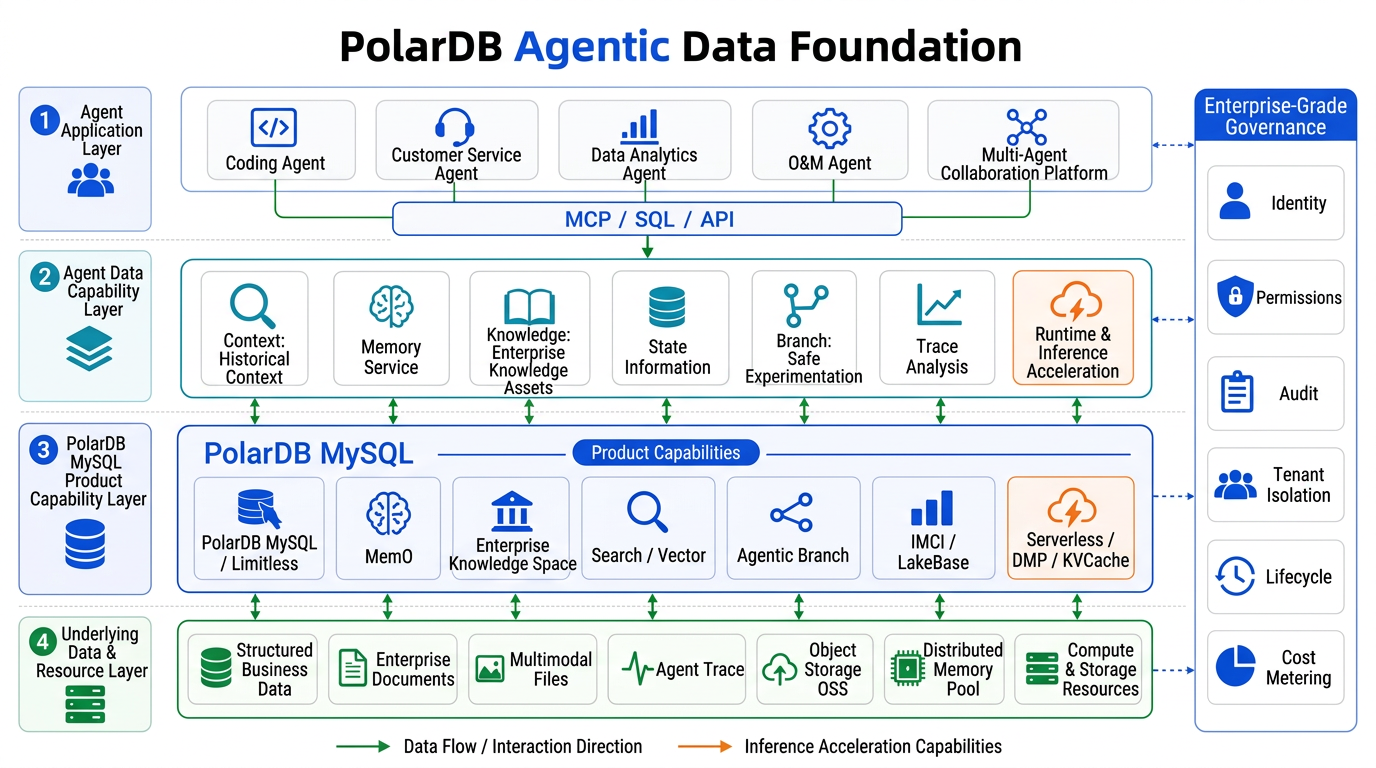
Around the eight core needs of agents, it provides the following integrated capabilities:
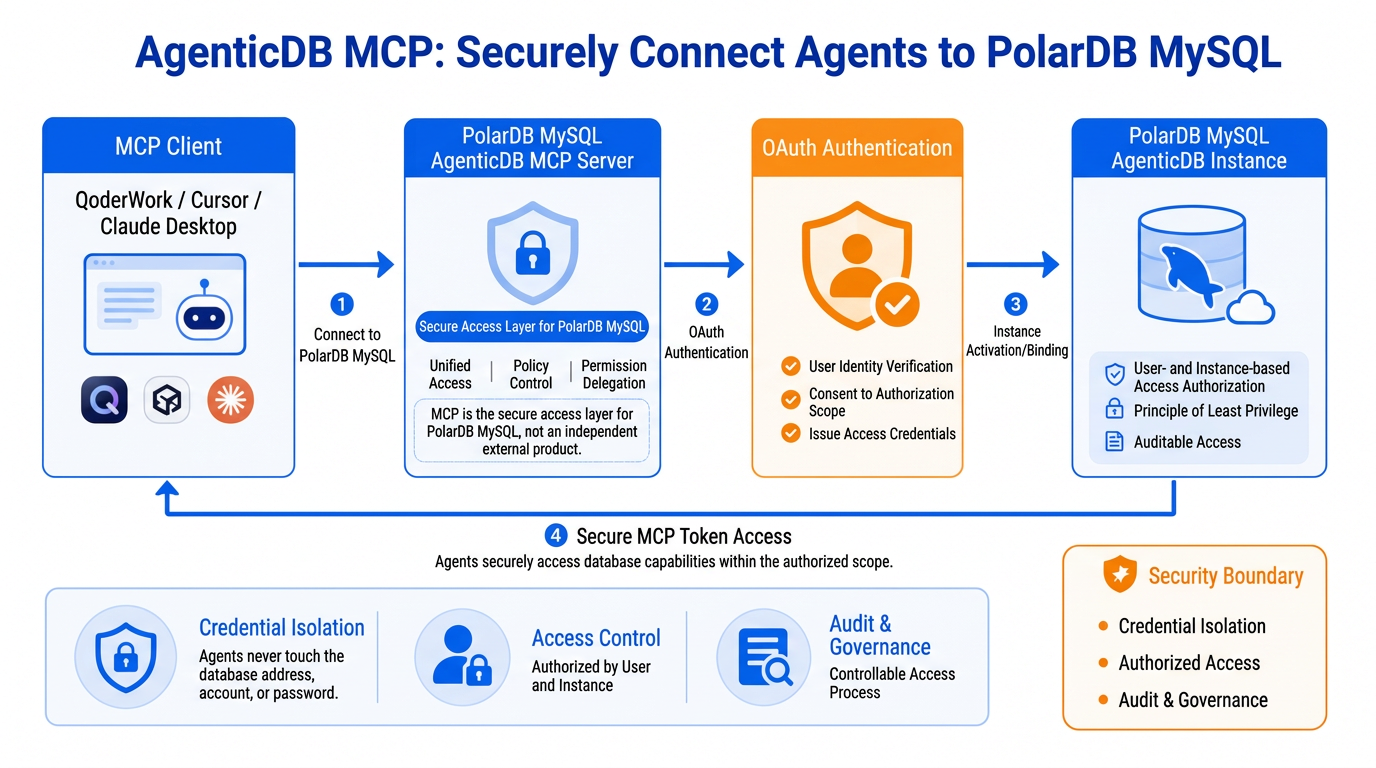
Access (secure access): Agents connect over the standard Model Context Protocol (MCP) and never touch the database address, account, or password. OAuth handles identity authentication, the server side holds the credentials, and the client holds only an MCP token with a bounded scope and lifecycle. Mainstream clients such as Cursor, Claude, and QoderWork can connect directly.
Context & State: Agentic Database stores the agent’s historical context and state, in two forms — Limitless (horizontal scaling to tens of billions of records) and Agile Serverless (elasticity in seconds, Scale to Zero) — with unified SQL and transaction consistency.
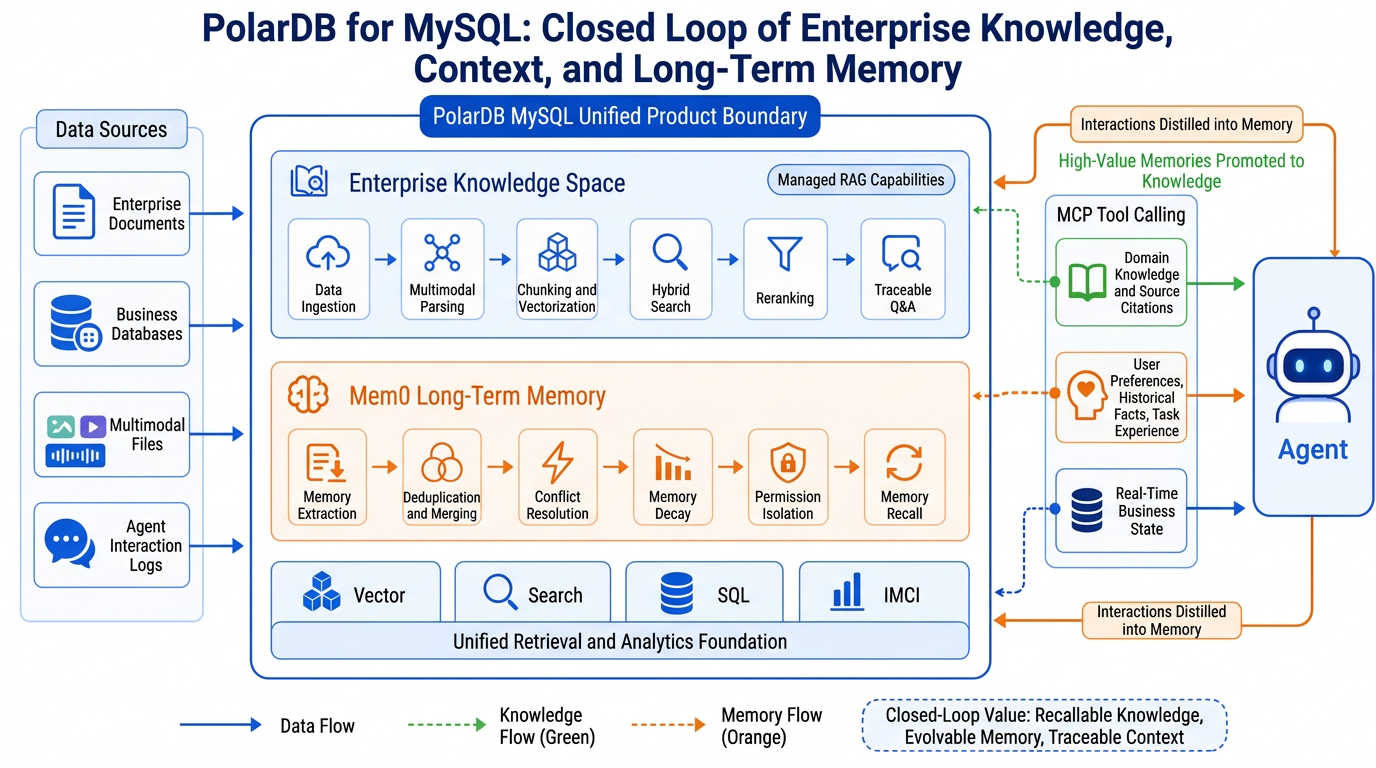
Memory (long-term memory): PolarDB Mem0 extracts entities, relationships, preferences, facts, and experience from interactions, then recalls and evolves them across four dimensions — user, agent, project, and organization. It serves as the long-term memory layer of context engineering, continuous across sessions and evolving over time, so a new agent starts its work on top of the organization’s experience.
Knowledge & Research: An integrated enterprise knowledge space, multimodal parsing of knowledge assets, and hybrid multi-way recall together form the enterprise knowledge and real-time retrieval layer of context engineering. Agentic Research breaks down questions autonomously, iterates over multiple rounds, cross-validates across sources, and produces research reports with traceable citations.
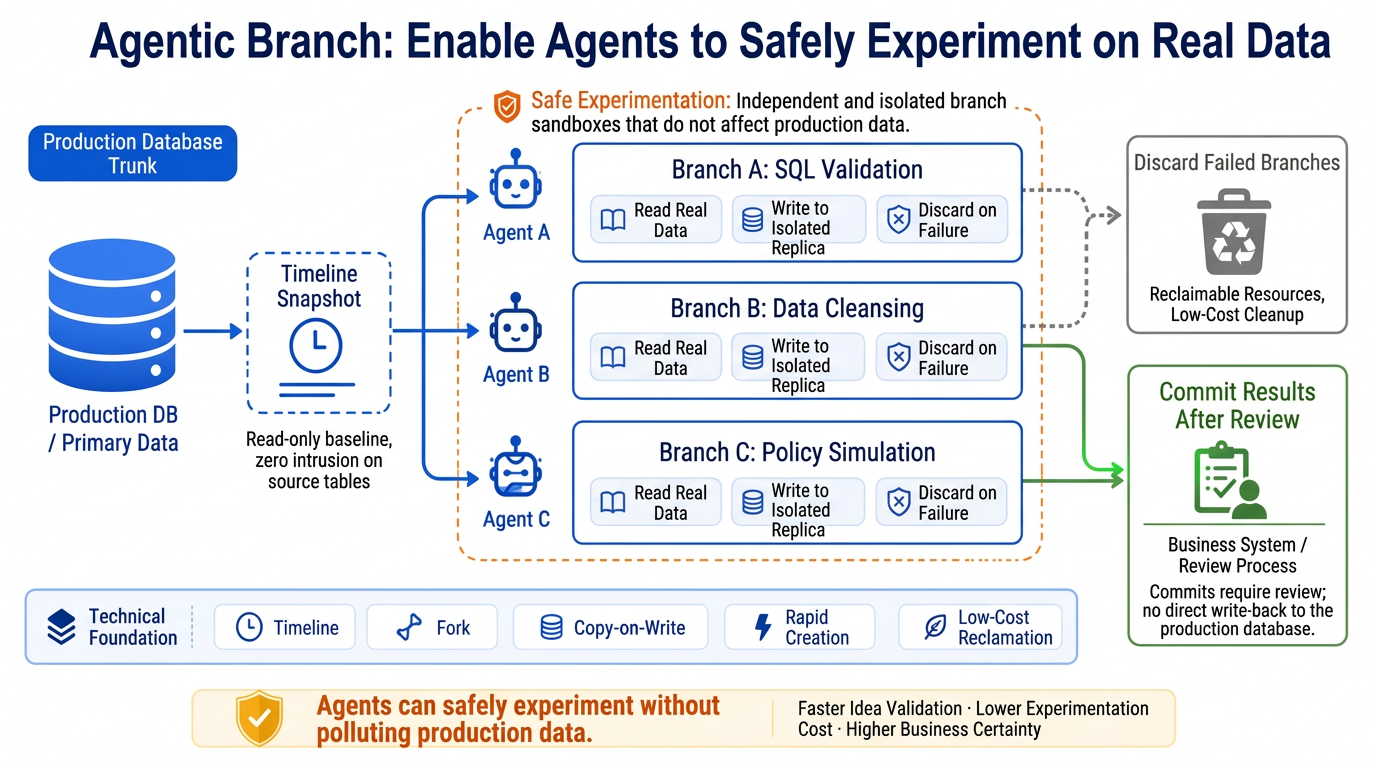
Branch (safe experimentation at the database level): PolarDB Agentic Branch lets an agent quickly create an isolated branch from a real database and run exploratory changes, plan validation, and parallel what-if runs. Failures can be discarded; successes can be persisted or committed. The database thus evolves from “only storing results” into the agent’s “executable workspace.”
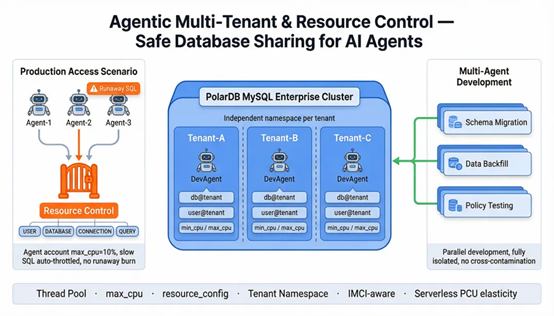
Multi-tenancy and resource isolation: Resource Control limits CPU share across four dimensions — USER, DATABASE, CONNECTION, and QUERY — preserving a safety margin, and slow SQL can be throttled instantly. Multi-tenant capabilities provide triple isolation of database, account, and CPU within the same cluster. Production databases need not fear a runaway agent; development databases need not fear agent crosstalk.
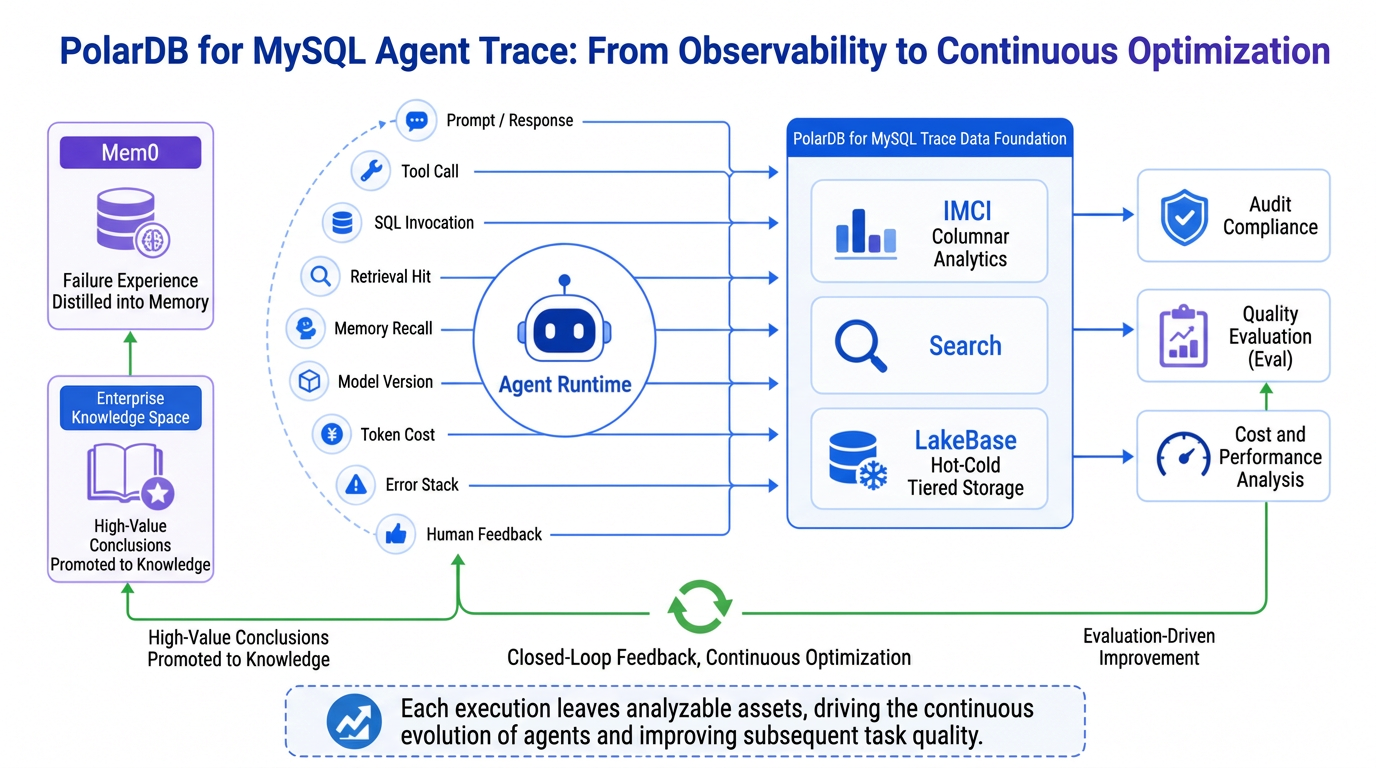
Trace (execution traces): Prompt, Response, Tool Call, task DAG, Token consumption, retrieval hits, memory recall, Eval results, and more are carried by IMCI columnar storage and Search, with hot-cold tiering to control cost. This forms the audit–evaluate–optimize loop, and failed cases flow back into Memory and Knowledge.
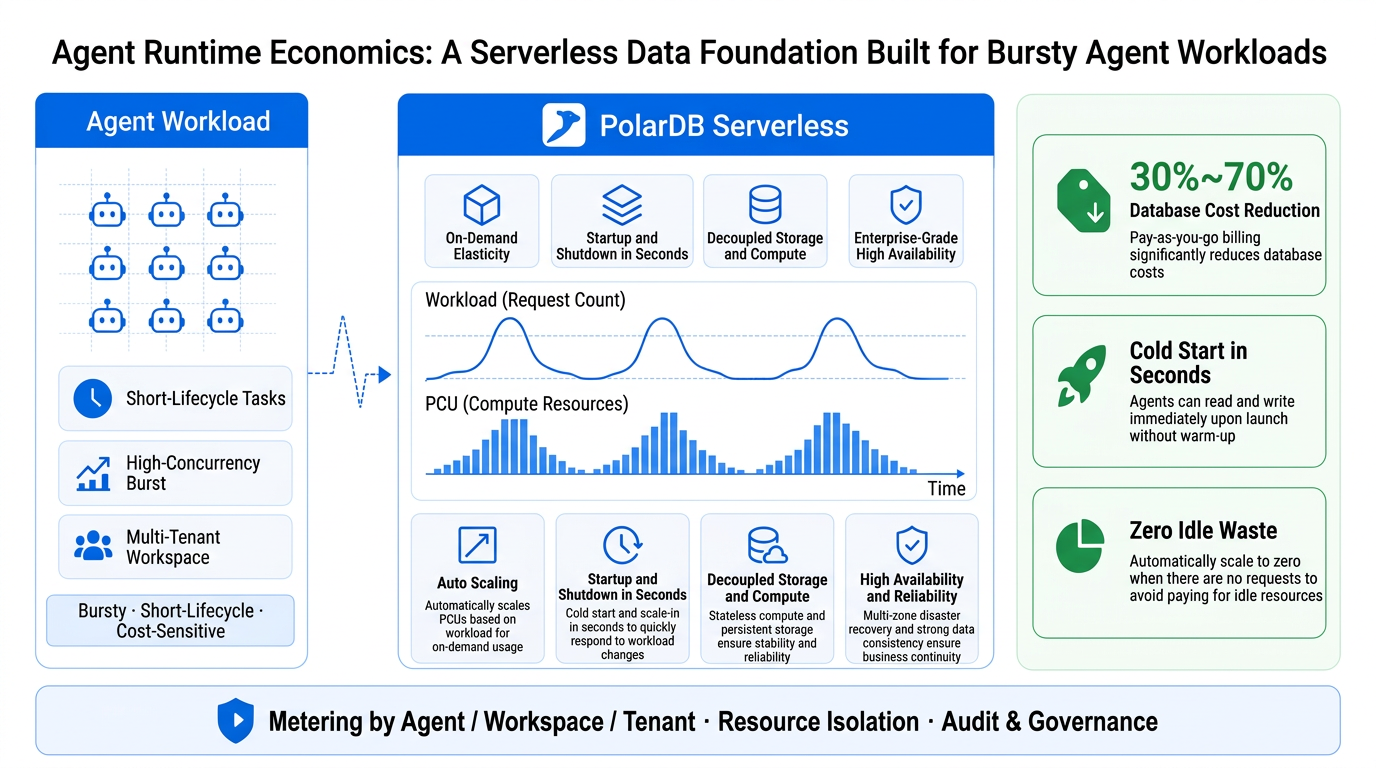
Runtime (elastic runtime): PolarDB Serverless provides PolarDB Capacity Unit (PCU) elasticity in seconds and Scale to Zero. An Agent Workspace is created, run, and released on demand, at near-zero cost when idle.
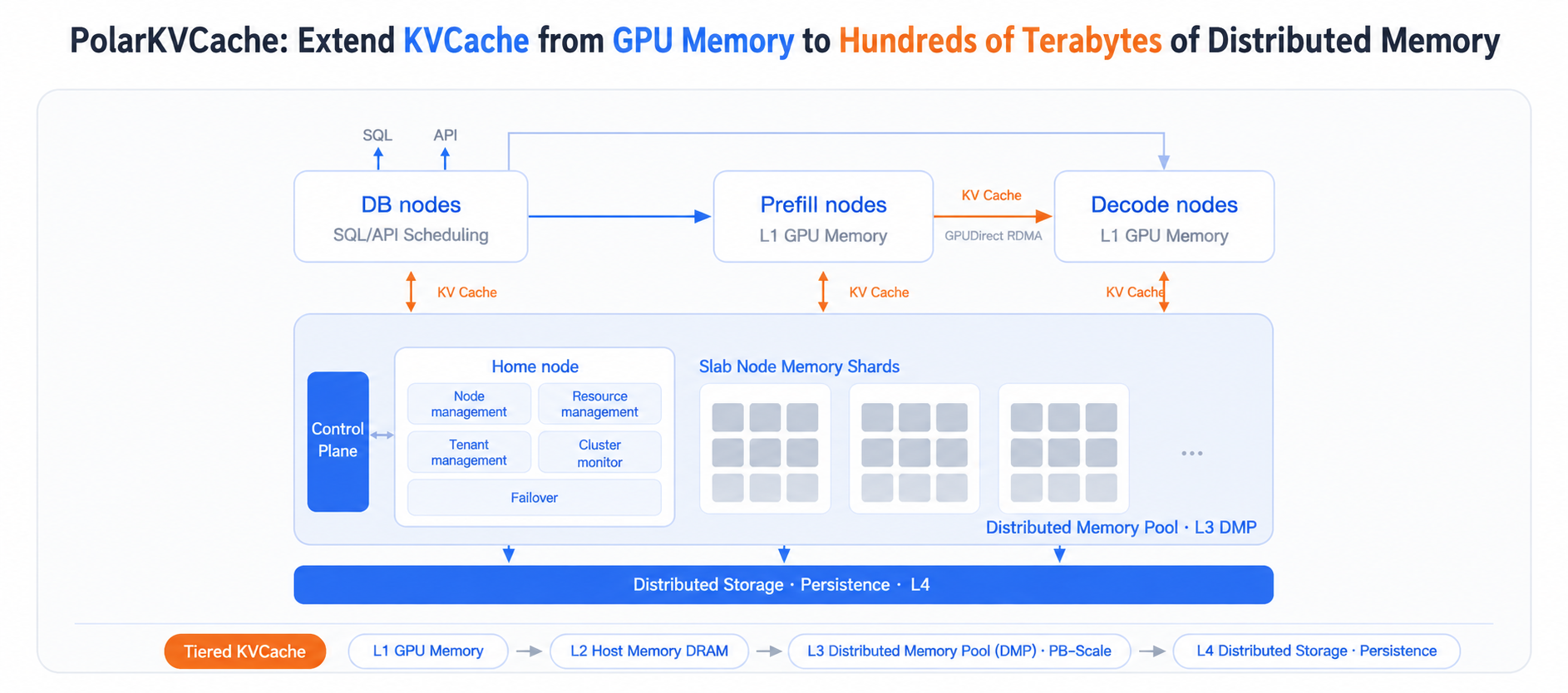
Inference (inference acceleration): PolarKVCache extends and accelerates KVCache for LLM inference on top of the Distributed Memory Pool (DMP). The reason a database vendor is stepping into inference infrastructure is that KVCache is, at heart, a class of high-throughput, large-capacity, low-latency key-value data systems — sharing the same engineering roots as databases in distributed memory, hot-cold tiering, and shared storage.
For agents, a unified foundation is not a nice-to-have. It is a must-have. A single session is both the runtime context of the moment and reusable memory and training corpus. Split it across mutually independent systems, and the innate connections in the data are severed — and with them, the “execute, record, reflect, accumulate” loop grinds to a halt. The essence of being unified is not stuffing several products into one process — it is letting data flow naturally within a single governance boundary.
PolarDB’s choice is not to rebuild point components. It is to converge database-level governance capabilities — the sovereignty boundaries, temporality, and relationships of data — into a single MySQL-compatible, cloud-native, enterprise-grade data foundation, where developers integrate quickly, results land directly in the database as reusable assets, and high-risk operations are validated on an isolated branch first.
Agents are pushing LLM applications from expression to execution. Every agent that reaches production needs a data workspace it can connect to, remember with, search, experiment in, roll back, trace, and run elastically. PolarDB MySQL Agentic Data Foundation is the full-stack data foundation behind that workspace.
As the opening piece of the PolarDB MySQL Agentic Data Foundation series, this article sketches the overall contours of this new form. Across eight directions — Access, State, Memory, Knowledge & Context, Branch and multi-tenant isolation, Trace, Runtime, and Inference — we will unpack the technical details and real-world practice one by one in the articles that follow.
MemOS × PolarDB All-in-One Memory Management Solution: Giving AI Unbroken Memory
[Infographic] Highlights | Database New Features in August 2026
Alibaba Cloud Community - September 27, 2025
Alibaba Cloud Community - May 27, 2026
Alibaba Cloud Native Community - May 26, 2026
Alibaba Cloud Community - May 20, 2026
Alibaba Cloud Community - September 22, 2026
ApsaraDB - September 2, 2026
 PolarDB for PostgreSQL
Alibaba Cloud PolarDB for PostgreSQL is an in-house relational database service 100% compatible with PostgreSQL and highly compatible with the Oracle syntax.
Learn More
PolarDB for Xscale
Alibaba Cloud PolarDB for Xscale (PolarDB-X) is a cloud-native high-performance distributed database service independently developed by Alibaba Cloud.
Learn More
PolarDB for MySQL
Alibaba Cloud PolarDB for MySQL is a cloud-native relational database service 100% compatible with MySQL.
Learn More Database for FinTech Solution
Leverage cloud-native database solutions dedicated for FinTech.
Learn MoreMore Posts by ApsaraDB


