Amidst the global craze, the lobsters in the pond are raising their tiny claws and getting to work.
But when you use OpenClaw to orchestrate your AI Agents and call large models, where do you store your API Keys?
Configuration files? Environment variables? Hard-coded in plain text? When multiple Agents share the same credentials, how do you trace an issue back to the specific "lobster" and its "human host"?
Relying on manual rotation? Operations will explode as your Agent fleet scales.
This isn't hypothetical; it's the real challenge OpenClaw users face today. OpenClaw solved the "how to call," but what about the "who can call, why can they call, and how do we track them after they call?" How do we answer these questions?
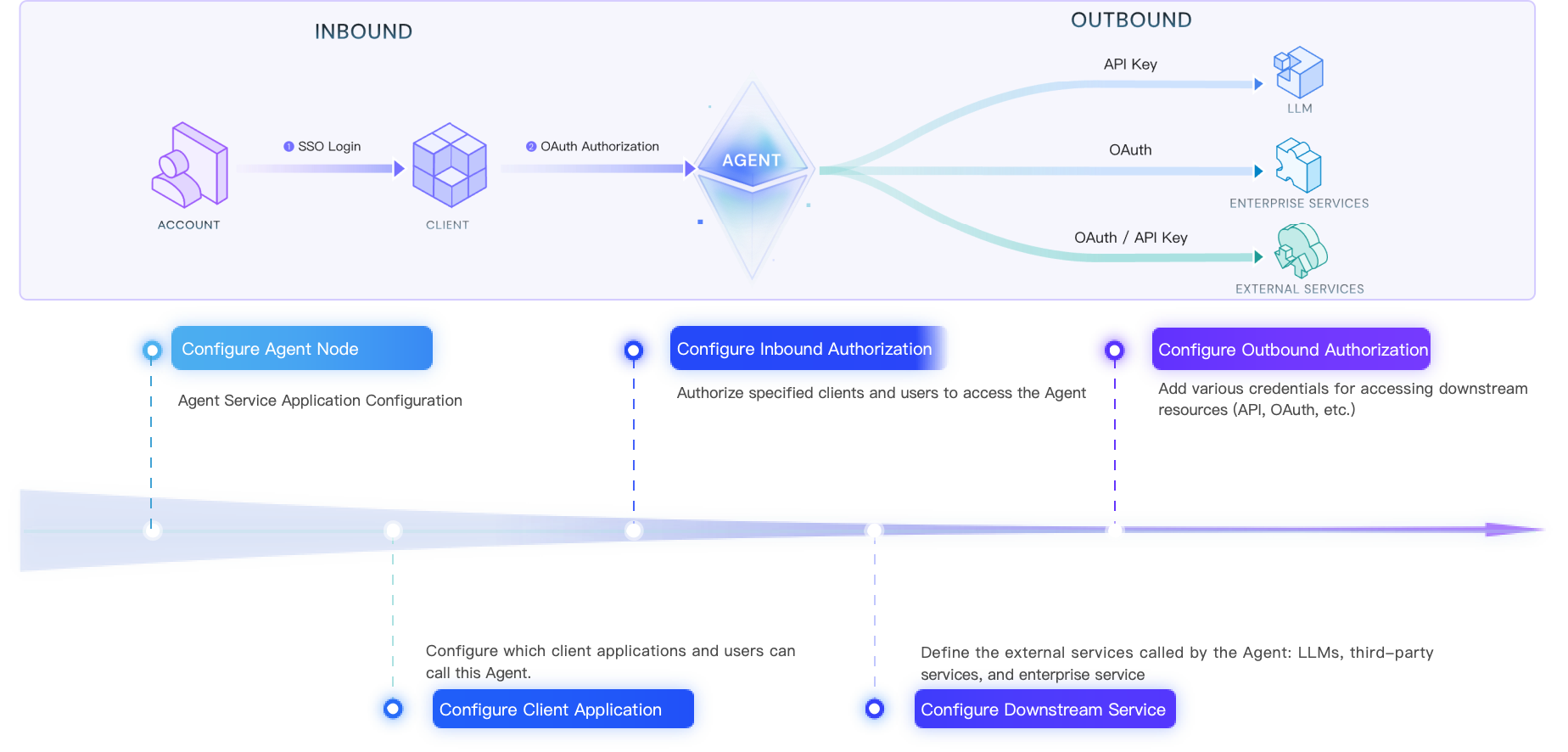
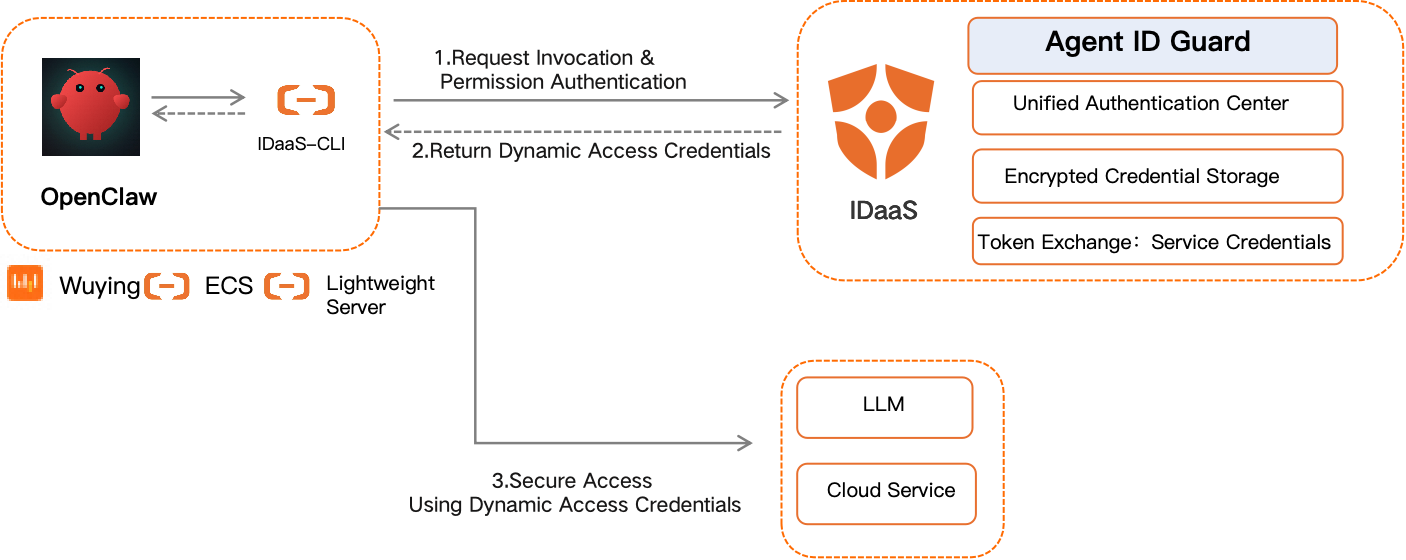
Alibaba Cloud's Application Identity Service introduces the Agent ID Guard solution, enabling end-to-end permission control from "Users" to "Agents" and down to "Tools/Services."
In an unmanaged environment, a powerful OpenClaw instance is essentially a high-privileged "anonymous user" lurking within the intranet. This absence and misalignment of "identity" evolve into systemic risks during large-scale deployment.
Agents use permanent AK/SKs: Once leaked, full access to cloud resources is compromised.
Shared credentials across multiple Agents: Impossible to trace specific actions back to the individual executor.
Agents act on behalf of humans: Yet operation logs only record down to the "role" level.
Incident investigation: Unable to pinpoint which Agent or specific invocation caused the issue.
Manual configuration: Every new Agent requires manual setup of credentials and permissions.
Cost explosion at scale: In scenarios with hundreds of Agents, the cost of credential rotation and permission revocation grows exponentially.
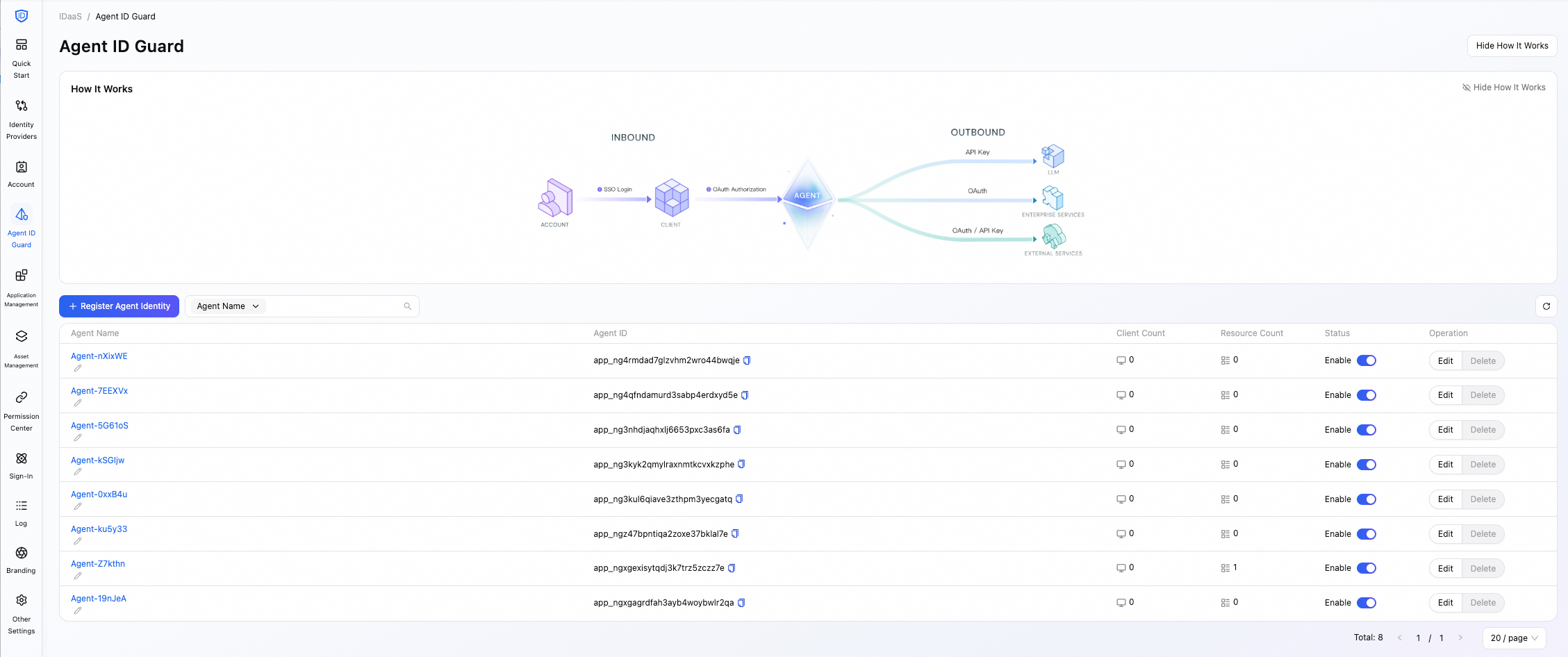
● Centralized Oversight: Manage all created or registered Agents from a single console.
● Global Uniqueness: Assign a globally unique Agent ID to every Agent, ensuring identities are identifiable, traceable, and auditable.
● Eliminate Blind Spots: Bid farewell to the management blind spot of "not knowing which Agent is making the call."
● Seamless Integration: Deeply integrated with existing identity systems such as DingTalk, WeCom, and Entra ID, it builds an end-to-end trusted access chain from "User → Client → Agent → Resource."
● Principle of Least Privilege: While executing tasks, Agents access downstream resources (Large Models, Enterprise Services, SaaS) based on the least-privilege policy, with operations carrying an auditable identity context.
● Protocol Security: Full-chain token transmission and verification based on OIDC/OAuth protocols to prevent identity spoofing and privilege escalation.
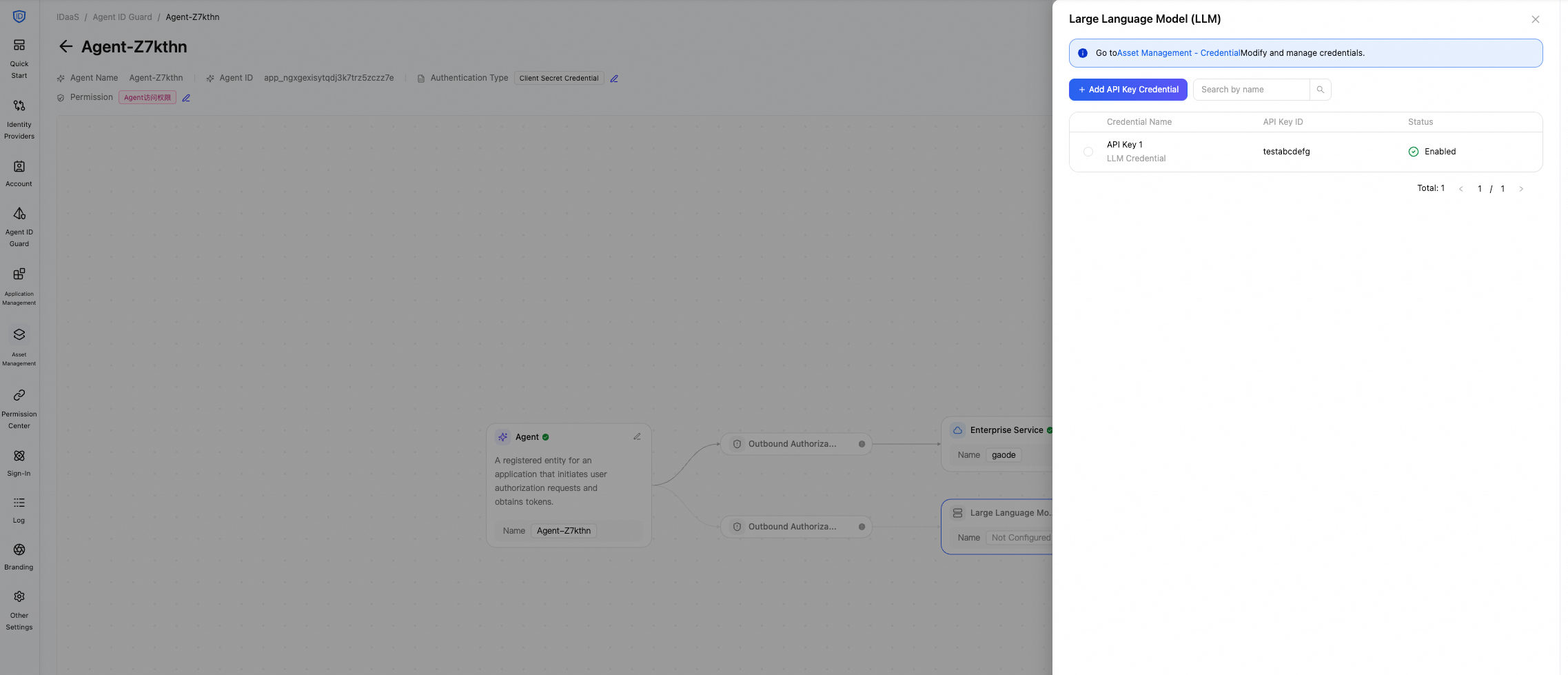
● Encrypted Storage: All credentials are encrypted and托管 (hosted/managed) by Alibaba Cloud KMS, eliminating plaintext leaks.
● Just-in-Time Delivery: Credentials are delivered only when an Agent has explicit authorization, and strictly on a need-to-know basis.
● Automated Lifecycle: Automatic issuance, rotation, and revocation of credentials, resulting in zero operational overhead.
● Inbound Logging: Records the user/system, time, and source that triggered the Agent.
● Outbound Logging: Records the downstream services called by the Agent, the credentials used, and the operations executed.
● Credential Auditing: All credential access and usage are linked to the specific Agent ID and invocation context.
As a key component of Alibaba Cloud's Agent Security Center, Agent ID Guard boasts three distinct advantages:
Seamlessly integrates with 10+ mainstream enterprise identity sources (AD/LDAP, DingTalk, WeCom, Entra ID, etc.). Enterprises can map their existing organizational structures and permission logic to OpenClaw instances without overhauling their account systems, achieving unified management of "Human and Agent" identities.
Covers physical machines, IDC hosting, multi-cloud virtualized environments, and K8S/Docker clusters. Security policies take effect automatically as Agents migrate, eliminating security fragmentation in hybrid cloud architectures.
Supports fine-grained permission management for hundreds of SaaS and on-premises applications—not just "whether an application can be accessed," but precisely "whether a specific file can be read" or "whether a specific approval can be initiated." This ensures every step is precisely controlled when Agents execute complex Agentic Flows.
As open-source frameworks like OpenClaw drive rapid Agent adoption within enterprises, identity governance becomes the cornerstone of efficient system operations.
Alibaba Cloud Agent ID Guard issues a controlled "Digital ID Badge" to every Agent. Every cross-application action and every access to sensitive data is bounded by clear perimeters and backed by legitimate authorization. This ensures that security is the prerequisite for scaling your digital workforce.
Click here to learn more about Alibaba Cloud Agent ID Guard
What is Agent Identity Security?
Alibaba Cloud ClawHub Skill Scan: Security Metrics Across 30,000 AI Agent Skills

39 posts | 4 followers
FollowCloudSecurity - March 16, 2026
CloudSecurity - April 10, 2026
CloudSecurity - May 26, 2026
CloudSecurity - April 15, 2026
Alibaba Cloud Native Community - March 5, 2026
CloudSecurity - September 2, 2026
39 posts | 4 followers
Follow QwenWork
QwenWork is dedicated to helping employees strengthen their professional competitiveness in the AI era and to enabling enterprises to improve organizational effectiveness.
Learn More Token Plan
Build more, spend less. One plan, every modality.
Learn More AgentBay
Multimodal cloud-based operating environment and expert agent platform, supporting automation and remote control across browsers, desktops, mobile devices, and code.
Learn More Qwen
Qwen
Full-range, open-source, multimodal, and multi-functional
Learn MoreMore Posts by CloudSecurity

