When "Open Claw" agents mobilize data to achieve their goals, the API becomes a critical chokepoint.
Facing the massive volume of calls in the AI Agent era, traditional API security solutions feel like cold-weapon tools confronting heavy artillery. A paradigm shift towards an agentic-native approach is urgently needed.
Alibaba Cloud WAF introduces new Agentic API Security capabilities. Powered by the Qwen Large Language Model, it delivers precise API asset profiling, context-aware sensitive data identification, and real-time adaptive masking.
While the "Open Claw" agents focus on efficient execution, Alibaba Cloud Agentic API Security stands guard as the ultimate data defense line during API invocations.
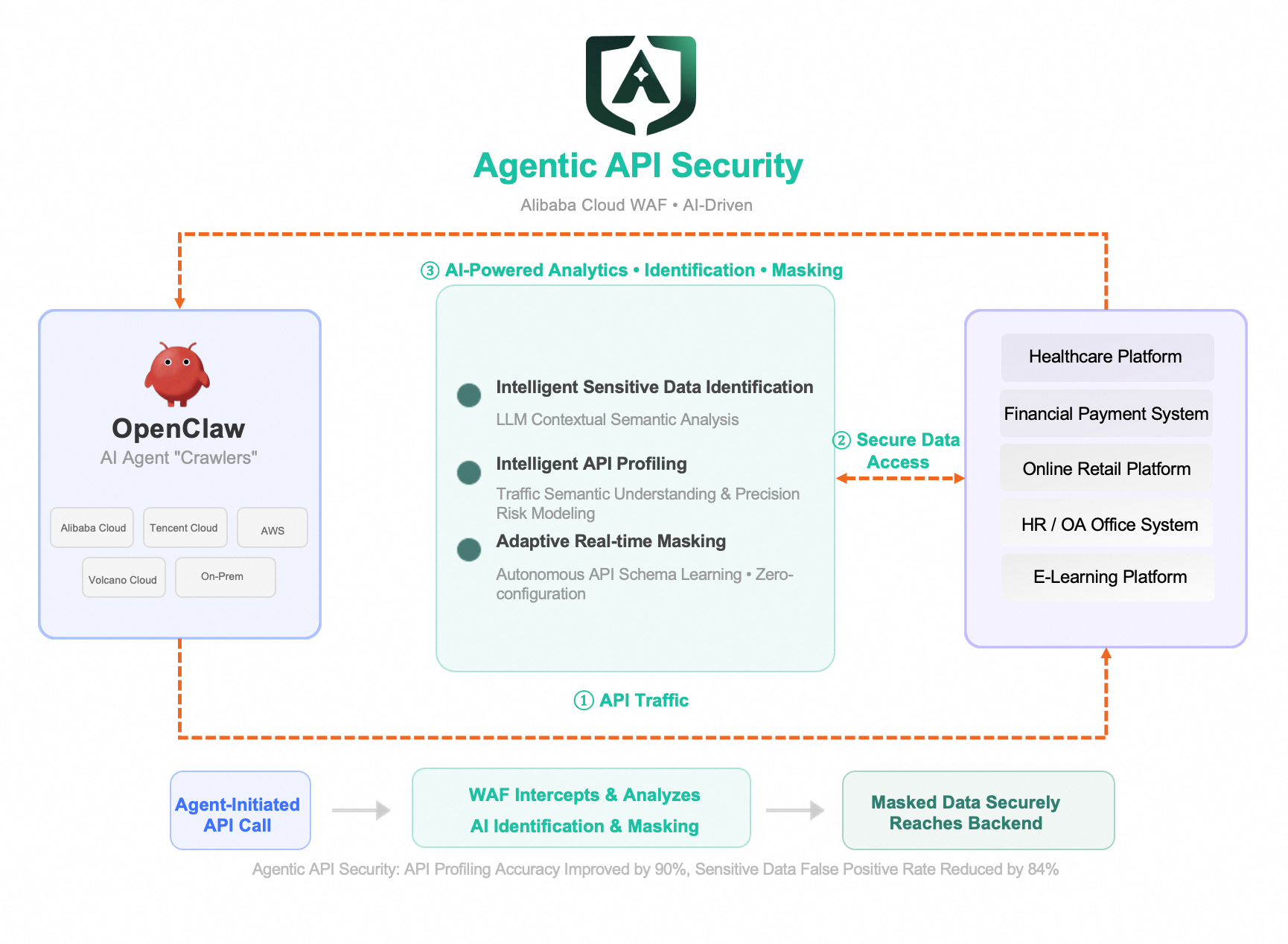
Traditional API Protection Fails During Agent Execution
In traditional protection strategies, rule-based matching struggles to identify semantically ambiguous custom APIs, amplifying biases in risk modeling. The lack of profiling causes security detection to go "out of focus." For instance, since interfaces like login and payment face different attack surfaces, the inability to accurately categorize APIs equates to a failure in protection.
Relying solely on regex (regular expressions) for sensitive data identification lacks context awareness. When facing fields with similar formats (e.g., user_id vs. order_id) or unstructured data (e.g., addresses, business license numbers), it easily triggers high false positives—leading to alert fatigue—or false negatives that compromise compliance defenses. Especially in legally sensitive scenarios like cross-border data transfer, a single missed detection can trigger privacy breaches and regulatory penalties.
Traditional API security masking requires security personnel to manually configure the location of sensitive information. This involves not only a heavy configuration workload but also high cross-departmental communication costs. When API call volumes surge, protection strategies cannot adapt to dynamic structural changes or achieve fine-grained masking. Consequently, enterprises often hesitate to enable masking functions, leaving data leakage and cross-border compliance pain points unresolved.
The key advantages of Alibaba Cloud Agentic API Security compared to traditional protection approaches are as follows: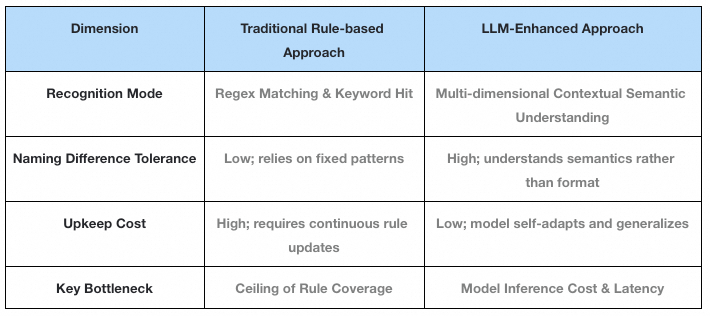
By leveraging the Qwen Large Language Model, the Agentic API Security engine combines historical traffic characteristics of each API to accurately comprehend the specific business scenarios behind the interface. The LLM analyzes past invocation patterns, parameter distributions, and response structures to reconstruct the authentic positioning of the API within the business chain. The specific processing workflow is illustrated below: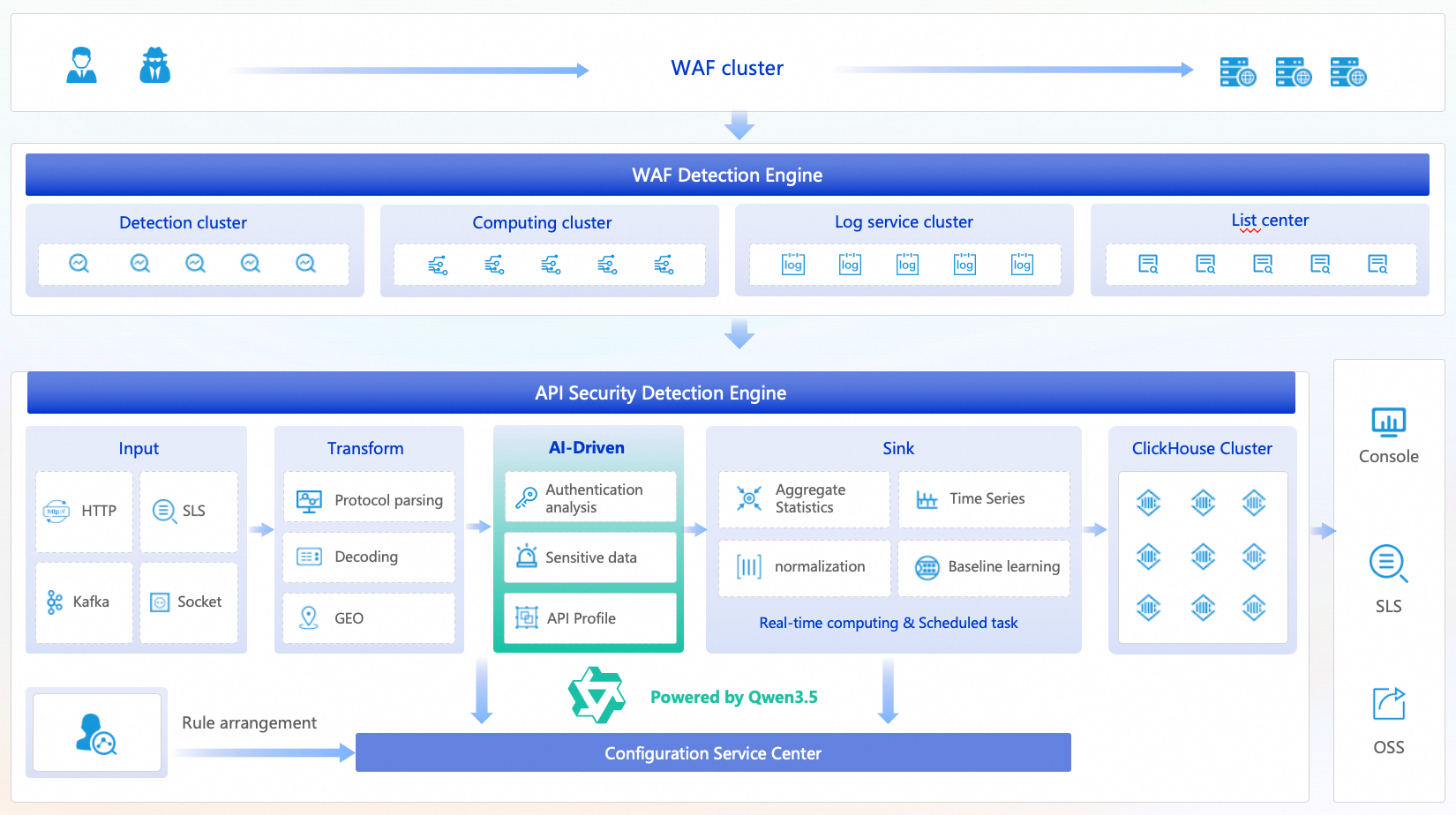
Tests across 63 major scenarios on Alibaba Cloud show that the LLM-based semantic understanding solution improves performance by over 50% compared to traditional rule-based approaches, significantly reducing the risks of data breaches and fraud caused by misjudgment.
For instance, in date-related scenarios, the LLM achieves an accuracy of 98.19%, significantly outperforming regular expressions at 79.59%. However, for certain URL-based scenarios where regex already reaches 100% accuracy, introducing an LLM is unnecessary.
The Agentic API Security engine breaks through the limitations of traditional rule-based isolated field matching. It employs semantic-level understanding based on the complete structural context of requests and responses.
It not only proactively corrects misjudgments by combining field names, locations, and surrounding semantics (e.g., distinguishing usernames from phone numbers), but also penetrates complex forms like encoding, nesting, or assembly to accurately identify the true role of data within business processes. This achieves a qualitative shift from "format matching" to "semantic awareness," significantly improving the accuracy and adaptability of sensitive data identification.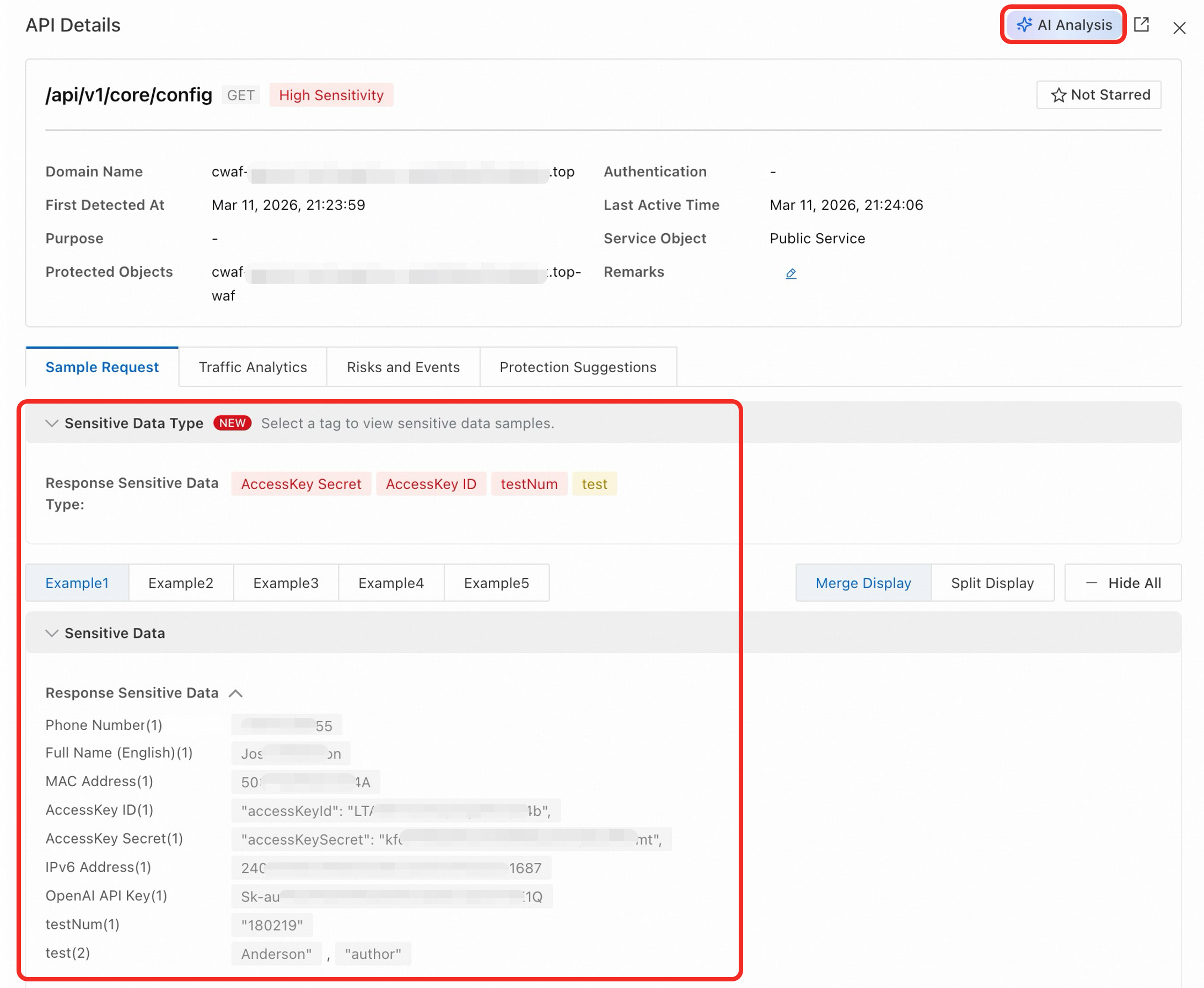
Covering industries ranging from finance, healthcare, and education to manufacturing, energy, and retail, the LLM-based identification method achieves an accuracy rate greater than or equal to the "Regex + Small Model" approach for all categories of sensitive data.
For fields with a high proportion of digits—such as passport numbers, Hong Kong/Macau travel permits, and Unified Social Credit Codes—Agentic API Security, empowered by LLMs and a secondary verification mechanism, improves the average identification accuracy for these subtle sensitive fields by 61.38%.
The system autonomously learns API structures within enterprise scenarios, automatically locating sensitive data fields and performing real-time masking—eliminating the need for security teams to configure rules one by one in advance. It is truly "out-of-the-box."
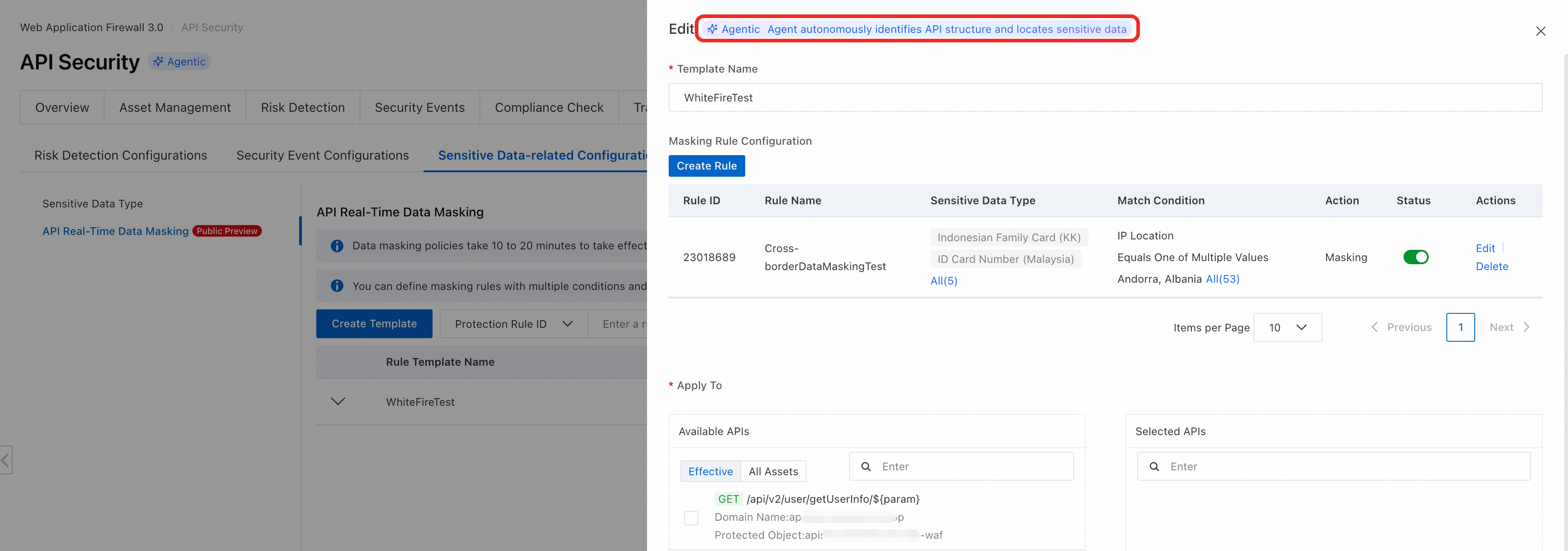
● Zero-Configuration Startup: The system automatically comprehends API structures and identifies the locations of sensitive data fields. Real-time masking is achieved without the need for manual pre-configuration of sensitive data structures.
● Flexible & Precise: Supports masking control down to the level of a single API or field. It also supports hybrid strategies of "partial masking + partial pass-through" to meet the differentiated needs of various business scenarios.
● Elastic Adaptation: When API interfaces are added or structures change, the system automatically perceives and synchronizes updates to masking strategies. This eliminates the need for manual reconfiguration, allowing security capabilities to scale automatically with business growth.
Alibaba Cloud Agentic API Security and Agent ID Guard achieve deep synergy, creating a closed-loop interaction of "Trusted Identity + Controllable Data." The working principles and capabilities are illustrated below: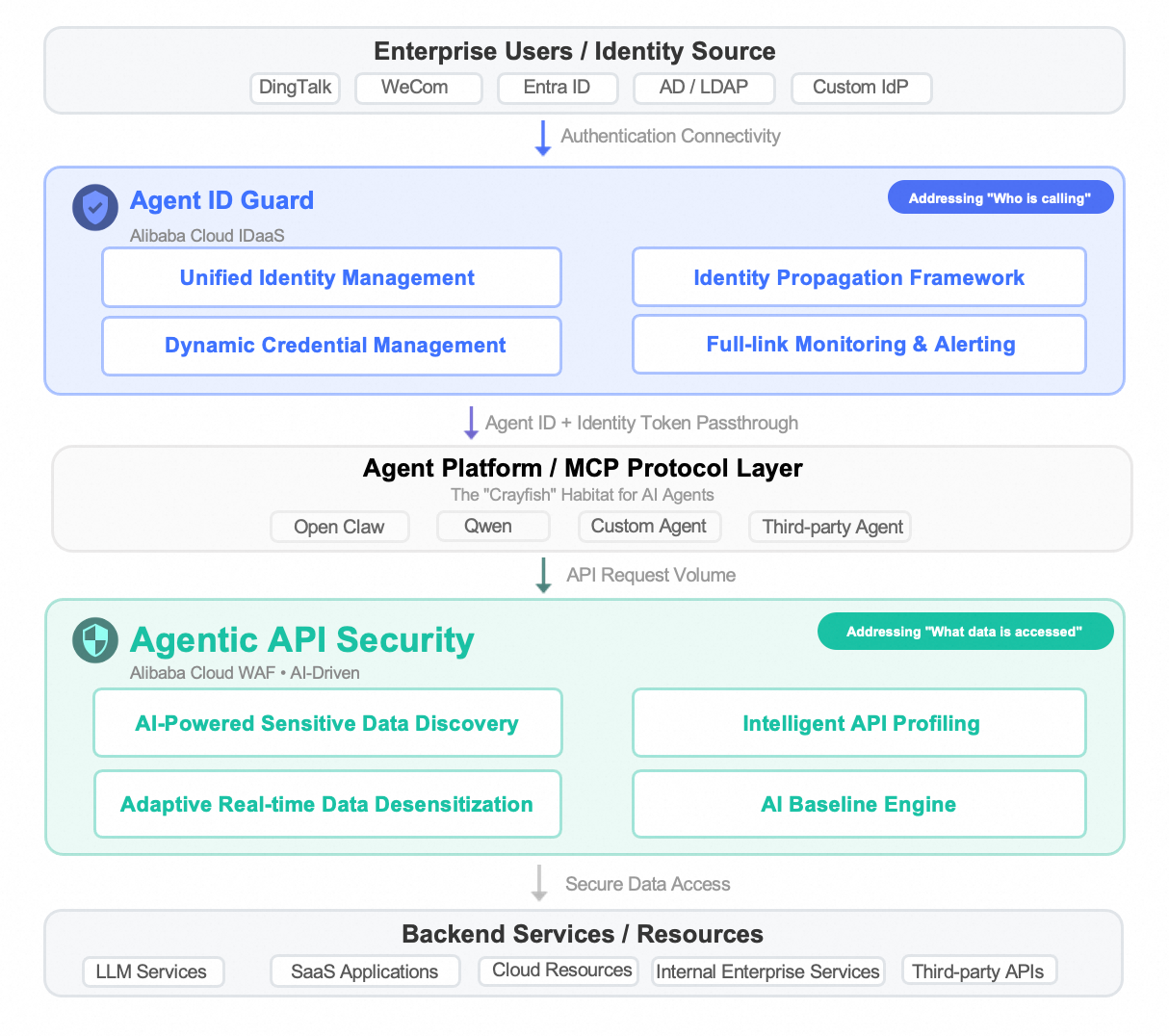
Acting as the upstream identity hub, Agent ID Guard provides unified Agent ID management and dynamic credential distribution for enterprise users and identity sources (such as DingTalk, AD/LDAP, etc.), while pass-through the Agent ID + Token to the Agent platform.
Downstream, Agentic API Security handles this traffic by leveraging the incoming Agent ID to enforce fine-grained access control, sensitive data identification, and adaptive masking. Simultaneously, it utilizes the AI baseline engine and intelligent profiling to perform risk modeling and real-time interception of API calls.
Ultimately, this creates a full-link security shield—from "who is calling" to "what is being called"—issuing a controlled "digital badge" for every Agent to ensure that API access is both identity-traceable and data-compliant.
While building an API ecosystem for its internet finance and securities investment products, this client was trapped in the "semantic confusion" of traditional rules: stock names were misjudged as human names, and trading volumes were mistaken for phone numbers. This high false positive rate required massive manual review every week.
Due to numerous legacy systems and a lack of early API standardization, API naming was arbitrary. Traditional API security products failed to identify the accurate purpose of interfaces, rendering many risk models that relied on interface usage ineffective.
After adopting Alibaba Cloud's Agentic API Security with semantic cognition capabilities, the accuracy of sensitive information identification increased by 65%, and the false positive rate dropped by 98%, establishing it as a benchmark for "AI + Security" implementation in the FinTech industry.
Following a security incident involving stolen dealer accounts, crawled intranet data, and ransomware threats, the client faced a dilemma: the scope of the leak was unknown, and the impact was difficult to assess.
Alibaba Cloud's Agentic API Security solution helped the client establish a five-step closed-loop disposal system: "Threat Discovery → Induced Verification → Precise Statistics → Autonomous Traceability → Judicial Execution." This enabled them to quickly locate two major leakage incidents and accurately quantify the volume of leaked data using Agent-based identification capabilities.
Precise identification and a complete traceability chain built a reliable data security system for the client. They successfully upgraded from passive guidance to active accountability, significantly improving emergency response efficiency and compliance governance, earning high praise from the client.
It ensures that the "Little Lobsters" not only work efficiently but also work securely and compliantly.
Alibaba Cloud Unveils Agentic SOC: An Enterprise-Grade, AI Agent-Driven Security Operations Platform

43 posts | 4 followers
FollowCloudSecurity - July 24, 2026
Alibaba Cloud Native Community - October 11, 2025
Alibaba Cloud Community - June 8, 2026
CloudSecurity - July 9, 2026
Alibaba Cloud Community - August 6, 2026
CloudSecurity - January 14, 2026
43 posts | 4 followers
Follow Security Center
A unified security management system that identifies, analyzes, and notifies you of security threats in real time
Learn More AgentBay
Multimodal cloud-based operating environment and expert agent platform, supporting automation and remote control across browsers, desktops, mobile devices, and code.
Learn More Security Solution
Alibaba Cloud is committed to safeguarding the cloud security for every business.
Learn More Qoder
Qoder
From Assisted to Autonomous — Adapting to Every Programming Need
Learn MoreMore Posts by CloudSecurity

