Agent ID Guard is an IAM service built for AI agents. It provides centralized identity registration, credential management, access control, and audit logging to secure agent interactions across your enterprise.
Background
AI agents introduce a new category of non-human identities (NHIs) that existing IAM solutions were not designed to handle. Agents operate autonomously, invoke external services, and chain API calls across multiple systems — blurring traditional access boundaries.
Without purpose-built identity governance, agents create three systemic risks:
-
Unmanaged agent sprawl: Organizations lack visibility into how many agents exist, who created them, and what data they access. An unregistered agent with a vulnerability can leak data undetected because security teams have no inventory to trace.
-
Privilege escalation: Users gain access to restricted resources through agents with broader permissions than their own roles allow. For example, an employee accesses executive expense records through a reimbursement agent, or an orphaned agent from a departed employee continues running with full credentials.
-
Credential mismanagement: Administrators grant agents overly broad permissions. Developers hard-code API keys and secrets into agent code. Without centralized credential governance, rotation and revocation become impractical at scale.
Agent ID Guard addresses these risks as a centralized identity hub for all agents. It covers the full agent identity lifecycle — from registration through credential management to runtime monitoring.
Core capabilities
Unified identity management
Agent ID Guard provides a dedicated management console where you register and manage all agents. Each agent receives a unique Agent ID — its digital identity across your environment. The Agent ID enables:
-
Identification: Every agent has a traceable identity with a known owner and defined purpose.
-
Access governance: Permissions are defined per Agent ID and enforced consistently.
-
Auditability: All agent activity is linked to a specific Agent ID for investigation and compliance.
Enterprise identity integration
Agent ID Guard integrates with existing identity providers (DingTalk, WeCom, Lark, LDAP, Microsoft Entra ID (Azure AD)) to establish an end-to-end trusted access chain:
User → Client → Agent → Resource
Security is enforced at each transition:
|
Transition |
Mechanism |
Example |
|
User to Client |
SSO authentication |
User logs in through the corporate IdP. |
|
Client to Agent |
Policy-based access control |
Only HR department members can invoke the onboarding workflow agent. |
|
Agent to Resource |
Least privilege enforcement |
The agent accesses only the downstream resources (LLMs, enterprise services, SaaS) required for its current task. |
|
End-to-end |
OIDC / OAuth 2.0 protocol security |
Token propagation and validation at each step prevent identity spoofing and unauthorized access. |
Dynamic credential management
Agent ID Guard manages credentials (API keys, OAuth secrets, tokens) that agents use to access LLMs, SaaS services, and internal systems.
-
Encrypted storage: All credentials are encrypted at rest using Key Management Service (KMS).
-
Dynamic delivery: Agents retrieve credentials only when explicitly authorized. Agent code never accesses long-lived raw credentials. At runtime, agents receive short-lived, scoped tokens through a secure channel.
-
Auditable distribution: All credential distribution is logged and bound to the requesting Agent ID and call context.
End-to-end monitoring and alerting
Agent ID Guard integrates with Simple Log Service (SLS) for behavior auditing:
|
Log category |
What is recorded |
|
Inbound records |
The user or system that triggers the agent, along with the timestamp and source. |
|
Outbound records |
The downstream services the agent calls, the credentials used, and the operations performed. |
|
Credential audit |
All credential retrieval and usage, associated with the specific Agent ID and call context. |
Events are written to SLS in standardized JSON format. You can query logs by Agent ID, user identity, timestamp, and resource type.
Architecture
The following diagram shows how users, clients, agents, and downstream resources interact through the identity and credential management layer.
Business flow
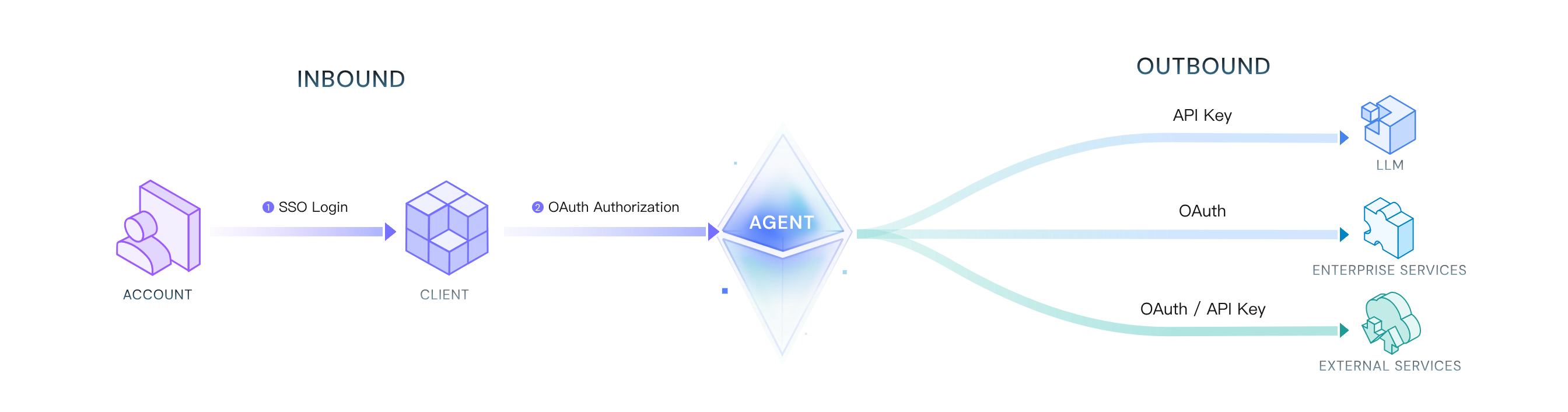
Agent types
Agent ID Guard supports two agent types:
|
Type |
Description |
Access pattern |
|
Autonomous agent |
Operates independently on a preset schedule without user context. Example: an operations agent that periodically restarts services. |
Outbound only |
|
Interactive agent (user-delegated) |
Acts on behalf of a specific user. Requires user authentication before performing tasks such as sending emails or scheduling meetings. |
Inbound and outbound |
Core components
|
Component |
Description |
|
Agent ID |
A unique application identity assigned to each AI agent. Defines the agent's access permissions. Clients must authorize through the Agent ID before accessing agent services. |
|
LLM integration |
Hosts LLM API keys so developers never access raw credentials. The Agent ID retrieves authorized keys through identity authentication at runtime. |
|
Enterprise service (MCP) |
Exposes enterprise systems to LLMs through the Model Context Protocol (MCP). Each service maps to an M2M application with custom resource servers and permissions for secure API exposure. |
|
Client |
The access entry point for interactive agents (web or mobile applications). Users authenticate through the client and obtain an access token to invoke agent services. |
|
Credential management service |
High-availability credential storage. Encrypts all credentials (API keys, OAuth secrets) with KMS. Only authorized Agent IDs can retrieve credentials as short-lived temporary tokens. |
What to do next
-
Agent ID Guard configuration guide: Step-by-step instructions for registering agents, configuring LLM nodes, and setting up access policies.