Before an organization administrator can add you to Quick BI, you must obtain your account information and provide it to the administrator. Quick BI supports Alibaba Cloud accounts, Resource Access Management (RAM) users, DingTalk accounts, and other account types.
Obtain Alibaba Cloud account information
Obtain an Alibaba Cloud account ID
-
Log on to the Alibaba Cloud Management Console.
-
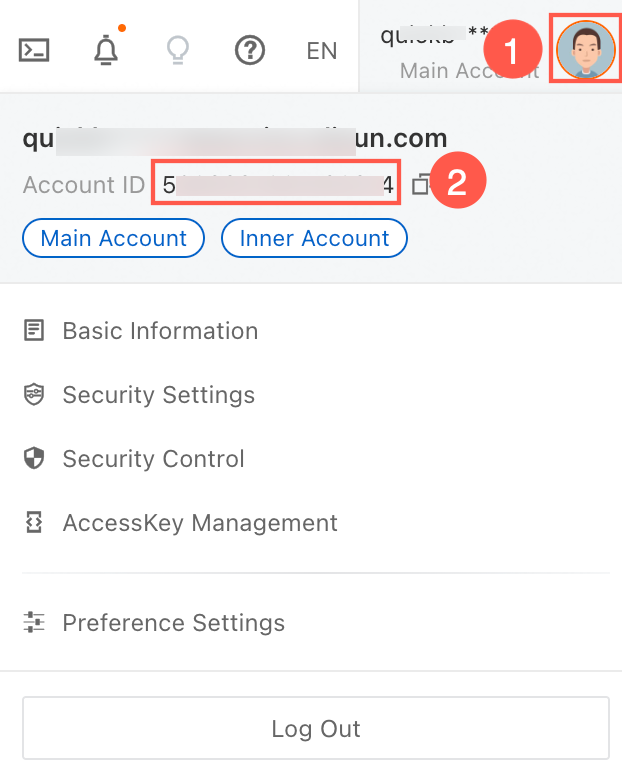
Hover over the profile picture (①) in the upper-right corner to view your Alibaba Cloud account ID (②).
 Alternatively, you can hover over the profile picture (①) in the upper-right corner and click Security Settings (②).
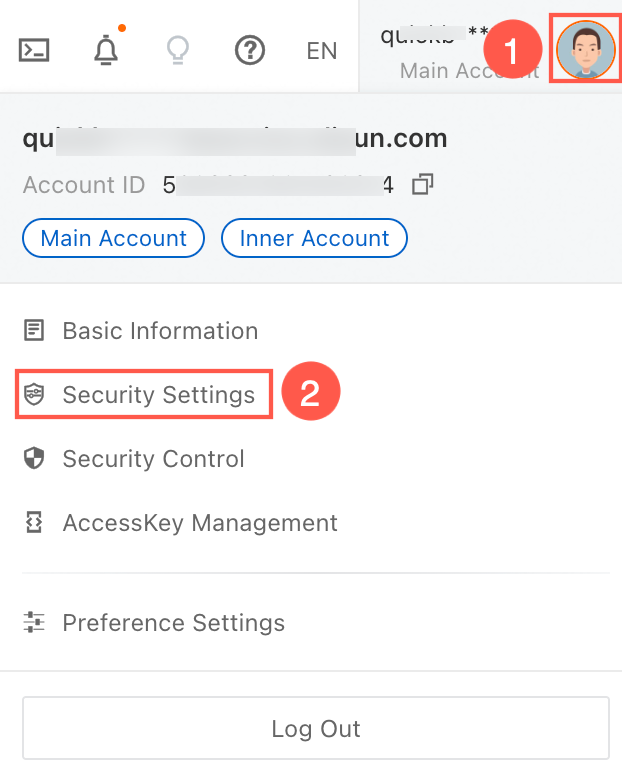 On the Security Settings page, the Account ID is your Alibaba Cloud account ID.
Obtain an Alibaba Cloud account name
-
Log on to the Alibaba Cloud Management Console.
-
Hover over the profile picture (①) in the upper-right corner to view the Alibaba Cloud account (②).
 Alternatively, you can hover over the profile picture (①) in the upper-right corner and click Security Settings (②).On the Security Settings page, the Logon Account displays your Alibaba Cloud account.
Obtain RAM user information
-
Create a RAM user.
If your Alibaba Cloud account does not have a RAM user, you must create one. For more information, see Create a RAM user.
-
Obtain RAM user information.
RAM user details are visible only from the associated Alibaba Cloud account. For more information, see View RAM user information.
Obtain a RAM user ID
-
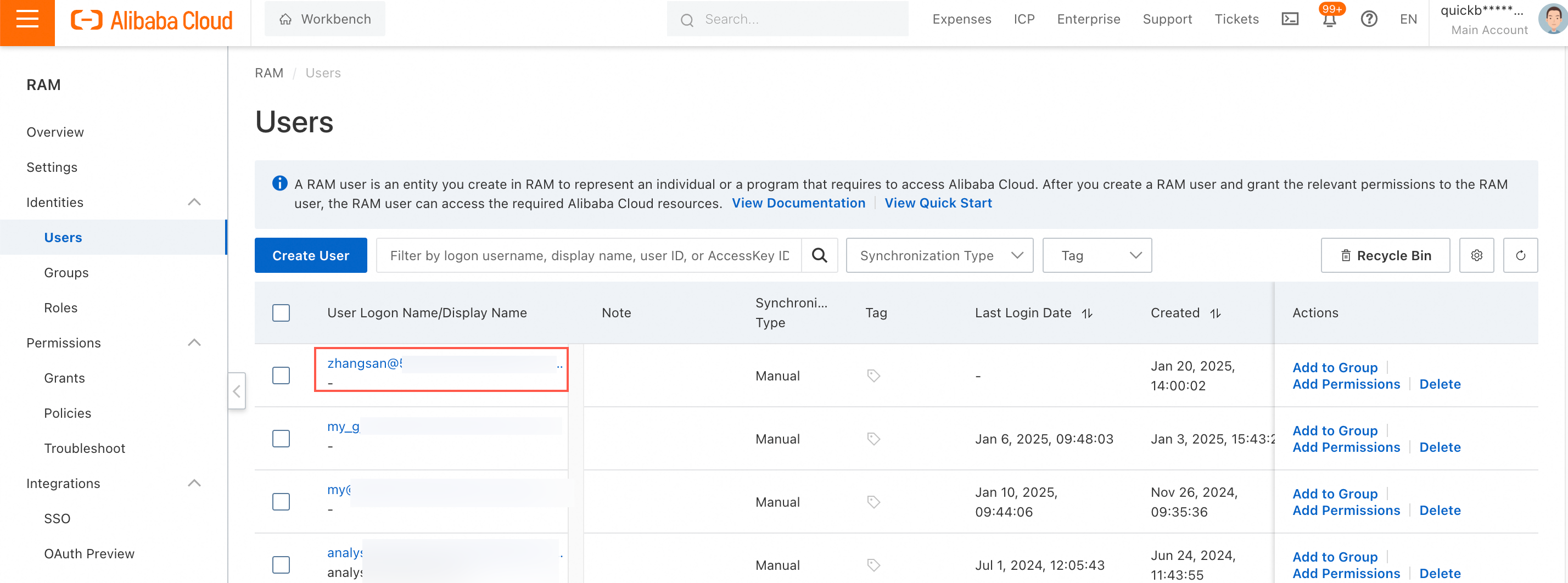
Log on to the RAM console using an Alibaba Cloud account. In the navigation pane on the left, choose Identity Management > Users. Click the name of the target RAM user to go to the user details page.
 On the user details page, locate the UID. This is the RAM user ID.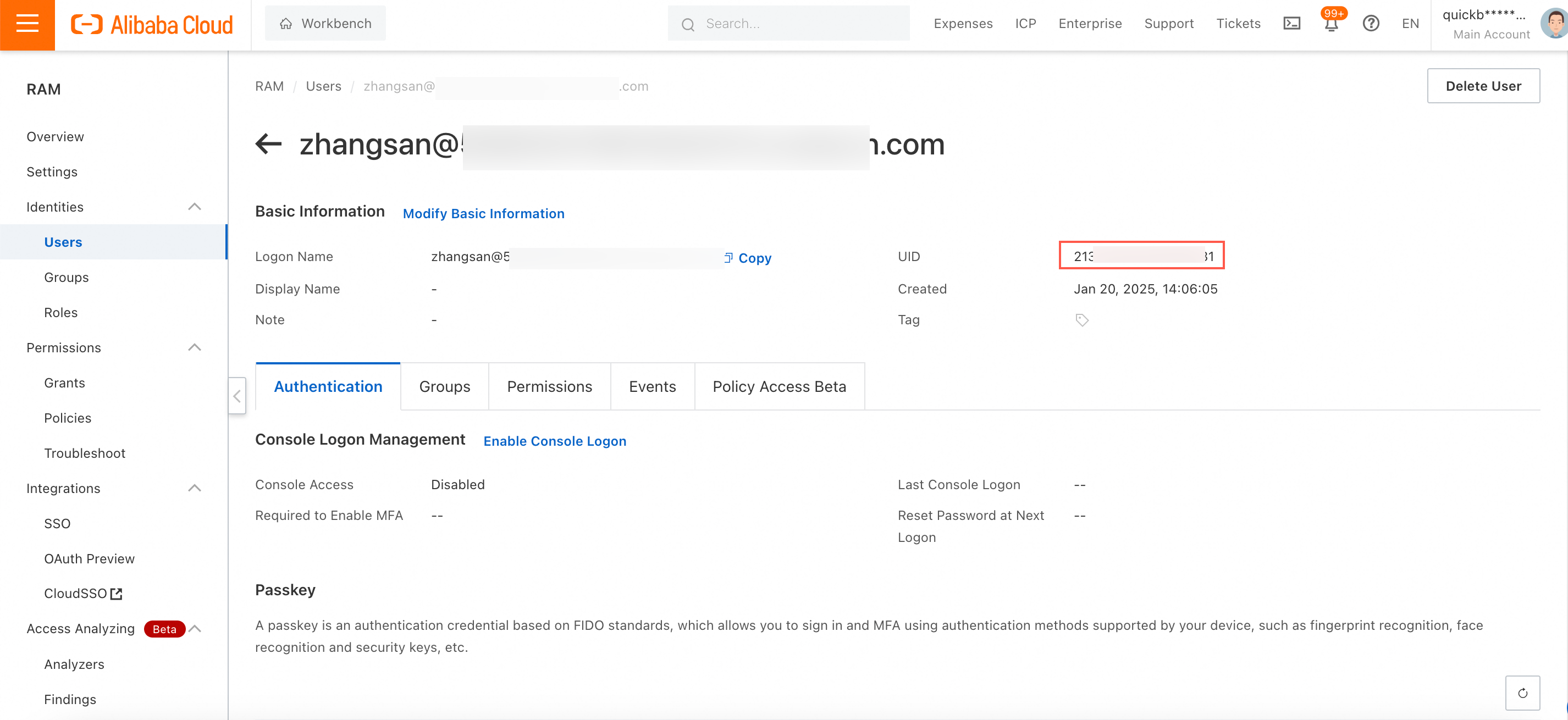
-
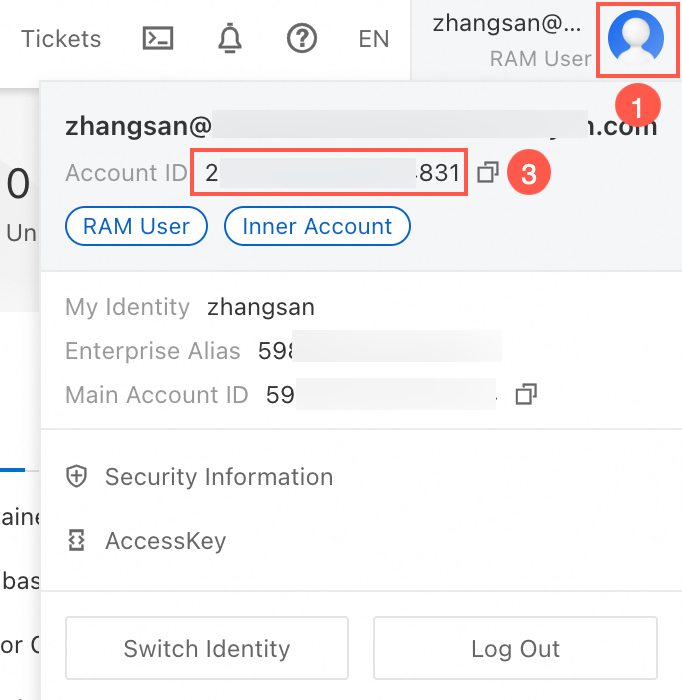
Log on to the Alibaba Cloud Management Console using a RAM user. Hover over the profile picture (①) in the upper-right corner to view the RAM user ID (②).
Obtain a RAM username
-
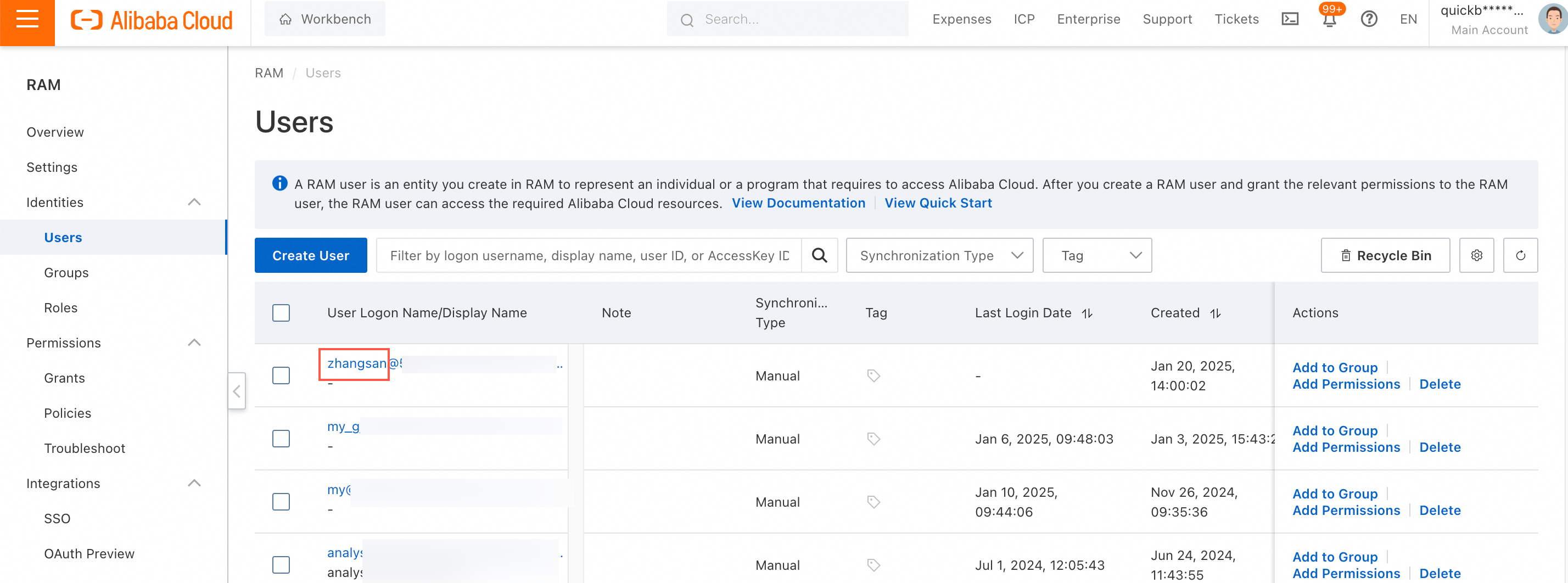
Log on to the RAM console using an Alibaba Cloud account. In the navigation pane on the left, choose Identity Management > Users to view the RAM user information.
 Note
NoteThe RAM username is the part before the at sign (@) in the full login name. The login name format is `username@default_domain_name` or `username@enterprise_alias.onaliyun.com`. For example, if the login name is zhangsan@test.onaliyun.com, the username is zhangsan.
For more information, see Obtain RAM user information.
-
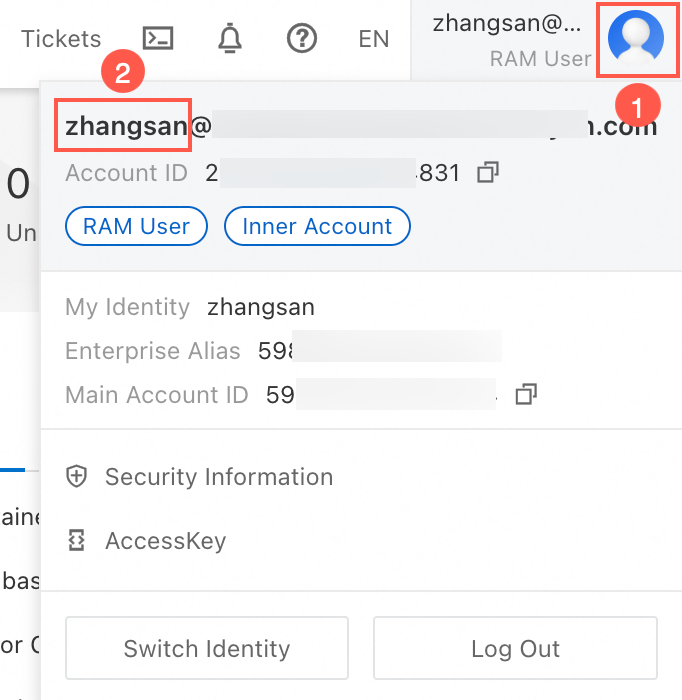
Log on to the Alibaba Cloud Management Console using a RAM user. Hover over the profile picture (①) in the upper-right corner to view the username (②).
Obtain RAM role information
-
Log on to the RAM console using an Alibaba Cloud account. In the navigation pane on the left, choose Identity Management > Roles to view the role information.

-
Click the name of the target role to go to the Role Basic Information page and locate the Role ID.

Obtain DingTalk account information
Provide the CorpId of your DingTalk organization to a Quick BI organization administrator. After the administrator authorizes the DingTalk API, your DingTalk organization's address book is synced to Quick BI. For more information, see (Public Cloud) Enable the DingTalk micro-application.
Obtain Feishu account information
Provide the CorpId of your Feishu organization to a Quick BI organization administrator. After the administrator authorizes the Feishu API, your Feishu organization's address book is synced to Quick BI. For more information, see (Public Cloud) Enable the Feishu micro-application.
Obtain Lark account information
Provide the AppId and other information of your Lark organization to a Quick BI organization administrator. After the administrator authorizes the Lark API, your Lark organization's address book is synced to Quick BI. For more information, see (Public Cloud) Enable the Lark micro-application.
Obtain Teams account information
Provide the tenant ID, application ID, and client credential of your Teams organization to a Quick BI organization administrator. After the administrator authorizes the Teams API, your Teams organization's address book is synced to Quick BI. For more information, see (Public Cloud) Enable the Teams micro-application.