By default, OSS uses a pay-as-you-go billing model. For a more cost-effective option, you can purchase OSS resource plans to cover storage, traffic, and other resources. If a resource plan expires or its quota is used up, OSS automatically bills any overage on a pay-as-you-go basis.
OSS offers free trial resource plans for some features. For more information, see View OSS free trial resource plans.
Resource plan types
|
Resource plan |
Description |
|
storage plan |
Covers storage costs for OSS files. |
|
standard zone-redundant storage plan |
Covers storage costs for OSS files that use the Standard storage class and zone-redundant storage. |
|
standard LRS plan |
Covers storage costs for OSS files that use the Standard storage class and locally redundant storage (LRS). |
|
IA LRS plan |
Covers storage costs for OSS files that use the IA storage class and locally redundant storage (LRS). |
|
archive zone-redundant storage plan |
Covers storage costs for OSS files that use the Archive storage class and zone-redundant storage. |
|
cold archive LRS plan |
Covers storage costs for OSS files that use the Cold Archive storage class and locally redundant storage (LRS). |
|
data transfer plan |
Covers OSS traffic costs. |
|
outbound data transfer plan |
Covers traffic costs for transferring data from OSS to clients over the internet. |
|
transfer acceleration plan |
Covers traffic costs for accessing OSS through an acceleration endpoint. |
|
Anti-DDoS Basic plan |
Covers reservation costs for Anti-DDoS Basic instances. |
Recommendations
Select by use case
Select by billable items
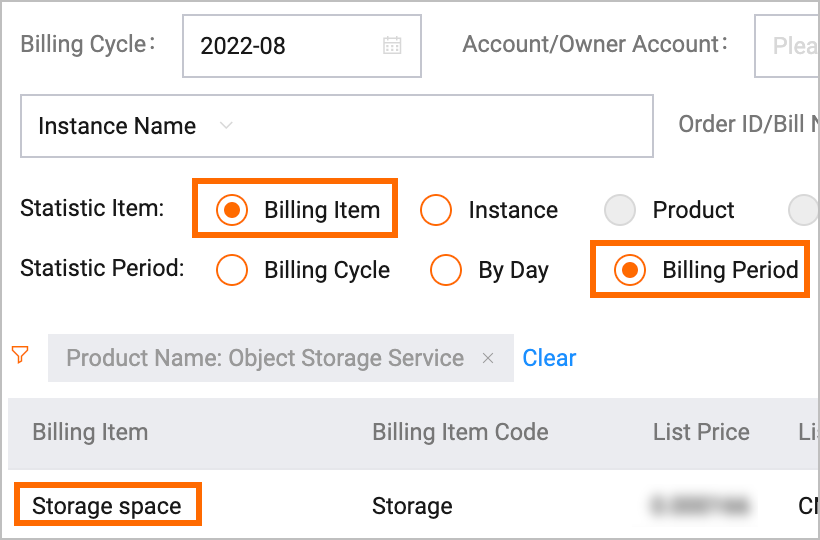
If you have an existing OSS bill, you can review the billable items on the Detailed Bills page to select a suitable resource plan.
For example, if a billable item is Standard LRS capacity, you can purchase a Standard LRS plan to cover this cost.
Select by usage
Troubleshoot hourly charges
Limitations
-
OSS resource plans only cover costs for the Alibaba Cloud account that purchased them and cannot be shared with other accounts.
-
OSS resource plans apply only to the OSS service and do not cover costs for other products.
-
OSS resource plans only cover costs incurred after purchase and cannot be applied retroactively.
-
A resource plan only covers costs for its corresponding billable item. For more information, see Resource plan types.
-
A resource plan for a specific region only covers costs for its corresponding billable item in that region, while a plan that is universal for the Chinese mainland covers the item's costs in any region within the Chinese mainland. For more information, see Regions.
Deduction methods
|
Deduction method |
Resource plan |
Example |
|
Fixed hourly quota |
|
A fixed quota is provided every hour. Unused quota does not carry over to the next hour.
|
|
fixed monthly quota |
outbound data transfer plan |
A fixed quota is provided every month. The quota resets on the first day of the next month. Unused quota from the current month does not carry over to the next month. For example, if you purchase a one-month, 100 GB outbound data transfer plan on the 18th of the current month, the plan covers 100 GB of outbound traffic from the 18th to the end of the month. Any excess usage is billed on a pay-as-you-go basis. The quota resets on the first day of the next month. From the 1st to the 18th of the next month, the plan covers 100 GB, and any excess usage is billed on a pay-as-you-go basis. |
|
total declining balance |
transfer acceleration plan |
The quota balance declines with usage until it reaches zero or the plan expires. For example, if you purchase a 5 TB plan for three months, you have a total quota of 5 TB for transfer acceleration traffic over the three months. Any excess usage is billed on a pay-as-you-go basis. |
Regions
When you purchase an OSS resource plan, you must specify a region, except for Anti-DDoS Basic plans. A region-specific resource plan covers costs only in the specified region.
An Anti-DDoS Basic plan covers charges in any region that supports Anti-DDoS instances. However, within the same hour, it covers charges for only a single instance in a single region. If you incur Anti-DDoS charges in multiple regions within the same hour, purchase additional Anti-DDoS Basic plans to cover the charges.
|
Region type |
Description |
|
Global |
Covers usage costs for corresponding resources in all regions. Can be shared across regions. |
|
Region-specific① |
Covers usage costs for corresponding resources in a specific region. Cannot be shared across regions.② |
|
Universal for the Chinese mainland① |
Covers usage costs for corresponding resources in multiple regions within the Chinese mainland. Can be shared across regions.③ |
|
Transfer acceleration region |
Covers upload and download acceleration traffic costs for cross-region access to OSS through an acceleration endpoint. |
|
Transfer acceleration M2M |
Covers upload and download acceleration traffic costs (AccM2MIn, AccM2MOut) when a client in the Chinese mainland accesses an OSS bucket also in the Chinese mainland through an acceleration endpoint. |
|
Transfer acceleration M2O_O2M |
Covers upload and download acceleration traffic costs (AccM2OIn, AccM2OOut, AccO2MIn, AccO2MOut) when a client outside the Chinese mainland accesses an OSS bucket in the Chinese mainland, or vice versa, through an acceleration endpoint. |
|
Transfer acceleration O2O |
Covers upload and download acceleration traffic costs (AccO2OIn, AccO2OOut) when a client outside the Chinese mainland accesses an OSS bucket also outside the Chinese mainland through an acceleration endpoint. |
① You can purchase a universal resource plan for the Chinese mainland and a region-specific resource plan for a region in the Chinese mainland. The region-specific plan is used first. If the quota of the region-specific plan is exhausted, the universal plan is used. Any remaining usage is billed on a pay-as-you-go basis.
② For example, a resource plan for China (Qingdao) covers usage costs for resources in that region only.
③ For information about the regions in the Chinese mainland that are supported by universal resource plans, see Regions supported by universal plans for the Chinese mainland.
Supported actions
"✓" indicates an operation is supported, and "×" indicates it is not.
|
Resource plan |
|||||
|
Standard zone-redundant storage plan |
✓ |
✓ |
✓ |
✓ |
✓ |
|
Standard LRS plan |
✓ |
✓ |
✓ |
× |
✓ |
|
IA LRS plan |
✓ |
✓ |
✓ |
× |
✓ |
|
Cold Archive LRS plan |
✓ |
✓ |
✓ |
✓ |
✓ |
|
Outbound data transfer plan |
✓ |
× |
✓ |
✓ |
✓ |
|
Transfer acceleration plan |
✓ |
× |
× |
✓ |
✓ |
|
Anti-DDoS Basic plan |
✓ |
× |
✓ |
✓ |
✓ |
①You can purchase multiple resource plans of the same type. When you stack these plans, the one that expires first is used first. For example, on February 1, 2022, you purchase a one-year, 1 TB outbound data transfer plan. On March 1, 2022, you purchase another three-month, 1 TB outbound data transfer plan of the same type. In this case, the plan purchased on March 1, 2022, is used first.