This topic walks you through creating an application, configuring connection parameters, and validating the client in your Spring Boot project. Once connected, your application can use the SchedulerX platform for automated and precise job management.
Prerequisites
-
(Optional) Create a namespace. If your application has strict security requirements, you can create a namespace to isolate resources and services. For more information, see Create a namespace.
-
You have an existing Spring Boot project.
Overview
Connecting a Spring Boot application to SchedulerX involves the following steps:
-
Create an application in SchedulerX to get connection parameters and manage jobs centrally.
-
Connect the client to SchedulerX: Add the required parameters for the SchedulerxWorker to your project's configuration file and create a JobProcessor class.
-
Verify the results: Confirm that your Spring Boot application is successfully connected and running correctly.
Step 1: Create an application
1.1 Basic settings
Log on to the MSE SchedulerX console, and select a region in the top navigation bar.
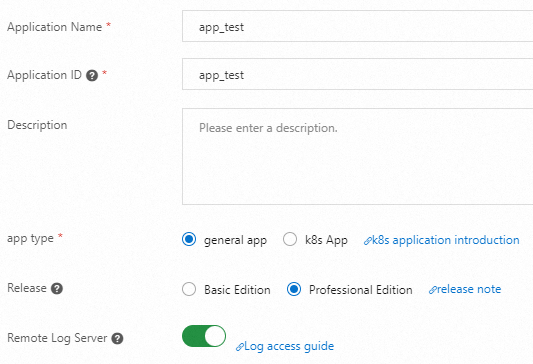
On the Application Management page in the left navigation bar. Select the target Namespace, and click Create Application. Enter the Application Name and Application ID, select the Application Type, configure advanced settings as needed, and click Next.
 Important
Make sure that resources are created in the selected region and namespace and the resource information is valid.
Configuration item
Description
Default value
Application Name
Customize the application name.
None
Application ID
The Application ID is the GroupID for application access. It must be unique within the same namespace. Otherwise, the creation fails. It can be the same as the Application Name.
None
Application Type
Regular App: Select this option if the application is not deployed in a Kubernetes cluster or does not require Kubernetes jobs.
k8s App: Select this option if you want to deploy the application in a Kubernetes cluster and require Kubernetes jobs.
Regular App
Edition
Select an edition based on your requirements.
Professional Edition
Simple Log Service
If you enable this feature, add a Log4j or Logback configuration. Then, you can view the scheduling logs of jobs, including distributed jobs, in the console for troubleshooting.
Off
load5
The value cannot be greater than the number of CPU cores available on the client machine.
0
Memory Usage
If the average memory usage within the previous 5 minutes exceeds the threshold that is specified by this parameter, the worker is considered busy.
90%
Disk Usage
If the disk usage exceeds the threshold that is specified by this parameter, the client machine is considered busy.
95%
Trigger Busy Machine
Specify whether to continue to trigger job execution when the machine is busy.
On
Advanced Configuration
Maximum Number Of Jobs
Specify the maximum number of jobs that are supported in a group.
1000
Automatic Scale-out
Specify whether to enable automatic scale-out. If you enable this feature, you need to set Global Job Count.
Off
Traffic Throttling
Specify whether to enable traffic throttling. If you enable this feature, you need to set Task Instance Concurrency.
Off
Calendar
You can select Financial Day or Workday from the drop-down list to schedule the application.
Financial day: a trading day for financial business.
Workday: a day of normal work or operations for a society, organization, or individual.
0
1.2 Notification settings
On the Notification Configuration wizard page, enter the relevant information, select a Notification Channel, and set Contacts.
The Notification Channel supports Text Message, Email, Webhook, and Phone.
For more information about Webhook configuration, see Webhook configuration description.
Notification Contacts supports two methods: contact groups and contacts.
Contact Group
All contacts in the contact group can receive notifications. For more information about how to create a contact group, see Create a notification contact or notification contact group.
Contact
Added contacts can receive notifications. You can add multiple contacts at a time. After you Add Contact, click Go To Create Contact.
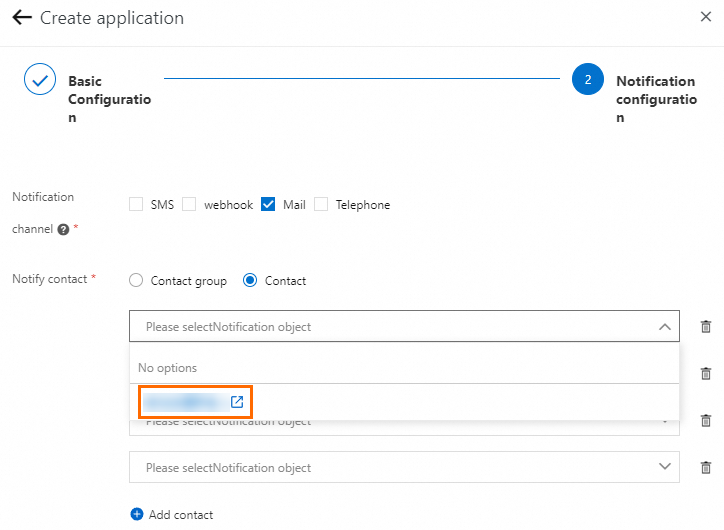
In the dialog box that appears, click Create Contact, and enter the contact information.

Configuration item
Description
Notification Channel
The following notification channels are supported: Text Message, Email, Webhook, and Phone.
Email
Enter the email address of the contact.
Webhook
Enter the webhook URL that you want to use. WeCom, Lark, and DingTalk are supported. You can also specify multiple webhook robots at a time. Separate multiple robot links with commas (,).
You need to add the keyword "SchedulerX" (case-sensitive) to the DingTalk robot. Otherwise, you cannot receive alert information.
For more information about how to obtain a webhook URL, see DingTalk Developer Documentation, WeCom Developer Documentation, and Lark Developer Documentation.
Mobile Phone Number
Enter the mobile phone number of the contact.
Verification
Refresh the page and select the specified region and namespace. Then, view the information about the created application.
Step 2: Connect the client to SchedulerX
-
Add the dependency to pom.xml
Add the schedulerx2-spring-boot-starter dependency to your project's pom.xml file to use SchedulerX features.
NoteSchedulerX supports connections from Spring Boot 2.x and 3.x.
<dependency> <groupId>com.aliyun.schedulerx</groupId> <artifactId>schedulerx2-spring-boot-starter</artifactId> <version>${schedulerx2.version}</version> <!-- If you use logback, exclude log4j and log4j2 --> <exclusions> <exclusion> <groupId>org.apache.logging.log4j</groupId> <artifactId>log4j-api</artifactId> </exclusion> <exclusion> <groupId>org.apache.logging.log4j</groupId> <artifactId>log4j-core</artifactId> </exclusion> <exclusion> <groupId>log4j</groupId> <artifactId>log4j</artifactId> </exclusion> </exclusions> </dependency>ImportantReplace <version>${schedulerx2.version}</version> with the latest client version. For example: <version>1.11.5</version>. For more information, see Client release notes.
-
Configure parameters
In your Spring Boot application's
application.propertiesfile, add the required parameters to connect the SchedulerxWorker to your SchedulerX application.spring.schedulerx2.endpoint=${endpoint} spring.schedulerx2.namespace=${namespace} spring.schedulerx2.groupId=${groupId} # Only version 1.2.1 and later supports configuring appKey. spring.schedulerx2.appKey=${appKey} # If you do not use an appKey, you can use an Alibaba Cloud AccessKey ID and AccessKey secret, or an STS token. #spring.schedulerx2.aliyunAccessKey=${aliyunAccessKey} #spring.schedulerx2.aliyunSecretKey=${aliyunSecretKey} #spring.schedulerx2.stsToken=${aliyunStsToken}Parameter source:
In the MSE SchedulerX console, go to the Application Management page in the left-side navigation pane. In the Actions column for your target application, click Access Configuration and select Spring Boot as the service type. In the dialog box that appears, you can view example values for parameters like
endpoint,namespace,groupId, andappKey. Copy these values into the corresponding locations in your configuration file.ImportantEnsure that the SchedulerX
regionmatches theclientregionto avoid connection failures.If you are using a non-Alibaba Cloud server or a local environment, make sure you have enabled public network access and created your application in a public-facing
regionof the scheduling platform. For more details, see Connect to a public environment locally.NoteIf your
clientapplication includes multiple services or requires permission management to isolate scheduled jobs, you can create multiple applications in the console for fine-grained job management. For example, if aclientapplication namedanimalshas two applications,animals.dogandanimals.cat, created in the console, you do not need to request separate instances for each. Instead, you can configure them in the application.properties file by specifying multiple application IDs in thespring.schedulerx2.groupId=${groupId}parameter, separated by commas, such as:spring.schedulerx2.groupId=animals.dog,animals.cat.Parameter description:
-
endpoint: When initializing the SchedulerxWorker, use theregionand corresponding endpoint where your application is deployed. For more information, see Endpoints. -
namespace: The ID of thenamespace. You can find it on the Namespaces page in the console. -
groupIdandappKey: ThegroupIdis the application ID, and theappKeyis the application key. You can find them on the Application Management page in the console. -
aliyunAccessKeyandaliyunSecretKey:aliyunAccessKeyis your Alibaba Cloud account'sAccessKey ID, andaliyunSecretKeyis theAccessKey secret. You can obtain them from the Security Management page in the User Information Management console. -
For more parameters, see the following table:
Key
Description
Value
Supported from version
spring.schedulerx2.enabled
Enables the SchedulerX 2.0 starter. Default:
true.true
false
0.1.7
spring.schedulerx2.endpoint
Sets the endpoint for the region. For more information, see Endpoints.
None
0.1.7
spring.schedulerx2.namespace
Sets the UID of the namespace. You can find it on the Namespaces page in the console.
None
0.1.7
spring.schedulerx2.groupId
The
groupId. You can find it on the Application Management page in the console.None
0.1.7
spring.schedulerx2.appKey
The
appKey. You can find it on the Application Management page in the console.None
1.2.1
spring.schedulerx2.host
If you have multiple IP addresses (for example, from a VPN or multiple network cards), you can specify the IP address to use.
None
0.1.7
spring.schedulerx2.port
A custom port for the client to listen on. If not set, a random available port is chosen.
None
0.1.7
spring.schedulerx2.blockAppStart
If
true, blocks application startup if SchedulerX fails to initialize. Default:true.true
false
1.1.0
spring.schedulerx2.shareContainerPool
If
true, all job executions on the client share a single thread pool. Default:false.true
false
1.2.1.2
spring.schedulerx2.sharePoolSize
Sets the size of the shared thread pool when
spring.schedulerx2.shareContainerPoolistrue. Default: 64.None
1.2.1.2
spring.schedulerx2.label
You can set labels on different clients and specify labels for job execution in job management. This is useful for scenarios like canary releases and stress testing.
None
1.2.2.2
spring.schedulerx2.enableCgroupMetrics
Specifies whether to use cgroups to collect metrics for client instances. This must be enabled manually in container (K8s) environments. The default is
false.true
false
1.2.2.2
spring.schedulerx2.cgroupPathPrefix
The cgroup path inside the container.
The default path is /sys/fs/cgroup/cpu/. If this path exists, you do not need to set this parameter.
1.2.2.2
spring.schedulerx2.enableHeartbeatLog
Specifies whether to print the
heartbeat logto ${user.home}/logs/schedulerx/heartbeat.log.The default is
true.true
false
1.2.4
spring.schedulerx2.mapMasterStatusCheckInterval
The interval, in milliseconds, at which a Map job checks for sub-job completion. A lower value can accelerate scheduling for second-level jobs.
3000
1.2.5.2
spring.schedulerx2.enableSecondDelayCycleIntervalMs
If
true, thesecond_delayvalue from the console is treated as milliseconds instead of seconds, enabling faster scheduling. Default:false.true
false
1.2.5.2
spring.schedulerx2.broadcastMasterExecEnable
Specifies whether the master node participates in the execution of a
broadcast job. The default istrue.true
false
1.8.13
spring.schedulerx2.broadcastDispatchRetryTimes
The number of retry attempts for a failed broadcast dispatch. The retry interval is fixed at 2 seconds and is not configurable.
3
1.8.13
spring.schedulerx2.enableSecondDelayStandaloneDispatch
Specifies whether to enable second-level dispatch and execution for standalone jobs. The default is
false.true
false
1.8.13
-
-
Create a job processor class
Create a JobProcessor class in your Spring Boot application to handle the job logic.
The following example shows how to create a simple JobProcessor class that prints a message periodically (example package name:
com.example.schedulerx.job).package com.example.schedulerx.job; import com.alibaba.schedulerx.worker.domain.JobContext; import com.alibaba.schedulerx.worker.processor.JavaProcessor; import com.alibaba.schedulerx.worker.processor.ProcessResult; import org.springframework.stereotype.Component; @Component public class MyHelloJob extends JavaProcessor { @Override public ProcessResult process(JobContext context) throws Exception { System.out.println("hello schedulerx2.0"); return new ProcessResult(true); } }
Step 3: Verify the results
Log on to the MSE SchedulerX console. In the left navigation bar, click Application Management and view the Total Instances of the target application.

If Total Instances is 0, the application failed to connect. Check and modify the local application.
If Total Instances is not 0 and shows the number of connected instances, the application is successfully connected.
What to do next
After the application is connected to SchedulerX, you can create scheduling tasks in the Distributed Task Scheduling Platform. For more information, see Create a scheduling task.
FAQ
-
For information on handling alerts in SchedulerX, see Alerts FAQ.
-
For common issues related to connecting Spring jobs to SchedulerX, see Spring job issues.
-
For permission and connection issues in SchedulerX, see Permission issues and Connection issues.
Related documentation
To learn about other client connection methods, see Quickly connect a client to SchedulerX.