By Luo Yu
The task is simple: place a heated cup in a cabinet. An agent first puts the cup in a microwave, then in the cabinet, and subsequently becomes trapped in a loop of repeatedly checking the cabinet. It repeats this ineffective behavior 36 times until its action budget is exhausted, yet the task remains incomplete.
The missing step is heating the cup. This is a real case presented in the paper using an ALFWorld simulated task: the Raw Trajectory baseline, which uses the full interaction history, fails after exhausting all 50 steps, while PoS completes the same task within 17 steps. Actions keep occurring, but the critical requirement is never satisfied.
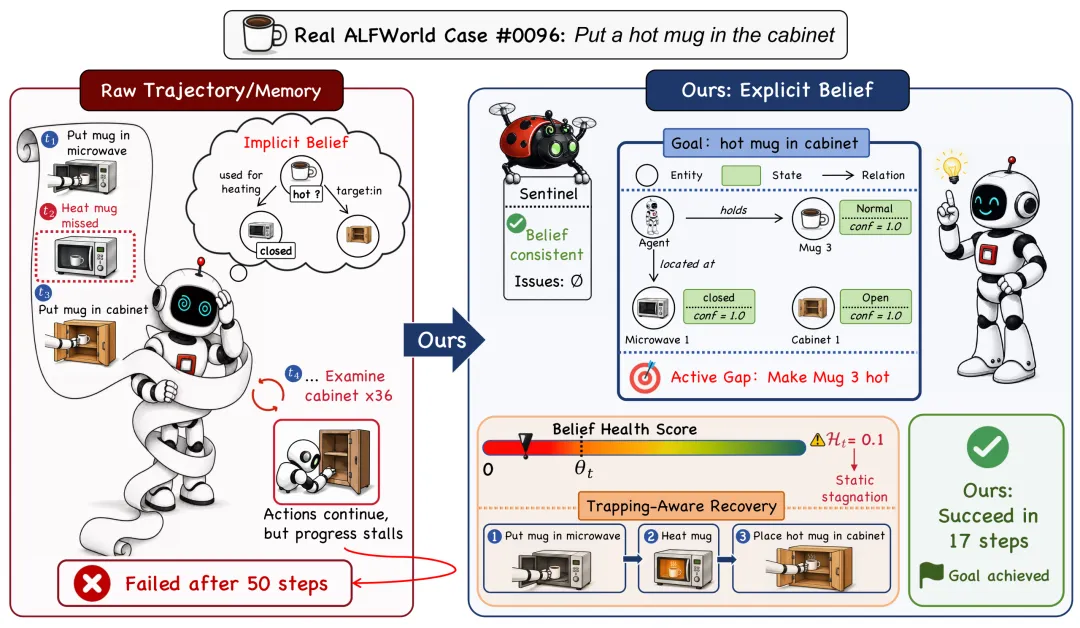
Figure 1: Two execution paths for the heated-cup task. After missing the heating step, the Raw Trajectory baseline keeps checking the cabinet; PoS explicitly retains the unmet heating requirement and guides recovery when progress stalls.
The agent continues calling tools, receiving observations, and generating its next plan. It appears to be working throughout, yet the critical requirement to "heat the cup" never advances. Similar difficulties arise in other interactive tasks: a GUI agent clicks repeatedly while the interface remains unchanged; a coding agent rereads the same files without moving on to effective modification and validation. The operation log keeps growing, but unresolved issues remain. These scenarios raise a shared question: before the budget is exhausted, can the system determine whether current actions are still advancing critical requirements—and redirect them when progress stalls?
A research team from Nankai University, Alibaba Cloud, and other institutions formalizes this problem as Belief Trapping: the agent continues interacting with the environment, but the evolution of its goal-relevant beliefs no longer produces meaningful task progress. This may appear as repetition in place, cycling among several states, or continued exploration that never reaches the truly unresolved issue.
To address this, the team proposes PoS (Progression of States). It continuously maintains an explicit belief state that records the current world and unresolved requirements. On this basis, Belief Health measures task progress; once trapping is detected, Trapping-Aware Recovery is applied according to the trapping pattern and gap type. From recognizing that the agent is already stuck to deciding how to restore progress, this forms the core feedback loop of PoS.
Across 12 experimental settings comprising four benchmarks and three base models, PoS achieves higher overall metrics than every other method compared in the paper. The underlying question is highly concrete: how can "the agent has been busy for a long time but has accomplished nothing" be turned into a process that is computable, diagnosable, and open to intervention?

Information in long-horizon tasks becomes stale. A cup that was in the microwave moments ago may already have been removed; a tool call expresses what is intended, whereas the returned observation reveals what actually happened; and judgments that seemed reasonable several rounds earlier may be overturned by new evidence.
A complete trajectory preserves the sequence of events, while memory and compression mechanisms help filter and organize those records. They provide an important evidentiary foundation. Yet whenever the agent selects an action, it must still reconstruct its understanding of the current task from scattered information and determine which conclusions remain valid and which have expired.
PoS makes this step explicit. Here, "belief" means the agent's current understanding based on available evidence, encompassing both direct observations and inferences that remain to be tested. It can be updated, it can be checked, and it may be wrong. To determine whether the task is advancing, the system first needs a current state that can be compared over time.
The first step is to establish "what the situation is now." PoS organizes the task-relevant world in terms of entities, states, and relations: the cup, microwave, and cabinet are entities; whether the cup is hot and whether the microwave is closed are states; and where the cup is located or who is holding it is represented through relations. States and relations also retain their source, confidence, and available supporting evidence for subsequent verification.
This representation retains only information that affects actions, outcome judgments, and goal completion. For example, a task that requires heating a cup must track its temperature and location; merely recording that "the microwave was operated" is insufficient.
The second step is to establish "what is still missing." PoS divides unresolved requirements into two categories: an Epistemic Gap is something that still needs to be clarified, while an Achievement Gap is something that still needs to be changed through action. If there is no evidence confirming whether the cup became hot, more information is needed; if the cup is known not to have been heated, the heating must actually be performed.
This distinction also applies to diagnosis. When troubleshooting a service failure, "is the latency caused by database waiting or by internal JVM processing?" is an Epistemic Gap. The next step should seek evidence that distinguishes the two explanations, rather than continuing to collect logs irrelevant to the judgment.
When multiple unresolved requirements exist, PoS selects one Active Gap to prioritize for the time being. The agent can still see the complete task state, but its actions now have a clear focus. Once that gap is resolved, it proceeds to the subsequent requirements.
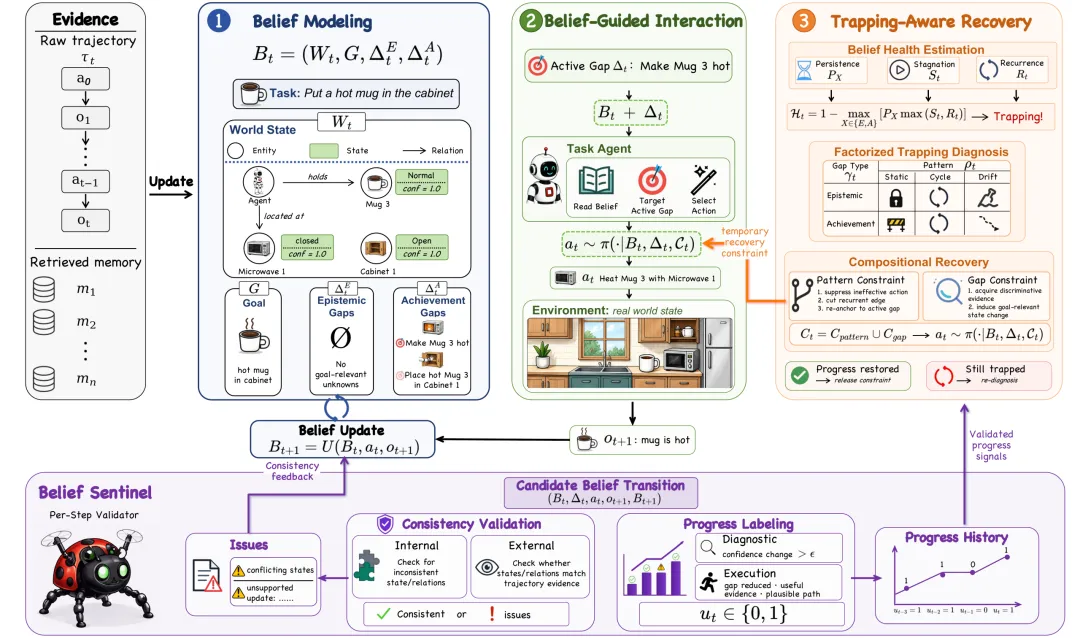
Figure 2: Overall PoS workflow. The left side constructs the current world and unresolved requirements; the center selects actions around the Active Gap; the Belief Sentinel at the bottom checks updates and records progress; and the right side generates temporary recovery constraints when trapping occurs.
Explicitly recording state introduces another problem: that state is itself generated by a model. If an incorrect judgment is written into it, subsequent decisions may continue to unfold from a false premise.
Therefore, after an action returns a new observation, PoS first generates a candidate update and submits it to the Belief Sentinel for checking. The Sentinel primarily verifies two things: whether the update is internally consistent and whether it is supported by interaction evidence. For example, the same microwave cannot simultaneously be recorded as open and closed, and merely observing the cup being placed in the microwave is insufficient to record "heated" as an established fact.
When a problem is found, the agent revises the update using the evidence, and only a validated state enters subsequent decision-making. In the public implementation, if the repaired update still fails validation, the previously committed state is retained. This also provides a prerequisite for trapping detection: first verify whether the state change is credible, then determine whether these changes constitute progress.
However, internal consistency and compatibility with observations do not mean that the task is necessarily advancing. An agent may accurately remember that "the cup is still not hot" and then continue checking the cabinet. Detecting Belief Trapping requires shifting attention from a single correctly recorded state to changes in belief over a period of time.
Repeated actions alone cannot establish that an agent is trapped. Multiple calls to the same tool may be gathering different evidence; conversely, using a different tool at every step may still avoid the key issue. PoS therefore asks whether, while unresolved requirements persist, validated beliefs continue to change in ways that help the task.
It first labels progress for each state transition, then examines three signals over the latest K validated transitions. For execution tasks, single-step progress includes narrowing the current gap, obtaining necessary information, or advancing a plausible completion path. For diagnostic tasks, it checks whether confidence in a relevant inference changes by more than a threshold. A decrease in confidence may indicate that an incorrect explanation has been ruled out, so it also counts as change.
| Signal | What It Measures | Design Rationale |
|---|---|---|
| Gap Persistence Px | Among the gaps present at the start of the window, the proportion that remained unresolved throughout; Epistemic Gaps and Achievement Gaps are counted separately | Confirms which task requirements remain persistently blocked; however, "not yet completed" alone does not indicate trapping and must be combined with progress information |
| Progress Stagnation St | The proportion of transitions within the window that recorded no effective progress | Identifies continued action without advancement, even when a different action is taken at each step |
| Belief Repetition Rt | Compares historical belief states around the same current gap and takes the highest repetition rate across different time intervals | Captures cycles that return to previous states, supplementing overall lack of progress that single-step progress labels may miss |
Based on these three complementary signals, PoS constructs an interpretable heuristic metric—Belief Health:

Here, E and A denote Epistemic Gaps and Achievement Gaps, respectively; the lower the health score, the stronger the trapping signal. The combination follows this principle: a strong trapping signal emerges when persistently unresolved requirements coincide with stalled progress or repeated beliefs. The inner max preserves the stronger anomaly between stagnation and repetition, preventing an obvious signal from being diluted by a weaker one; multiplication by gap persistence associates the anomaly with a long-unresolved requirement; and the outer max focuses on whichever gap type is more severely blocked. Thus, an unfinished task alone does not trigger a trapping judgment, while positive progress labels on some individual steps cannot conceal a persistent state cycle.
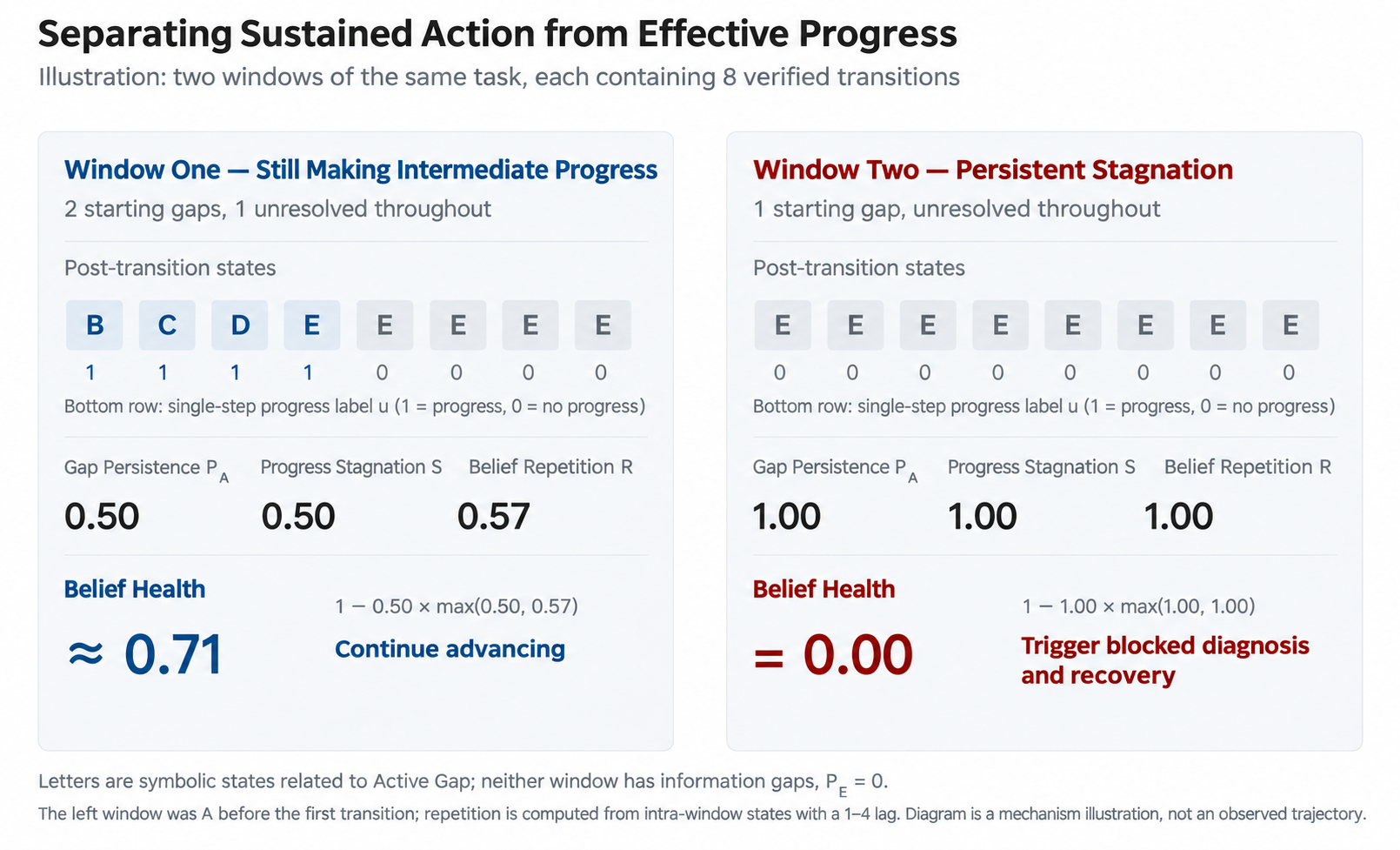
Figure 3: Illustration of health at different stages of the same task. The earlier window still contains intermediate progress; the later window contains only persistently unresolved requirements and repeated states.
The paper begins detection after eight validated transitions have accumulated. When Belief Health Hₜ ≤ 0.25, trapping diagnosis begins.
Health answers "whether intervention is needed." The recovery mechanism must also answer "which behavior should change, and what progress should be restored." PoS divides the diagnosis along two dimensions.
The first dimension is the behavioral pattern. Static means the local world state remains unchanged; Cycle means periodically looping among previously encountered states; and Drift means the world state changes, but the part relevant to the current gap does not advance. Classification follows that order, with generic recovery used when no specific pattern matches.
The second dimension is the type of blocked gap. PoS compares the persistence of nonempty Epistemic and Achievement Gaps and selects the more stubborn category: the former requires new evidence that distinguishes among explanations, while the latter requires an actual change in task state. The same apparent "stagnation in place" may call either for a different investigative direction or for finally executing an action that has repeatedly been omitted.

In the formula,  denotes the trapping pattern,
 denotes the detection window, X is the blocked gap type, and Bt and Δt are the current belief and the Active Gap, respectively. The two groups of constraints work together: pattern constraints break ineffective behavior, while gap constraints specify the progress that the next step must restore.
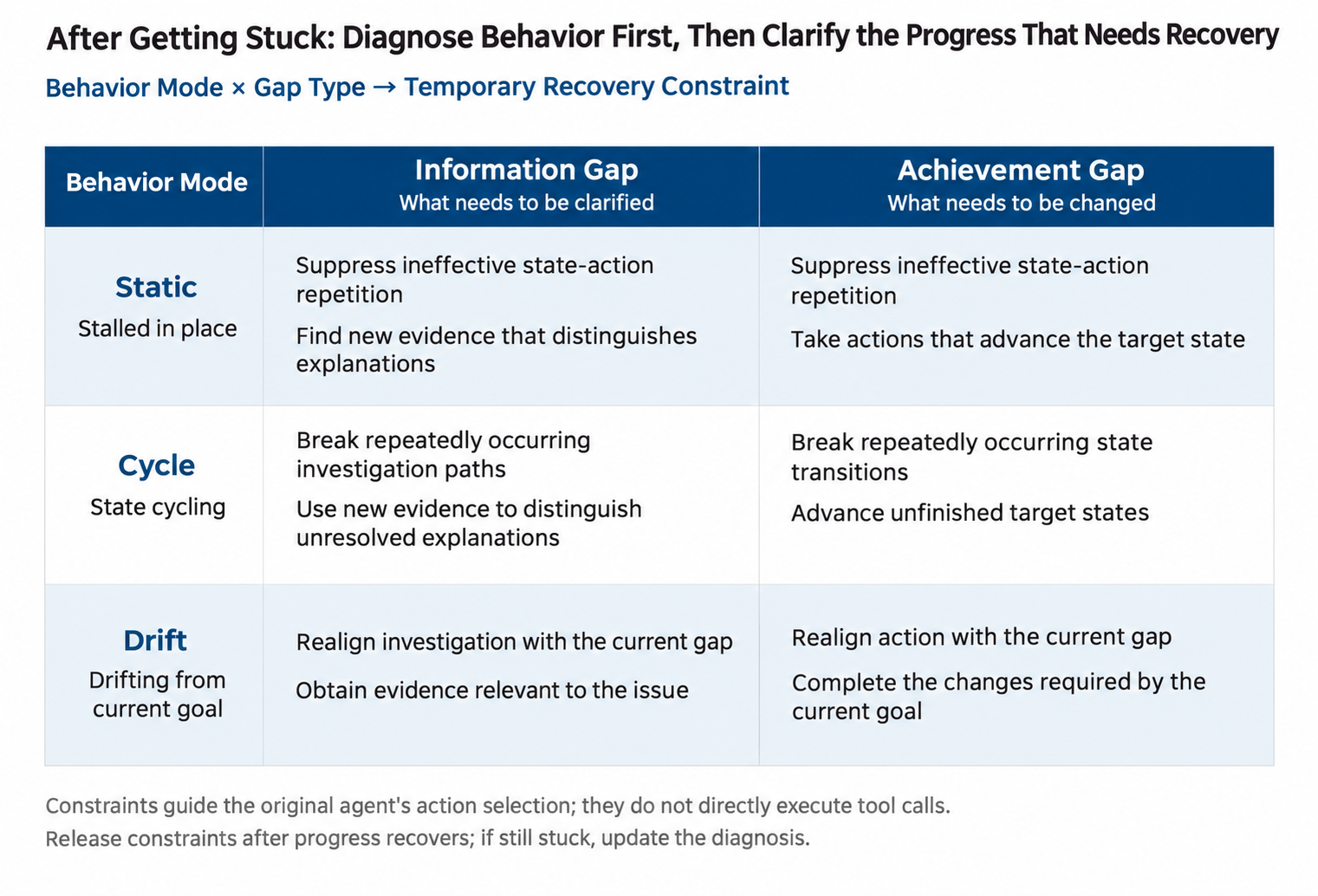
Figure 4: Trapping diagnosis considers both behavioral pattern and gap type. Each cell combines "how to break the current behavioral pattern" with "which kind of progress must be restored," forming constraints on the next action.
Accordingly, for Static trapping, the constraints suppress ineffective state–action repetition; for Cycle, they break repeated transitions; and for Drift, they realign behavior with the Active Gap. They must also be paired with another requirement: obtain discriminative evidence or produce a goal-relevant state change. In the cup task, merely telling the agent "stop checking the cabinet" is insufficient; subsequent actions must also advance the unmet requirement that "the cup becomes hot."

Recovery constraints are supplied to the original agent as additional conditions, and it continues selecting actions while the current Active Gap remains unchanged. After each new transition is validated, the system recalculates health: if it rises above the threshold, the temporary constraints are released; if the agent remains trapped, the diagnosis and constraints are updated. Trapping detection, constraint generation, and post-recovery reassessment together form a continuous feedback loop.
RCA-100 case t024 in the paper demonstrates this process. The Kimi-K3 agent had discovered that slow requests from the inventory service coincided with increased garbage-collection activity, but could not distinguish database waiting from internal JVM processing. PoS identifies "Static + Epistemic Gap" and requires the agent to stop ineffective repetition and seek evidence that can distinguish the two explanations.
The agent then chooses to inspect CPU activity. Recovery still includes three low-progress actions, after which the CPU evidence, together with the existing garbage-collection observations, prompts a belief revision. The run executes 28 actions in total, and its final submission, inventory/memoryPressure, matches both the fault entity and type in the benchmark annotation.
The research team evaluates PoS on two types of tasks. ALFWorld and LOCA-Bench require agents to complete goals through multiple rounds of operations, while RCA-100 and ClinDiag require agents to continually acquire evidence and diagnose faults or medical conditions. The four benchmarks evaluate 134, 525, 103, and 604 cases, respectively; the overall LOCA-Bench result aggregates seven environment-description lengths.
The experiments use Qwen3.7-Plus, Kimi-K3, and GLM-5.3. For each base model, the same model powers PoS execution, belief maintenance, and validation. Comparison methods include full trajectories, ACON, PACE, HiAgent, and LongHorizon-Harness, which explicitly maintains task state. PoS requires no base-model parameter updates for these tasks.
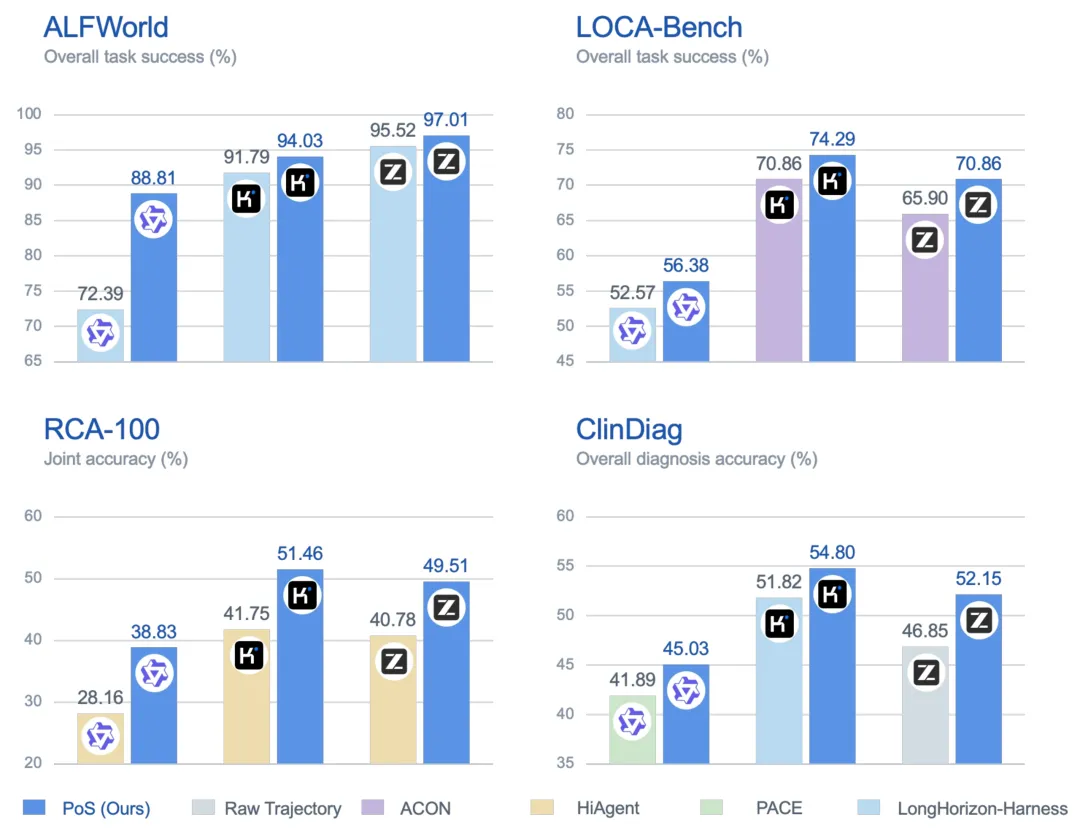
Figure 5: Four-benchmark comparison on the left side of the paper's teaser. Each group shows the strongest baseline and PoS under the same base model; the icons correspond, in order, to Qwen3.7-Plus, Kimi-K3, and GLM-5.3. ALFWorld and LOCA-Bench report task success rate, RCA-100 reports joint accuracy for fault type and entity, and ClinDiag reports diagnostic accuracy. The panels use different y-axis ranges; exact values are labeled above the bars.
PoS achieves the highest overall metric among the compared methods in all 12 "benchmark × model" settings. With Qwen3.7-Plus, for example, ALFWorld rises from 72.39% for the strongest baseline to 88.81%, an increase of 16.42 percentage points and a relative gain of 22.68%; RCA-100 joint accuracy rises from 28.16% to 38.83%, an increase of 10.67 percentage points and a relative gain of 37.89%.
These results cover both task structures: "changing the world as the goal requires" and "gradually clarifying a judgment through evidence." Further ablations and recovery comparisons examine the respective contributions of continuous state validation, trapping detection, and targeted constraints.
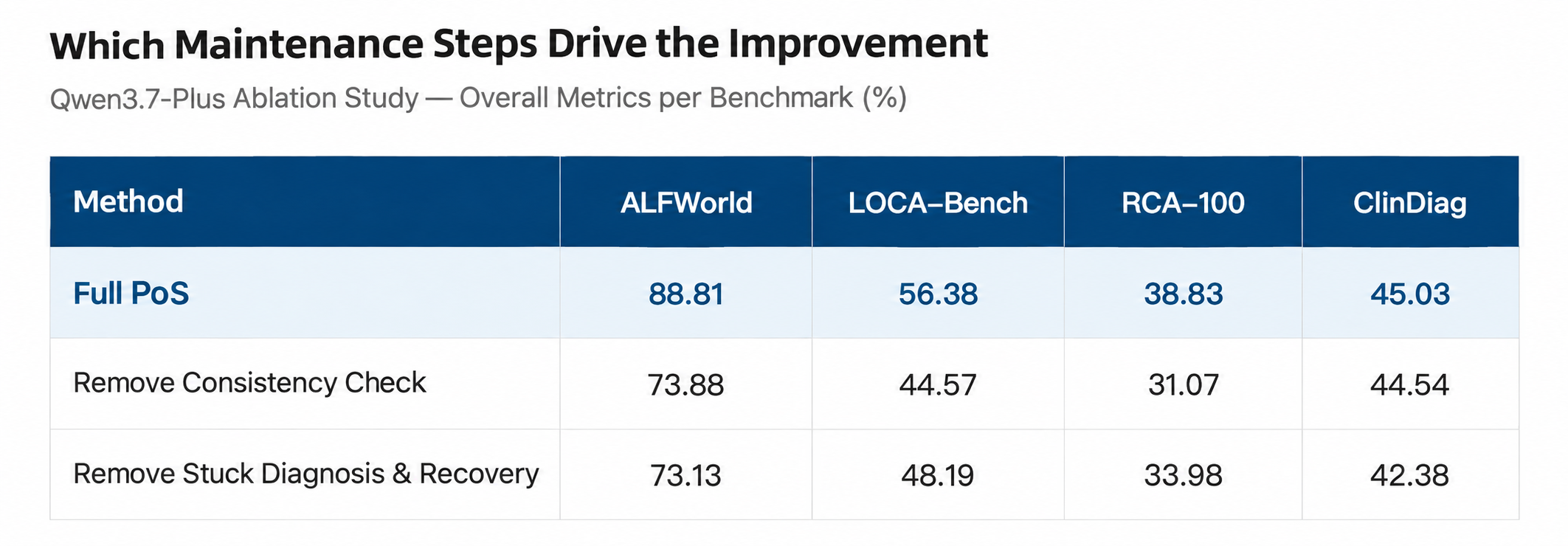
Table 1: Ablations of consistency validation and trapping diagnosis/recovery with Qwen3.7-Plus. Values are overall benchmark metrics in percent. Removing either consistency validation or trapping diagnosis and its recovery reduces performance on all four benchmarks.
With Qwen3.7-Plus, removing consistency validation lowers ALFWorld from 88.81% to 73.88% and LOCA-Bench from 56.38% to 44.57%. Execution tasks require frequent coordination between environmental changes and new observations; these results show that reliable state updates are especially important for such tasks.
After trapping diagnosis and recovery are removed, Qwen3.7-Plus joint accuracy on RCA-100 falls from 38.83% to 33.98%; across the three models, the decline on this benchmark ranges from 4.85 to 6.79 percentage points. Validation helps the agent maintain an evidence-grounded understanding, while recovery redirects actions toward unresolved requirements when the current line of investigation is no longer effective.
The form of recovery also matters. The paper retains trapping detection but replaces specific recovery constraints with a generic "please try to recover" prompt. Across all four benchmarks with Qwen3.7-Plus, targeted PoS recovery achieves higher final task metrics.
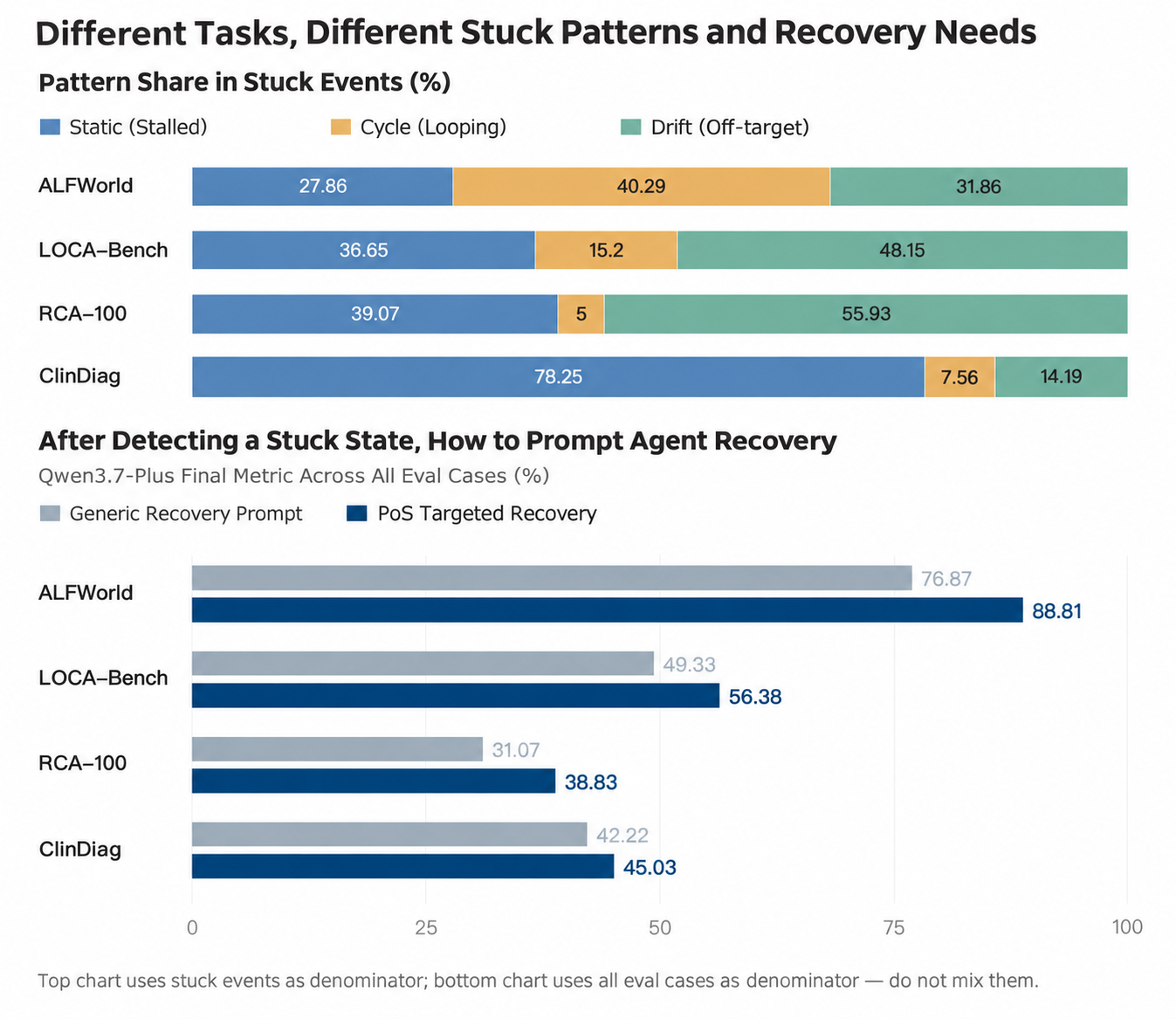
Figure 6: Trapping patterns and recovery effectiveness across tasks. The upper chart shows the share of each pattern among detected trapping events; the lower chart compares final task metrics over all evaluation cases when Qwen3.7-Plus uses a generic recovery prompt versus targeted PoS recovery.
This targeting corresponds to task differences: Cycle is the most common trapping event in ALFWorld; Drift away from the current goal accounts for 55.93% in RCA-100; and Static stagnation accounts for 78.25% in ClinDiag. Merely telling the agent to "try another approach" may not identify which behavior must change or what must be filled in.
LOCA-Bench also provides a stress test: environment descriptions expand from 8K to 256K tokens to assess whether agents can complete tasks in longer contexts. Performance generally declines across methods as length increases. PoS remains relatively stable from 96K to 256K; at 256K, the three models outperform the strongest baseline in the same setting by 10.67 to 16.00 percentage points.
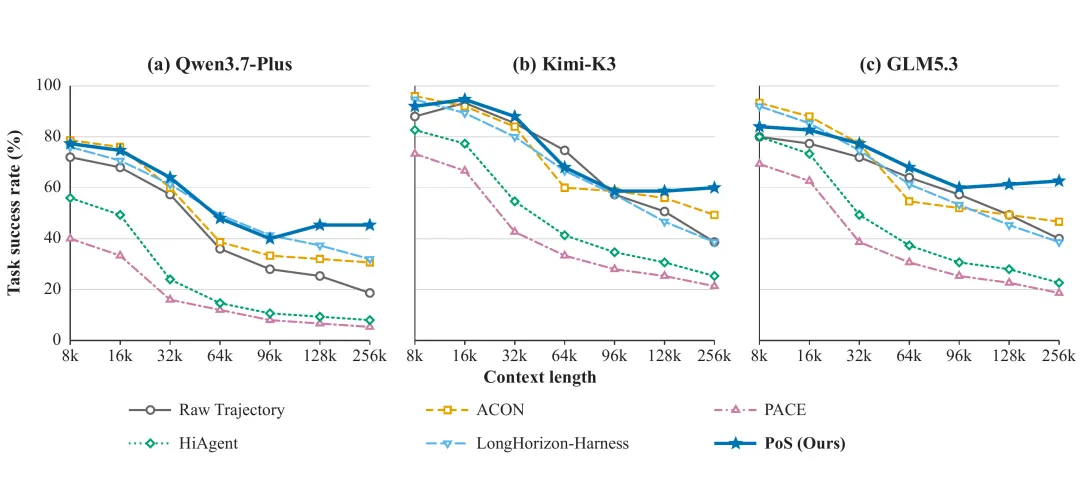
Figure 7: Task success rate on LOCA-Bench as environment descriptions grow from 8K to 256K. The blue solid line represents PoS; the x-axis shows environment-description length (8K–256K).
This result is consistent with the PoS design: each new observation updates the existing task state, allowing subsequent decisions to focus on current conditions and reducing the need to repeatedly reconstruct task state from a long history. As background information grows, continually maintaining which information still affects current decisions becomes increasingly important.
PoS devotes additional inference compute to belief construction, updating, and validation. Under the RCA-100/Qwen3.7-Plus setting, the paper measures average total input and output tokens per case, revealing the practical cost of this investment.
| Method | Joint accuracy | Task Agent tokens | Total method tokens |
|---|---|---|---|
| Raw Trajectory | 24.27% | 355.70K | 355.70K |
| PoS | 38.83% | 281.20K | 1,800.13K |
Table 2: Average overhead across 103 RCA-100 cases. The execution agent corresponds to the Task Agent; the method total also includes belief construction and the Sentinel, and K denotes thousands of tokens.
Under the RCA-100/Qwen3.7-Plus setting, PoS raises joint accuracy from 24.27% for the Raw Trajectory baseline to 38.83%, while total method-level token consumption reaches 5.06 times that of the baseline. Token consumption by the execution agent itself decreases by approximately 20.9%; the additional overhead comes from belief maintenance and the Sentinel. In this experiment, PoS reflects the trade-off between higher diagnostic accuracy and additional inference investment.
PoS still depends on the base model's ability to understand evidence. Belief Health identifies stalled progress; it does not directly verify the final answer. Even a state that is internally consistent and compatible with available observations may contain incorrect judgments caused by insufficient domain knowledge. The paper discusses two future directions: using a more compact latent world-state representation to reduce the cost of repeatedly generating text, and introducing domain-knowledge retrieval into state updates to help the model interpret specialized evidence.
Returning to the opening cup task, 36 ineffective checks expose the problem clearly: while the agent is still acting, the system must be able to determine whether progress has stopped. PoS formalizes Belief Trapping as a state that requires detection and intervention, uses explicit beliefs as the observational basis, identifies stagnation through health, and directs recovery constraints toward the truly unresolved requirement.
The PoS code is open source, providing the complete framework, a Raw Trajectory baseline, two ablation configurations, method documentation, and a reproduction guide. The project page also offers interactive demonstrations of progress monitoring, trapping recovery, and execution cases.
The first author of this paper, Luo Yu, is a second-year PhD student in the AIOps research group at Nankai University, supervised by Associate Professor Sun Yongqian, and currently works as an algorithm intern at Alibaba Cloud. His research focuses on belief states and active inference in long-horizon, multi-turn interactions, as well as self-evolving agents, combining large model reasoning, memory, retrieval augmentation, and reinforcement learning to build collaborative multi-agent systems. He has published 10 papers at conferences and journals including ICML, EMNLP, KDD, ASE, and TOSEM; representative works include Graph of States (ICML 2026) and OpsAgent (ASE 2026).
The corresponding author of this paper, Sun Yongqian, is an Associate Professor and PhD supervisor at the College of Software, Nankai University. He has long worked on intelligent operations (AIOps) research, focusing on failure mechanisms in scenarios such as cloud-native environments, data centers, supercomputing, and AI computing, while also conducting research on multi-agent collaboration and large model inference optimization to advance intelligent decision-making for complex systems.
No More Manual Index Maintenance: SLS Automatically Indexes New Log Fields for Search and Analysis

807 posts | 61 followers
FollowAlibaba Cloud Native Community - October 12, 2026
ApsaraDB - July 23, 2026
Alibaba Cloud Indonesia - July 3, 2026
Alibaba Cloud Community - October 19, 2026
Hesey - December 30, 2019
Alibaba Cloud Native Community - November 6, 2026
807 posts | 61 followers
Follow Token Plan
Build more, spend less. One plan, every modality.
Learn More QwenWork
 is dedicated to helping employees strengthen their professional competitiveness in the AI era and to enabling enterprises to improve organizational effectiveness.
Learn More DeepSeek
-V4.1-Flash is the lightweight flagship of DeepSeek's new architecture family, packing 552B total MoE parameters to deliver flagship-surpassing intelligence across key benchmarks.
Learn More AgentCore
 unifies agent construction, governance, and execution capabilities so enterprises can deploy diverse agents with confidence.
Learn MoreMore Posts by Alibaba Cloud Native Community

