At the 2026 Apsara Conference, Alibaba Cloud Simple Log Service (SLS) announced a major upgrade. On a real-time data foundation that it keeps strengthening, SLS introduced three new Agent-native capabilities: SLS SessionStore for Agent operational data objects; the SLS semantic layer for business context; and, for Agent-native interfaces, the SLS MCP (Model Context Protocol) Server and an orchestration-ready Skills framework. SLS also launched SLS DataAgent, a conversational Agent built for business users. Building on its service to developers, operations staff, and business users, SLS now also supplies real-time data, business context, and standardized tools to Agents, evolving into an intelligent data engine that serves both people and Agents.
As Agents move into production systems, the relationship between applications and data is changing. In traditional applications, the users are people and deterministic programs that work through a console or an API; behavior follows fixed workflows with predictable outcomes, and data takes the form of single-line logs, metrics, and trace spans. In Agent applications, the user becomes an Agent that continuously reads data and calls tools; behavior becomes multi-step decision-making and execution, and data expands into sessions and trajectories. An Agent is both a new consumer and a new producer of data, generating operational facts as it uses that data. The value of Agent data also shifts from invocation records to an understanding of the task: the scope extends from the request of a single call to sessions and trajectories that span multiple rounds, models, and tools, reconstructing how a complete task was executed; the depth extends from technical events such as fields, status codes, and response results to business objects, relationships, and rule definitions, as well as task goals, process status, and judgment evidence.
For the Agent era, an intelligent data engine needs four core characteristics: efficient real-time performance, Agent data objects, business semantic context, and Agent-native interfaces. To deliver them, SLS keeps upgrading its real-time data foundation across four stages: real-time ingestion, unified storage and indexing, real-time analysis and computing, and real-time processing. The foundation is real-time, unified, correlatable, and verifiable, and carries general observability data such as logs, metrics, traces, and events; Agent operational data such as messages, tool calls, and steps; and business data such as users, orders, and assets. The new Agent-native capabilities let SLS better supply Agents with trustworthy, understandable data — SLS SessionStore for session-level data organization, the SLS semantic layer for business semantics, and SLS DataAgent for business analysis — and let Agents use SLS more easily and safely, through the SLS MCP Server and a Skills framework for orchestration.
To supply Agents with trustworthy data, SLS first needs to organize how Agents run. Until now, Agent reasoning, model calls, and tool calls have been scattered across traces and logs, with inconsistent fields and events that are hard to pair. A complete task is difficult to reconstruct, let alone evaluate and reuse. The new SLS SessionStore organizes Agent data at the session level. Once an Agent's raw process data is ingested, the system automatically normalizes fields, pairs events, and reconstructs the task process, consolidating it into reusable session fact assets for the first time.
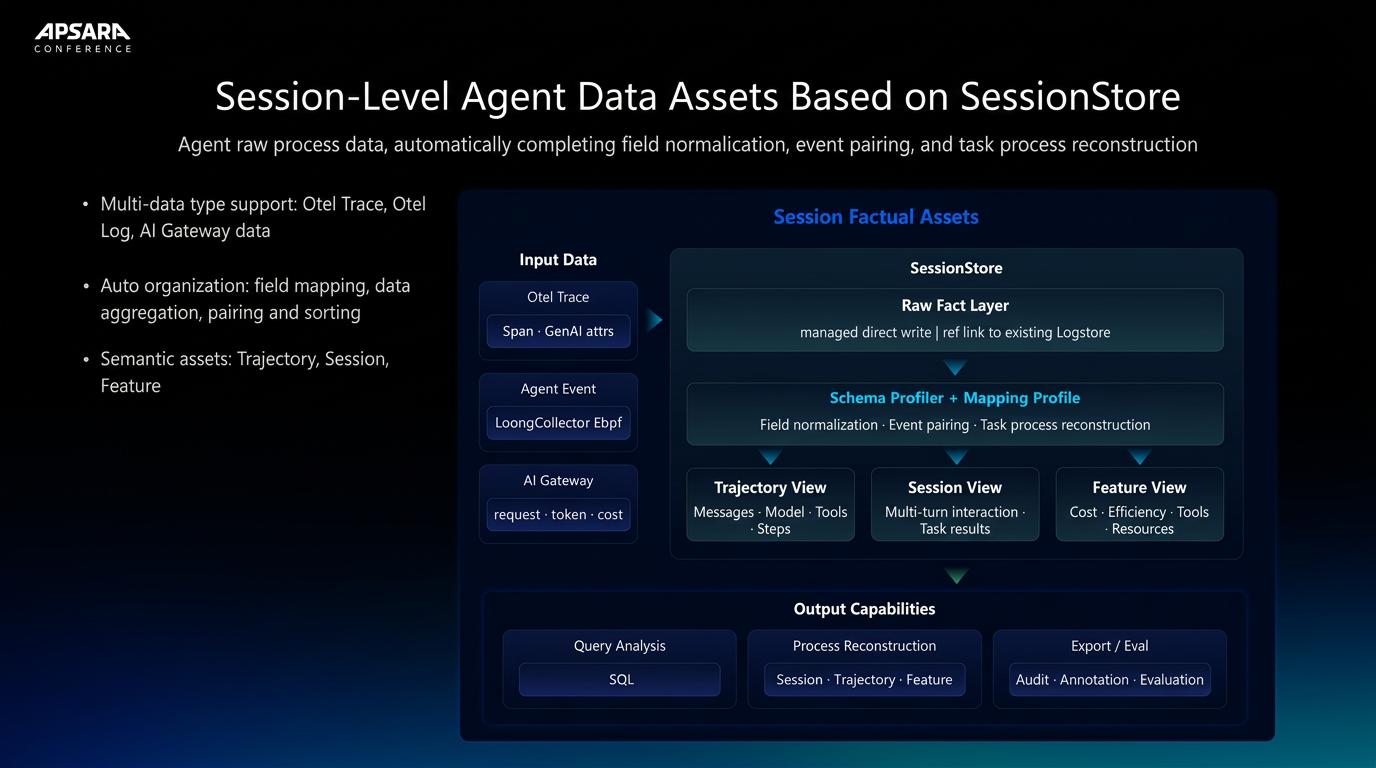
For data organization, SessionStore has a raw fact layer at the bottom that supports two approaches: managed direct write and Ref association with existing LogStores. In the middle, the schema profiler and the mapping profile normalize fields, pair events, and reconstruct the task process. At the top it outputs three semantic views: a trajectory view that reconstructs messages, models, tools, and steps; a session view that shows multi-round interactions and task results; and a feature view that characterizes cost, efficiency, tools, and resources. SessionStore supports multiple data types, including OpenTelemetry (OTel) traces, OTel logs, and LLM Gateway logs. It automatically maps, pairs, and sorts fields, and uses SQL to query, analyze, and reconstruct sessions, trajectories, and raw data, supporting scenarios such as observability, auditing, annotation, and evaluation. Compared with assembling session data from raw traces by hand, SessionStore stands out for zero modification and automation. Existing LogStores can be brought in through Ref association without migration. Field normalization and event pairing happen automatically, and a single pass of organization supports multiple views at once for troubleshooting, evaluation, and cost analysis.
This ensures that every Agent execution is reconstructed into a data asset that can be reviewed, evaluated, and reused, giving downstream observability analysis, quality evaluation, and continuous optimization directly consumable input — without reconstructing the task from raw traces every time.
Organized data is just the starting point; Agents also need to understand what it means for the business. A general Agent can read fields and values, but it cannot tell what those fields represent in a specific business, which definition a metric should use, or where to set an anomaly threshold. Its answers are therefore prone to drift, and definitions tend to diverge from one place to another. The new SLS semantic layer closes this gap. It automatically extracts a Source Model from operational data and organizes unified semantics by business domain, forming a complete path from SLS data assets through the Source Model and the Context Model to accurate Agent responses.
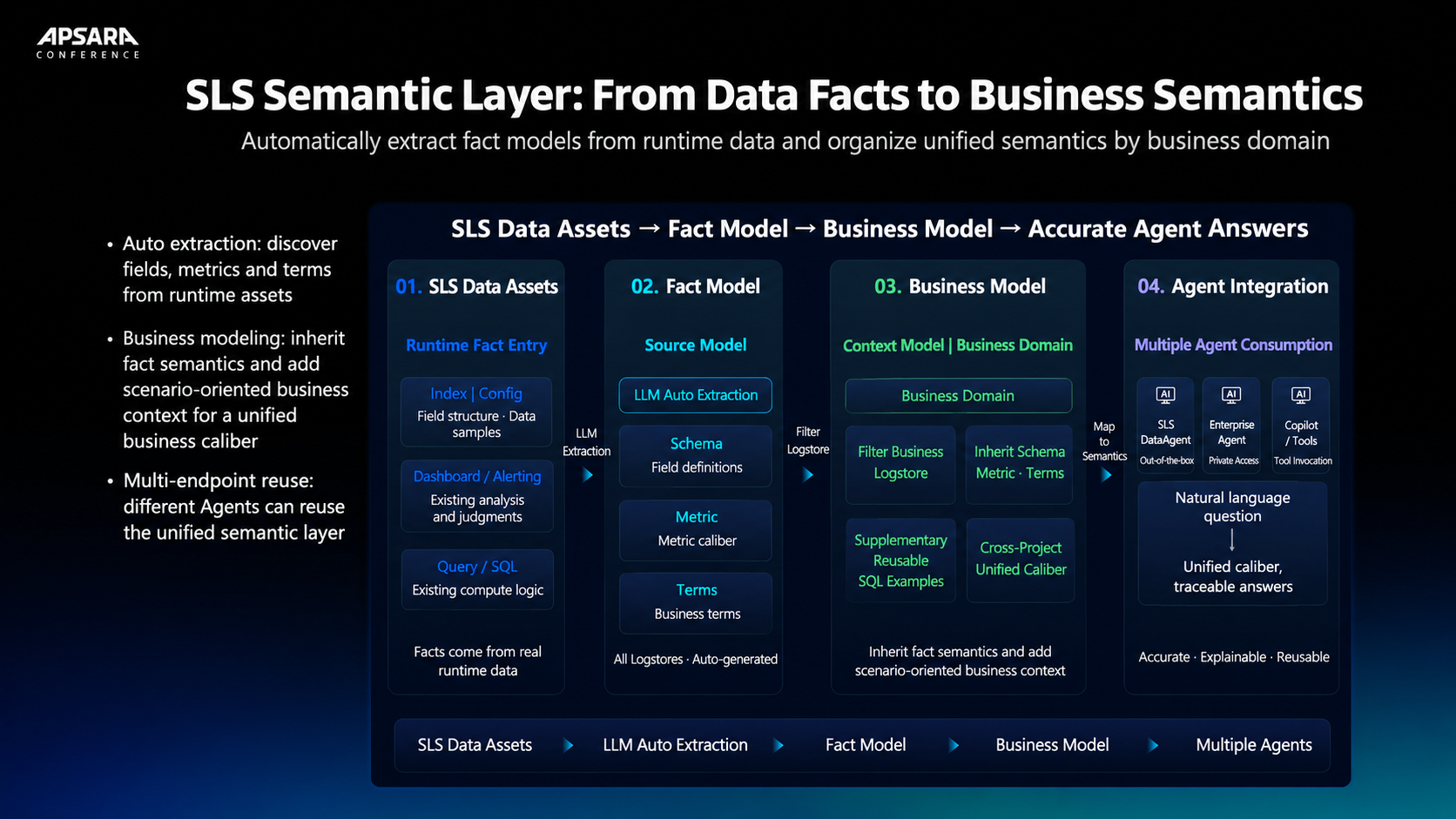
The path has four steps. First comes the operational fact entry point, which automatically discovers fields, metrics, and terms from SLS data assets, including existing analytical assets such as index configurations, dashboards and alerts, and Scheduled SQL. Second comes the Source Model, where LLMs automatically extract the schema (field definitions), metrics (metric calculation definitions), and terms (business terminology) of every LogStore. Third comes the Context Model, which selects LogStores by business domain, inherits the fact semantics, and adds scenario-specific business context to unify business definitions across projects. Fourth comes Agent integration: SLS DataAgent works out of the box, enterprise-owned Agents connect through APIs, and copilots and tools consume the layer through tool calls. The semantic layer stands out for automation and reuse. The Source Model is extracted automatically by LLMs from real operational data, so nothing has to be defined field by field. The Context Model inherits the fact semantics and adds scenario context, so one modeling effort can be consumed by multiple Agents.
Enterprises do not need to maintain a separate set of business definitions for every Agent. The same question gets a consistent, explainable, traceable, and accurate answer in SLS DataAgent, in enterprise-owned Agents, and in third-party tools.
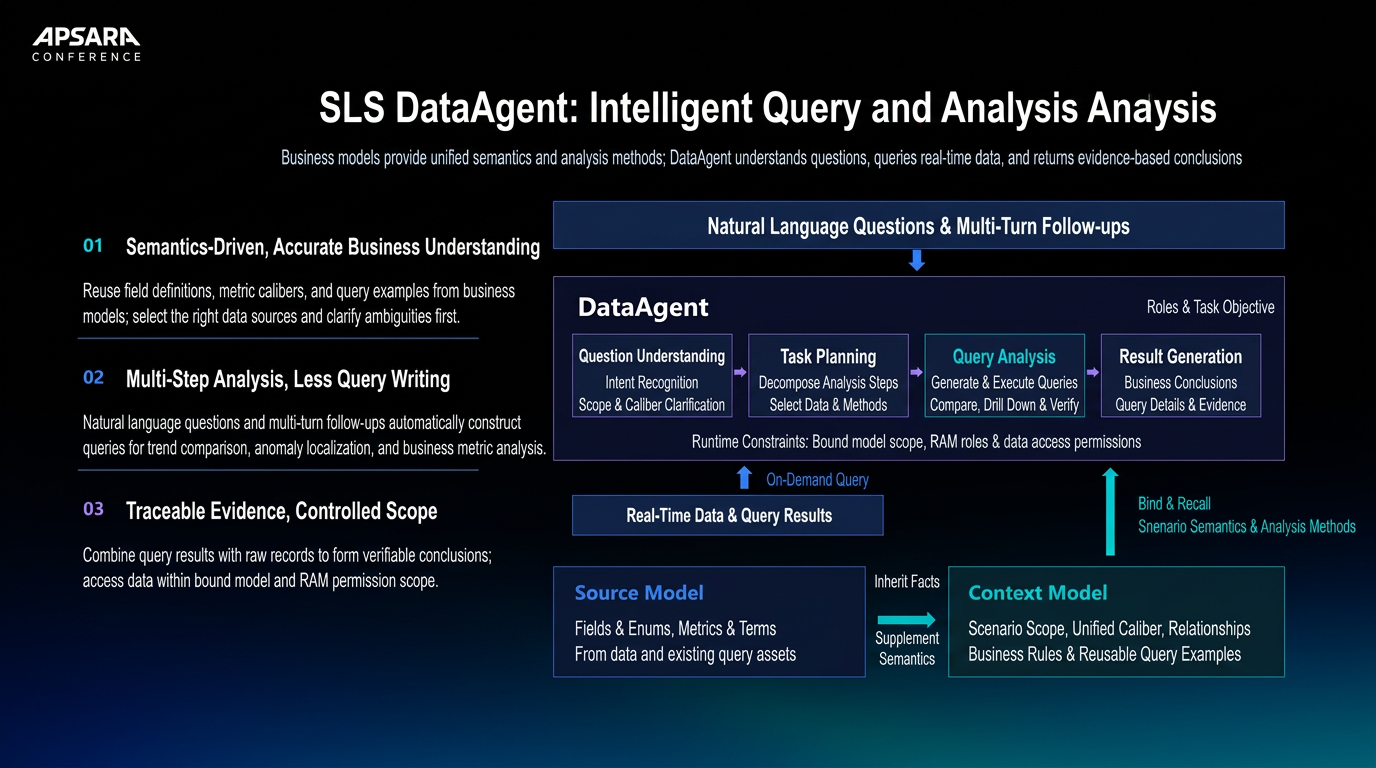
On top of the semantic layer, SLS DataAgent, launched at the same time, turns SLS's supply-side capabilities directly into analytical conclusions for business users. It offers conversational data query and analysis for business users, runs on SLS real-time operational data, is supported by the Context Model, and operates within enterprise governance. It converts natural language questions into query plans, analysis results, and verifiable conclusions.
DataAgent's differentiator is that it is data-native. General Agents reason well, but when they face enterprise operational data they often cannot judge on their own what a field means in a specific business, which definition a metric uses, how services and resources relate to the business, or what counts as an anomaly. What they lack is not the model but the context. DataAgent grows where the data is generated, turning continuously changing operational data into understandable, trustworthy, real-time context.
Take a game customer service scenario. A player asks, “Why hasn't my top-up arrived?” If an Agent queries the raw logs directly, it faces fragmented fields such as pay_status=success, deliver_status=failed, error_code=BAG_FULL, and item_id=WPN_LEG_001. Correlating across LogStores is complex and business definitions are inconsistent, so the Agent can give only a tentative answer: the delivery may have failed, and neither the cause nor whether a reissue is possible is clear. DataAgent instead queries through the SLS semantic layer, where BAG_FULL has already been translated as “backpack full” and WPN_LEG_001 as “Sky-Rending Blade”. DataAgent can therefore return an evidence-backed business conclusion: payment succeeded, but delivery failed because the player's backpack is full, and once the player frees up space, delivery can be retried according to the rules. By adding business translation between real data and the Agent, the SLS semantic layer turns field values into explainable business conclusions.
Structurally, DataAgent rests on three layers. The perception foundation is rooted in SLS real-time operational data and covers logs, metrics, traces, events, alerts, and resource status. The understanding hub binds to the Context Model to read entities, metric definitions, relationships, anomalies, and verified analysis paths. The action runtime executes tasks within governance, supporting multi-source triggers, dynamic context assembly, tool calls, and tiered auditing. Actions come in three tiers: analysis and suggestions only, execution after human confirmation, and automatic execution under explicit rules and permissions. The Context Model is not a static, one-time artifact: user confirmations, corrections, new queries, and remediation experience keep flowing into context evidence, which after validation and governance incrementally updates the model, so DataAgent becomes more accurate the more it is used. In business scenarios, a DataAgent bound to the relevant context model can continuously report business progress, explain trends, surface opportunities, and flag risks, and can be reused as a shared capability by marketing Agents, operations copilots, and business workflows.
The SLS real-time data foundation and its new Agent-native capabilities also support agentic applications above it. AgentLoop builds an enterprise Agent quality evaluation and tuning loop on SLS. It ingests Agent operational logs and traces through collection agents (probes) or OpenTelemetry, and SLS handles real-time storage, data transformation, and query and analysis. With SessionStore organizing sessions and reasoning trajectories, AgentLoop keeps accumulating reusable operational data assets and forms a closed loop of observability, evaluation, experimentation, and continuous optimization that covers agentic applications in coding, IT operations, customer service, gaming, and more.
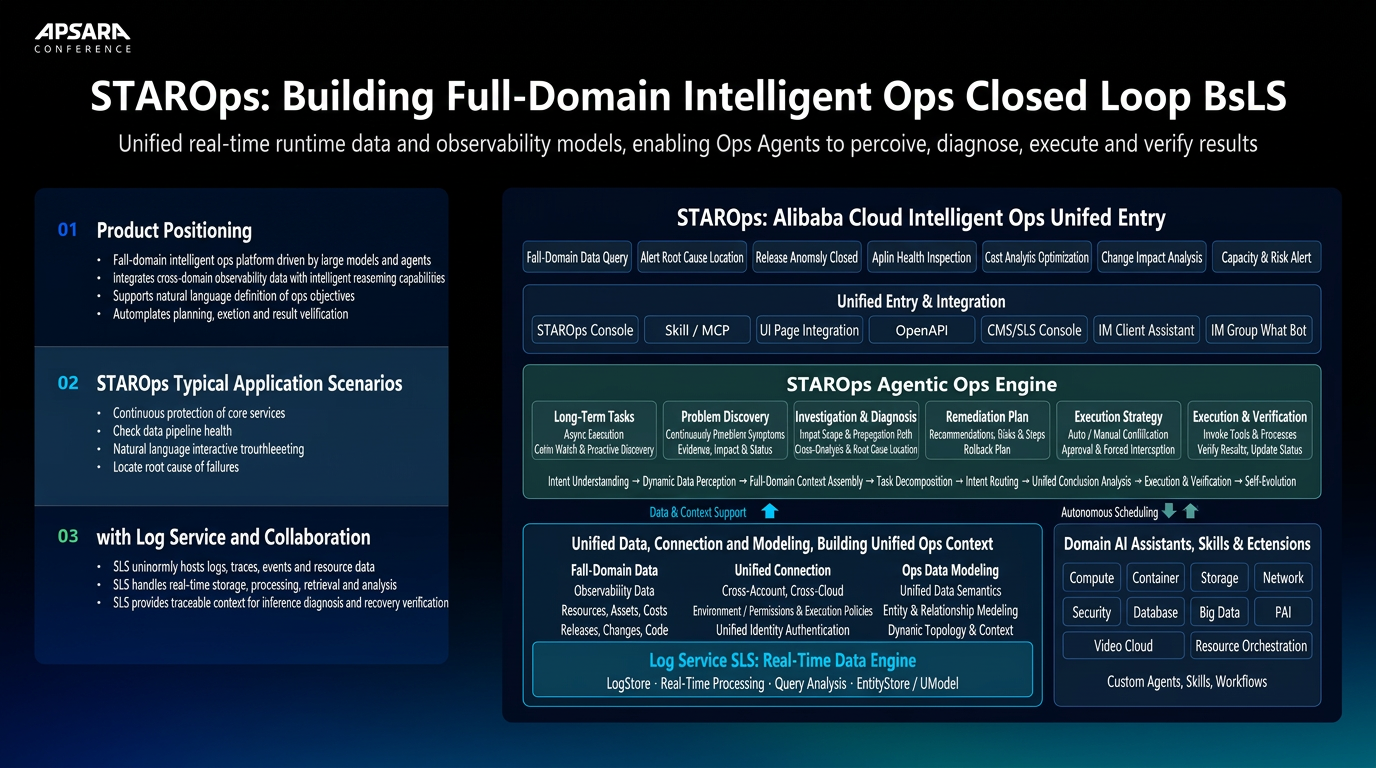
On SLS, STAROps builds a closed loop for full-domain AIOps (artificial intelligence for IT operations). SLS provides the real-time operational data along with the query and analysis that STAROps needs, carrying logs, traces, events, and changes in one place for real-time storage, transformation, and retrieval. UModel then organizes entities, relationship topologies, and data associations to provide traceable context for inference-based diagnosis and recovery validation, supporting natural language queries, alert root cause analysis, change impact analysis, and cross-product fault localization.
For upper-layer applications, SLS provides ready-to-use real-time data along with query and analysis. Neither AgentLoop nor STAROps has to build its own data pipeline; each can focus on evaluation and operations logic. That is why one foundation can support both the quality loop and the operations loop.
Beyond powering agentic applications above it, SLS also exposes its capabilities to a wider range of Agents through standard protocols. In the past, calling SLS from an Agent required building an OpenAPI wrapper, managing AccessKeys, and dealing with regions and permissions, which meant a high integration barrier and a real risk of key leakage. The new SLS MCP Server lets Agents use SLS securely through a standard protocol and passwordless OAuth. It logs in with OAuth, runs a local proxy, calls SLS OpenAPI with OAuth credentials on the user's behalf, and controls permissions with Resource Access Management (RAM), so no one has to enter an AccessKey. Sensitive configuration is masked automatically, and the region is matched on access, removing regional restrictions. The MCP Server provides three categories of standard capabilities: resource discovery, log analysis, and alert diagnostics. Compared with wrapping OpenAPI yourself, its advantages are security and zero modification. With OAuth delegated calls, RAM-based permissions, and sensitive configuration masked, any Agent that supports MCP can call SLS securely within its permission boundary without managing keys or changing its integration logic. For developers, integration work that used to be tedious now comes down to a single standard protocol connection.
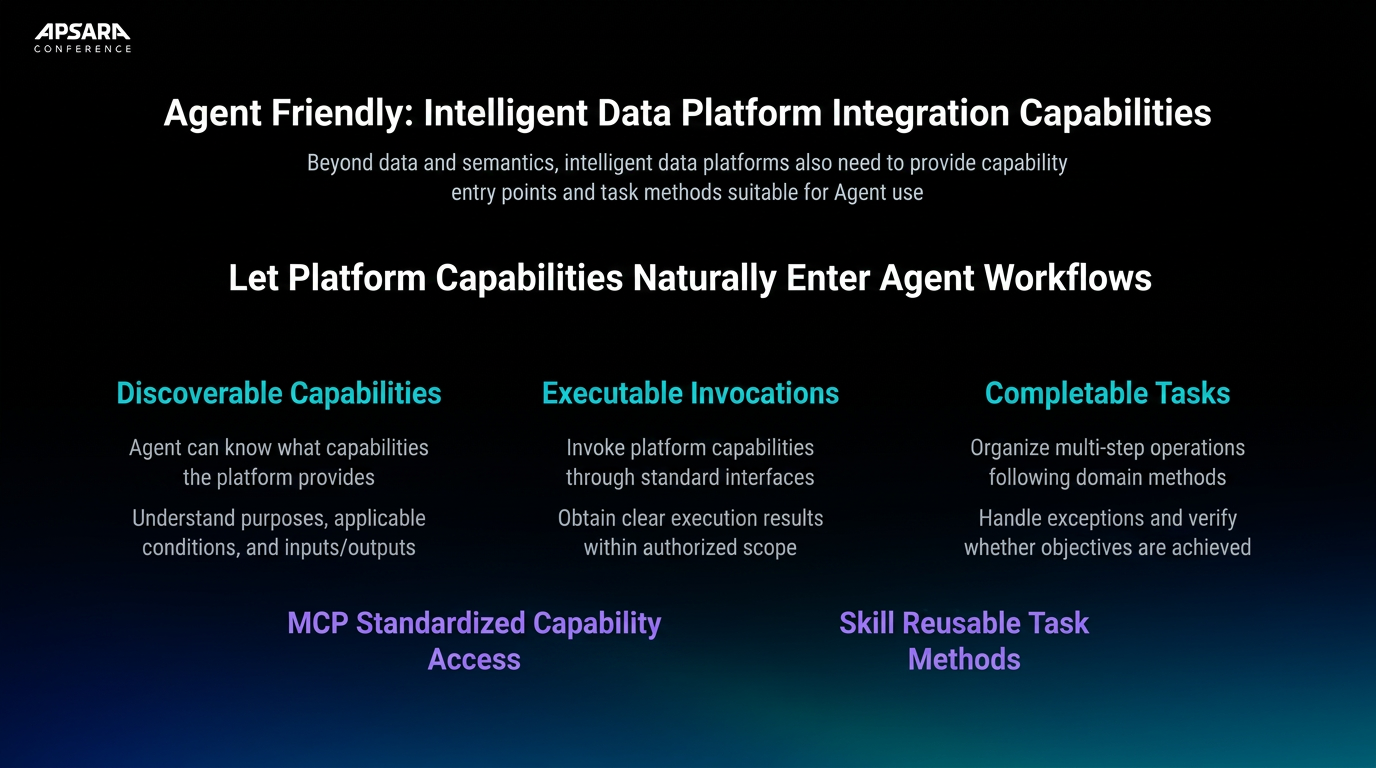
On top of MCP, SLS also released an orchestration-ready Skills framework. One orchestration Skill (alibabacloud-sls-agent-workflow) serves as the entry point, handling intent recognition, flow orchestration, security gating, and evidence consolidation. It links several specialized Skills that execute in their own domains: LoongCollector collection and operations, index configuration management, query and analysis, intelligent analysis, and SDK guidance. Rather than letting an Agent feel its way through every operation, the Skills framework turns expert experience into standard workflows that can be orchestrated. Users describe a goal in natural language. The orchestration Skill keeps breaking the task down, and each specialized Skill executes in its domain and returns status, evidence, and resource results, ultimately turning the user's goal into an executable, confirmable, and verifiable task.
From a real-time data foundation that keeps evolving to the Agent-native capabilities released in this upgrade, SLS has completed a key upgrade for the Agent era. First, the new SessionStore makes Agent operational data organizable and reconstructable; the new semantic layer makes data facts understandable to the business; and the new DataAgent lets business users go from natural language questions straight to verifiable conclusions. Second, the new MCP Server and Skills framework let Agents call SLS securely through standard protocols. Agentic applications such as AgentLoop and STAROps are built on the same foundation. When every piece of operational data has an intelligent Agent that understands it, enterprises building an AI-native data foundation have a real-time, unified, correlatable, and verifiable base to start from.
Durable Agent Explained: How to Keep an Agent Running Reliably in the Cloud over the Long Term

803 posts | 61 followers
FollowAlibaba Cloud Community - September 27, 2025
Alibaba Cloud Big Data and AI - October 27, 2025
Alibaba Cloud Native Community - November 24, 2025
OpenAnolis - July 15, 2026
Alibaba Cloud Native Community - August 25, 2026
Alibaba Cloud Native Community - November 4, 2025
803 posts | 61 followers
Follow Simple Log Service
An all-in-one service for log-type data
Learn More Log Management for AIOps Solution
Log into an artificial intelligence for IT operations (AIOps) environment with an intelligent, all-in-one, and out-of-the-box log management solution
Learn More CloudMonitor
Automate performance monitoring of all your web resources and applications in real-time
Learn More AgentLoop
An Agent self-evolution platform designed to make your Agents progressively smarter and more attuned to users.
Learn MoreMore Posts by Alibaba Cloud Native Community

