Reinforcement learning (RL) has become a core ingredient in advancing the reasoning capabilities of large language models (LLMs). Modern RL pipelines enable models to solve harder mathematical problems, write complex code, and reason over multimodal inputs. In practice, group‑based policy optimization—where multiple responses are sampled per prompt and their rewards are normalized within the group—has emerged as a dominant training paradigm for LLMs. However, despite its empirical success, stable and performant policy optimization remains challenging. A critical challenge lies in the variance of token‑level importance ratios, especially in large Mixture‑of‑Experts (MoE) models. These ratios quantify how far the current policy deviates from the behavior policy used to generate the training samples. When ratios fluctuate excessively (as they often do with expert routing or long autoregressive outputs), policy updates become noisy and unstable.
Existing solutions such as GRPO (token‑level clipping) and GSPO (sequence‑level clipping) attempt to control this instability by enforcing hard clipping: whenever the importance ratio falls outside a fixed band, gradients are truncated. While this reduces catastrophic updates, it introduces two inherent limitations:
As a result, GRPO and GSPO often struggle to strike a balance between stability, sample efficiency, and consistent learning progress. To address these limitations, we propose Soft Adaptive Policy Optimization (SAPO), an RL method designed for stable and performant optimization of LLMs. SAPO replaces hard clipping with a smooth, temperature‑controlled gating function that adaptively down‑weights off‑policy updates while preserving useful gradients. Unlike existing methods, SAPO offers:
This unified design allows SAPO to achieve stable and effective learning.
SAPO optimizes the following surrogate objective:
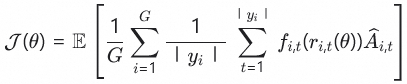
where
 is the token‑level importance ratio
 is the group‑normalized advantage
 is a smooth gating function defined as
  , with different temperatures
  and
and  for positive and negative advantages, respectively.
The gradient takes the form

where the weight is

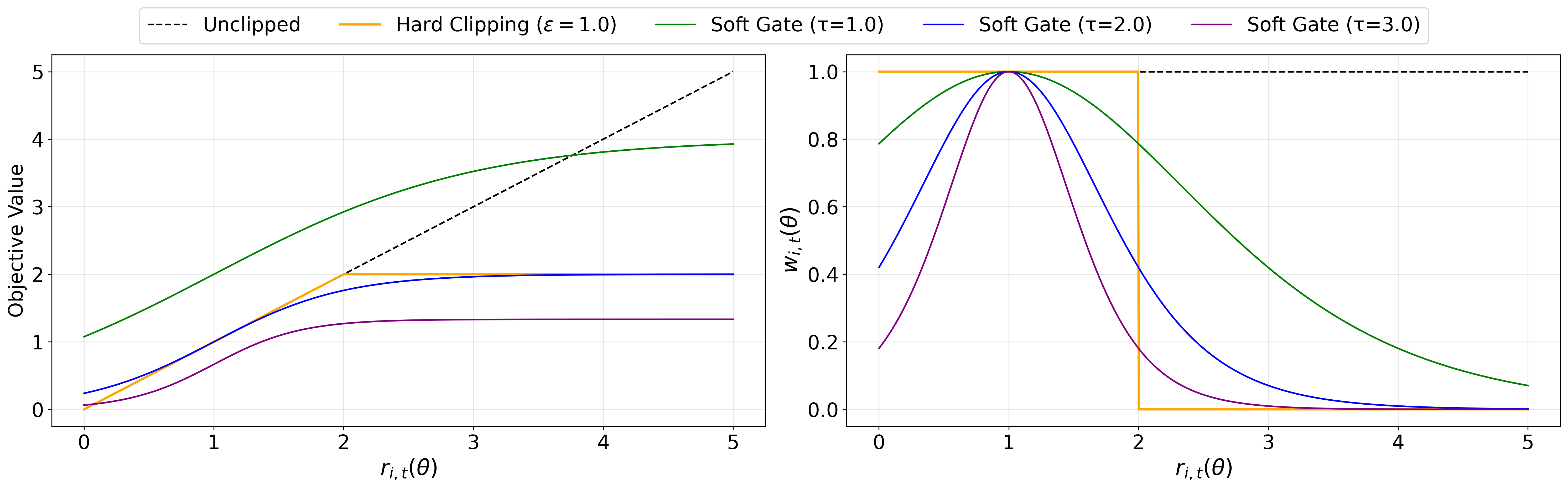
This weight peaks at  and decays smoothly on both sides.
Let  be the length‑normalized sequence‑level importance ratio:

If the policy updates are small and the token log‑ratios within a sequence have low variance—two assumptions that empirically hold for most sequences—then the average SAPO token gate becomes approximately a sequence‑level gate of the form 
 . This means SAPO behaves like GSPO at the sequence level but with a continuous trust region instead of hard clipping.
Key advantage over GSPO: If a few tokens in a sequence are very off‑policy,
This improves sample efficiency.
GRPO uses hard clipping:
This creates brittle, discontinuous optimization behavior.
SAPO replaces the hard cutoff with a smooth decay:
This allows SAPO to provide a more balanced way to retain useful learning signals while preventing unstable policy shifts.
Negative advantages increase the logits of many inappropriate tokens, especially in large vocabularies.
SAPO uses higher temperature for negative tokens  , which causes negative contributions to decay faster when off‑policy. Empirically, this simple asymmetry significantly improves RL training stability and performance.
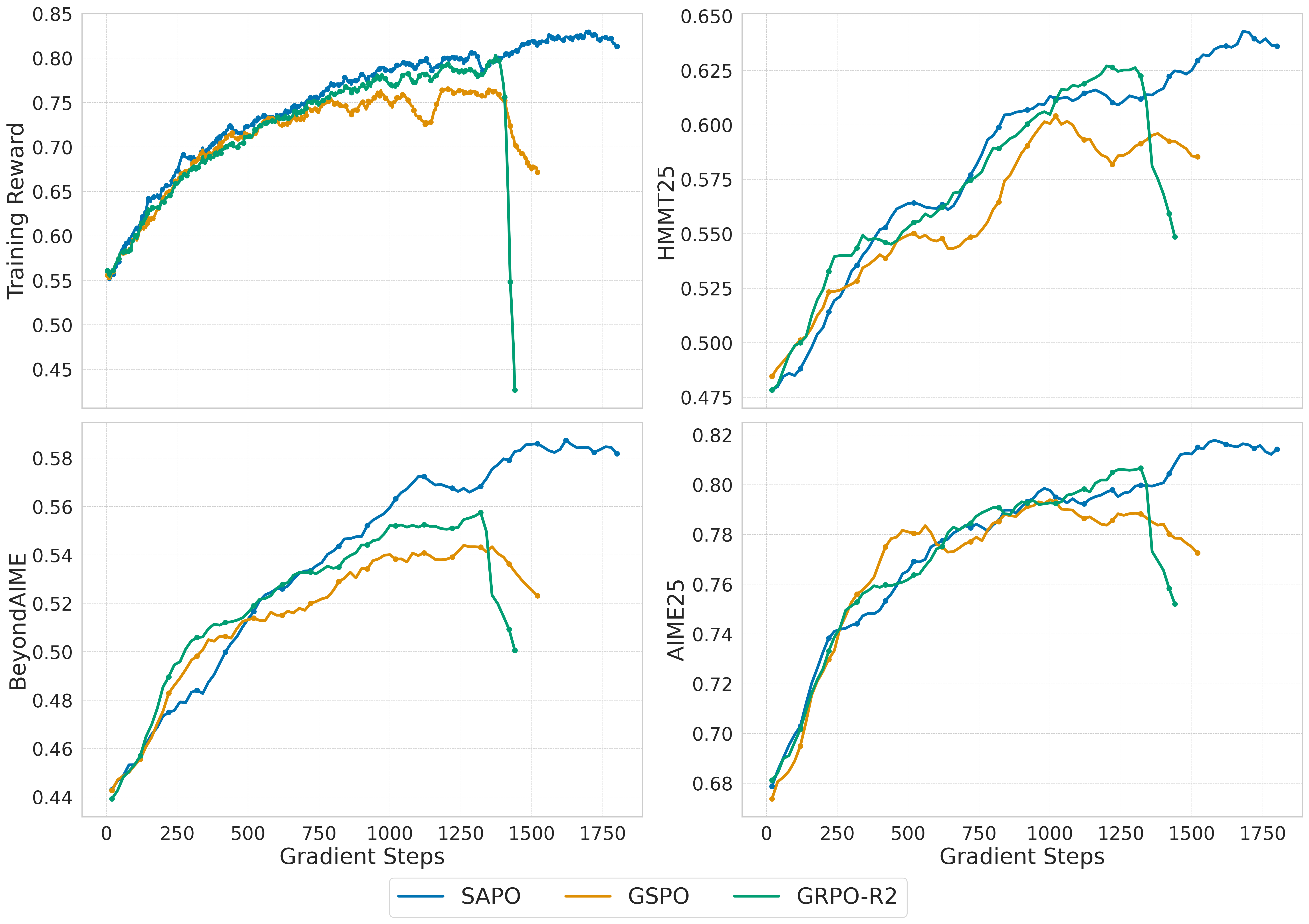
We compare SAPO against GSPO and GRPO‑R2 (GRPO with routing replay) using a cold‑start model fine-tuned from Qwen3-30B-A3B-Base.
Findings:
Temperature ablations confirm that:
 provides the most stable training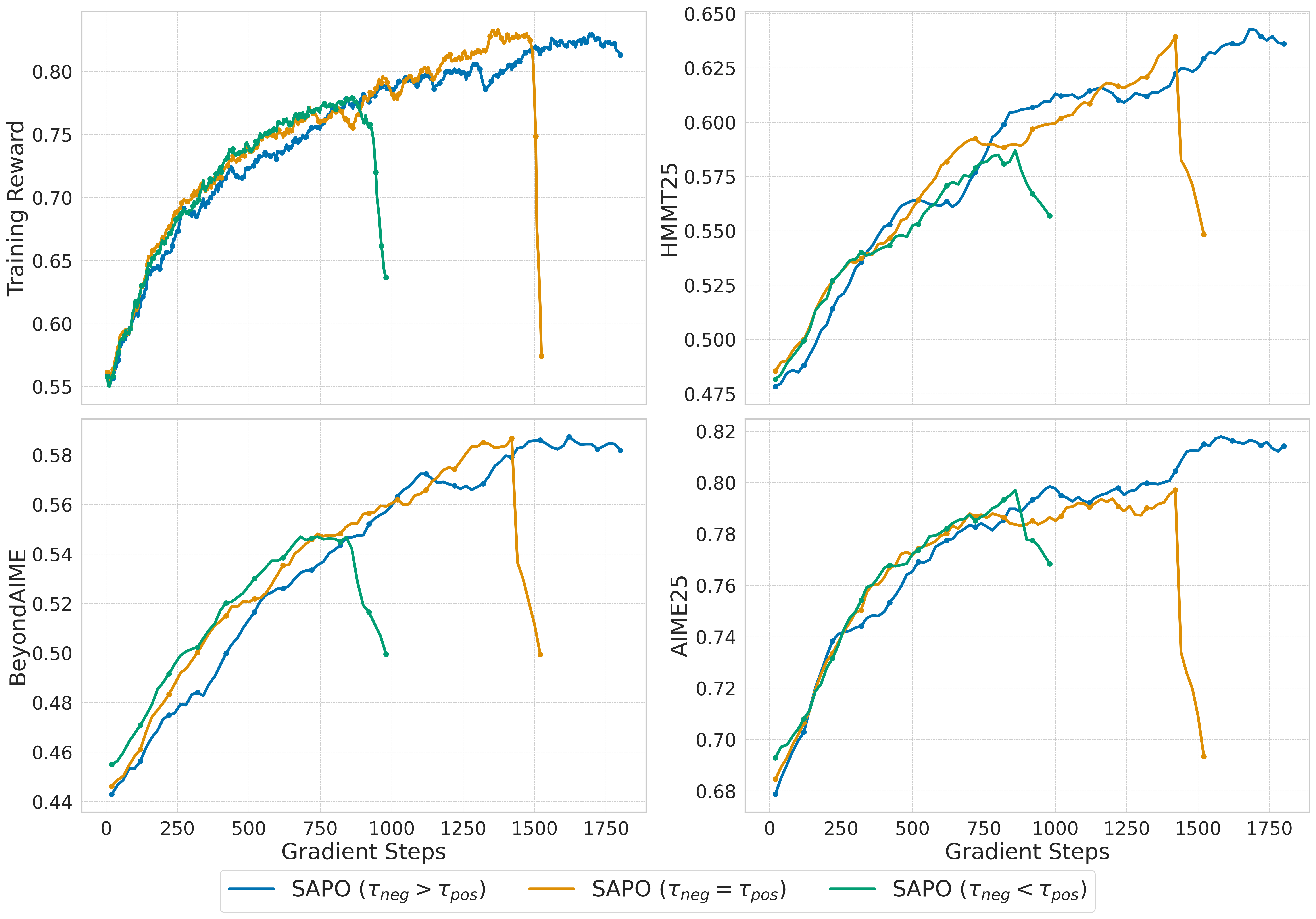
SAPO consistently improves performance across models of varying sizes and across both MoE and dense architectures. For comparison, we train a preliminary cold-start checkpoint of Qwen3‑VL‑30B‑A3B on a mixture of math, coding, logic, and multimodal tasks. Evaluation benchmarks include:
Results: SAPO consistently outperforms both GSPO and GRPO‑R2 under the same compute budget.
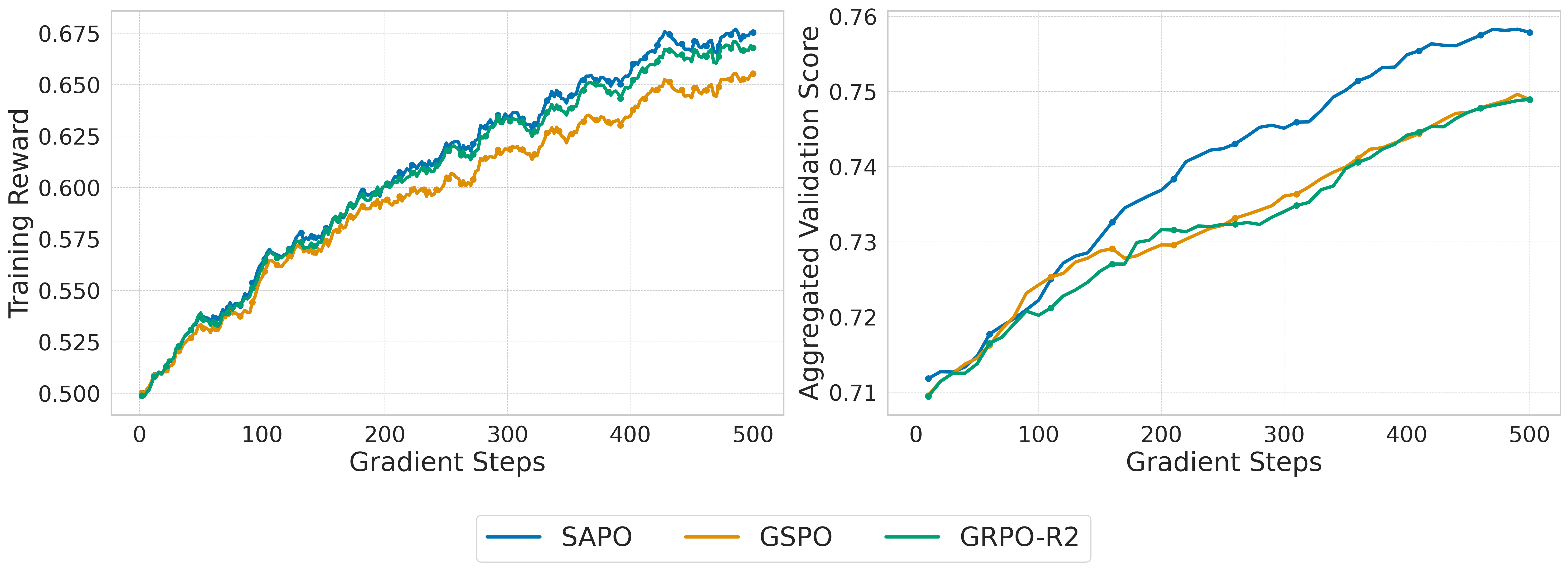
SAPO offers a practical way to stabilize and enhance RL training for LLMs:
As RL continues to drive frontier LLM capabilities, we expect that SAPO will become a foundational component of RL training pipelines.
For full technical details, theoretical analysis, and extensive experiments, please refer to our paper:
Soft Adaptive Policy Optimization
If you find our work helpful, feel free to cite it.
@article{sapo,
title={Soft Adaptive Policy Optimization},
author={Gao, Chang and Zheng, Chujie and Chen, Xiong-Hui and Dang, Kai and Liu, Shixuan and Yu, Bowen and Yang, An and Bai, Shuai and Zhou, Jingren and Lin, Junyang},
journal={arXiv preprint arXiv:2511.20347},
year={2025}
}
See the original source here.
Become an Agentic Enterprise Today: Salesforce on Alibaba Cloud at the Apsara Conference
Qwen3-Omni-Flash-2025-12-01: Hear You. See You. Follow Smarter!

1,549 posts | 520 followers
FollowFarruh - April 1, 2025
Alibaba Cloud Community - May 6, 2026
Alibaba Clouder - April 20, 2020
Yongbin Li - September 17, 2020
Alibaba Cloud Community - May 13, 2025
Alibaba Cloud Native Community - February 6, 2026
1,549 posts | 520 followers
Follow QwenWork
QwenWork is dedicated to helping employees strengthen their professional competitiveness in the AI era and to enabling enterprises to improve organizational effectiveness.
Learn More Token Plan
Build more, spend less. One plan, every modality.
Learn More
Alibaba Cloud Model Studio
A one-stop generative AI platform to build intelligent applications that understand your business, based on Qwen model series such as Qwen-Max and other popular models
Learn More Qwen
Qwen
Full-range, open-source, multimodal, and multi-functional
Learn MoreMore Posts by Alibaba Cloud Community

