A procurement team enters a demanding request into an enterprise product discovery system:
Find an alternative to the X200 industrial battery that meets EU safety requirements, works with our existing equipment, and can be delivered to our German factory within six weeks.
A useful answer must do much more than find documents with similar wording. It must identify plausible substitutes, locate certification evidence, trace recorded compatibility relationships, and assess delivery constraints using the latest ingested data. Each part of the request depends on a different form of evidence.
This is where RAG architecture becomes a business design question. Retrieval-augmented generation (RAG) grounds a large language model in enterprise information before it generates an answer. The quality of that answer depends on whether the retrieval layer can find relevant evidence and preserve the relationships that give the evidence meaning.
Vector retrieval remains an important part of the design. It helps the system understand intent and discover semantically similar content. Enterprise questions also contain exact terms, structured constraints, and multi-hop relationships. A practical RAG architecture coordinates full-text, vector, graph, and structured-data filtering, then uses the combined evidence to produce an answer that a business team can evaluate.
Consider what the procurement request is asking the system to establish.
“Alternative to the X200” requires semantic interpretation. A strong substitute may use different product language, belong to another supplier’s taxonomy, or describe equivalent operating characteristics without using the word “alternative.” Vector retrieval can surface these candidates.
“Meets EU safety requirements” requires precise evidence. A certification code, regulatory phrase, test report, or contractual statement must correspond to the stated requirement. Full-text term and phrase searches can locate the relevant source passages for review.
“Works with our existing equipment” is a relationship question. Product descriptions may not contain every supported machine model. Compatibility may be represented through components, adapters, approved configurations, or prior deployments. Graph retrieval can traverse recorded relationships and expose the path behind a match.
“Delivered to our German factory within six weeks” depends on structured operational data. Inventory, supplier status, shipping region, lead time, contract validity, and effective dates usually live in tables. SQL filters and analysis can apply these constraints to the candidate set.
The answer becomes more auditable when these paths support one another. A product may look similar in an embedding space and still lack the required certification evidence. A certified product may be unsuitable for the installed equipment. A compatible product may have no available supply route within the required time window.
Enterprise retrieval therefore needs a way to coordinate several evidence types without flattening them into a single similarity score too early.
A vector-based RAG pipeline converts documents and queries into embeddings, searches for nearby vectors, and sends the retrieved passages to a large language model. This works well when users and source documents describe the same concept with different words. The limitation appears when similarity is one condition among several.
Product models, certification codes, policy clauses, and technical specifications can differ by a few characters while representing materially different objects. Embeddings may place related identifiers close together even when a decision requires the precise identifier.
Relationships create another gap. Vector search can retrieve one passage saying that a battery supports a controller and another saying that the controller is installed in a production line. It does not inherently represent the path that connects those facts.
A delivery deadline, approved-supplier flag, destination region, or effective date should usually be evaluated as a filter or calculation. Encoding these values into text and relying on semantic proximity weakens decision precision.
These gaps define the role of additional retrieval paths. Each path handles a different evidence type, while the orchestration layer combines the results for the question at hand.
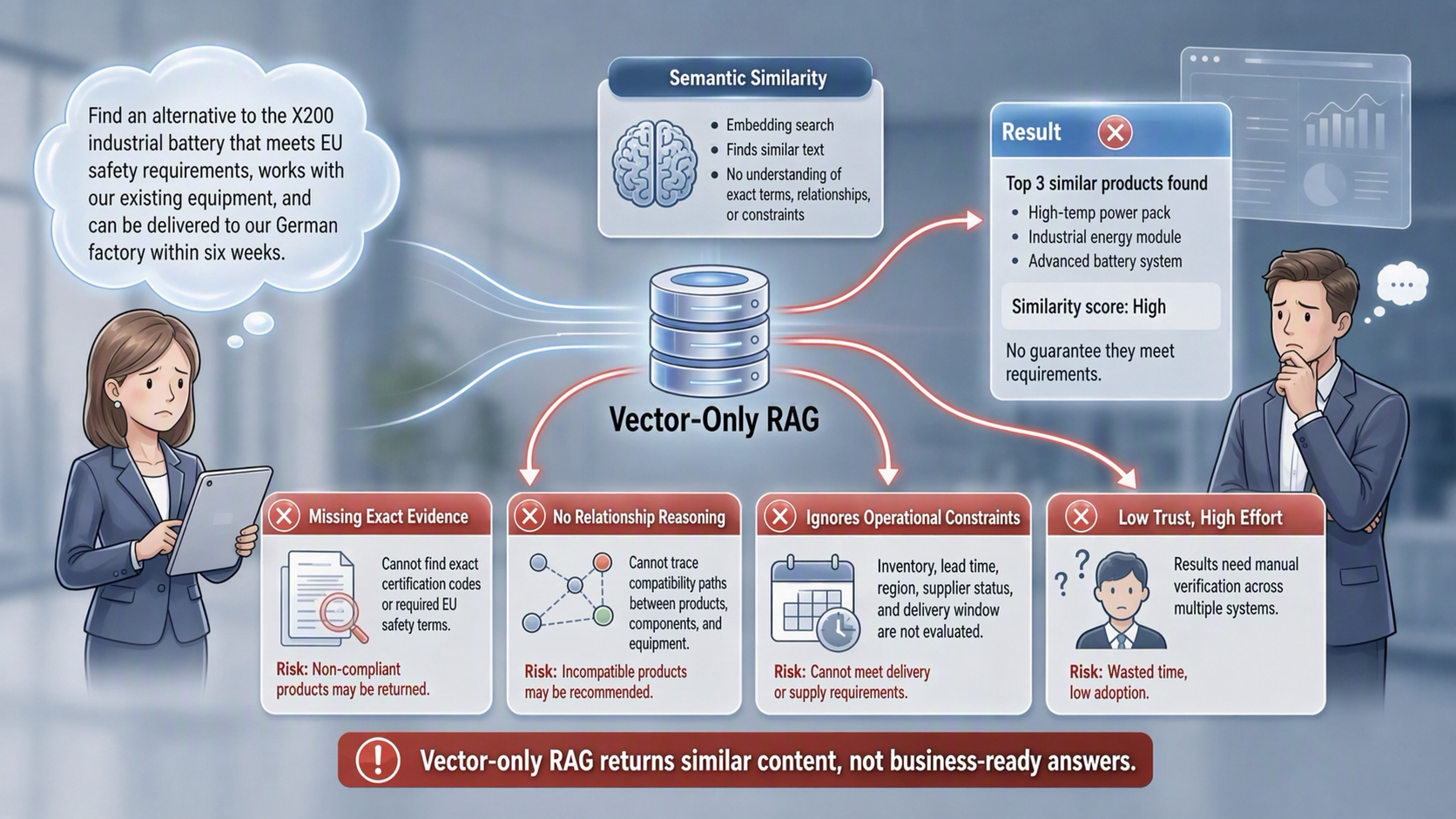
Figure 1. Vector-only RAG can find similar content, but similarity alone does not establish exact evidence, recorded compatibility, or operational feasibility.
Full-text retrieval handles the parts of a query where words, phrases, and identifiers matter directly. In the battery example, term or phrase search can locate “X200,” an EU certification name, a safety standard, or required language in supplier documentation.
This capability matters because enterprise language often carries contractual or technical meaning at the token level. Two certification codes can describe related topics and still have different legal or operational implications. Semantic discovery may find the surrounding subject, while precise term and phrase searches locate the passages that reviewers need to inspect.
Hologres provides a full-text inverted index based on Tantivy and supports BM25 relevance scoring. Its documented search modes cover keyword matching, phrase matching, term matching, fuzzy matching, and a natural-language query syntax. Default keyword matching is tokenized and relevance-ranked, so applications should select term or phrase mode when the requirement calls for precise indexed terms or wording. Natural-language mode is a full-text query syntax; it does not mean that the database answers conversational questions by itself.
For the procurement workflow, full-text retrieval can narrow the evidence set to product sheets and certificates that mention the stated standard. A buyer or compliance reviewer can then inspect the retrieved source passage and apply the relevant validation rules.
This gives the RAG pipeline supporting evidence: the model can explain why a candidate was included and point to the text behind the claim.
The buyer may describe the desired outcome differently from the suppliers in the catalog. “Alternative to the X200” could refer to products described as compatible replacements, equivalent power modules, high-temperature battery packs, or approved substitutes. Keyword matching alone may miss them.
Vector retrieval maps text into an embedding space where semantic similarity can surface candidates with related meaning. It is well suited to discovery across catalogs assembled from different manufacturers and naming conventions. Cross-language discovery is also possible when the selected embedding model supports the relevant languages.
A vector search could retrieve products whose descriptions emphasize operating temperature, discharge profile, form factor, or industrial use, even when they do not mention the X200. The RAG architecture can then pass these candidates to the textual, relational, and structured checks that follow.
Hologres supports exact vector computation and approximate vector retrieval. Its HGraph index accelerates approximate nearest-neighbor search. Exact vector functions perform brute-force computation and do not use the HGraph index. Approximate search can generate a broad candidate set, while exact computation can rerank or calculate distances across a reduced set.
Approximate retrieval involves a recall trade-off, so it should be treated as candidate discovery rather than proof that every possible match has been found. The business workflow still needs explicit checks for the requirements that determine eligibility.
Compatibility rarely exists as a single sentence in a single document. It may depend on a chain of facts spread across product master data, equipment registries, supplier records, certification mappings, and historical approvals.
A graph can represent these facts as entities and relationships. For example:
With this structure, the system can check whether a candidate product connects to the German factory’s equipment through a recorded compatibility path. It can also return that path as evidence: candidate battery A uses adapter B, adapter B supports controller C, and controller C is installed on the target production line.
This changes the answer from a loose association into an explainable relationship recorded in the data. The buyer can see which connection supports the recommendation and identify where engineering or commercial review is still needed.
Hologres provides graph query capabilities through Apache AGE and Cypher. Cypher supports fixed-length and variable-length traversal, filtering, aggregation, and relationship analysis. Graph results can participate in SQL operations because Cypher queries are exposed through a SQL table function. This allows an application to join a relationship path with product, supplier, inventory, or order data.
Graph retrieval should be scoped to the relationships that matter for the decision. A large, loosely governed graph can introduce ambiguous paths. Clear entity definitions, relationship types, source ownership, and update processes are part of the RAG architecture, even though they sit outside the language model itself.
After semantic, textual, and relational retrieval identify plausible products, the system must determine which candidates are actionable according to the latest ingested data.
This stage applies ordinary business constraints through structured-data filtering, sometimes called scalar retrieval: available inventory, destination country, approved supplier status, unit price, minimum order quantity, lead time, contract dates, and factory-specific rules. These values belong in typed columns where SQL can filter, join, aggregate, and compare them consistently.
For example, the application could exclude suppliers whose approval has expired, select stock assigned to European distribution centers, calculate whether the promised lead time falls within six weeks, and retain the evidence used in each decision. The output is a smaller candidate set that satisfies the available business constraints.
Structured-data filtering also prevents the RAG pipeline from turning every fact into unstructured text. A date remains a date, a region remains a region, and an approval flag remains a controlled value. Freshness depends on how frequently the source systems update the data that the retrieval layer uses.
The model can then summarize the answer in business language: which alternatives remain, why each one remains, what evidence supports the result, and which conditions still require human confirmation.
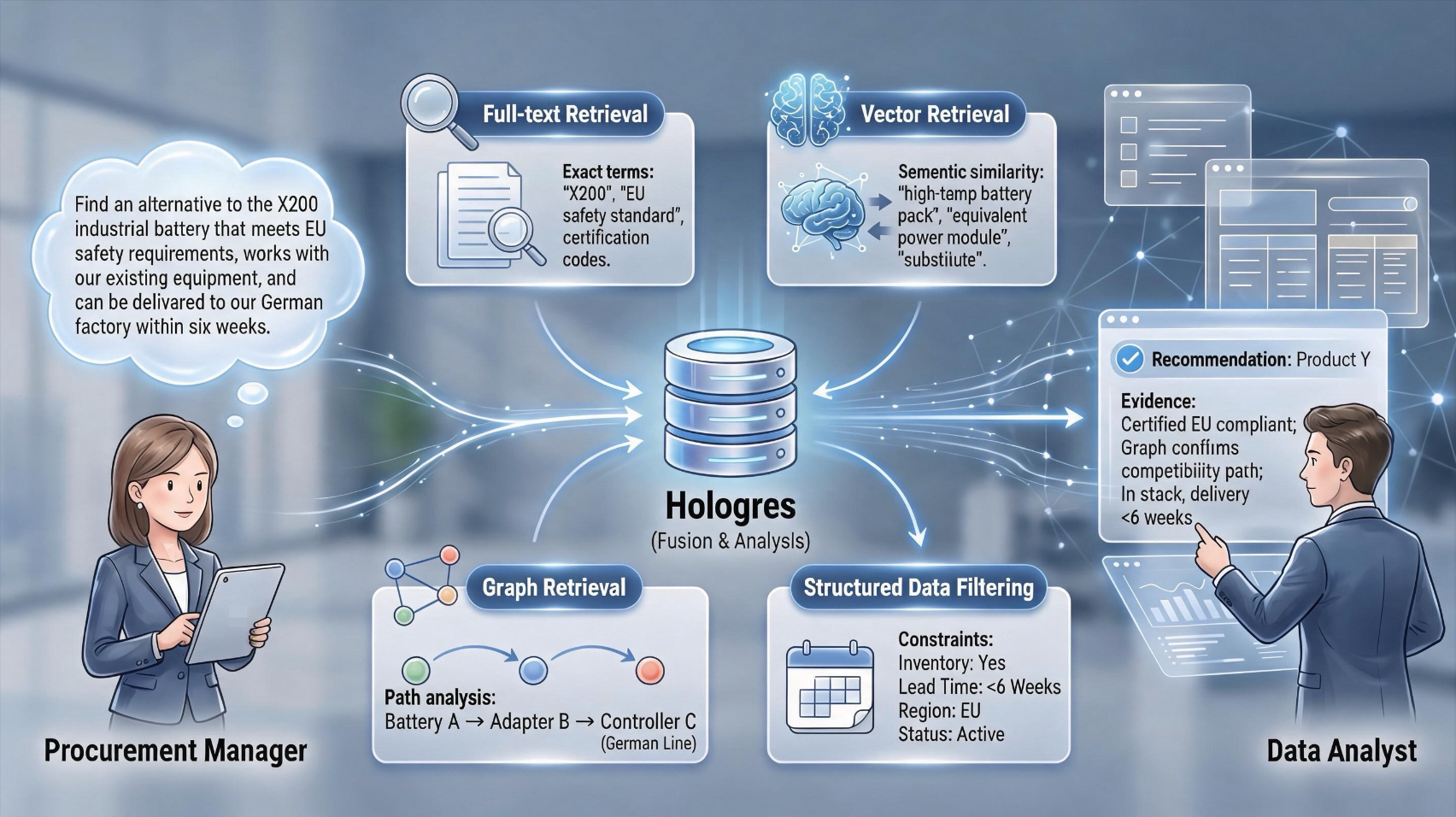
Figure 2. The business goal is not more retrieval results, but a recommendation supported by evidence, relationship paths, and operational constraints.
A multi-path RAG architecture does not require every query to use every retrieval method. The question determines the plan.
A broad discovery question may begin with vector retrieval and then use full-text and structured-data checks. A compliance question may start with a certification term or phrase search before exploring semantically related products. A compatibility question may begin with a known equipment entity and traverse the graph to a set of connected components. The orchestration layer can route the query according to the evidence required.
One practical flow for the battery request is:
Fusion is an application design choice. The Hologres documentation cited below provides an example of combining full-text and vector rankings with Reciprocal Rank Fusion (RRF) implemented in SQL. Graph results can also be joined with other results through SQL. The cited documentation does not describe an automatic operator that performs three-way full-text, vector, and graph fusion. Applications should define how candidates are merged, weighted, filtered, and audited for their own business process.
This explicit approach lets teams see which retrieval path contributed each piece of evidence. They can tune semantic recall without weakening exact checks, and they can change relationship or operational rules without rebuilding the entire generation layer.
Product discovery is a repeated operating process. Buyers compare alternatives, sales teams respond to complex requests, compliance teams review eligibility, and supply teams assess feasibility across changing catalogs and supplier networks.
A multi-path RAG architecture can support this work with a shared evidence layer. Full-text retrieval locates exact wording. Vector retrieval broadens discovery. Graph retrieval carries recorded relationships and multi-hop context. Structured-data filtering applies operational constraints from the latest ingested data.
The expected outcome is an answer that is better prepared for review. Instead of returning several similar product descriptions, the system can present a candidate shortlist with certification passages, compatibility paths, supply constraints, and source references. Human reviewers remain responsible for decisions that require commercial, engineering, or regulatory approval, but they start from a more complete evidence package.
This architecture also creates clearer governance boundaries. Teams can manage document freshness, embedding updates, entity relationships, and structured source data as separate concerns. Retrieval quality can be evaluated by evidence type rather than reduced to one overall relevance score.
Hologres brings structured data, full-text search, vector computation, graph queries, and SQL analytics into one product. This matters when enterprise answers depend on both unstructured content and operational data.
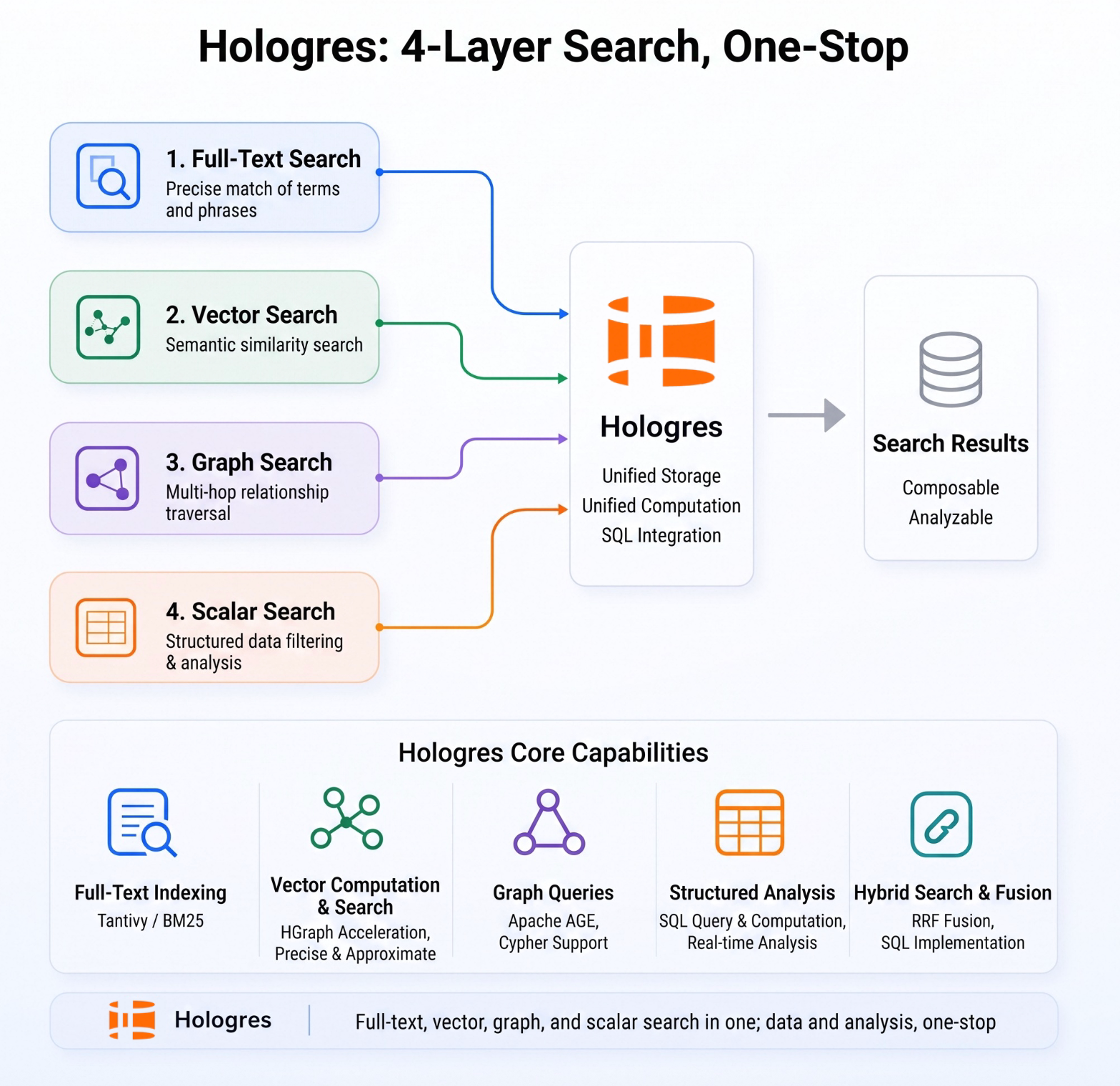
Figure 3. Hologres provides the retrieval and SQL analytics foundation, while the application controls planning, access, fusion policy, prompting, and answer generation.
The product can store searchable text alongside embeddings and business attributes, use HGraph for approximate vector retrieval, query relationships with Cypher, and compose results with SQL. Full-text and vector rankings can be fused in SQL, while graph paths can be joined with relational tables for further filtering and analysis.
Hologres supplies the retrieval and analytical building blocks. The surrounding application still handles query planning, access control, evidence selection, prompt assembly, model invocation, and answer presentation. Keeping that boundary clear helps teams design a RAG architecture that matches their governance and business requirements.
For the procurement request, the resulting answer can bring together the layers that matter: a semantically relevant substitute, a retrieved certification passage, a traceable recorded compatibility path, and a delivery assessment based on the latest ingested data. The same pattern can support other enterprise discovery processes in which text, meaning, relationships, and structured constraints must agree.
Enterprise RAG needs a retrieval layer that reflects how enterprise evidence is actually stored. Meaning appears in text. Exact obligations appear in terms and identifiers. Compatibility and ownership appear in relationships. Feasibility appears in structured operational data.
Vector retrieval gives RAG systems an effective way to discover related content. Full-text retrieval locates exact terms and phrases. Graph retrieval follows recorded business relationships. Structured-data filtering applies operational constraints. Together, these paths give the generation layer a broader and more auditable evidence set.
The result is a RAG architecture designed around evidence rather than a single search technique. For business users, that means answers that explain what appears to fit, why it fits, how the facts connect, and which conditions still require review.
Alibaba Cloud Hologres Tops the Official TPC-H 3,000GB Benchmark, with the Best Price/Performance

28 posts | 0 followers
FollowNeel_Shah - May 21, 2026
Alibaba Cloud Big Data and AI - March 10, 2026
Alibaba Cloud Big Data and AI - March 23, 2026
Alibaba Cloud Big Data and AI - February 26, 2026
Data Geek - September 4, 2026
Alibaba Cloud Data Intelligence - June 20, 2024
28 posts | 0 followers
Follow Hologres
A real-time data warehouse for serving and analytics which is compatible with PostgreSQL.
Learn More Big Data Consulting for Data Technology Solution
Alibaba Cloud provides big data consulting services to help enterprises leverage advanced data technology.
Learn More Big Data Consulting Services for Retail Solution
Alibaba Cloud experts provide retailers with a lightweight and customized big data consulting service to help you assess your big data maturity and plan your big data journey.
Learn More Data Lake Analytics
A premium, serverless, and interactive analytics service
Learn MoreMore Posts by Alibaba Cloud Big Data and AI

