Picture this: You’re three hours into debugging a messy production issue. Your AI coding assistant suggests a patch that looks absolutely perfect. It compiles cleanly, passes your unit tests, and you confidently deploy it. Twenty minutes later, your monitoring dashboard lights up bright red. Why? Because the patch broke three downstream services that the AI simply couldn't "see."
If this sounds painfully familiar, you aren't alone. In enterprise deployments, 67% of AI-generated code ends up breaking production systems.
The real bottleneck in 2026 isn't that AI models aren't smart enough. The bottleneck is the "Context Gap." It’s the massive disconnect between the intricate, unwritten architectural knowledge floating around in your engineers' heads and the painfully limited slice of information your AI assistant can actually process.
If we want to stop fixing the AI's mistakes and actually speed up development, we need to rethink how these tools remember things.
The root of this massive headache comes down to one fundamental misunderstanding: We are treating the LLM's context window like a permanent hard drive, when it actually behaves like highly volatile RAM.
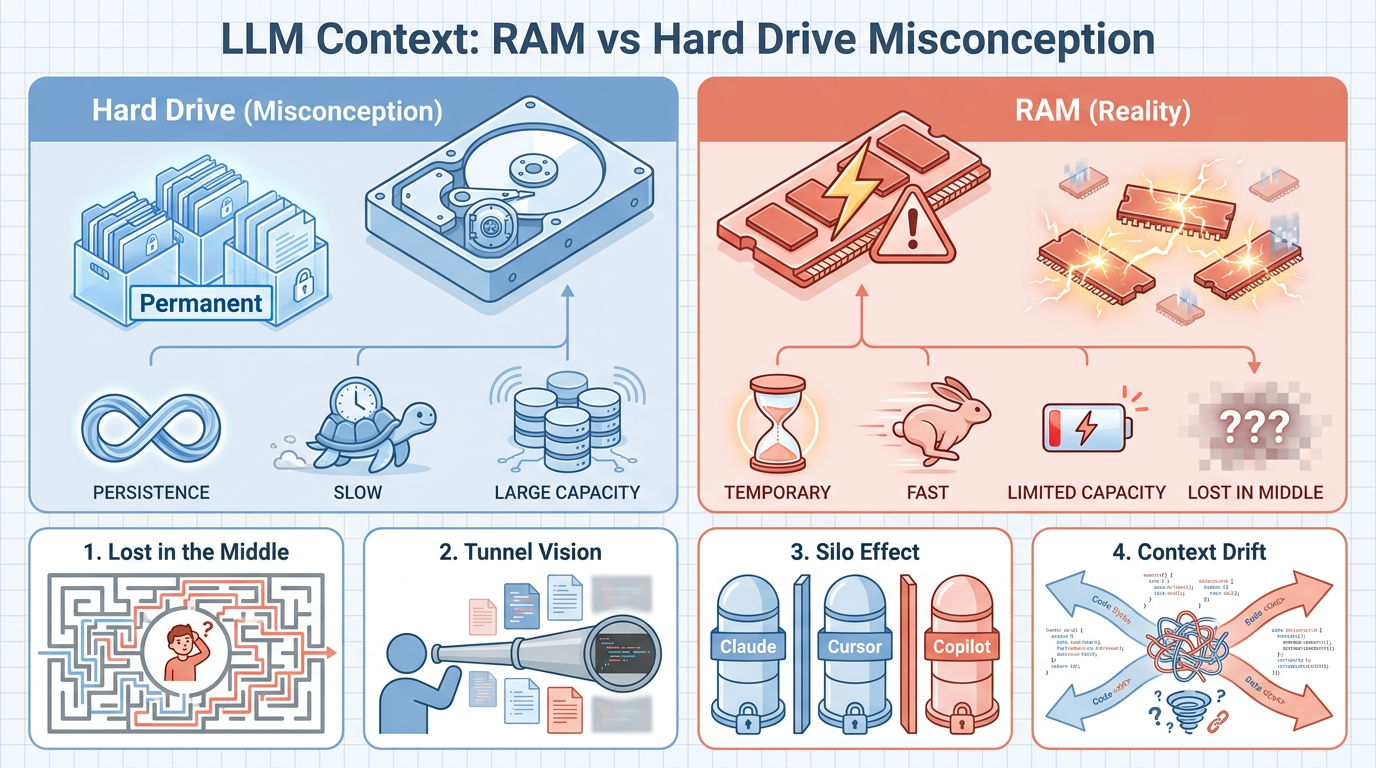
When teams try to solve the context gap, they usually try to brute-force it by shoving entire codebases, massive log files, and endless chat histories into a single prompt window. This immediately hits a few brick walls:
validatePayment() function already exists in another folder, so they hallucinate duplicate business logic or suggest outdated, vulnerable third-party libraries.CLAUDE.md, Cursor uses .cursor/rules, and GitHub Copilot has its own proprietary system. If your team switches devices or models, the AI completely forgets your project’s rules.To fix this, the industry is moving away from endless prompt engineering and adopting ContextOps—specifically, implementing a dual-layer memory architecture.
Think of it as splitting your AI's brain into two distinct parts:
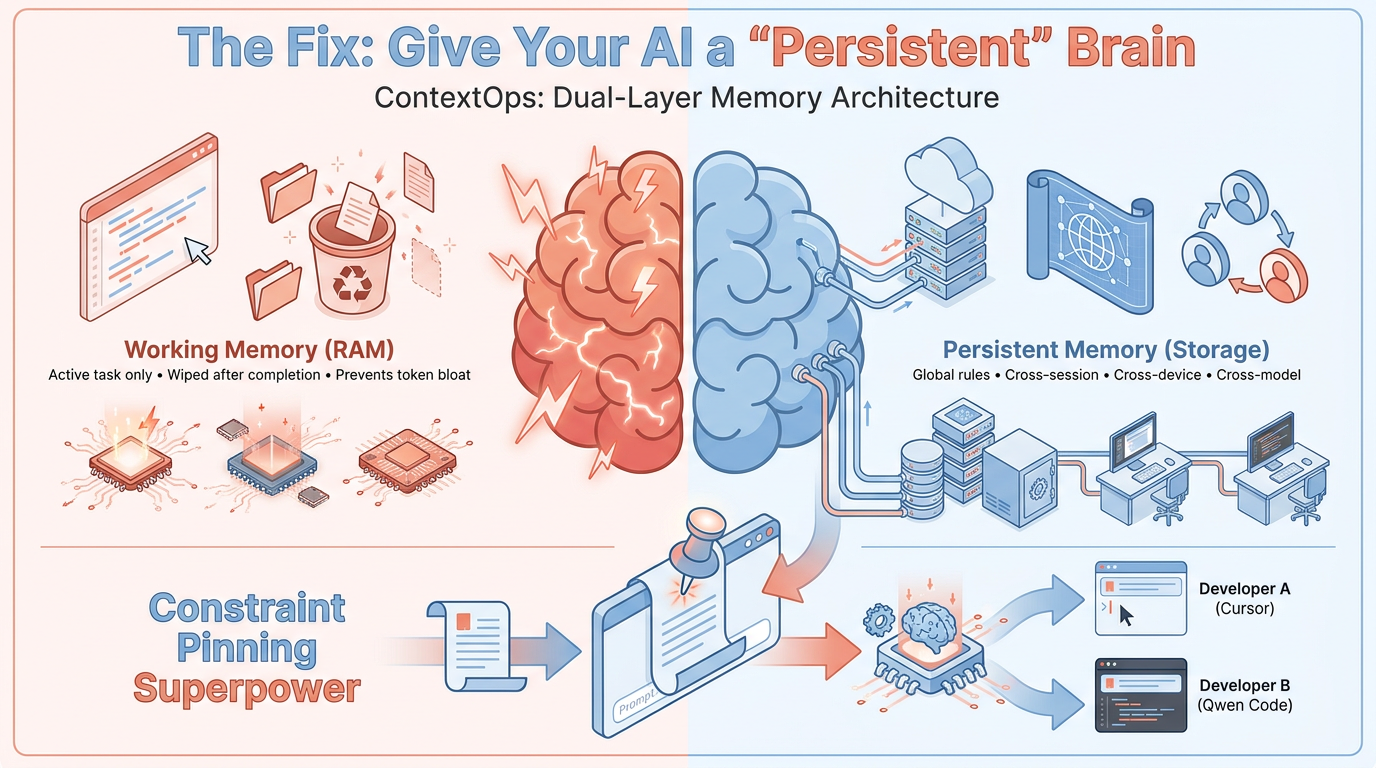
This separation unlocks a superpower called Constraint Pinning. Instead of hoping the AI remembers a crucial security rule buried in chat history, the system retrieves that rule from persistent storage and forcefully pins it to the very top of every single prompt. It makes it structurally impossible for the AI to "forget" your team's coding standards.
By creating a single source of truth for the whole team, you ensure that Developer A using Cursor and Developer B using Qwen Code are getting the exact same architectural guidance.
If you are managing a complex, multi-service repository, you need a seriously robust infrastructure to handle this persistent memory layer. This is exactly where Code Context Hologres steps in.
It is a smart, open-source plugin built on the Model Context Protocol (MCP)—think of MCP as the "USB-C" standard for AI, allowing models to easily plug into external data. Code Context Hologres acts as a secure, shared "cloud brain" for all your favorite AI coding agents.
While traditional local vector databases choke and crash on massive enterprise monorepos, this solution utilizes the highly scalable Hologres real-time data warehouse. It easily digests million-line codebases and serves up lightning-fast semantic searches to your AI.
Hologres doesn't just blindly dump code into a database; it operates as a highly optimized ContextOps pipeline:
1. AST-Aware Chunking (Intelligent Parsing) Most basic systems chop files up arbitrarily by character count, which rips functions in half. Code Context Hologres defaults to Abstract Syntax Tree (AST) chunking. By sensing the natural boundaries of functions, classes, and modules, it ensures that every snippet stored in Hologres retains its complete semantic structure.
2. Hybrid Search & RRF Re-ranking (Extreme Precision) When searching code, pure vector search might miss exact variable names, while pure keyword search fails to understand natural language intent. Hologres tackles this by utilizing a Hybrid Search mode. It combines dense vectors (for semantic understanding) with BM25 sparse vectors (for exact symbol matching). The results are then mathematically combined using Reciprocal Rank Fusion (RRF), ensuring the AI is fed the absolute most relevant context.
3. Incremental Indexing via Merkle Trees (Real-Time Freshness) Codebases are living, breathing things. Instead of forcing you to re-index the entire repository every time you save a file, Hologres uses an underlying Merkle tree structure to instantly detect changes. It incrementally re-indexes only the modified files in the background, ensuring your AI always has the freshest context without blocking your development flow.
Performance Evaluation: Doing More with Less
You might assume that adding a massive semantic search layer would slow things down or cost a fortune in API fees. However, performance evaluations paint a highly efficient picture.
According to controlled evaluations published in the project's GitHub repository, utilizing the Code Context Hologres MCP achieves a ~40% token reduction while maintaining the exact same retrieval quality. By surgically extracting only the exact AST-parsed code blocks needed to answer a prompt, you avoid flooding the LLM's context window. This translates to significantly better answers under strict token limits, alongside massive cost and time savings in high-volume production environments.
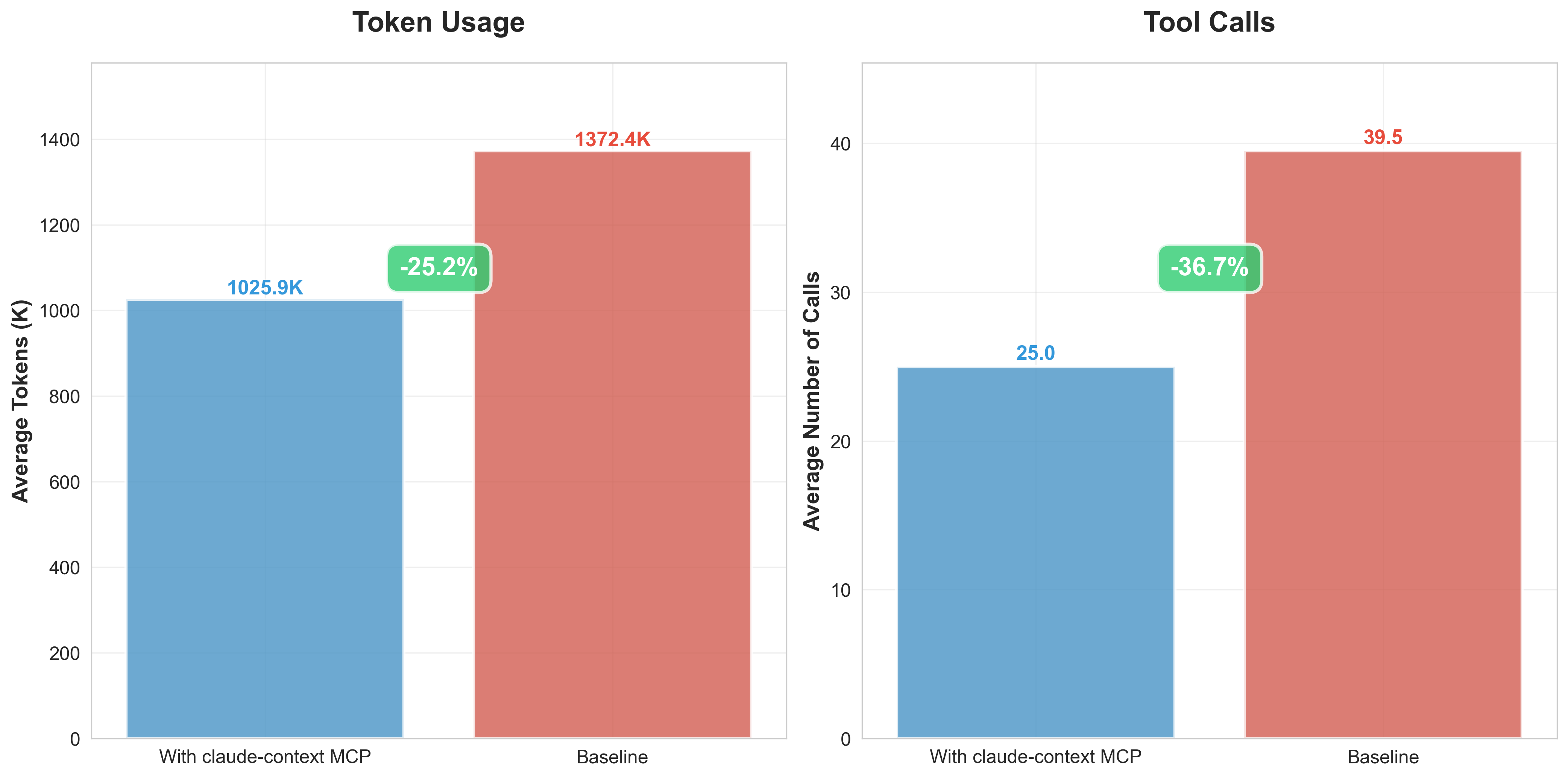
Integrating this into your daily workflow is surprisingly frictionless thanks to the Model Context Protocol. Here is a brief look at how developers use it in practice:
code-context-mcp-hologres package as an MCP server inside your AI agent (like Claude Code or Qwen Code).The future of software development isn't just about renting access to an AI model with an infinitely larger context window. It’s about owning your context architecture.
By integrating a persistent memory layer like Hologres into your team's workflow, you stop treating your AI like an amnesiac intern. You transform it into a globally aware, highly consistent engineering partner. Embrace ContextOps, connect your tools, and finally start shipping reliable code at the speed you were promised.
Discover how Hologres serves as a high-performance, persistent memory layer for AI applications—explore the Hologres documentation and check out the open-source GitHub repo.
Q: What exactly is the "context gap" in AI coding?
A: The context gap refers to the massive disconnect between the implicit architectural knowledge stored in an engineer's head and the limited, isolated information an AI assistant can process. Because AI agents generally only see the specific file you are editing, they lack global visibility across thousands of files in a repository. This tunnel vision is a primary reason why AI coding tools can generate technically correct code that still ends up breaking production systems.
Q: Why can't we just use models with massive 1-million-token context windows to read the whole codebase?
A: It is a common architectural mistake to treat the LLM's context window like a persistent database (a hard drive) when it actually behaves like highly volatile RAM. Even if a model supports millions of tokens, pushing massive amounts of text into the window degrades performance well before the token limit is reached. LLMs suffer from the "Lost in the Middle" effect, meaning they reliably retrieve information from the beginning and end of a long prompt but heavily ignore crucial constraints buried in the middle. Additionally, the model must re-process the entire context window on every single API call, which leads to skyrocketing token costs and severe latency.
Q: Why use "Hybrid Search" instead of just standard Vector Search?
A: Pure vector (dense) search is great for semantic understanding but might miss exact variable names or code symbols, while pure keyword search fails to understand natural language intent. Code Context Hologres solves this by using Hybrid Search, which combines dense vectors with BM25 sparse vectors. The results are then mathematically combined using Reciprocal Rank Fusion (RRF) to guarantee the AI gets the absolute most precise context.
Q: Will I have to manually re-index the database every time I save a code file?
A: No. Codebases are constantly evolving, so Code Context Hologres utilizes Merkle trees to detect file changes automatically. It incrementally re-indexes only the modified files in the background, ensuring your AI always has the freshest context without interrupting or blocking your development workflow.
Q: What is the Model Context Protocol (MCP) and why does it matter here?
A: MCP is a standardized open framework—often described as the "HTTP for AI integrations"—designed to connect AI models to external tools, APIs, and data systems. By building on MCP, Code Context Hologres allows any compatible AI agent to dynamically discover, access, and search your codebase securely and predictably, eliminating the need to write fragile, custom middleware for every new AI tool.
Hybrid Scalar-Vector Retrieval with Alibaba Cloud EMR Serverless Spark

27 posts | 0 followers
FollowAlibaba Cloud Community - June 17, 2026
Alibaba Cloud Native Community - May 26, 2026
Johnny Mai - September 10, 2026
Neel_Shah - July 2, 2026
Community Builder - June 8, 2026
Data Geek - September 4, 2026
27 posts | 0 followers
Follow Hologres
A real-time data warehouse for serving and analytics which is compatible with PostgreSQL.
Learn More QwenWork
QwenWork is dedicated to helping employees strengthen their professional competitiveness in the AI era and to enabling enterprises to improve organizational effectiveness.
Learn More Qwen
Qwen
Full-range, open-source, multimodal, and multi-functional
Learn More Token Plan
Build more, spend less. One plan, every modality.
Learn MoreMore Posts by Alibaba Cloud Big Data and AI

