Your Credits Go Further: Qoder Auto Cuts Per-Task Usage by 41%
Learn More about Qoder
Explore Qoder – Agentic Coding For Enterprise
Over the past two months, we have been optimizing toward one goal: improving credit efficiency in the Auto tier so you get more done with every Credit. Here is our latest progress:
The Auto Tier Uses Less: Credits Usage Multiplier Reduced by 40%
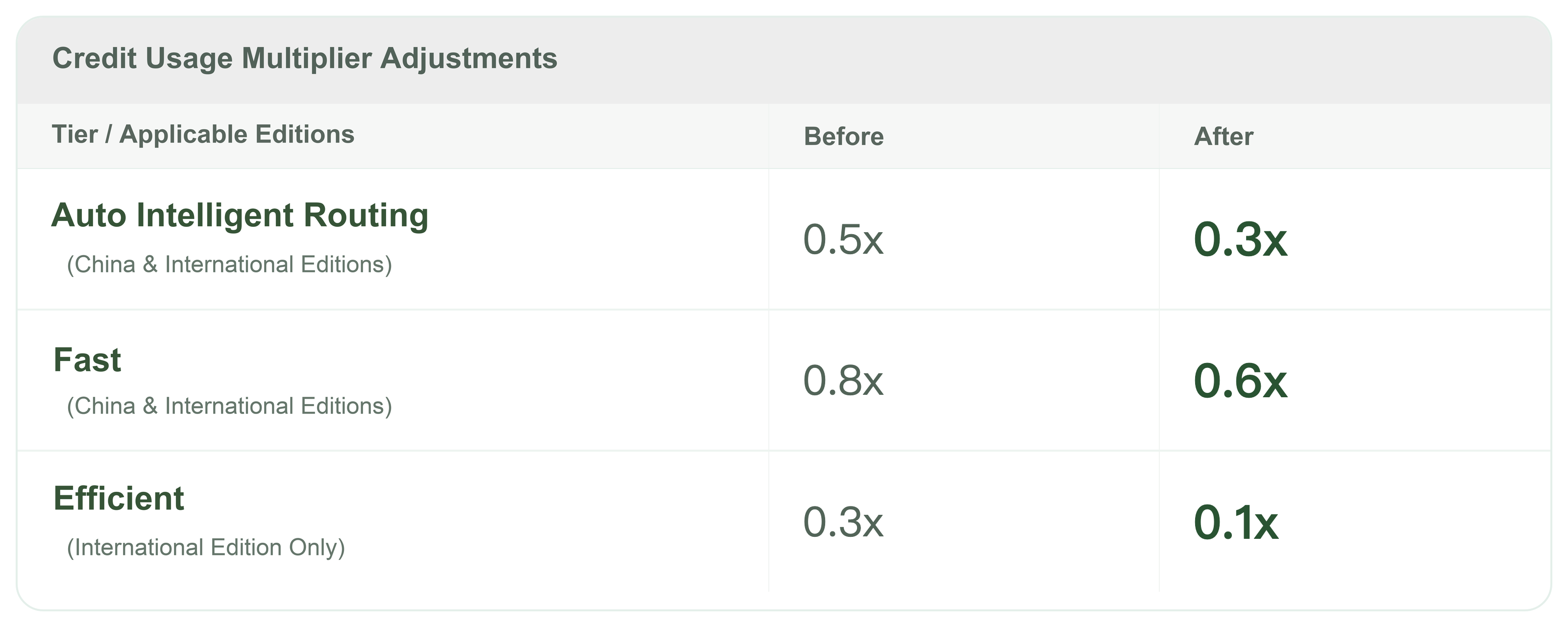
These model scheduling and engineering improvements are also reflected in lower Credits usage multipliers. The Auto tier's Credits usage multiplier drops from 0.5x to 0.3x, a 40% reduction; Fast mode drops from 0.8x to 0.6x, a 25% reduction. The Credits usage multiplier for Efficient mode in the international version has also been reduced. During the limited-time free period for paid users, Efficient mode's Credits usage multiplier remains 0.0x. These adjustments took effect on November 18 across the entire Qoder product family.
Get More Done with the Same Credits
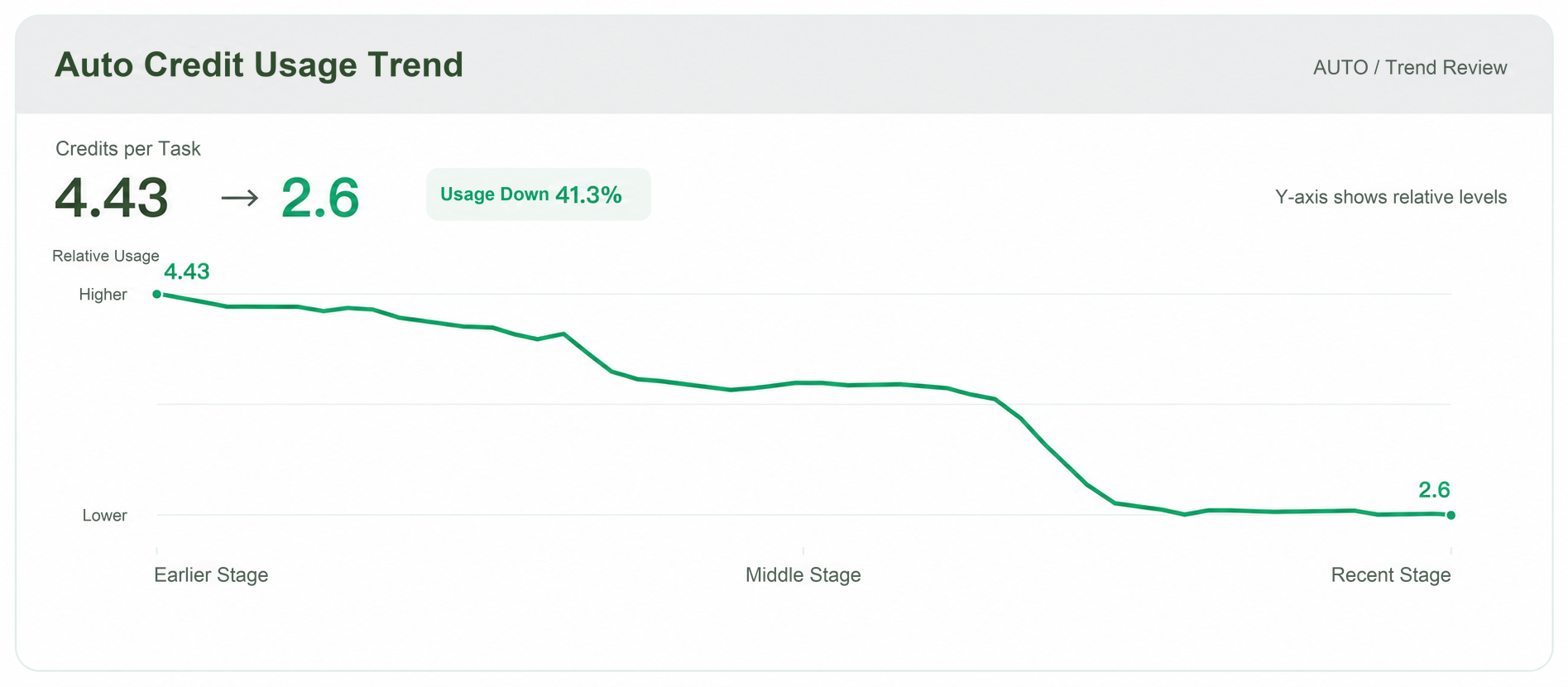
We continue to optimize Auto for credit efficiency: per-task Credits usage has dropped from 4.43 to 2.6, a reduction of about 41.3%. Based on these starting and ending values, the same Credits budget can complete about 1.7 times as many tasks as before.
For a more concrete illustration: if a Credits budget previously lasted about 15 days, these usage changes would make it last around 26 days, provided the task types and daily usage intensity are comparable.
If you have ever worried, "My Credits have run out before the next refresh date", this improvement is meant to reduce the need to keep checking your balance and give you more room to finish the work at hand.
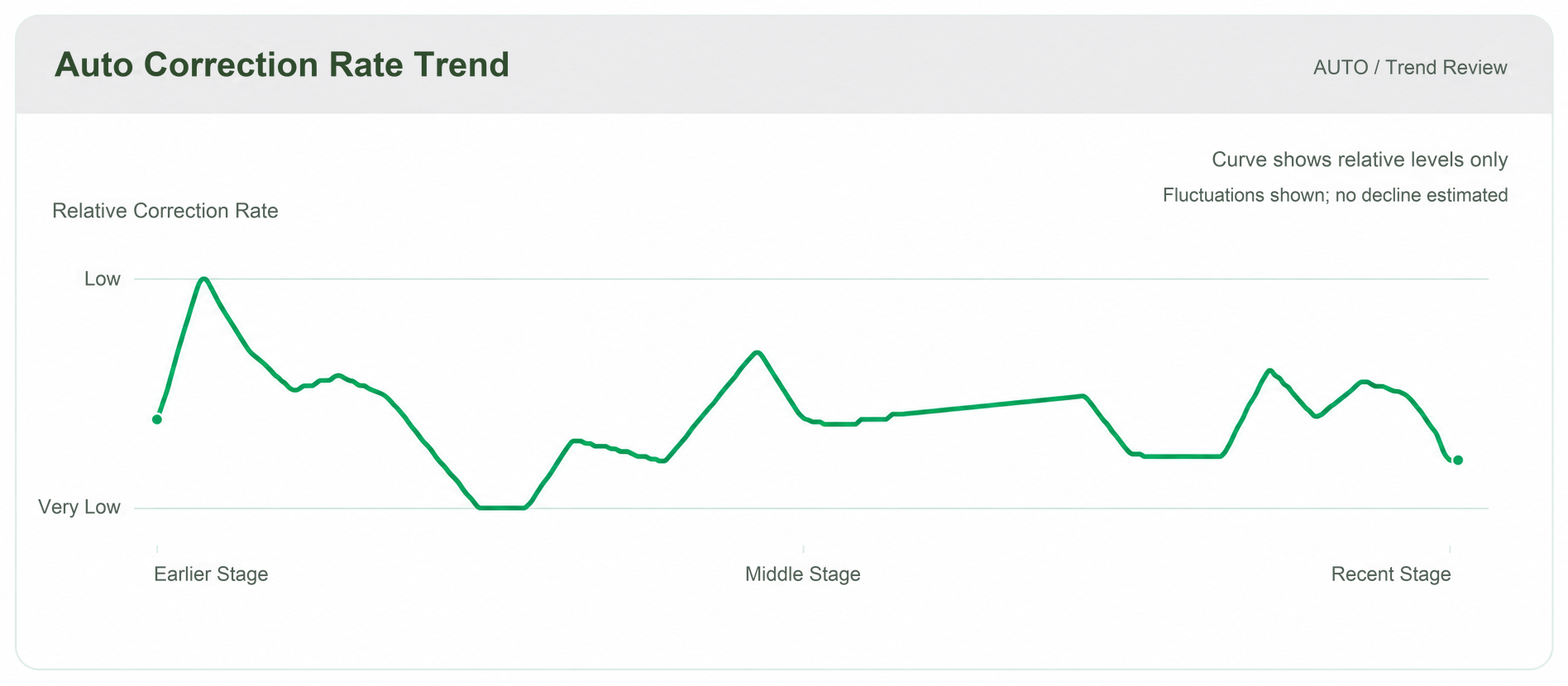
Results: The user correction rate remains low. This metric measures the proportion of tasks in which users need to intervene to correct the AI. We will continue to monitor it alongside tool error rates and user feedback, looking not just at lower usage figures but also at whether tasks progress smoothly.
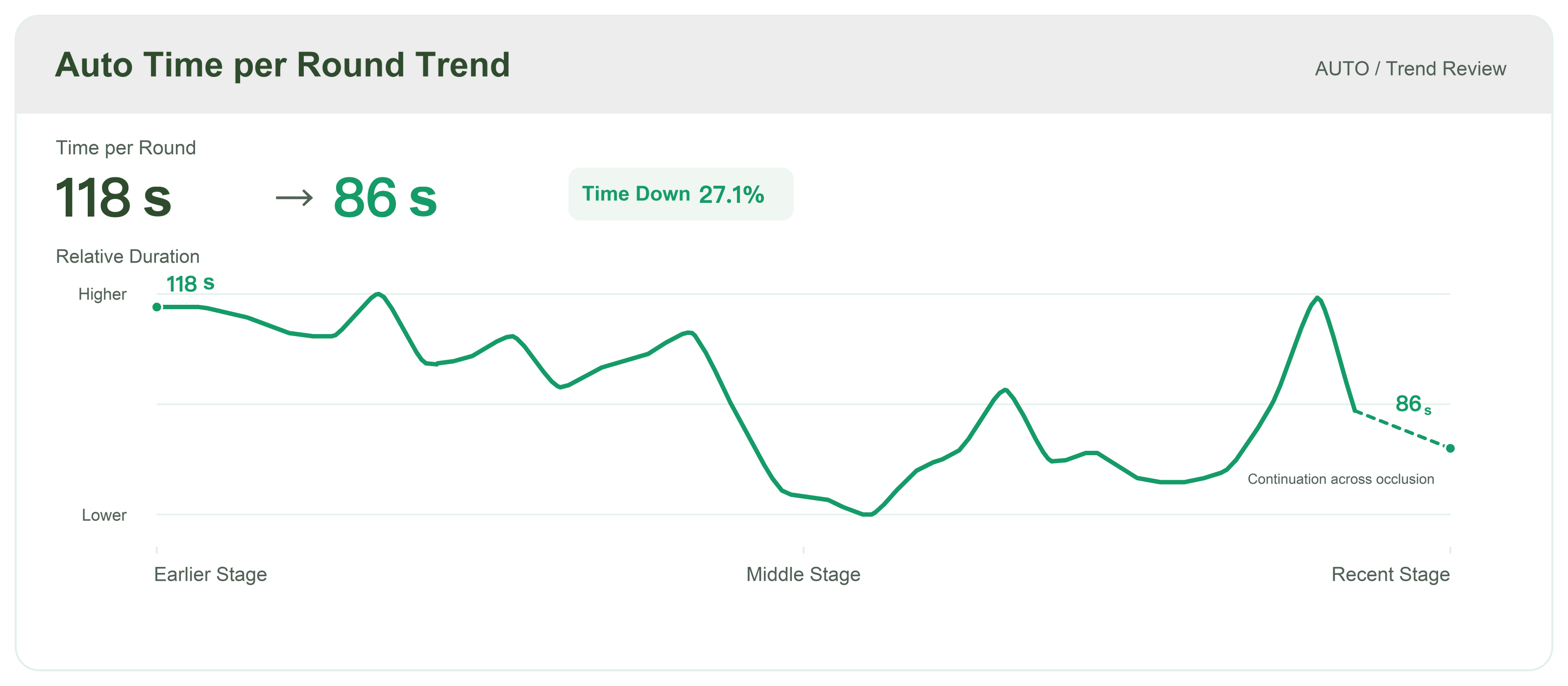
Performance: Per-turn task duration has dropped from 118 seconds to 86 seconds, a 27.1% reduction. Fewer tool round trips and less repeated preparation also mean less waiting as tasks progress.
In practice, usage varies with task complexity, context length, and the number of revision rounds. The Credits you save can go toward the next revision of a report, another round of code testing, or the next small tool you want to build.
The goal of better credit efficiency is to move tasks forward, not just make individual calls cheaper.
Technical Optimizations Make Models More Credit-Efficient
Choosing the right model is only the first step. The Credits needed to complete the same task also depend on cache reuse and how the agent reads files, uses tools, and builds on existing progress. We optimize at both the model layer and the agent harness layer, which is the engineering layer that supports the agent.
Our approach is simple: make model calls lighter, make fewer of them, and get more done with each one.
Model Layer: Increase Cache Reuse
1. Shared prompt cache: Separate reusable content. In a request, the system prompt includes both content shared across users and content personalized for each user. Mixing them together affects cache hits for the shared content.
We separate globally shared content from personalized content, making tool descriptions and shared prompts easier to cache and reuse. This optimization improves credit efficiency by 6% for models that support explicit caching.
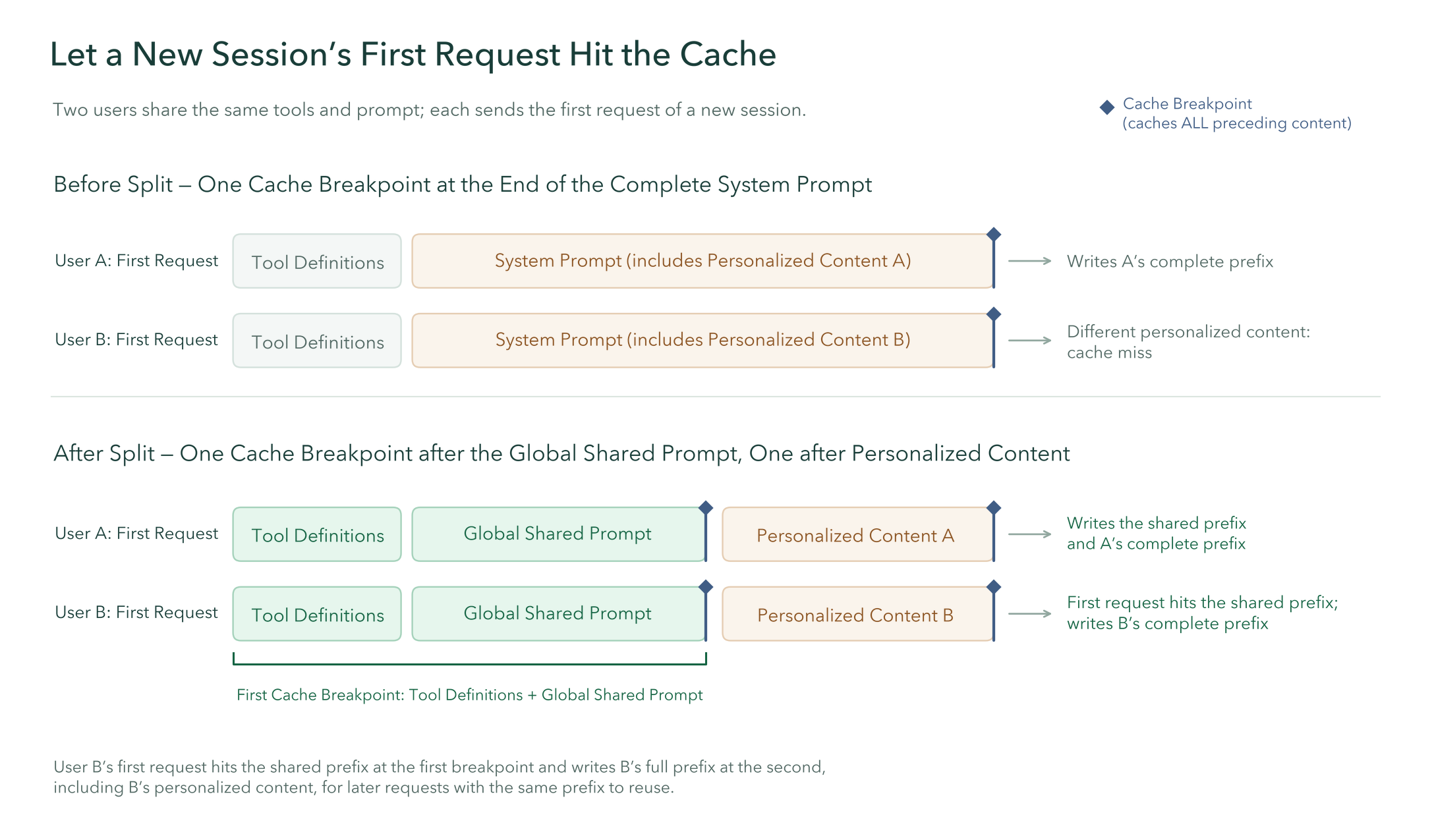
Shared Prompt Cache: How New Sessions Hit the Cache
2. Affinity routing based on cache lifetime: Cache lifetimes vary by model; make the most of caches while they remain valid**.
We use affinity routing based on cache lifetime so that subsequent requests hit the same cache wherever possible while it remains valid, avoiding repeated charges. This optimization improves credit efficiency by 4% for some models with longer cache lifetimes.
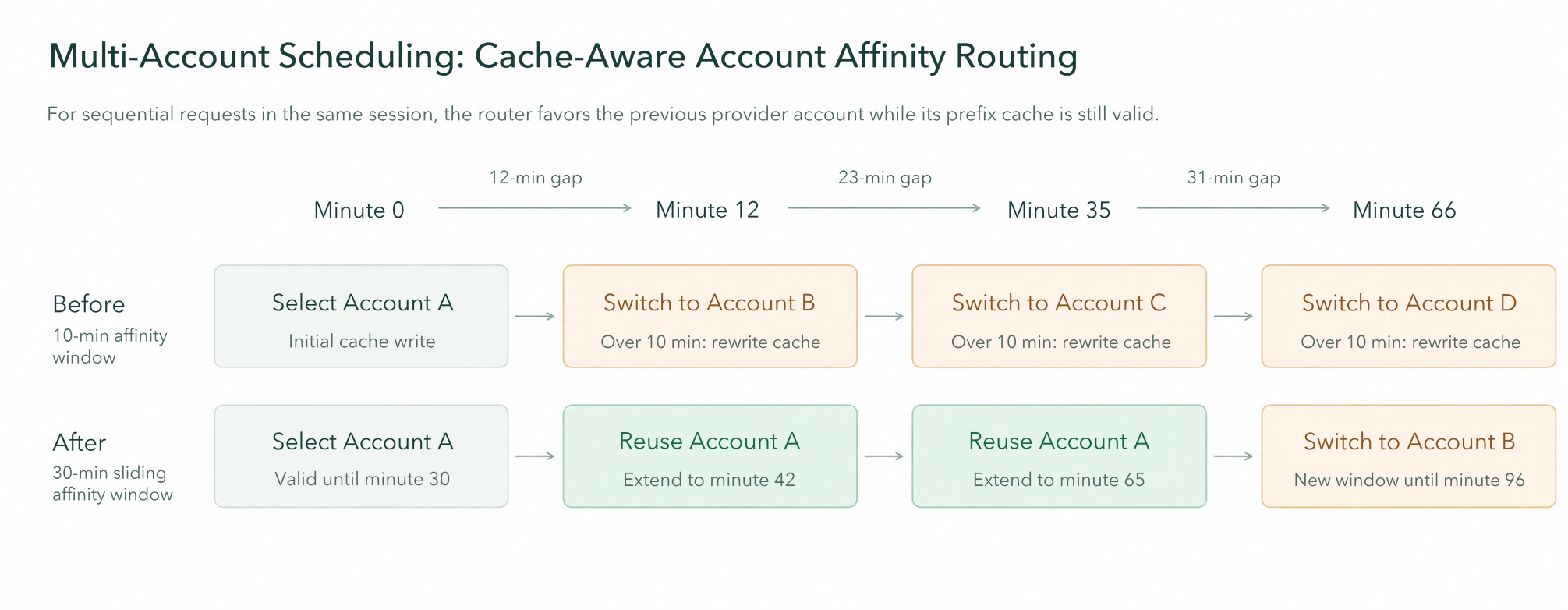
Affinity Routing Based on Cache Lifetime
Harness Layer: Reducing Task Overhead
1. Tool Optimization: Fewer Repeated Reads and Writes
Read files on demand and reuse unchanged content when the tool output is still available in context. For edits, provide only the text needed to precisely identify the location to change. Retain reusable webpage content to reduce repeated fetches.
We also improved timeout and permission handling for commands, reducing retries and unnecessary workarounds after errors. Production observations showed that the mean cumulative volume of text returned from reads fell by about 26%, and the webpage refetch rate fell by more than half. Fewer redundant reads and fetches leave more Credits for necessary operations.
2. Context Compaction and Handoff: Keeping Long Tasks on Track
If context compaction leaves only a summary and discards information about files already read and edits already made, the model may repeat work it has just completed.
The handoff retains recent tool results, key file content, and current task progress, keeping them consistent with the actual state of the files so the model can pick up where it left off. In internal evaluations, task duration fell by about 20%, and the task pass rate also improved.
3. Prompt Optimization: Running Independent Operations in Parallel
Some operations, such as reading different files or querying different information sources, are independent and do not need to wait for the previous operation to finish.
Prompts guide the model to distinguish operations that can run in parallel from those that must run in order, batching tool calls while respecting dependencies and ensuring correct results. Investigation is scoped to the task, keeping simple edits from turning into broad investigations and reducing unnecessary delays before work begins.
4. CodeMode: Orchestrating Batched Tool Operations
For tasks with a well-defined workflow that process multiple items in sequence, having the model read each result and decide what to do next adds round trips and increases token consumption.
CodeMode uses code to orchestrate multiple tool operations, handling batch queries, result filtering, and follow-up processing in a single execution. This reduces the repeated inclusion of intermediate results in context. In internal evaluation scenarios suited to this approach, model call count and token consumption fell by about 30%.
5. On-Demand Tool Loading: Loading Instructions Only When Needed
Connecting more MCP services brings more tool definitions. Parameters and usage instructions take up space in the input context even when the current task does not need them.
MCP initially provides searchable service and tool summaries, retrieving full tool definitions and schemas only when needed. Full Skill instructions are also loaded on demand for the task. Observations during the staged rollout showed that Credits consumption per turn fell by about 19%. A broad range of tool capabilities remains available without carrying every instruction into every turn.
"The results above come from separate experiments for each optimization. Their effects overlap and cannot simply be added together; overall results should be judged by actual per-task measurements."
Let Auto choose the model. Focus on getting the work done.
Auto has a simple goal: no matter how many models are available or how their prices change, you can focus on your work instead of researching them.
Open Qoder, select Auto, and tell it what you want to do. Get more work done with the same Credits.
Read previous post:
Qwen4-Max: One Flagship for Complex Work, at a Price That Scales
-

-
Alibaba Cloud Community
1,609 posts | 526 followers
Follow
Comments
-
-
Alibaba Cloud Community
1,609 posts | 526 followers
Follow
Related Products
-
 Qoder
From Assisted to Autonomous — Adapting to Every Programming Need
Learn More -
 QwenWork
 is dedicated to helping employees strengthen their professional competitiveness in the AI era and to enabling enterprises to improve organizational effectiveness.
Learn More -
 Token Plan
Build more, spend less. One plan, every modality.
Learn More -
 DeepSeek
-V4.1-Flash is the lightweight flagship of DeepSeek's new architecture family, packing 552B total MoE parameters to deliver flagship-surpassing intelligence across key benchmarks.
Learn More
More Posts by Alibaba Cloud Community
- Qwen4-Max: One Flagship for Complex Work, at a Price That Scales
- Qwen4-Max at Work: Six Real-World Scenarios for an Always-On AI Teammate
- Alibaba Cloud Named a Leader in Gartner® Magic Quadrant for Container Management for Fourth Consecutive Year
- The Easiest Way to Try the Latest Models in One Place: Token Plan Starting at $3 for the First Month
- 一個平台輕鬆試用最新 AI 模型:Token Plan 首月低至 $3
- Alibaba Cloud Advances AI Adoption in Malaysia with Nationwide Youth Contest and Industry Collaborations
- Alibaba Cloud Unveils New AI Initiatives at Hong Kong Summit to Advance the City’s AI Ecosystem
- QoderWake: Digital Workers Take the Initiative — No Need to @ Every Time
- What Is Model Thinking Effort? Should You Choose Low, High, or Maximum?