Alibaba Joins Antalya AI Pledge at COP31 to Support Sustainable AI
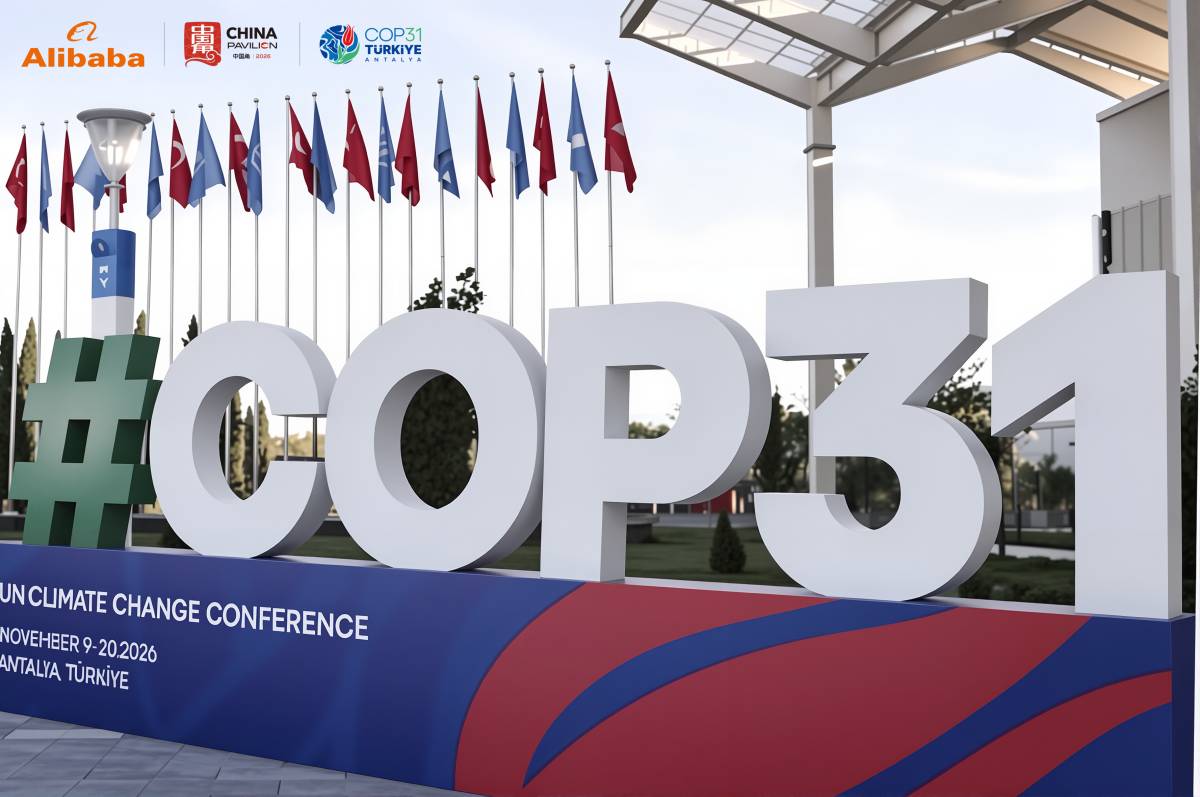
Alibaba has joined the Antalya AI Pledge at COP31 in Antalya, Türkiye, joining an international effort to advance artificial intelligence for climate action and to enhance the sustainability of the technology itself.
Jointly developed by the International Telecommunication Union (ITU) and the COP31 Türkiye Presidency, the voluntary, non-prescriptive pledge reflects a shared ambition to harness AI for climate solutions and to make the infrastructure behind AI more sustainable.
At COP31, Alibaba shared practical experience from its data center operations and AI-enabled platform services, alongside representatives from the ITU, the Global Enabling Sustainability Initiative (GeSI) and the World Business Council for Sustainable Development (WBCSD).
Building AI Infrastructure Around Local Conditions
For the infrastructure behind AI, Roger(Zhaoyang) Wang, General Manager of Global Data Centers at Alibaba Cloud, said the company’s approach is guided by three considerations: social acceptability, environmental sustainability and economic viability.
Alibaba Cloud has continued to improve the energy performance of its self-built data centers and to increase their clean-electricity share. By March 2026, AI-powered load optimization and cooling control have been implemented across 24 self-built data centers to lower operational energy consumption, and the average annual power usage effectiveness, or PUE, among all self-built data centers improved from 1.247 in fiscal 2022 to 1.187 in fiscal 2026. PUE measures the total facility energy to IT equipment energy over the same period, with lower values indicating greater efficiency.

Over the same period, the share of clean electricity used in these facilities rose from 21.6% to 73.6%. Alibaba also selects water, air or liquid cooling according to local conditions, and its data center sites including Ulanqab reused 135,858 cubic meters of reclaimed water in fiscal 2026 for non-drinking uses such as cooling.
In Zhangbei, Hebei province, in Northern China, Alibaba Cloud has also connected server waste heat to the municipal heating network. According to the company, the recoverable heat at full load could serve more than half of the county’s residential floor area requiring heating, turning a computing byproduct into a resource for the surrounding community.
Alibaba Cloud is also rethinking how data centers are built. Its CUBE 5.0 modular architecture shifts much of the construction process from the site to the factory. Across five systems, including power, cooling, security, intelligence and fire protection, modularization has increased from 30% to 90%, while delivery time has been shortened to 100 days.
Additionally, people and skills are also part of the transition. Alibaba Cloud has expanded role-based training from its own employees to partners and the wider industry, while recruiting talent from sectors such as real estate and manufacturing. A data center campus can also generate jobs in technical, administrative, logistics, security and support services. Roger Wang says the goal is for data centers to grow with their communities, rather than simply being built within them.
AI Applications That Help Extend Resource Use

Alibaba also highlighted how AI can support more sustainable consumption. On Xianyu, its largest secondhand marketplace in China, an AI selling assistant helps users improve listings and reduce the friction involved in reselling used goods.
At the China Pavilion, Li Xiang, Sustainability Director of Xianyu, the secondhand marketplace from Alibaba shared the case of a used camera that had remained listed for 923 days. After the seller followed suggestions from the AI assistant, the camera sold within two hours. The example shows how AI can help idle products find a second life more quickly, supporting reuse and reducing waste.
Li said secondhand trading and recycling activity on Xianyu enabled an estimated 12.788 million metric tons of CO2e in avoided emissions in fiscal 2026, based on the company’s “Scope 3+” avoided emissions methodology and verified by a third party.
China Experience and Broader Methodologies
Alibaba’s experience suggests that sustainable AI infrastructure is not only a question of efficiency, but also of local context, implementation methods and cross-sector coordination. Different climates, energy mixes, water conditions and community needs can all affect how AI infrastructure should be designed and operated.
For that reason, experience from China’s large-scale digital infrastructure deployment may help inform broader international methodologies. Practical operating data, pilot projects and implementation experience can contribute evidence that supports more widely applicable approaches, while also helping to refine future standards and frameworks through multistakeholder exchange.

Alibaba also released the English-language edition of its 2026 AI for Good Action Report during COP31, placing these initiatives within its broader agenda for socially beneficial uses of the technology.
By joining the Antalya AI Pledge and sharing its operating experience at COP31, Alibaba is contributing to the international discussion and movement on how to make AI more useful for climate action and reducing the environmental footprint of AI itself.
This article was originally published on Alizila written by Gabbie Fu.
Read previous post:
Getting More Done with Auto: Inside Qoder's Harness Optimizations
Read next post:
Steering AI Toward Social Value: Inside Alibaba's 2026 AI for Good Action Report
-

-
Alibaba Cloud Community
1,613 posts | 526 followers
Follow
Comments
-
-
Alibaba Cloud Community
1,613 posts | 526 followers
Follow
Related Products
-
 Qwen
Full-range, open-source, multimodal, and multi-functional
Learn More -
 Token Plan
Build more, spend less. One plan, every modality.
Learn More -
Alibaba Cloud Model Studio
A one-stop generative AI platform to build intelligent applications that understand your business, based on Qwen model series such as Qwen-Max and other popular models
Learn More -
 AgentBay
Multimodal cloud-based operating environment and expert agent platform, supporting automation and remote control across browsers, desktops, mobile devices, and code.
Learn More
More Posts by Alibaba Cloud Community
- Steering AI Toward Social Value: Inside Alibaba's 2026 AI for Good Action Report
- Getting More Done with Auto: Inside Qoder's Harness Optimizations
- Same Credits, Nearly Double the Tasks: A Technical Breakdown of Qoder's Durability Optimization
- Your Credits Go Further: Qoder Auto Cuts Per-Task Usage by 41%
- Qwen4-Max: One Flagship for Complex Work, at a Price That Scales
- Qwen4-Max at Work: Six Real-World Scenarios for an Always-On AI Teammate
- Alibaba Cloud Named a Leader in Gartner® Magic Quadrant for Container Management for Fourth Consecutive Year
- The Easiest Way to Try the Latest Models in One Place: Token Plan Starting at $3 for the First Month
- 一個平台輕鬆試用最新 AI 模型:Token Plan 首月低至 $3