By Ruiping Wan

Note: In this article, SysOM refers to an O&M component of the Alibaba Cloud Operating System Console. Both the SysOM Inspection Skill and the previously released SysOM Diagnostic Skill will be integrated into the upcoming SysOM Skill Bundle. Together, they form a complete "inspection + diagnosis" capability.
Any on-call O&M engineer jolted awake at 2:00 AM knows the drill. The only thing worse than the system breaking is staring at a mountain of data and having absolutely no idea what to do next.
Recently, the Alibaba Cloud OS Console launched the SysOM diagnostic Skill, offloading the post-alert workflow—logging into hosts to manually trace root causes—to an Agent. However, we know well that diagnosis only solves the problem of "finding the root cause after an issue occurs." A far better approach is to identify hidden risks before they escalate into outages.
Driven by this philosophy, the Alibaba Cloud Operating System Console is officially making the SysOM Inspection Skill open-source today. Moving forward, it will join the SysOM Diagnostic Skill in the upcoming SysOM Skill Bundle. Together, they form a complete, closed-loop workflow: "inspection detects issues → diagnosis pinpoints the root cause → delivering remediation suggestions." This empowers the Agent to not only mitigate impact after an incident but also proactively prevent it.
It was an ordinary Thursday in the early hours of the morning. Lin was jolted awake by an @all ping in the on-call group. As his screen lit up the dark room, he was greeted by a cold, hard notification:
"The memory usage of an instance in the production environment has remained at 91.90% for 30 minutes."
And then? Then came the frantic routine that anyone who has ever worked in O&M knows all too well:
Open the jump server, log into the machine, and type top—a wall of processes scrolls by, making it impossible to immediately spot the culprit. Next, you type free -h, only to see a meager 100-plus MB of free memory remaining. A quick check of /proc/meminfo reveals abnormally high Anonymous page usage. Instinctively, you spin up a group chat, pulling in the SRE, DBA, and business developers to "take a quick look." Someone asks if the cache failed to release, another suspects an application memory leak, while someone else suggests just rebooting it...
That night, it took the team nearly forty minutes from the initial alert to finally pinpoint the rogue python process consuming 12.95 GB of memory. They managed to stabilize the service just before the next wave of traffic hit, but Lin knew the truth: they just got lucky this time.
Had he been armed with the SysOM Inspection Skill that night, the story would have ended very differently.
Picture the exact same machine and the exact same memory spike. This time, however, the SysOM Inspection Skill was already running its routine inspection. Just 37.4 seconds later, a comprehensive report landed in Lin's hands:
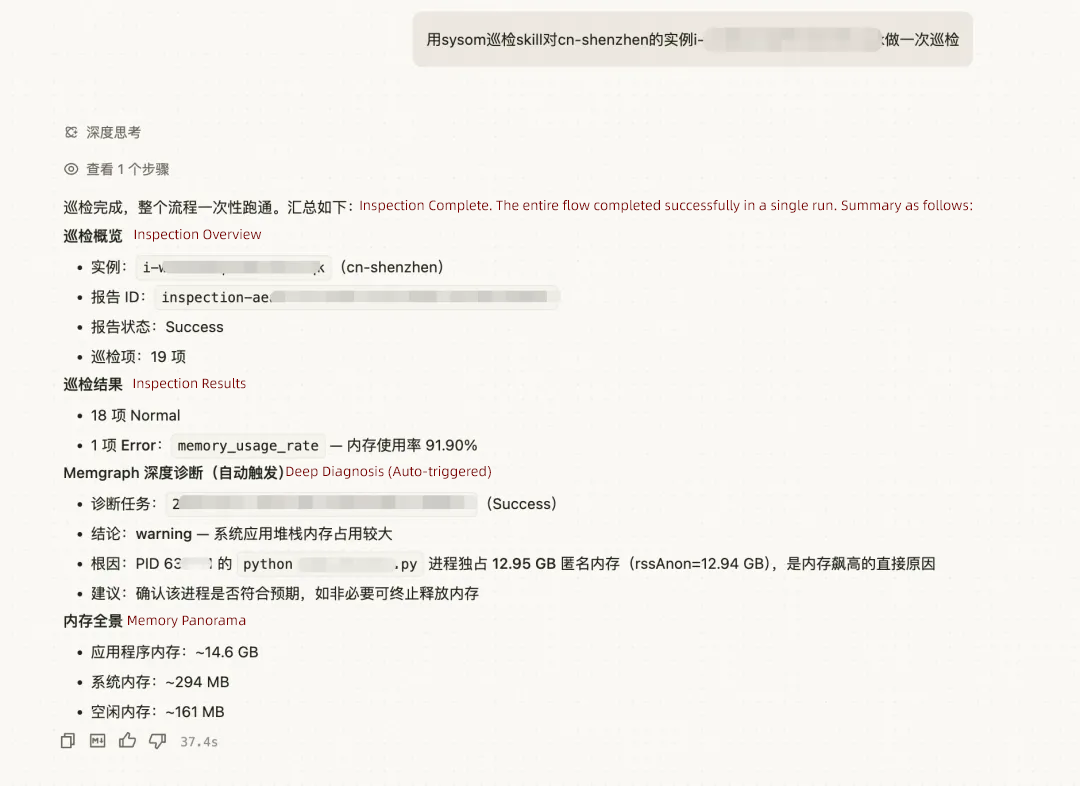
Out of 19 inspection items executed, 18 returned Normal, while 1 Error triggered: memory usage at 91.90%. With only 161 MB of free memory remaining, the system was one traffic spike away from an OOM crash.
Crucially, the report didn't just stop at "high memory usage." The moment the error triggered, a deep memgraph diagnosis was automatically initiated, serving up the exact answer on the very next screen:
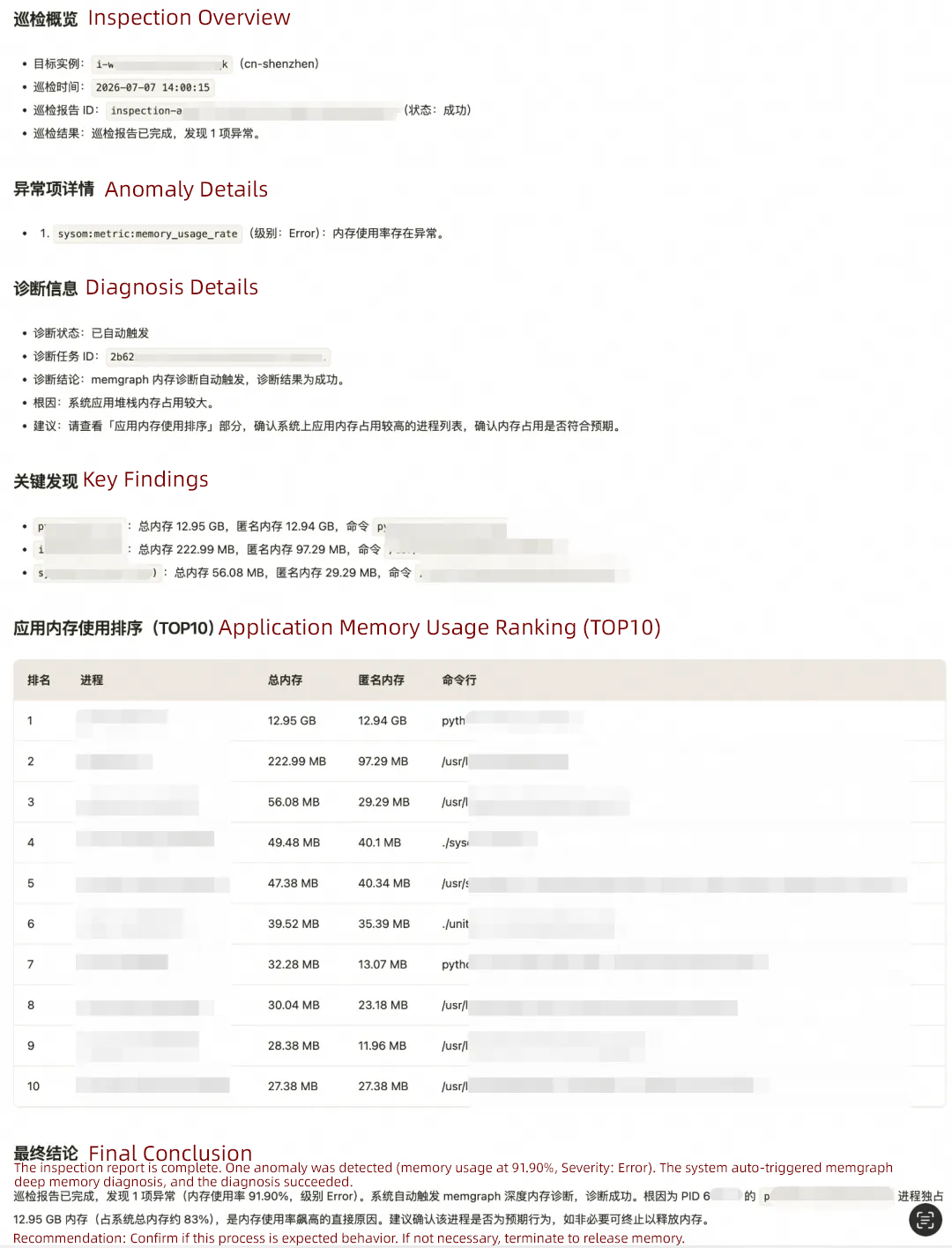
The inspection and diagnosis pinpointed that a user's python process was exclusively hoarding 12.95 GB of anonymous memory—roughly 83% of the system's total memory. This was the direct root cause of the spike. Furthermore, the combined memory usage of the remaining top 10 processes was less than 600 MB, immediately ruling out the possibility of cumulative scattered consumption.
Lin now only had to do one thing: confirm whether this python process was executing expected behavior. If not, a simple kill command would instantly reclaim 12 GB of memory.
From the initial wake-up call to full remediation, a grueling forty-minute ordeal was compressed into less than five minutes.
The true cost of a 3 AM wake-up call is never just forty minutes of overtime. It's the crushing brain fog that hits the on-call engineer at 3 PM the next day. It's the shattered focus of the five other team members dragged into the emergency chat. It's the slow erosion of trust every time the business team asks, "Did the system crash again?" It's the sheer anxiety of every passing second during peak traffic windows. You can't easily put a number on these costs, but anyone in O&M feels their weight.
Multiply these hidden costs by 365 days a year, factor in your team size, and you finally see the true ledger of your stability investments. Ultimately, the SysOM Inspection Skill isn't just about saving forty minutes. It's about dismantling a reactive model that relies heavily on individual experience, sheer luck, and whoever happens to be the most awake at 3 AM. It transforms tribal O&M knowledge into an automated organizational capability.
That Thursday morning story could be forty minutes of sheer panic, or it could be a simple report generated in 37 seconds. The SysOM Inspection Skill is designed to eliminate surprises and deliver actionable conclusions during every inspection. It ensures your infrastructure is fully prepared long before the next traffic surge hits.
From detecting anomalies and pinpointing the root cause to providing actionable recommendations, every inspection brings you one step closer to rock-solid business stability.
Many teams have spent years refining their inspection processes, successfully solving the baseline question: "Is there an anomaly?" However, in real-world O&M scenarios, when an alert triggers, frontline engineers urgently need answers to three advanced questions: How severe is this anomaly? What is the most likely root cause? And what specific action needs to be taken next?
The SysOM Inspection Skill is specifically designed to front-load the answers to these questions by embedding them directly into the inspection process. Currently, the product boasts over 40 inspection capabilities. These span a wide array of dimensions, including system load, memory usage, disk read/write latency, scheduling delays, file handles, thread resources, root partitions and inodes, socket leaks, TCP/UDP memory, and various memory leak risks. By capturing everything from baseline performance metrics to deep kernel mode risks, it ensures that all critical failure signals are brought into the inspection spotlight.
For high-risk scenarios, the system doesn't just throw an alert and stop there. Instead, it automatically triggers the SysOM Diagnostic Skill. This spans multiple OS subsystems—including load, memory, network, disk, and scheduling—tracing the troubleshooting path all the way down to the root cause. Internal evaluations show an overall anomaly detection accuracy of over 80%, with a zero percent false-positive rate for high-risk items. In other words, when it warns you of a "high risk," it's never crying wolf.
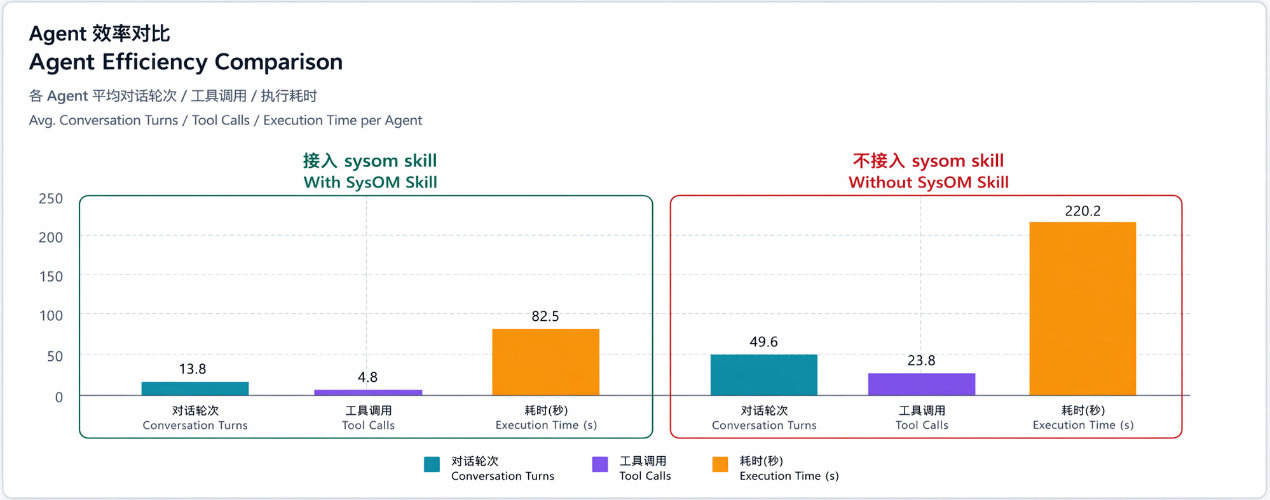
The SysOM Inspection Skill encapsulates the deep troubleshooting expertise of Linux kernel specialists. Consequently, when an AI tackles a Linux system issue, it no longer relies on the model to just "take a guess." Instead, it executes a rigorously verified troubleshooting path. To prove the effectiveness of this expert knowledge, we set up a controlled evaluation using 16 real-world OS failure scenarios. We tested two groups: one group of Agents was equipped with the SysOM Inspection Skill, while the control group had to brute-force the investigation using only general-purpose AI capabilities.
Let's look at efficiency first. When facing identical system issues, the Agents equipped with the Skill showed a dramatic reduction in dialogue turns, tool invocations, and overall execution time. They didn't waste time on trial-and-error or piecing together fragmented commands; instead, they followed the expert path straight to the solution. System outages typically require pulling multiple engineers into a chat and cross-validating data across various tools. By automating this, we save far more than just AI inference time—we preserve the frontline team's focus and eliminate costly context switching.
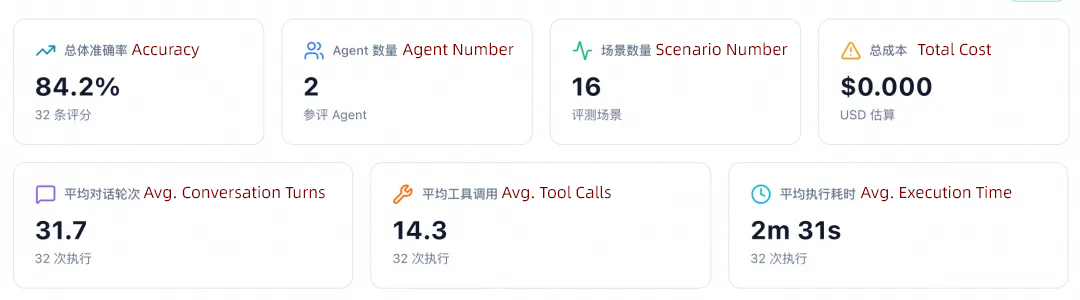
Now, let's examine accuracy. Overall, Agents equipped with the Skill demonstrated a massive leap in diagnostic accuracy for kernel-related issues compared to the baseline. When we break down the specific scenarios, the performance gap was most glaring in areas requiring deep expert judgment. For complex kernel-layer problems like socket buffer leaks, vmalloc memory anomalies, and memcg misconfigurations, the Skill-equipped Agents delivered a striking improvement in accuracy. This reinforces an intuitive conclusion: the more a kernel issue demands specialized expertise, the more exponential the value the Skill provides.
In other words, we have packaged the exact same expert capabilities into two distinct formats. For human engineers, it operates as an out-of-the-box inspection product. For an Agent, it functions as a directly callable capability. Whether you are building your own O&M AI from the ground up or simply want to plug into a ready-made inspection service, you no longer need to reinvent the wheel by painfully accumulating verified Linux troubleshooting experience.
The SysOM Inspection Skill is now open-source on the Alibaba Cloud Agent Skills Platform. It includes comprehensive troubleshooting paths, diagnostic prompts, and execution scripts, ready to be loaded directly into popular Agent environments like Qoder and Claude Code. By pairing it with the previously open-sourced SysOM Diagnostic Skill, you unlock the complete end-to-end workflow: "inspection detects issues → diagnosis pinpoints the root cause → delivering remediation suggestions." Moving forward, both capabilities will be officially unified in the upcoming SysOM Skill Bundle. S
SysOM Inspection Skill Link: https://skills.aliyun.com/skills/alibabacloud-alinux-sysom-inspection
A single command is all it takes to install (using Qoder as an example):
npx skills add aliyun/alibabacloud-aiops-skills --skill alibabacloud-alinux-sysom-inspection --agent qoder -y --full-depthAfter installation is complete, simply send your request directly in the Agent dialogue. For example, "Help me inspect the i-xxx instance in the cn-shenzhen region." The Agent will automatically invoke the inspection capabilities within the Skill. If high-risk items are triggered, it will automatically initiate SysOM's deep diagnosis, ultimately outputting a comprehensive report containing the anomalies, key findings, and the root cause. Installation instructions for different Agent hosts can be found on the Skills page linked above.
Are You Using Hermes? It Can Also Possess the Full Set of ANOLISA Capabilities
A Comprehensive Performance Analysis of Alibaba Cloud Linux 4

120 posts | 6 followers
FollowAlibaba Cloud Native Community - August 19, 2026
OpenAnolis - July 14, 2026
OpenAnolis - September 15, 2026
OpenAnolis - May 27, 2026
Alibaba Cloud Native Community - August 26, 2026
Alibaba Cloud Native Community - August 25, 2026
120 posts | 6 followers
Follow Bastionhost
A unified, efficient, and secure platform that provides cloud-based O&M, access control, and operation audit.
Learn More Alibaba Cloud Linux
Alibaba Cloud Linux is a free-to-use, native operating system that provides a stable, reliable, and high-performance environment for your applications.
Learn More Managed Service for Grafana
Managed Service for Grafana displays a large amount of data in real time to provide an overview of business and O&M monitoring.
Learn More ID Verification
A digital ID verification solution to provide highly secure, convenient, and flexible remote ID verification
Learn MoreMore Posts by OpenAnolis

