This week, Alibaba’s newly open-sourced CosyVoice 3 supports nine languages and achieves SOTA performance across multiple established benchmarks; AgentScope releases upgrades to better support the development and deployment of production-grade AI agents; Meanwhile, a Teams plan is launched to empower businesses with scalable, secure, and production-ready AI-powered development.
Alibaba has open sourced CosyVoice 3, a multilingual speech synthesis model that significantly outperforms its predecessor in content consistency, speaker similarity, and prosodic naturalness.
At the core of the model is a novel speech tokenizer that enhances a wide range of speech understanding and analysis capabilities—including automatic speech recognition (ASR), speech emotion recognition, language identification, audio event detection, and speaker analysis. Additionally, the model introduces a new differentiable reward optimization (DiffRO) method for post-training, which directly optimizes speech tokens. This technique is particularly effective for large language model (LLM)-based speech synthesis models, enabling more precise and expressive voice generation.
Trained on an expansive dataset of 1 million hours of audio, the model is available in two variants—featuring 0.5 billion and 1.5 billion parameters, respectively. CosyVoice 3 supports nine languages including English, Chinese, German, Spanish, French, Italian, Japanese, Korean, and Russian. It achieves state-of-the-art (SOTA) performance across multiple established benchmarks.
As a zero-shot speech generation model, CosyVoice 3 marks a major leap forward in multilingual, high-fidelity voice synthesis—paving the way for more versatile, natural, and context-aware voice applications in real-world scenarios such as virtual assistants, audiobook/podcast narration, customer service automation, voice-over production for short videos and games, and interactive dialogue generation in educational settings.
Global developers can now access to the model on Hugging Face, Github and ModelScope and experience the model on demo site.
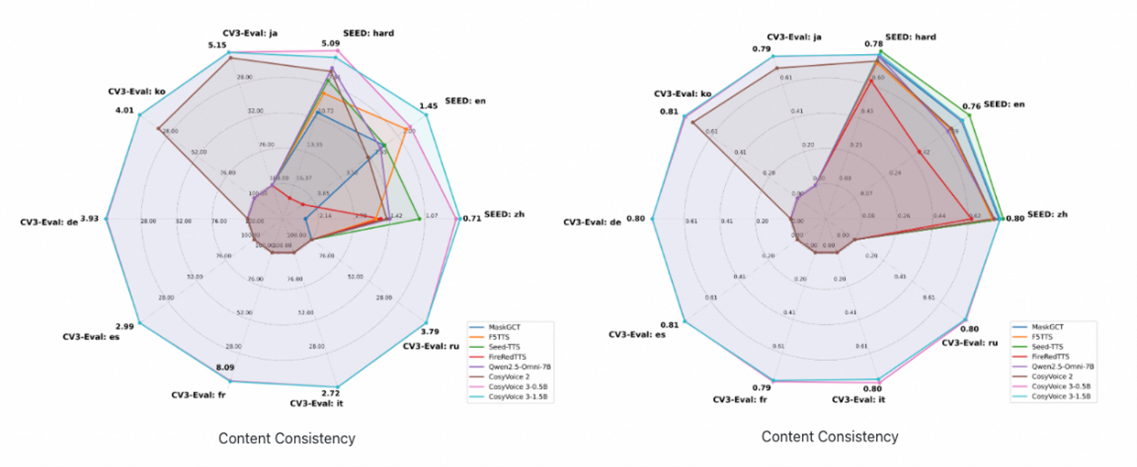
CosyVoice3 achieves remarkable performance on content consistency
Alibaba Tongyi Lab has announced upgrades to AgentScope, its AI agent development framework, focusing on broader application scenarios, stronger infrastructure, and improved production readiness to better support the development and deployment of production-grade AI agents.
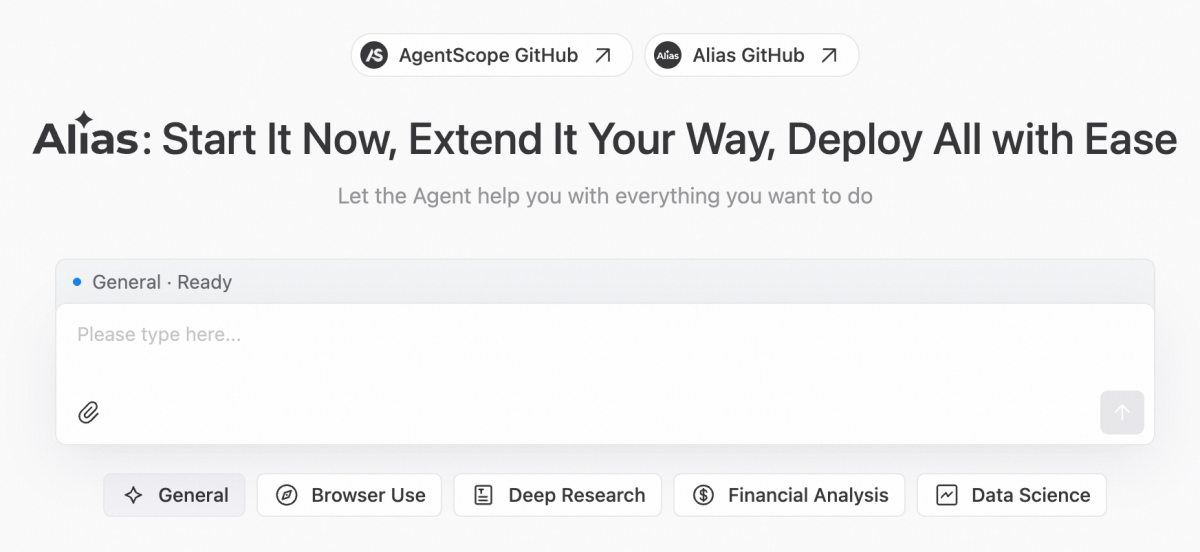
On the application side, AgentScope has evolved from providing foundational capabilities—such as deep research, browser-use, and planning—to delivering ready-to-use, scenario-optimized agent applications. For example, Alias is a production-ready agent that dynamically switches between general and specialized modes (e.g., Financial Analysis, Data Science), supports one-click local deployment, and serves as a customizable template for domain-specific solutions. EvoTraders simulates real-world investment teams and uses the ReMe memory system for strategy refinement. Both Alias and EvoTraders offer highly customizable interfaces for configuring toolsets, prompts, and orchestration logic, and can be used out of the box or extended to integrate proprietary tools, data, and business workflows.
At the foundational layer, AgentScope introduces Agent Skill, a plug-and-play dynamic skill framework that lets agents flexibly compose capabilities for complex tasks. It also introduces AgentScope-Studio, a visual development environment with dual-view message streams, ReAct state tracing, and OpenTelemetry integration to improve debugging efficiency and developer experience.
For deployment, AgentScope-Runtime v1.0 introduces a “white-box” paradigm that balances ease of use with flexibility. Developers can now precisely control the agent application lifecycle without sacrificing simplicity. The runtime natively supports multi-agent collaboration, enabling customizable sharing of sessions, memory, and toolkits for efficient coordination and even enables cross-framework orchestration to ensure consistency from development to production. It also features a sandbox matrix composed of multiple types, covering local and cloud environments across a range of device types, providing secure, isolated execution for browser control, file operations, and mobile automation—all with MCP-based extensibility.
The AgentScope ecosystem also includes SparkChat with a built-in Web UI for instant visual interaction and AgentScope-Java v1.0 for enterprise Java stacks.
The latest AgentScope upgrades are now publicly available on GitHub, offering enterprises and developers access to a more robust, production-ready agent development ecosystem.
Qoder, an agentic coding platform built for real-world software development, has launched Qoder Teams—a new plan designed to empower businesses of different sizes with scalable, secure, and production-ready AI-powered development.
The Teams plan delivers enterprise-grade capabilities, including advanced knowledge services, enhanced context awareness, and specification-driven development. It also offers a flexible suite of tools—such as the Qoder IDE, the Qoder plugin for JetBrains IDEs, and the Qoder CLI—to integrate seamlessly into diverse team workflows and existing development environments.
Key enterprise features further enhance the offering: centralized billing, single sign-on (SSO) integration, and upcoming support for shared credit pools. With this upcoming functionality, organizations will be able to purchase AI credits collectively and allocate them dynamically across teams—enabling flexible, usage-based resource management.
By integrating AI features into the development environment, Qoder helps engineering teams streamline coding, reduce context switching, and accelerate delivery —all without compromising on security or code quality.
This article was originally published on Alizila written by Crystal Liu and Claire Mo.
Alibaba Unveils Wan2.6 Series Enabling Everyone to Star in Videos

1,546 posts | 519 followers
FollowAlibaba Cloud Native Community - June 23, 2026
Alibaba Cloud Native Community - December 11, 2025
Alibaba Cloud Native Community - February 3, 2026
Alibaba Cloud Native Community - January 22, 2026
Alibaba Cloud Community - September 27, 2025
Alibaba Cloud Native Community - June 8, 2026
1,546 posts | 519 followers
Follow QwenWork
QwenWork is dedicated to helping employees strengthen their professional competitiveness in the AI era and to enabling enterprises to improve organizational effectiveness.
Learn More Token Plan
Build more, spend less. One plan, every modality.
Learn More
Alibaba Cloud Model Studio
A one-stop generative AI platform to build intelligent applications that understand your business, based on Qwen model series such as Qwen-Max and other popular models
Learn More Qwen
Qwen
Full-range, open-source, multimodal, and multi-functional
Learn MoreMore Posts by Alibaba Cloud Community

