By Liu Zunfei (Yiyan)
A ticket spanning multiple business modules often requires several types of specialized expertise working together: explaining business rules, verifying system data, analyzing the causes of anomalies, and then consolidating the findings from different stages into an evidence-based, actionable response.
Enterprises have already accumulated business documentation, system interfaces, and operating procedures. Once these resources are made available to Agents, the next question is: how can different areas of expertise be organized so that each fulfills its own responsibilities, they make coordinated progress, and they are accountable for the final outcome?
With identity, communication, teams, and tasks as its foundation, Alibaba Cloud AgentCore enables specialized Agents and human members to collaborate on business work. Enterprises can combine knowledge, tools, Skills, and models according to responsibilities, continuously track work through the task system, and use AgentLoop to evaluate outcomes and optimize configurations.
As the scope of business handled by an Agent expands, its tools, knowledge, and working rules grow as well. When dealing with complex tasks, enterprises typically need to consider three types of engineering pressure.
Specialized roles provide a way to organize work that addresses these issues: assign domain knowledge and tool configurations to the corresponding Agents for maintenance, define inputs, responsibilities, and delivery requirements, and then combine these capabilities as each task requires.
For example, in an enterprise ticket response system, a domain Agent can explain business rules, a business verification Agent can retrieve the necessary information, and a diagnostic Agent can analyze system issues. Work proceeds independently in parallel where possible, with sequential handoffs where dependencies exist. A Leader Agent then consolidates the response.
This division of work should be designed around business capabilities and maintenance responsibilities. Work with clear boundaries and only a few steps can be completed directly by a single Agent; work involving multiple specialized domains, ongoing execution, or result acceptance is better suited to a team.
The collaboration capabilities enterprises need can be summarized in four areas: combining assets on demand, clearly defining cross-departmental authority and responsibilities, continuously tracking tasks, and measuring quality and cost.
Once specialized Agents form a team, it must be clear who is participating, how they communicate, which resources they can access, and who is responsible for driving tasks to completion.
In AgentCore's collaboration architecture, AgentIdentity handles identity integration and mapping, Matrix supports rooms, membership relationships, and message communication, and Team and Task organize the division of work and delivery. Build and management capabilities support asset configuration, member roles, and team maintenance, while observability and governance capabilities provide a basis for runtime analysis and continuous optimization.
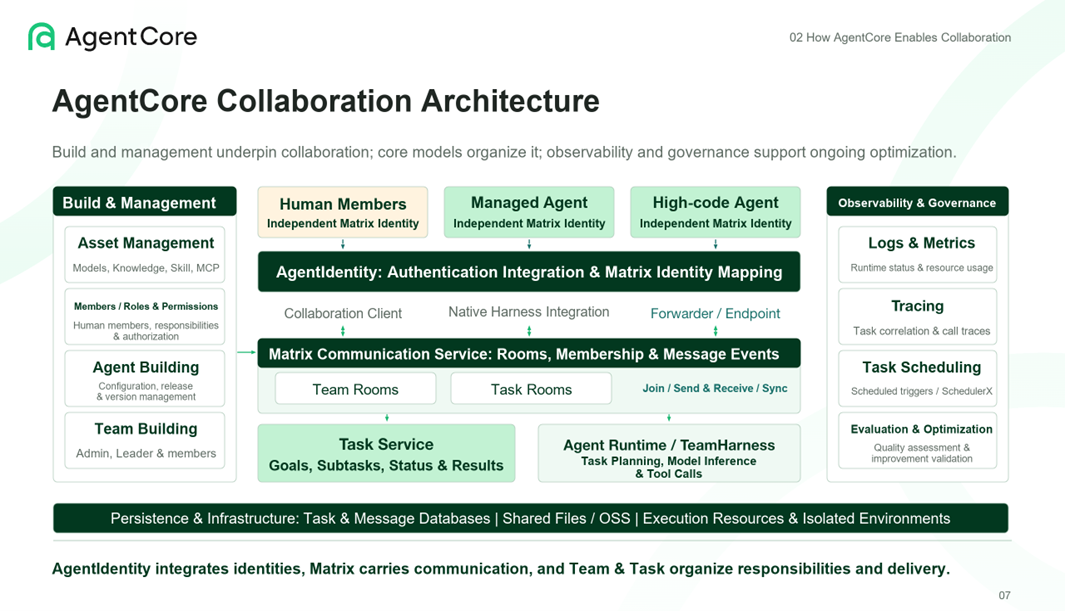
Human members, hosted Agents, and integrated, independently developed Agents each participate in collaboration under a separate identity. Enterprises can use AgentIdentity to integrate their existing account systems and then associate the corresponding Matrix identities.
This makes collaboration relationships clearer: the member who made a request, the Agent that took on the work, and the person or Agent that submitted the result are all explicitly identifiable. Business resources are still accessed according to responsibilities and permissions; joining the same collaboration room does not mean sharing all data and tool permissions.
Matrix extends human-to-human communication to human-to-Agent and Agent-to-Agent communication. Members publish plans, report progress, add information, and reference results in rooms, allowing users to understand the collaboration process through the message timeline.
Visible information includes the analytical explanations members share publicly, execution progress, and deliverables. Human experts can also contribute business judgments, correct information, or participate in result acceptance within the same space, keeping collaboration close to the communication practices used in everyday work.
The team Admin is a human, responsible for team information, members, and Leader configuration. The Leader Agent is responsible for understanding objectives, developing plans, coordinating the division of work, and consolidating results. Worker Agents take on specific domain work, while a human TL or domain experts participate in judgment and acceptance as configured for the task.
Enterprises can preserve each business team's maintenance responsibilities while enabling their specialized capabilities to collaborate on shared tasks.
Identity and communication address participation and interaction. A business activity also needs clear objectives, responsibilities, progress, and completion criteria.
A task is a piece of work with clear objectives, assigned responsibilities, execution status, and delivery requirements. The AgentCore task system organizes it through three core objects:
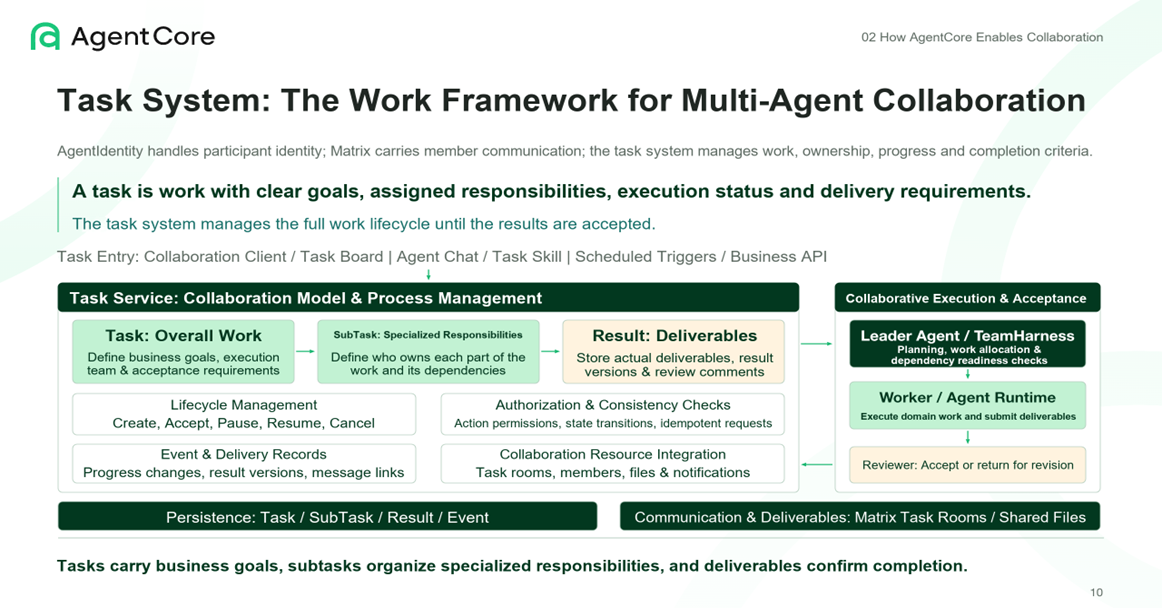
Returning to the example of responding to tickets spanning multiple business areas, the Leader can organize subtasks around the objective and have the relevant domain Agents look up rules, verify information, and analyze issues. Each member submits artifacts, and the Leader advances the work based on dependencies and completion status. After consolidation, the results are submitted to the configured reviewer for acceptance.
During task execution, users can view progress, add information, and inspect subtasks and result files. When work is blocked or changes are needed, status and comments are continuously recorded, allowing the team to continue from the work already completed. Specific operations are performed according to task status and permissions.
At the implementation level, TeamHarness provides role-specific collaboration Skills for Leader and Worker, and Agents interact with the task service through the accompanying task CLI. The Leader is responsible for planning and task management, while the Worker is responsible for accepting assignments, reporting status, and submitting results. The task service validates operation permissions and state transitions, while Matrix handles communication and notifications between members.
This allows business stakeholders to focus configuration on domain responsibilities, business assets, and delivery requirements. The division of work, states, events, and results generated during collaboration are represented by a unified task model. For details of the mechanisms, see the TeamHarness Usage Guide and Team Task Documentation.
For recurring work, enterprises can also configure scheduled tasks. They can set execution times, target teams, and task content in the interface, or create rules by conversing with an Agent. Each trigger creates a separate execution record, and the same task mechanisms continue to be used to track the results. Disabling a scheduling rule controls subsequent triggers, while canceling a particular task controls that execution.
Enterprises can implement multi-agent collaboration along the path of preparing assets, configuring specialized Agents, forming teams, and integrating with business workflows.
Knowledge bases and retrieval services provide a basis for business work. Organize business documentation, domain knowledge, rules, and historical cases, and establish retrieval capabilities while defining who is responsible for the materials, their scope of applicability, and how they are updated.
MCP and CLI toolsets provide business operation capabilities. Existing business APIs can be published as MCP tools through an AI gateway, with descriptions, parameters, and permissions configured. Existing command-line capabilities can also be used as CLI tools, with the necessary dependencies, execution environments, and access controls prepared.
Skill captures reusable working methods. Organize enterprise SOPs and domain experience into applicability conditions, processing steps, exception handling, and delivery requirements to guide Agents in using knowledge and tools to complete their work.
These assets can be maintained independently and combined flexibly according to Agent responsibilities. A knowledge service or business tool can also be reused by multiple Agents within the scope of authorization.
Define the responsibilities, inputs, and delivery boundaries of each specialized Agent, then configure matching knowledge, Skills, tools, models, and permissions. An organizational division of work helps clarify maintenance responsibilities, while the specific granularity should be determined by business capabilities and delivery interfaces.
Models can also be selected by role. Complex planning and cross-domain consolidation have different model capability requirements from information extraction and classification governed by clear rules. Provided that quality requirements are met, enterprises can choose suitable models for different roles and compare costs and effectiveness using actual task data.
Once specialized Agents can work independently, the team Admin configures the Leader and members, defines how human experts participate, and organizes these capabilities into a team for a specific business area.
AgentCore offers five types of access: a Web collaboration client, DingTalk, Feishu, WeCom, and integration via the AG-UI protocol. The three enterprise IM platforms provide access through their respective bots associated with the Leader Agent; business frontends or custom-built applications can integrate through AG-UI.
Users submit objectives through familiar entry points, and the Leader coordinates specialized members and consolidates results. Configuration and presentation differ across channels, so enterprises can choose an integration path suited to their work scenarios.
When multiple Agents work on multiple tasks concurrently, execution paths, dependencies, and invocation records also grow in number. Starting from business tasks, enterprises need to understand which stages are waiting, which tools are encountering problems, and which calls cause redundant resource consumption.
AgentCore provides task and execution data, while AgentLoop supports observability, evaluation, and continuous optimization. After correlating Task, SubTask, and Agent Trace, collaboration performance can be analyzed using task events, model and tool calls, and deliverables. Correlation analysis requires the corresponding data integration and identifiers.
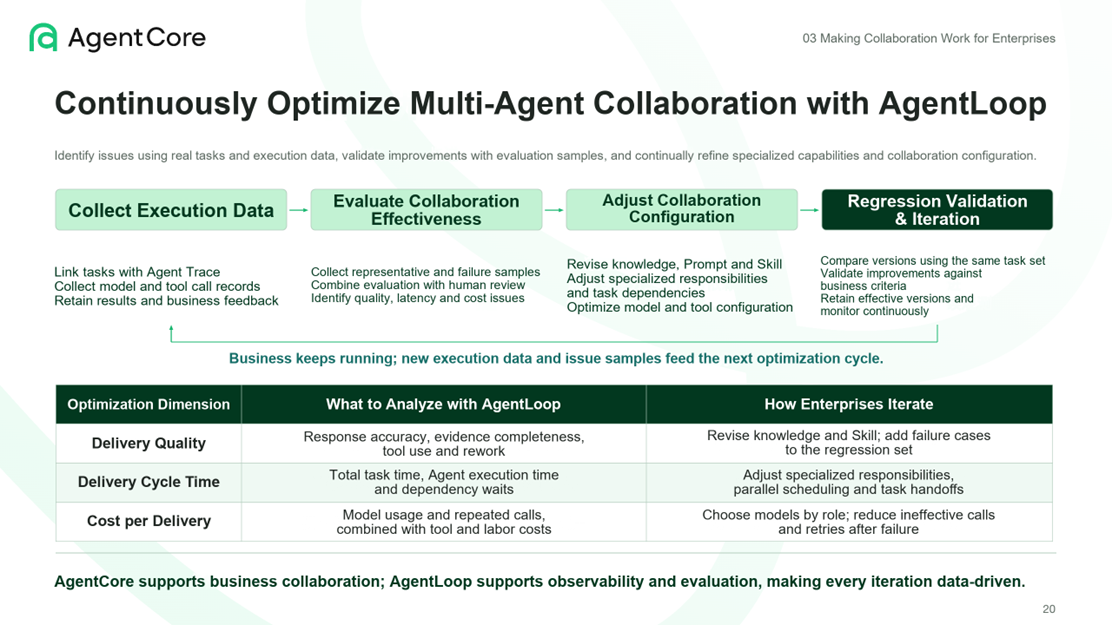
Enterprises can organize continuous iteration into four steps:
Evaluation can focus on three dimensions: delivery quality, assessed through accuracy, completeness of evidence, and rework; delivery cycle, distinguishing actual execution from time spent waiting on dependencies; and cost per delivery, accounting for models, tools, retries after failures, and human effort.
This provides a comparable basis for every configuration change, while assets and configurations validated as effective can continue to be reused. For AgentLoop's observability and evaluation capabilities, see the Product Overview.
Responding to tickets spanning multiple business areas is one entry point for enterprises to organize specialized Agents. Enterprises can start by selecting a type of work with clear responsibility boundaries, the necessary knowledge and interfaces in place, and results that can undergo acceptance review. They can then define delivery criteria and combine the required assets and members.
AgentCore implements specialized roles through identity, communication, team, and task mechanisms, enabling enterprises to organize existing knowledge and system capabilities, continuously track work, and measure collaboration effectiveness through business outcomes.
Learn about Alibaba Cloud AgentCore and build your multi-agent collaboration team.
· Visit the AgentCore Official Website
· View the Team Task Usage Documentation
Using Nacos 3.3.0 ARD to Enable Task-Based Tool and Skill Discovery for Agents

814 posts | 61 followers
FollowAlibaba Cloud Native Community - October 12, 2026
Alibaba Cloud Native Community - November 6, 2026
Alibaba Cloud Native Community - October 26, 2026
Alibaba Cloud Native Community - October 27, 2026
Alibaba Cloud Native Community - October 11, 2025
Alibaba Cloud Native Community - May 26, 2026
814 posts | 61 followers
Follow Token Plan
Build more, spend less. One plan, every modality.
Learn More QwenWork
 is dedicated to helping employees strengthen their professional competitiveness in the AI era and to enabling enterprises to improve organizational effectiveness.
Learn More Wan3.0
Unleash Your Creativity Try Wan 3.0 now — longer narratives, greater control, endless creativity.
Learn More Qoder
From Assisted to Autonomous — Adapting to Every Programming Need
Learn MoreMore Posts by Alibaba Cloud Native Community

