June 2026 is a month of practical wins across the Alibaba Cloud database portfolio — updates you can turn on today and see value from immediately, without rebuilding your architecture. The theme is simple: lower cost, unified search, and easier data mobility. PolarDB for MySQL makes cross-region full-text search self-serving, PolarDB-X lets you cut storage cost for large fields with a single keyword, and Data Transmission Service (DTS) opens up several new heterogeneous migration and real-time ingestion paths.
Below is a quick overview of all twelve releases, followed by deep dives into the three most impactful, easiest-to-adopt updates.
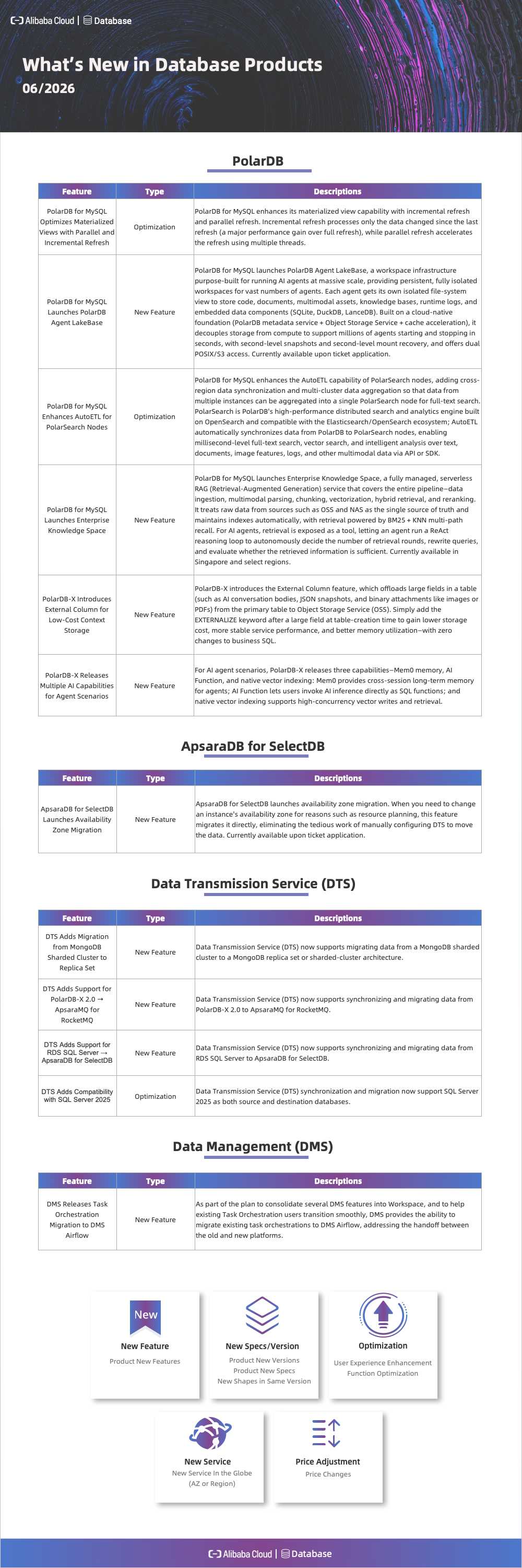
| Product | Feature | Type |
|---|---|---|
| PolarDB for MySQL | Materialized Views: Parallel & Incremental Refresh | Enhancement |
| PolarDB for MySQL | PolarSearch AutoETL: Cross-Region & Multi-Cluster Aggregation | Enhancement |
| PolarDB for MySQL | PolarDB Agent LakeBase | New Feature |
| PolarDB for MySQL | Enterprise Knowledge Space | New Feature |
| PolarDB-X | External Column for Low-Cost Context Storage | New Feature |
| PolarDB-X | AI Capabilities for Agent Scenarios (Mem0 / AI Function / Vector Index) | New Feature |
| ApsaraDB for SelectDB | Availability Zone Migration | New Feature |
| Data Transmission Service (DTS) | MongoDB Sharded Cluster → Replica Set Migration | New Feature |
| Data Transmission Service (DTS) | PolarDB-X 2.0 → ApsaraMQ for RocketMQ | New Feature |
| Data Transmission Service (DTS) | RDS SQL Server → ApsaraDB for SelectDB | New Feature |
| Data Transmission Service (DTS) | SQL Server 2025 Compatibility | Enhancement |
| DMS (Data Management) | Task Orchestration Migration to Airflow | New Feature |
What it is:
PolarDB for MySQL enhances the AutoETL capability of its PolarSearch nodes, adding cross-region data synchronization and multi-cluster data aggregation — so data from many instances can flow into a single PolarSearch node for full-text and vector search without any hand-built pipeline.
Description:
Traditionally, if you wanted to run unified full-text search over data scattered across multiple database instances or regions, you had to build and operate your own ETL pipeline: extract from each source, transform, and load into a separate search cluster, then keep it all in sync. That pipeline is fragile, costly to maintain, and a common source of stale search results.
PolarSearch is PolarDB's high-performance distributed search and analytics engine, built on OpenSearch and compatible with the Elasticsearch/OpenSearch ecosystem. Its AutoETL feature already synchronizes data from PolarDB to PolarSearch nodes automatically. With this release, AutoETL can now pull from multiple clusters and across regions, consolidating everything into one PolarSearch node. From there you get millisecond-level full-text search, vector search, and intelligent analysis over text, documents, image features, logs, and other multimodal data — accessible by API or SDK.
Why developers and enterprises should pay attention:
What it is:
PolarDB-X introduces the External Column feature, which offloads large fields — think JSON snapshots, long text bodies, and binary attachments like images or PDFs — from the primary table to Object Storage Service (OSS), with zero changes to your business SQL.
Description:
Large fields are expensive to keep in a primary table. They inflate storage cost, put pressure on memory and buffer pools, and can drag down the performance of the queries that don't even need them. The usual workaround — manually splitting large blobs into a separate store and rewriting application logic to fetch them — is invasive and error-prone.
External Column solves this declaratively. At table-creation time, you simply add the EXTERNALIZE keyword after a large field. PolarDB-X then transparently stores that field's data in OSS while the table continues to behave exactly as before. Your application SQL stays untouched, but the primary table gets leaner: lower storage cost, more stable service performance, and better memory utilization. It's a natural fit for storing large-object attachments and, increasingly, AI agent context such as long conversation bodies.
Why developers and enterprises should pay attention:
What it is:
DTS expands its connectivity with two practical new paths: real-time ingestion from RDS SQL Server into ApsaraDB for SelectDB, and migration from a MongoDB sharded cluster to a replica set (or sharded-cluster) architecture — both fully managed by DTS.
Description:
Getting data from one engine to another has always been the unglamorous but critical work behind analytics and modernization projects. Two common asks got much easier this month.
First, RDS SQL Server → ApsaraDB for SelectDB. Traditionally, feeding SQL Server transactional data into a real-time analytics warehouse meant building and babysitting your own ETL. DTS now synchronizes and migrates that data directly, streaming SQL Server business data into the SelectDB real-time warehouse in one step — so you can run real-time OLAP analytics without any custom pipeline.
Second, MongoDB sharded cluster → replica set. Sharded MongoDB deployments were previously awkward to migrate. DTS now supports moving data from a MongoDB sharded cluster to a replica set or sharded-cluster target, opening a clean path for cloud migration, architecture restructuring, or version upgrades — with the whole process managed by DTS to reduce manual effort and risk.
Rounding out the month, DTS also adds PolarDB-X 2.0 → ApsaraMQ for RocketMQ streaming for CDC-based event-driven architectures, and day-one SQL Server 2025 compatibility as both source and destination.
Why developers and enterprises should pay attention:
PolarDB for MySQL enhances its materialized view capability with incremental refresh and parallel refresh. Incremental refresh processes only the data changed since the last refresh — a major performance gain over full refresh — while parallel refresh uses multiple threads to speed things up. Together they dramatically cut refresh time and resource usage, keeping reports and aggregated results fresher in near real time with less impact on online workloads.
PolarDB for MySQL launches PolarDB Agent LakeBase, a workspace infrastructure purpose-built for running AI agents at massive scale. Each agent gets its own fully isolated, persistent file-system view for code, documents, multimodal assets, knowledge bases, and embedded data components. Built on PolarDB metadata service + OSS + cache acceleration, it decouples storage from compute so cost scales with business activity rather than agent count, with second-level snapshots and dual POSIX/S3 access.
Note: Currently available upon ticket application.
PolarDB for MySQL launches Enterprise Knowledge Space, a fully managed, serverless RAG service covering the entire pipeline: ingestion, multimodal parsing, chunking, vectorization, hybrid retrieval (BM25 + KNN), and reranking. It treats raw data in sources like OSS and NAS as the single source of truth and maintains indexes automatically, and it exposes retrieval as a tool that AI agents can call directly in a ReAct reasoning loop.
Note: Currently available in Singapore and select regions.
PolarDB-X releases three capabilities for AI agent scenarios: Mem0 memory for cross-session long-term agent memory, AI Function for invoking AI inference directly as SQL functions, and native vector indexing for high-concurrency vector writes and retrieval. Together they let PolarDB-X serve an agent's memory, inference, and vector needs in one place using familiar SQL — reducing the complexity of bolting on external vector stores and inference services.
ApsaraDB for SelectDB launches availability zone migration. When you need to change an instance's availability zone — for resource planning or AZ moves — this feature migrates it directly, eliminating the tedious work of manually configuring DTS to move the data, and reducing business disruption.
Note: Currently available upon ticket application.
As part of consolidating several DMS features into Workspace, DMS now lets existing Task Orchestration users migrate their orchestrations to Airflow. This provides a smooth handoff between the old and new platforms, avoiding job interruption or rebuilds, protecting existing orchestration assets, and lowering migration cost.
June's releases share a common thread: they make hard, expensive things simple and self-serviceable — aggregating search data across regions, shrinking storage cost with a single keyword, and moving data freely between engines. These are the kinds of practical, low-effort wins that compound over time. We'll be back next month with the latest updates across the Alibaba Cloud database portfolio.
Learn more about Alibaba Cloud Database services: ApsaraDB Product Page
ApsaraDB for ClickHouse Releases an Enterprise-Grade Agent Observability Solution
ApsaraDB - March 29, 2026
ApsaraDB - July 23, 2024
ApsaraDB - April 20, 2026
ApsaraDB - May 21, 2026
ApsaraDB - February 27, 2026
ApsaraDB - July 28, 2025
 Data Transmission Service
Supports data migration and data synchronization between data engines, such as relational database, NoSQL and OLAP
Learn More PolarDB for MySQL
Alibaba Cloud PolarDB for MySQL is a cloud-native relational database service 100% compatible with MySQL.
Learn More Time Series Database (TSDB)
TSDB is a stable, reliable, and cost-effective online high-performance time series database service.
Learn More Security Center
A unified security management system that identifies, analyzes, and notifies you of security threats in real time
Learn MoreMore Posts by ApsaraDB


