July delivers a strong wave of convergence and AI-native capabilities across the Alibaba Cloud database portfolio. PolarDB for MySQL breaks down the wall between relational and document workloads with native MongoDB protocol support; PolarDB-X embeds a full AI search engine directly inside the database instance; and ClickHouse ships a landmark 26.3 LTS with data-lake federation, GA full-text indexing, and 31-dialect SQL compatibility. Below you'll find an at-a-glance table of all 10 releases, followed by three deep dives into this month's top highlights.
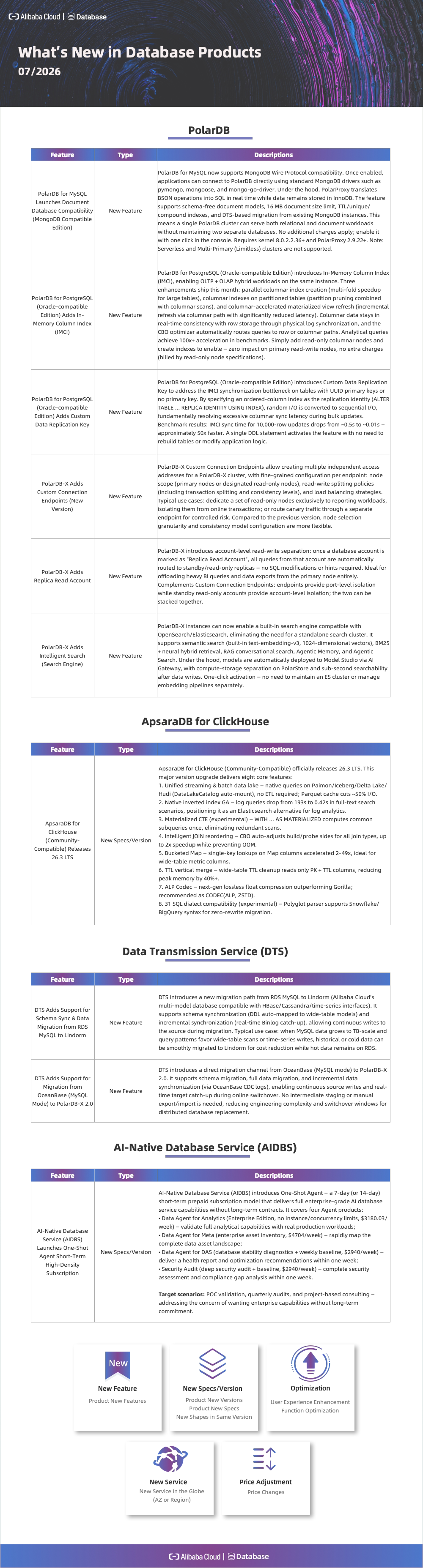
| Product | Feature | Type |
|---|---|---|
| PolarDB for MySQL | Document Database Compatibility (MongoDB Compatible Edition) | New Feature |
| PolarDB for PostgreSQL (Oracle-compatible) | In-Memory Column Index (IMCI) | New Feature |
| PolarDB for PostgreSQL (Oracle-compatible) | Custom Data Replication Key | New Feature |
| PolarDB-X | Custom Connection Endpoints (New Version) | New Feature |
| PolarDB-X | Replica Read Account | New Feature |
| PolarDB-X | Intelligent Search (Search Engine) | New Feature |
| ClickHouse | 26.3 LTS | New Version |
| DTS | RDS MySQL → Lindorm schema sync & data migration | New Feature |
| DTS | OceanBase (MySQL mode) → PolarDB-X 2.0 migration | New Feature |
| AIDBS | One-Shot Agent short-term subscription | New Feature |
What it is:
PolarDB for MySQL now natively supports the MongoDB Wire Protocol, allowing applications to connect with standard MongoDB drivers and issue document operations — all served by the same PolarDB cluster that handles relational workloads.
Description:
PolarDB for PostgreSQL has long offered MongoDB-compatible and DynamoDB-compatible interfaces, enabling applications to talk to a cloud-native relational engine using NoSQL protocols without code changes. With this release, PolarDB for MySQL joins the multi-protocol lineup — meaning the PolarDB family now provides seamless MongoDB access across both its MySQL and PostgreSQL editions. This positions PolarDB as a unified multi-protocol database platform: whether the application speaks SQL, MongoDB Wire Protocol, or DynamoDB, there is a PolarDB engine ready to serve it natively.
On the MySQL side, PolarProxy translates incoming BSON operations into SQL at the wire level, storing documents in InnoDB while exposing a schema-free interface. Applications using pymongo, mongoose, or mongo-go-driver can connect without code changes. The feature supports 16 MB documents, TTL/unique/compound indexes, and DTS-based migration from existing MongoDB instances. No additional charges; enable via console. Requires kernel 8.0.2.2.36+ and PolarProxy 2.9.22+. Serverless and Multi-Primary (Limitless) clusters are not yet supported.
Why developers and enterprises should pay attention:
What it is:
PolarDB-X instances can now activate a built-in search engine compatible with OpenSearch and Elasticsearch, delivering semantic search, hybrid retrieval, and RAG capabilities without deploying or syncing to a separate search cluster.
Description:
Maintaining a standalone Elasticsearch cluster alongside a transactional database introduces data synchronization complexity, operational overhead, and latency gaps between write and searchability. PolarDB-X's Intelligent Search eliminates this by embedding a search engine directly into the database instance. It supports semantic search via a built-in text-embedding-v3 model (1024-dimensional vectors), BM25 + neural hybrid retrieval, RAG conversational search, Agentic Memory, and Agentic Search. Models are automatically deployed to Model Studio via AI Gateway, with compute-storage separation on PolarStore providing sub-second searchability after writes. One-click activation from the console — currently experimental.
Why developers and enterprises should pay attention:
What it is:
ApsaraDB for ClickHouse (Community-Compatible) ships 26.3 LTS — a landmark long-term support release that brings native data-lake federation, GA full-text search indexing, intelligent JOIN optimization, and 31-dialect SQL compatibility.
Description:
ClickHouse users have long needed to ETL data out of data lakes for analysis, rely on external systems for full-text search, and rewrite SQL when migrating from other engines. The 26.3 LTS addresses all three. Native queries on Paimon, Iceberg, Delta Lake, and Hudi tables arrive via DataLakeCatalog auto-mount (with Parquet caching cutting ~50% I/O). The native inverted index graduates to GA, reducing full-text log queries from 193 seconds to 0.42 seconds — a credible Elasticsearch alternative. Materialized CTEs (experimental) eliminate redundant scans; intelligent JOIN reordering provides up to 2x speedup across all join types; Bucketed Map accelerates single-key lookups 2–49x; TTL vertical merge cuts peak memory 40%+ on wide tables; ALP Codec delivers superior lossless float compression; and a Polyglot parser handles 31 SQL dialects (Snowflake, BigQuery, etc.) for zero-rewrite migration.
Why developers and enterprises should pay attention:
Note: Materialized CTE and SQL dialect compatibility are experimental.
PolarDB Oracle-compatible Edition introduces IMCI for HTAP workloads on a single instance. July ships three enhancements: parallel columnar index creation for faster large-table indexing, columnar indexes on partitioned tables combining partition pruning with columnar scans, and columnar-accelerated materialized view refresh. Analytical queries achieve 100x+ acceleration while row-store transactions remain unaffected — CBO auto-routes queries to the optimal path. Enable by adding read-only columnar nodes; no extra charges beyond node specifications.
Addresses the IMCI sync bottleneck for tables with UUID primary keys or no primary key. By designating an ordered-column index as the replication identity (ALTER TABLE ... REPLICA IDENTITY USING INDEX), random I/O converts to sequential I/O, reducing IMCI sync latency from ~0.5s to ~0.01s for 10,000-row updates — approximately 50x faster. A single DDL activates the feature.
Create multiple independent access addresses per PolarDB-X cluster with fine-grained control over node scope, read-write splitting policies (including transaction splitting and consistency levels), and load-balancing strategies. Ideal for isolating reporting workloads on dedicated read-only nodes or routing canary traffic through separate endpoints. The new version offers more flexible node selection granularity and consistency model configuration.
Account-level read-write separation: mark a database account as "Replica Read" and all its queries automatically route to standby/read-only replicas — no SQL changes or hints required. Offloads heavy BI and data-export traffic from the primary node. Complements Custom Connection Endpoints (port-level isolation + account-level isolation can stack).
New migration path from RDS MySQL to Lindorm (multi-model database compatible with HBase/Cassandra/time-series interfaces). Supports schema synchronization with automatic DDL-to-wide-table mapping and incremental Binlog sync. Enables hot-cold data tiering: migrate TB-scale historical data to Lindorm at a fraction of MySQL storage cost while keeping hot data on RDS.
Direct migration channel supporting schema migration, full data migration, and incremental synchronization via OceanBase CDC logs. Enables online switchover with continuous source writes and real-time target catch-up — no intermediate staging or manual export required.
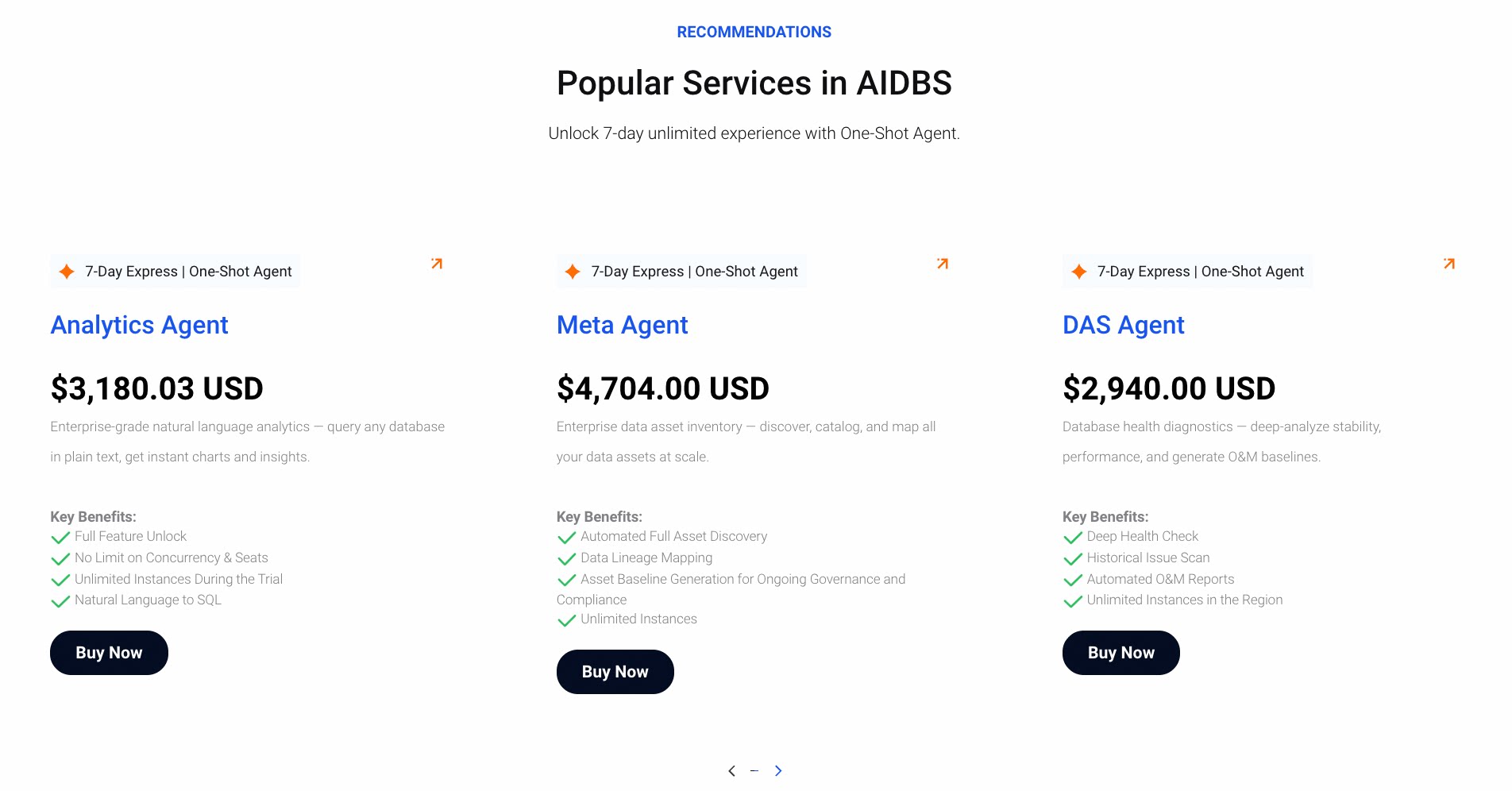
AIDBS introduces One-Shot Agent — a 7-day (or 14-day) prepaid subscription delivering full enterprise-grade AI database service capabilities without long-term contracts. Covers four Agent products: Data Agent for Analytics ($3,180/week), Data Agent for Meta ($4,704/week), Data Agent for DAS ($2,940/week), and Security Audit ($2,940/week). Designed for POC validation, quarterly audits, and project-based consulting where teams need enterprise capabilities on a defined timeline.
July's releases make a clear statement: the database is evolving from a passive data store into an active AI participant — embedding search engines, understanding MongoDB protocols, and federating across data lakes natively. As these capabilities mature from experimental to GA, expect deeper integration between database engines and AI orchestration layers. Stay tuned for next month's roundup.
Learn more about Alibaba Cloud Database services: ApsaraDB Product Page
Harness Engineering: A New Paradigm for Software Production in the AI Era
Get Started with Tair Semantic Caching in 4 Steps: Stop Burning Money on Repetitive AI Queries
ApsaraDB - August 19, 2024
ApsaraDB - August 25, 2025
ApsaraDB - March 29, 2026
ApsaraDB - May 21, 2026
ApsaraDB - April 20, 2026
ApsaraDB - February 27, 2026
 Data Lake Formation
An end-to-end solution to efficiently build a secure data lake
Learn More ApsaraDB for MongoDB
A secure, reliable, and elastically scalable cloud database service for automatic monitoring, backup, and recovery by time point
Learn More Data Lake Storage Solution
Build a Data Lake with Alibaba Cloud Object Storage Service (OSS) with 99.9999999999% (12 9s) availability, 99.995% SLA, and high scalability
Learn More PolarDB for PostgreSQL
Alibaba Cloud PolarDB for PostgreSQL is an in-house relational database service 100% compatible with PostgreSQL and highly compatible with the Oracle syntax.
Learn MoreMore Posts by ApsaraDB


