Wan2.7 vs. Wan3.0: What Actually Changed?
Wan2.7 vs. Wan3.0: What Actually Changed?
Wan3.0 doubles the single-generation window to 30 seconds and adds documents and webpages to the reference set. It carries forward the editing and director-control foundation that Wan2.7 introduced. This article compares the two releases across the generation window, reference inputs, editing, consistency claims, public benchmarks, and pricing.
01 · Wan2.7 set the director-control baseline
Wan2.7 moved the creator from an executor of isolated generations to a director controlling an end-to-end workflow. A single prompt could produce a storyboard. Wan3.0 inherits that ambition rather than inventing it from zero. That continuity is the right starting point for the comparison.
The model preserved vocal signatures while changing dialogue. Multi-character workflows centered on repeated identities, voices, emotional expression, camera movement, and continuation.
02 · The comparison, capability by capability
| Capability | Wan2.7 | Wan3.0 |
|---|---|---|
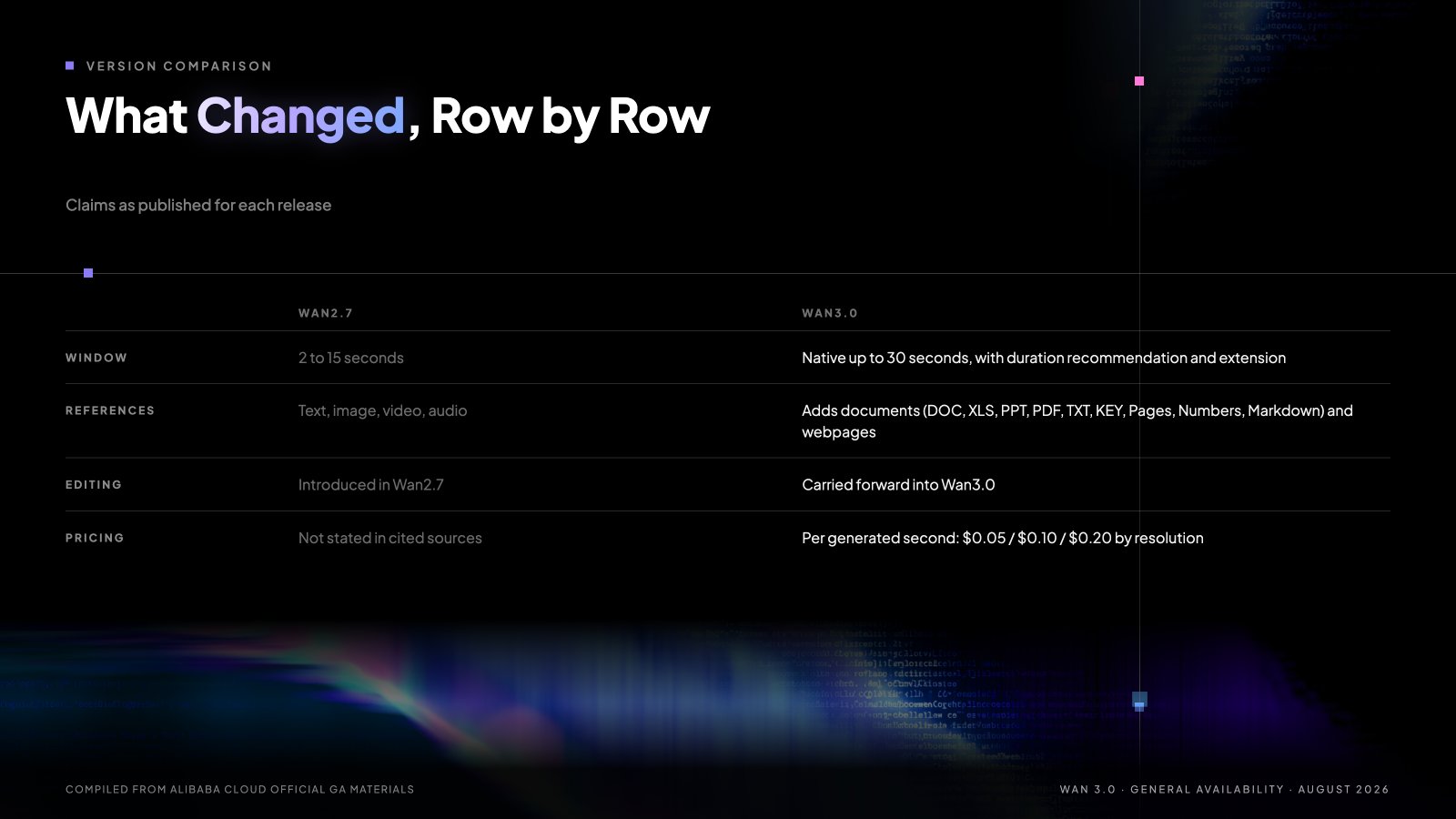
| Generation window | 2 to 15 seconds per generation | Native up to 30 seconds per generation, with smart duration recommendation and video extension |
| Reference inputs | Text, image, video, audio | Text, image, audio, video, plus DOC, XLS, PPT, PDF, TXT, KEY, Pages, Numbers, Markdown, and webpages |
| Editing | Introduced in Wan2.7 | Carried forward into Wan3.0 |
| Consistency claims | Multi-character and multimodal control across identity, voice, emotion, camera movement, and continuation | Expanded emphasis on characters, props, spaces, and style, with finer control over facial details, hair, clothing, accessories, spatial relationships, camera perspective, and stability across longer clips |
| Pricing | Not stated in the public materials | Per generated second: $0.05 at 480P, $0.10 at 720P, $0.20 at 1080P |
03 · Fifteen seconds became thirty
Fifteen seconds is often enough for one shot, one beat, or a short social asset. Thirty seconds can support multiple narrative beats, a setup and a payoff, a longer product demonstration, or an uninterrupted camera move.
The real test is not whether the model can fill 30 seconds. It is whether the extra time remains coherent, which is why the duration story is tightly connected to the consistency story. Duration buys production value only when coherence holds across it.
04 · Documents and webpages join the reference set
Wan2.7 already worked with multimodal references.
Wan3.0 adds a new category of context: structured documents and webpages. Wan3.0 supports DOC, XLS, PPT, PDF, TXT, KEY, Pages, Numbers, and Markdown, within defined intake limits.
A deck, a campaign brief, a webpage, a report, or a spreadsheet can now carry factual and visual context into generation instead of forcing the user to compress everything into a prompt. The instruction layer shifts from restating information to directing it: what matters, who the audience is, what tone to carry, how the camera should behave.
05 · Length becomes a model decision
Wan3.0 ships smart duration recommendation, which lets the system choose an appropriate length from the prompt and the references. It also ships video extension for continuing a narrative beyond the initial generation.
The useful reading is a shift in where decisions live. Generation settings are gradually becoming part of model reasoning rather than a sequence of manual controls.
If you want to talk through what Wan3.0 changes for your team, start the conversation with us. Bring the brief you already own:
06 · Consistency claims get more granular
Wan2.7 already addressed multi-character identity, voice, lighting, and continuation. Wan3.0 publicly broadens the target to include facial details, hair, clothing, accessories, props, spatial relationships, camera perspective, style, digital information, and more stable performance across longer clips.
Consistency did not suddenly appear.
Wan3.0 now attacks the consistency problem across more dimensions at once.

07 · Editing carries forward, and pricing becomes per-second
The video editing capability introduced in Wan2.7 carries forward into Wan3.0.
For teams building on APIs, the evolution is clear: Wan2.7 established a multi-mode creation and editing system, and Wan3.0 increases the temporal range, enriches the context, and pushes reference fidelity and real-world rendering further. A professional tool becomes more valuable when each release expands the surface without forcing users to relearn the basic creation loop.
The commercial side changed as well. On Aug. 24, 2026, Alibaba Cloud announced general availability across international channels, with a time-limited launch offer. Standard pricing is billed per generated second:
| Resolution | Standard price per generated second |
|---|---|
| 480P | $0.05 |
| 720P | $0.10 |
| 1080P | $0.20 |
Per-second pricing makes iteration economics explicit. A 30-second draft at 480P costs about $1.50, and a 30-second finish at 1080P costs about $6.00 before any promotional discount. Exploration and finishing can live in separate budgets.
08 · What did not change
- The creator still needs a clear creative intent. Richer input does not remove the need for direction.
- Editing remains iterative. A generated first draft is not automatically the final asset.
- Quality should still be evaluated against the specific workflow, not only against launch demos.
- The director framing still holds. Wan2.7 moved the creator from executor toward director, and Wan3.0 gives that director a longer scene and a richer brief.
09 · Where to start
If a team already runs a Wan2.7 workflow, the decision should be task-based:
- Do longer sequences reduce stitching in your current pipeline?
- Do document and webpage references reduce prompt translation?
- Does reference consistency survive your real identities, props, and brand material?
- Does editing plus extension reduce the cost of a revision pass?
- Does per-second pricing change how your team budgets drafts versus finals?
Those questions convert a version number into a business decision.
The broader lesson is that competition in AI video is moving away from isolated best-clip moments toward workflow completeness.
Visual quality still matters, but production usefulness depends on how much of the creative process can stay coherent inside one system: brief intake, reference control, generation, editing, extension, sound, consistency, and integration.
Wan2.7 established much of that workflow. Wan3.0 makes the unit of work larger.
If you want to talk through what Wan3.0 changes for your team, start the conversation with us. Bring the brief you already own:
By Johnny Mai
Director, Gen AI Product Strategy & GTM
About Wan.
Wan is Alibaba Cloud's generative video model family. Wan3.0 is available through Alibaba Cloud Model Studio and supported international channels, with API pricing billed per generated second. Learn more at alibabacloud.com.
Disclaimer: This post is provided for general information only. Figures from third-party research are quoted as published in those reports and are not independently verified by Qwen, WAN or Alibaba Cloud. Product and service availability, features, and program terms vary by region and may change over time. Nothing in this post constitutes professional, legal, or investment advice. © 2026 WAN. All rights reserved.
Read previous post:
Read next post:
Wan3.0 at General Availability: Capabilities, Benchmarks, Pricing, and the Workflows It Changes
-

-
Johnny Mai
22 posts | 2 followers
Follow
Comments
-
-
Johnny Mai
22 posts | 2 followers
Follow
Related Products
-
 Wan3.0
Unleash Your Creativity Try Wan 3.0 now — longer narratives, greater control, endless creativity.
Learn More -
 Alibaba Cloud Model Studio
A one-stop generative AI platform to build intelligent applications that understand your business, based on Qwen model series such as Qwen-Max and other popular models
Learn More -
 Qwen
Full-range, open-source, multimodal, and multi-functional
Learn More -
Token Plan
Build more, spend less. One plan, every modality.
Learn More
More Posts by Johnny Mai
- Alibaba Cloud Brings Qwen4-Max to the Enterprise: An AI Colleague That Plans, Builds and Delivers Finished Work
- Integrating Wan3.0 via API: Queues, Retries, and Cost Controls
- Batch vs. Real-Time Inference: Which Workloads Should Wait for Half Price
- Inference Is Now Most of the AI Cloud Bill. Plan for It.
- 7 Lessons from Taking Enterprise AI from Pilot to Production
- How to Prioritize AI Use Cases Before 2027: Six Types and One 2x2
- AI Guardrails Checklist: 7 Controls Every Enterprise Deployment Needs on Day One
- Qwen-Image-2.1 Pro and Turbo APIs Are Live: One 7B Model to Generate, Edit and Cut Out
- Budgeting AI Video by the Second: A Campaign Planning Template
- Wan3.0 vs. Wan3.0-Prime: Speed, Price, and Which One Your Workflow Needs