Presumably every AI developer has experienced such a scenario: your intelligent Agent is finally online. Demo ran smoothly, the internal review passed smoothly, and the boss nodded his approval. After two months of hard work, the team finally pushed it into the production environment. In the first week, user feedback was acceptable. But by the second week, you receive a user message like this: "The last time I explicitly said I wanted to return it, why is your robot still asking me if I want to exchange it?" You go through the conversation log, and what the user said is true-in the last round of dialogue, the intention to return was very clear. However, Agent has no impression. Every conversation is like meeting for the first time. You suddenly realize: Agent online is only the starting point, the real key is that it must "remember". And the pain behind this is far deeper than imagined.
This is the most direct experience of harm, but also the most silent reason for the loss of users. Users don't care about your technical architecture or which big model you use. All they know is that what they said yesterday will be repeated today. In the customer service scene, the user has already explained the order problem, the receiving address and the return request, but he has to repeat it from the beginning when he enters the line again. The experience collapses instantly and the customer complaint rate rises sharply. In the sales scene, the customer made it clear that "the budget has not been approved" before, and Agent still repeatedly pushes the quotation scheme, which will only make the customer feel that the assistant is not listening at all. In the learning scene, the next day, the system still repeatedly questions as weak items, which will only make people feel that the product is perfunctory.
Users will not complain about "your memory system is not working", they will only lose it silently, or be prepared before the next use-it can't remember what I said anyway.
After noticing the problem, many teams chose to develop their own memory system, only to find that the road was far more difficult than expected. Originally three weeks to complete the memory function, eventually evolved into three months of the underlying infrastructure reconstruction.
● Easy to store but difficult to recall: It is not complicated to store the dialogue history in the vector database. The difficulty is to accurately recall the "most relevant information" in the next round, rather than bringing back a bunch of invalid noise. If the retrieval quality is not up to standard, the memory will be useless, recalling five pieces of information and four pieces of interference, but will bias the model judgment.
● Only increase but not decrease, memory confusion: users prefer concise answers last month, and this month they want to explain in more detail. If the system only adds but not updates, the two contradictory information coexist, and the more dirty data they use, the more inconsistent judgments.
● Context stacking and effect reversal: Some people directly put all the history into the Prompt, which seems simple, but leads to double the token cost and slow response. The model filters valid content from redundant information, and the accuracy does not increase but decreases. Long context doesn't equal good memory, and many times it's just more expensive noise.
● Demo is smooth and production is unstable: The memory of a single machine performs well in the testing phase. In the first production phase, problems occur frequently, such as the memory of multi-instance deployment does not communicate with each other, the memory of instance destruction is lost, and the memory extraction of high concurrency slows down the main link...
This is the most hidden and most realistic pain point. The memory function can be realized technically, but after landing, the problem ensues: who will maintain the vector database? How do I troubleshoot and locate exceptions? User historical memory involves privacy. How can data isolation be ensured? Compliance requires that the memory can be traced and deleted. Can the existing scheme be supported? Will the memory assembly line drag down the entire service if the traffic surges tenfold? Before these questions are clearly answered, any prudent technical leader dares to connect the core agent to the primary link. Memory is not unable to do it, but after it is done, no one dares to be really responsible. As a result, a large number of agents in the team are in an awkward position: the functions are already available, the project is not ready, and the business is slow to deliver.
In the past few years, memory ability has almost become the most crowded track in agent infrastructure. Simply storing conversations, enabling vector retrieval, and recording user preferences are no longer scarce capabilities. What is really scarce is an enterprise-level memory system that allows enterprises to quickly access, fit business scenarios, and run stably in the production environment. This is the core problem AgentLoop MemoryStore want to solve. As a fully managed enterprise-level memory management agent, AgentLoop MemoryStore has three advantages: out-of-the-box, flexible customization, and serverless O&M-free. It is equipped with core capabilities such as multi-dimensional memory retrieval, intelligent memory update, asynchronous pipeline architecture, and hierarchical precision retrieval. It no longer asks "memory weight is not important"-the answer you already know. What it needs to solve is: why the enterprise has been slow to put the core agent online, and how this key point is completely broken.
For agents, the value of memory goes far beyond "preserving historical conversations." It determines whether the agent can upgrade from a one-time question and answer tool to a long-term collaboration partner that continuously understands users, reuses context, and deposits business experience. Without memory, each round of Agent dialogue is like a first meeting. With reliable memory, Agent can truly understand "who you are, what happened, and how to continue judgment".
For enterprises, memory is never an additional function, but a watershed of whether Agent can really be used. Does the customer service robot remember the user's last work order? Does the sales assistant remember the customer's decision-making progress and historical objections? Can the learning assistant dynamically adjust the content according to the learning progress? The core of these problems is not how personified the model is, but whether the entire memory system is sufficiently engineered, operational, and scalable.
However, to really solve these pain points, it is far from enough to rely on scattered memory functions. A complete solution designed for the production environment from access, use, operation and maintenance, and compliance is needed. AgentLoop MemoryStore starts from the real pain points of enterprises and uses a set of out-of-the-box, flexible, open, stable and reliable memory system to turn "usable" agents into "daring and easy-to-use" agents.
Many teams are not unable to make Memory Demo, but are stuck in the access cost. A self-built memory system often means that you must simultaneously process vector storage, structured storage, model invocation, asynchronous tasks, monitoring and alerting, permission isolation, and SDK encapsulation. Technically, it is not impossible, but the pace of product launch will be seriously slowed down. The first value of AgentLoop MemoryStore is not how cool the feature is, but how convenient it is:
a. out-of-the-box: you do not need to create a self-built vector database, MSMQ, or background task system. you can activate it and use it in a one-stop manner. it provides the ability to write and store raw data to long-term memory recall. Enterprise agents only need to focus on their own agent development, without the need to focus on the complex memory extraction process.
b. Multiple docking solutions: It provides a complete API and SDK for data writing and memory recall. The client can be seamlessly connected. In addition, AgentLoop MemoryStore allows you to consume trace data collected by observable probes. You only need to load the probes in the program to collect user interaction information in a non-intrusive manner without modifying the original business logic. For teams with existing memory-related code, the product is also compatible with the Mem0 API, enabling zero-cost migration. In addition, it also supports multiple access forms such as MCP Server and OpenClaw plug-ins, which can be easily integrated into various mainstream Agent frameworks, allowing existing systems to quickly have long-term memory capabilities.
c. Cross-device memory sharing: provides SaaS hosting services. Memory sharing is supported across machines, instances, and sessions. Compared with the open-source standalone memory system, AgentLoop Memory provides memory sharing across devices. In an enterprise-level agent, the agent generally runs in a sandbox for permission isolation. If the memory system is a stand-alone version, it will disappear with the destruction of the agent instance. However, based on AgentLoop Memory, the agent instance can be destroyed at any time, but the memory can be forever.
A typical customer service Agent, most afraid of is "talked yesterday, today all forget". The user explained the order problem, receiving preference and communication habits yesterday. When entering the line again today, the system started asking questions from scratch and the experience would collapse immediately. After you connect to the AgentLoop MemoryStore, the customer service team does not need to rewrite the entire memory logic. Mem0-compatible interfaces or OpenClaw plug-ins can be used to recall and write memories into existing processes. When users consult again, Agent can first see key information such as "last ticket progress", "users' common addresses" and "preferred communication methods". Naturally, answers are more continuous and manual transfer is more efficient. Compared with many open source memory solutions that are more suitable for local experiments or single-machine deployment, the SaaS-based AgentLoop MemoryStore also has a very practical advantage: memory is not tied to a single machine, but can be continuously shared among different devices, different instances, and different service nodes. If the user communicates with the Agent on the web page in the morning and moves to the mobile terminal in the afternoon, or the request is routed to another machine, the system can still continue the same memory. This cross-machine sharing capability is closer to the way enterprises operate real online services.
The focus of this type of value is not "technically achievable", but "how long the business team can use it". For many enterprises, going online as soon as a week is often more meaningful than one more concept function.
After solving the problem of "fast access", the next key is to make the memory really fit the business, rather than simply piling up historical conversations. Memory is prone to homogenization because many products only solve the "storage" problem, but do not really solve the "how to remember, what to remember, when to take" problem. In an enterprise scenario, memory is never a static file, but a set of dynamic assets that are updated with business changes. The core difference of AgentLoop MemoryStore is that it is open enough to "memory processing" and "memory retrieval": it supports multi-dimensional memory extraction, not only retains the original dialogue content, but also automatically extracts structured memories such as user preferences, factual information, and scene summaries, so that memories are no longer scattered chat records. At the same time, it supports the dynamic update of memory rather than a mere addition, when the user's preference changes, the system will automatically update the old memory, from the source to reduce the accumulation of dirty data. It also supports flexible custom rules, whether it is the global extraction policy of the entire memory base or the special processing rules of a single message, which can be flexibly defined according to business requirements, so that the memory fully fits your business logic. In addition, it also provides a hierarchical retrieval strategy from L1 to L3, covering basic hybrid retrieval, refined Rerank to deep Agetic Search, taking into account the response speed, recall accuracy and deep semantic understanding capabilities in all aspects. The most important point here is that enterprises do not have to accept a "black box Memory" default understanding, but can inject their own business judgment into it.
The key memory in the sales scenario is often not a "customer is interested in the product", but more detailed structured information: the current procurement stage of the customer, who is the decision maker, whether the budget is approved, what objections were raised in the last phone call, and what actions were agreed next. If you just put all the chat records back into context, the cost is high, the noise is much, and the effect is not stable. A more effective way is to extract information such as "organizational structure", "business opportunity stage", "historical objection" and "next action" into renewable long-term memory, and then cooperate with hierarchical retrieval to recall only the most relevant parts in the current round. In this way, Agent gives not only a "chat" reply, but more like a sales colleague who has really followed up the customer process.
In the learning scene, the more memory, the better. The system needs to distinguish between "long-term stable learning goals" and "short-term changes in knowledge mastery". For example, a user prefers video explanation at the beginning and then makes it clear that he prefers topic-driven learning. Another example is that after several rounds of practice, the old memory should be corrected instead of being kept as "weak points in learning".
AgentLoop MemoryStore supports separate processing by memory type and extraction strategy, allowing Learning Assistant to not only remember users, but also "remember changes." This improvement of the personalized experience is often more direct than simply expanding the context window.
Memory function is easy to use, flexible is not enough, once on the production, stability and operation and maintenance costs become the key to determine whether the landing. Once Memory enters the production environment, the real test is often not "whether it can be extracted", but "whether the main link will be slowed down during high concurrency". Many solutions work well in the Demo phase, but problems will be exposed when they reach the real business traffic: synchronous extraction is too slow, call queuing, upstream and downstream timeout, resource expansion depends on manual work, and monitoring and alerting are not systematic. AgentLoop MemoryStore is designed to be "production-ready": It uses the memory pipeline architecture of asynchronous writing to process time-consuming memory retrieval in the background to minimize the impact on the main process. Relying on the data processing pipeline developed by AgentLoop, it can also perform multi-dimensional deduplication for large-scale interactive data, covering lexical deduplication, hash deduplication, and semantic vector deduplication, reducing redundant dirty data from the source. At the same time, it completely decouples the storage, calculation and retrieval modules. Each module can be expanded independently according to the actual load and can be easily adapted to the Auto Scaling capacity no matter how the business traffic fluctuates. In addition, it natively supports multi-tenant isolation, complete audit logs, and end-to-end observability to fully meet the O&M and compliance requirements of enterprises.
When e-commerce is promoted, the pressure on customer service and shopping guide agents is usually several times or even dozens of times higher than usual. If the memory retrieval is executed in full synchronization, each dialogue has to wait for the model extraction and writing to be completed, and the latency of the main link will increase rapidly, eventually affecting the whole site experience. A more reasonable approach is to leave "the most critical recall to the user's reply" in the real-time path and put "more complex memory processing and precipitation" into the asynchronous pipeline. In this way, the Agent can respond in a timely manner without blocking the foreground service due to background memory processing. For enterprises, this is not a simple architecture optimization, but a question of whether they can stabilize service quality at critical moments.
The significance of Serverless and O&M-free is also here. What the enterprise team really wants to save is not only a few machines, but also a whole set of maintenance costs around Memory: expansion, monitoring, exception troubleshooting, task backlog, data isolation, and permission control. If you do all of this on your own, Memory will quickly go from being an "empowerment" to a "new burden."
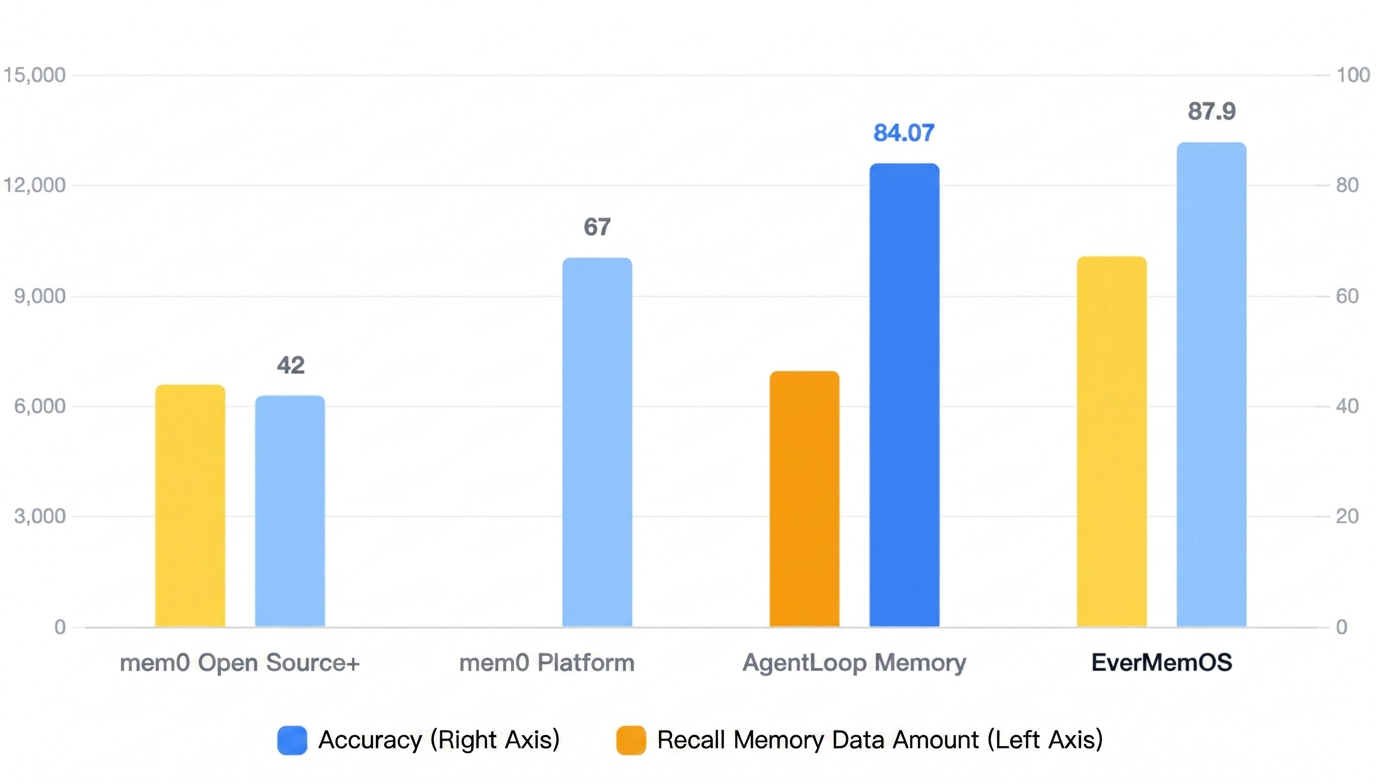
The access is fast, flexible, and stable. Eventually, it must be quantifiable, controllable, and compliant before it can truly enter the core link of the enterprise. When enterprises choose Memory, they will not only look at the concept, but also look at the results. Don't look at the advertisement, look at the curative effect, whether the effect is good or not, go to Benchmark to run and see. Based on a unified Benchmark, it is the touchstone for measuring different Memory systems. In the Locomo Benchmark evaluation, the accuracy score of AgentLoop Memory reaches 84.07%. At the same time, compared with EverMemos, the recalled memory volume is 30% less. This means that it doesn't just "remember more", but gives more efficient hit results with less context overhead.
In addition to the effect, enterprises are also concerned about the long-term operation. AgentLoop MemoryStore also provides several capabilities that are critical to the production environment: in addition to the effect, enterprises are also concerned about long-term operation. AgentLoop MemoryStore also provides several critical capabilities for the production environment: it has built-in multi-tenant data isolation capabilities to meet enterprise-level security boundary requirements; it also provides complete audit logs to support the full tracking of memory additions, deletions, modifications, and checks to meet the requirements of compliance audits. It also supports comprehensive observability and cost analysis capabilities. You can easily view the latency, token consumption, request volume, and storage volume, and quickly troubleshoot problems. It also supports multiple integration methods and reduces the access threshold for different technology stacks.
In other words, it wants to deliver not just a "memory agent", but a memory infrastructure that enterprises can confidently incorporate into their core business links.
To enable more teams to use reliable long-term memory, OpenClaw is further integrated with AgentLoop MemoryStore. This allows developers to quickly provide stable, reusable, and operational enterprise-level memory capabilities to existing agents without the need to build memory modules from scratch. If you are already using OpenClaw, the cost of accessing AgentLoop MemoryStore will be lower. We have packaged the integration solution as a separate npm package openclaw-plugin-agentloop-memory that, once installed and configured, can add enterprise-class long-term memory to OpenClaw without modifying the OpenClaw code itself.
Before you perform the migration, make the following preparations:
■ You have an Alibaba Cloud account and have activated the AgentLoop MemoryStore service.
■ Create a Workspace and MemoryStore in the AgentLoop MemoryStore console
■ The AccessKey ID and AccessKey secret of your Alibaba Cloud account.
Execute in the OpenClaw project directory:
npm install openclaw-plugin-agentloop-memoryAfter the installation is complete, enable the plug-in in the OpenClaw configuration and specify the connection parameters. Typical configurations are as follows:
{
  "memory-agentloop": {
    "endpoint": "cms.cn-hangzhou.aliyuncs.com",
    "accessKeyId": "${ALIBABA_CLOUD_ACCESS_KEY_ID}",
    "accessKeySecret": "${ALIBABA_CLOUD_ACCESS_KEY_SECRET}",
    "workspace": "my-workspace",
    "memoryStore": "my-memory-store"
  }
}
The following table describes the core parameters :
■ endpoint: the API endpoint address of AgentLoop MemoryStore. Enter the endpoint address based on the region where the instance is located, for example, cms.cn-hangzhou.aliyuncs.com
■ accessKeyId /accessKeySecret: Alibaba Cloud access credential, supports environment variable injection to avoid plaintext storage
■ workspace: Name of the workspace created in the AgentLoop MemoryStore control
■ memoryStore: The name of the memory bank in the workspace.
The plug-in also provides the following optional configurations:
■ userId /agentId: used for user-level and agent-level data isolation, applicable to multi-tenant scenarios
■ autoCapture: On by default, it automatically extracts valuable information from the conversation and writes it to the memory bank.
■ autoRecall: On by default, it automatically retrieves relevant memories and injects context before each conversation starts.
■ inferOnAdd: This feature is enabled by default. Intelligent extraction is enabled when you write data to the memory. Multi-dimensional memory extraction and deduplication are automatically performed.
After installation, the plug-in adds three types of capabilities to OpenClaw:
■ Agent tools: three memory operation tools: registration memory_recall, memory_store and memory_forget, which are convenient for Agent to actively retrieve, write and delete memory during dialogue.
■ Automated hooks: When autoRecall and autoCapture are enabled, memory recall and asynchronous precipitation are automatically completed to reduce business code transformation.
■ CLI command: provides openclaw agentloop command line capabilities to facilitate developers to search, add, list, and delete memories directly in the terminal, and perform connectivity checks.
If you want to quickly verify the effect first, you can also experience it directly through the Python SDK:
1. Get AgentLoop Memory SDK
pip install agentloop-memory2. Run the sample program
from agentloop_memory import Config
from agentloop_memory.client import AgentLoopMemoryClient
import os
import time
def main():
    # 1. Init memory store client
    config = Config(
        access_key_id=os.getenv("ALIYUN_ACCESS_KEY_ID"),
        access_key_secret=os.getenv("ALIYUN_ACCESS_KEY_SECRET"),
        endpoint=os.getenv("CMS_ENDPOINT", "cms.cn-shanghai.aliyuncs.com"),
    )
    client = AgentLoopMemoryClient(
        config,
        workspace=os.getenv("CMS_WORKSPACE"),
        memory_store=os.getenv("CMS_MEMORY_STORE"),
    )
    # 2. Create memory store
    result = client.create_memory_store(
        description="Example memory store",
        extraction_strategies=["FACT"],
    )
    print("create_memory_store:", result)
    time.sleep(5)
    # 3. Add memory
    result = client.add(
        messages="I live in Hangzhou and love visiting West Lake",
        user_id="user123",
    )
    print("add:", result)
    time.sleep(120)
    # 4. Search memory
    result = client.search(
        query="Where do I live?",
        user_id="user123",
    )
    print("search:", result)
    # 5. Get all memories
    result = client.get_all(
        user_id="user123",
        page=1,
        page_size=10,
    )
    print("get_all:", result)
    # 6. List memory stores
    result = client.list_memory_stores(max_results=10)
    print("list_memory_stores:", result)
if __name__ == "__main__":
    main()
Sample result
{'status_code': 200, 'headers': {'server': 'AliyunSLS', 'content-length': '0', 'connection': 'keep-alive', 'access-control-allow-origin': '*', 'date': 'Mon, 02 Feb 2026 03:27:53 GMT', 'x-log-time': '1770002873', 'x-log-requestid': '698019B5FA0F42BA63073DF6'}}
{'results': [{'event_id': '800c03bc-dc54-42de-bd07-153421f88259', 'message': 'Memory processing has been queued for background execution', 'status': 'PENDING'}]}
{'results': [{'created_at': 1770002874, 'hash': '55566d2fdec59e0a3bf8870b1cb17bfd', 'id': '019c1c65-9745-7773-92f8-189a2b4a3721', 'memory': 'lives in Hangzhou, 'score': 0.5316177221048695, 'updated_at':: updated_at': 1770002874, 'user_id': 'user_0.46264787090919 ', '74 createdy': at': 177a' 1770002874, 'user_id': 'user123'}, {'created_at': 1770002874, 'hash': '7b869aba23294ab37679c5f7e7465921', 'id': '019c1c65-990e-7381-8ba4-794867a634bd', 'memory': 'like the scenery of hangzhou', 'score': 0.4317308740071, 'updated_at': 1770002874, ''user_id': 'user12l':} 3'
{'results': [{'created_at': 1770002874, 'hash': '55566d2fdec59e0a3bf8870b1cb17bfd', 'id': '019c1c65-9745-7773-92f8-189a2b4a3721', 'memory': 'Lived in Hangzhou, 'updated_at': 1770002874, 'user_id': upered': 'user12y', {'7b869aba23294ab37679c5f7e7465921' 'user123'}, 'hash': 170002874', 'hidat ', 'hash' 'hash' 'hash' 1770002874, 'hash': '939ed9d15f907d252363fd0e2cffb9a9', 'id': '019c1c65-9ac3-7cd1-afea-1f091dcdc6fe', 'memory': 'frequent visit to the West Lake ', 'updated_at': 1770002874, 'user_id': 'user123'}], 'relations': []}
After the memory is added, the system automatically extracts and stores three key pieces of information:
■ "I live in Hangzhou"
■ "Love the scenery of Hangzhou"
■ "I often go to the West Lake to play."
When querying "Where do I live?", the system will accurately return "live in Hangzhou" and return other associated memories based on the relevance. The whole process without manual annotation, memory extraction and retrieval can be done automatically.
Today's Memory market does not lack new concepts, but solutions that can really help enterprises run agents, run stably, and run out of business value. The focus of AgentLoop MemoryStore is not to make "memory" more mysterious, but to do the three most realistic things well: to connect to the existing system faster, to fit the specific business more flexibly, and to run in the production environment more carefully. For teams that are already doing customer service, sales, learning, shopping guide and other agents, such Memory is really worth seeing and being connected to the main link.
Don't let your agents have only seven seconds of memory. Immediate access to AgentLoop MemoryStore so that data is truly deposited into reusable business wisdom:
LoongCollector + ACS Agent Sandbox: Build a Production-grade AI Agent Runtime Platform

776 posts | 60 followers
FollowAlibaba Cloud Big Data and AI - April 13, 2026
ApsaraDB - June 4, 2026
Data Geek - September 4, 2026
Alibaba Cloud Native Community - May 18, 2026
Alibaba Cloud Native Community - April 22, 2026
Justin See - March 26, 2026
776 posts | 60 followers
Follow QwenWork
QwenWork is dedicated to helping employees strengthen their professional competitiveness in the AI era and to enabling enterprises to improve organizational effectiveness.
Learn More Token Plan
Build more, spend less. One plan, every modality.
Learn More
Alibaba Cloud Model Studio
A one-stop generative AI platform to build intelligent applications that understand your business, based on Qwen model series such as Qwen-Max and other popular models
Learn More CloudMonitor
Automate performance monitoring of all your web resources and applications in real-time
Learn MoreMore Posts by Alibaba Cloud Native Community

