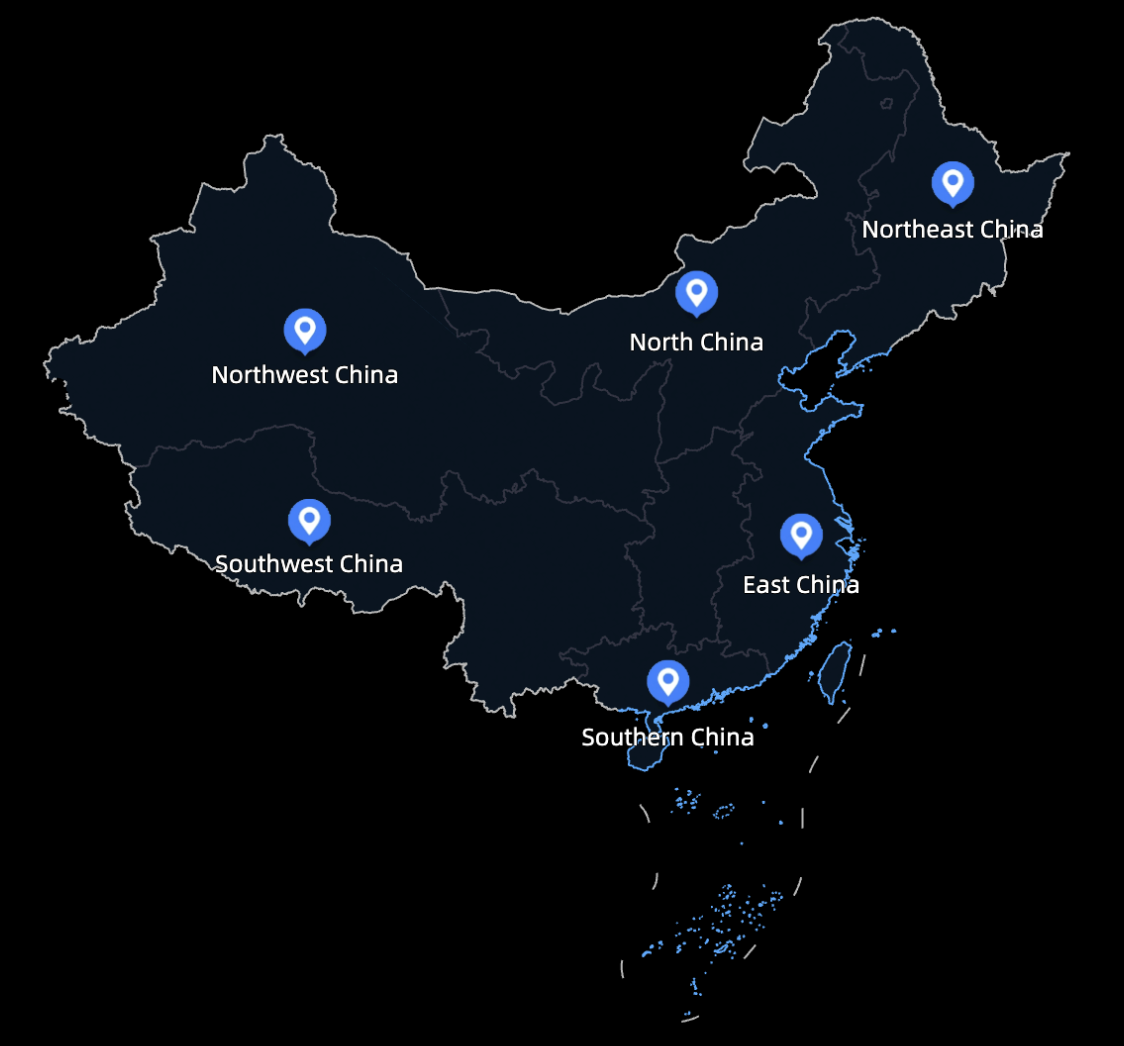
A symbol map uses a map as a background and displays icons or images to mark data points. This topic describes the use cases for symbol maps and how to configure their styles.
Prerequisites
A data visualization screen has been created. For more information, see Create a Data Visualization Screen.
Preview
Configure chart fields
In the Charts section of the widget library, find the Symbol Map widget and drag it to the canvas.
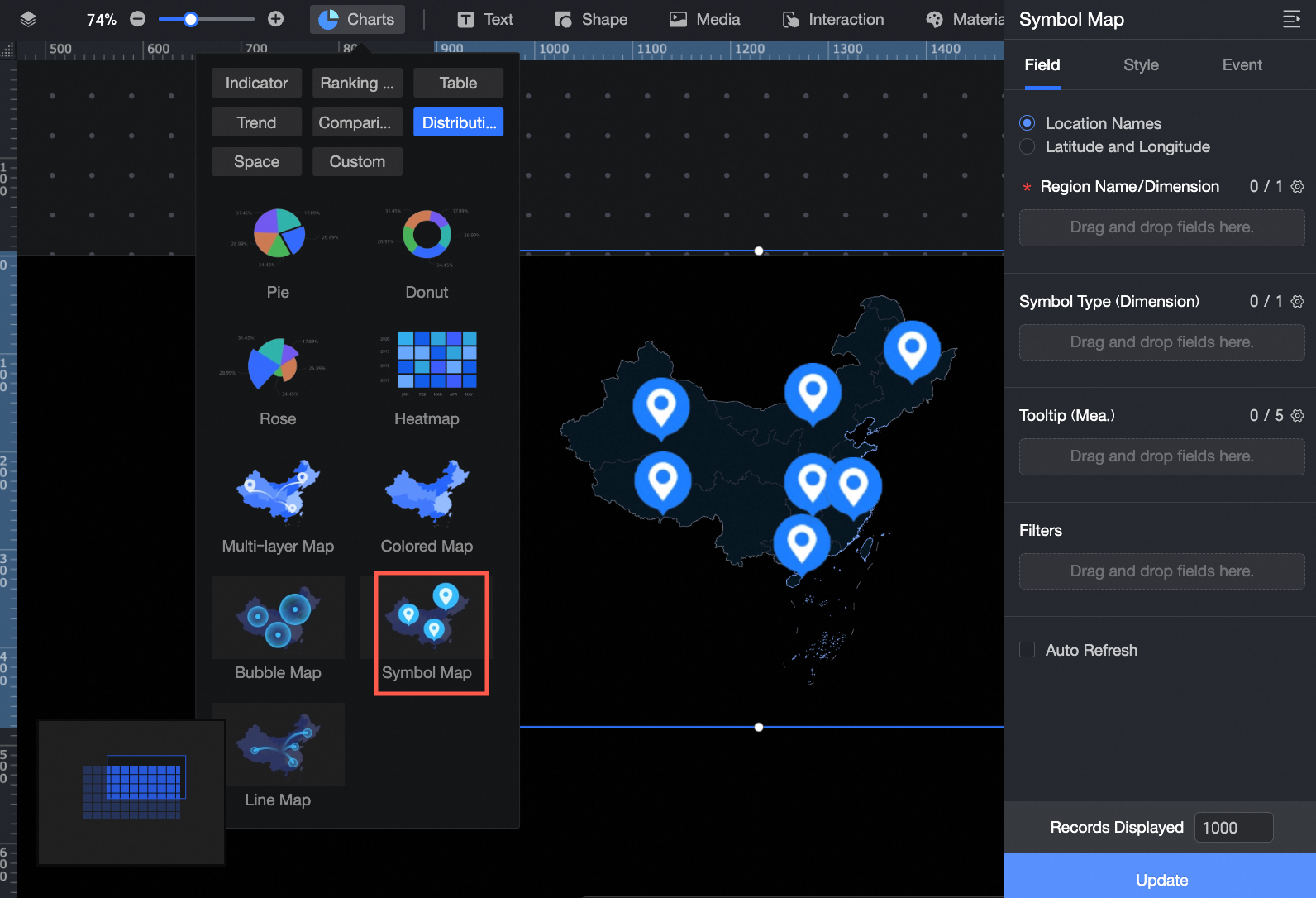
On the Fields tab, select the dimension and measure fields that you need:
You can specify geographic information using either an area name or latitude and longitude coordinates.
If you select Area Name, double-click or drag an area field to the Area Name/Dimension field.
If you select Latitude and Longitude, double-click or drag a longitude field to Longitude/Dimension and a latitude field to Latitude/Dimension. The Location Label/Dimension field is optional.
The symbol type determines the style of the symbol based on the selected dimension value. Double-click or drag the Product Type field to Symbol Type/Dimension.
From the list of measures, double-click or drag Profit Amount to Tooltip/Measure.
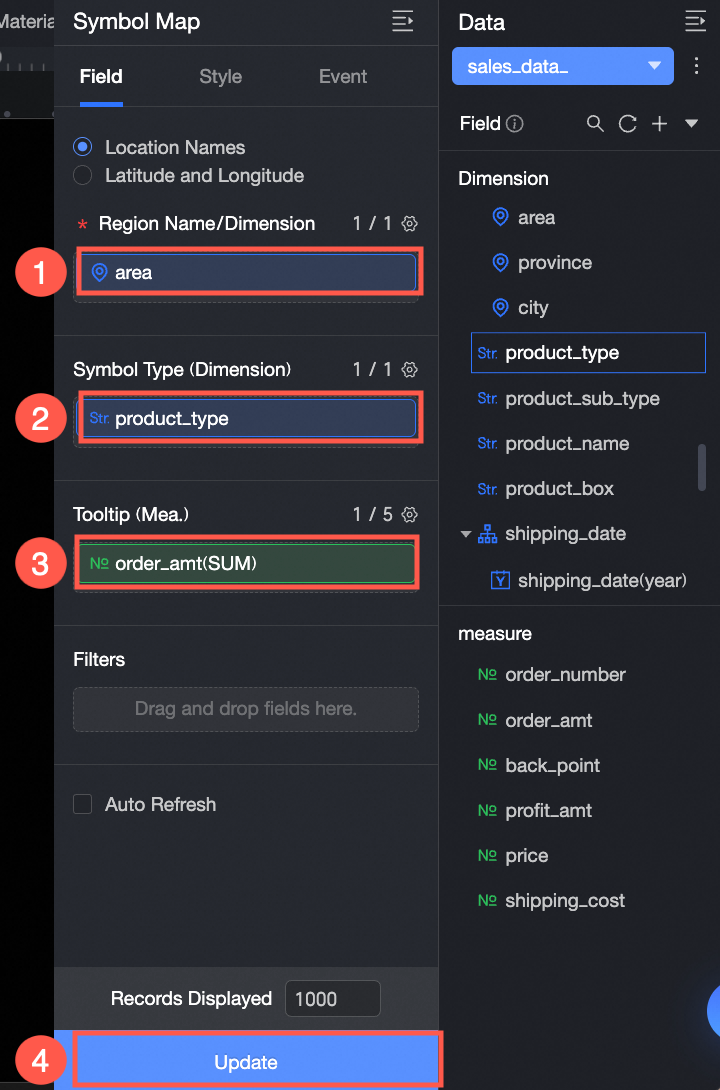
You can perform the following operations on the data as needed:
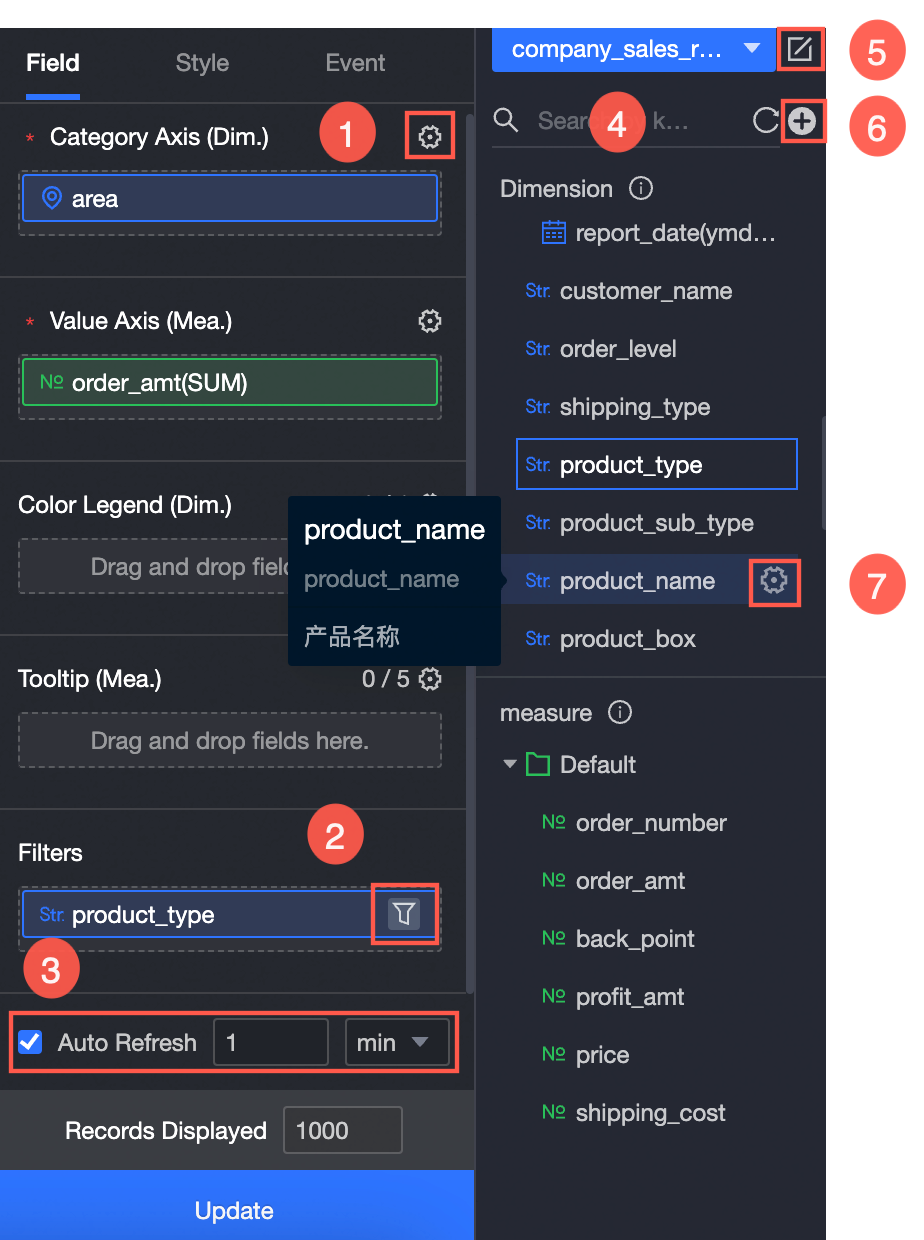
① Configure field formats in batches. For more information, see Batch configure field styles.
② Filter data. For more information, see Filter data.
③ Configure auto-refresh for data. For more information, see Refresh data on a schedule.
④ Switch datasets. For more information, see Switch datasets.
⑤ Edit the dataset. For more information, see Edit a dataset.
⑥ Process data by creating a calculated field or a new grouped dimension. For more information, see Create a Calculated Field and Create a new grouped dimension.
⑦ Copy a field. For more information, see Copy and convert to dimension.
Configure chart style
This section describes the style settings for the chart. For information about common chart style settings, see Configure Chart Style.
Geographic area
In the configuration section, you can configure the following settings for the widget:
For Display Range, select Auto or Custom.
NoteAuto adjusts the range based on the data. Custom lets you set the range manually. In interactive analysis scenarios, the range is always automatically adjusted based on the data.
Custom display ranges currently support only continents, countries, and regions, provinces, and cities in China.

You can also select Manual Adjustment. When you enable this option, the current centroid and scaling values are automatically generated, and you can modify these values.

In the Outline and Fill section, configure the background color of the area and the color of the outline.
NoteOutlines are not supported for some regions.

Select Enable Drag and Enable Zoom to allow users to drag and zoom the chart in the preview of the data visualization screen.

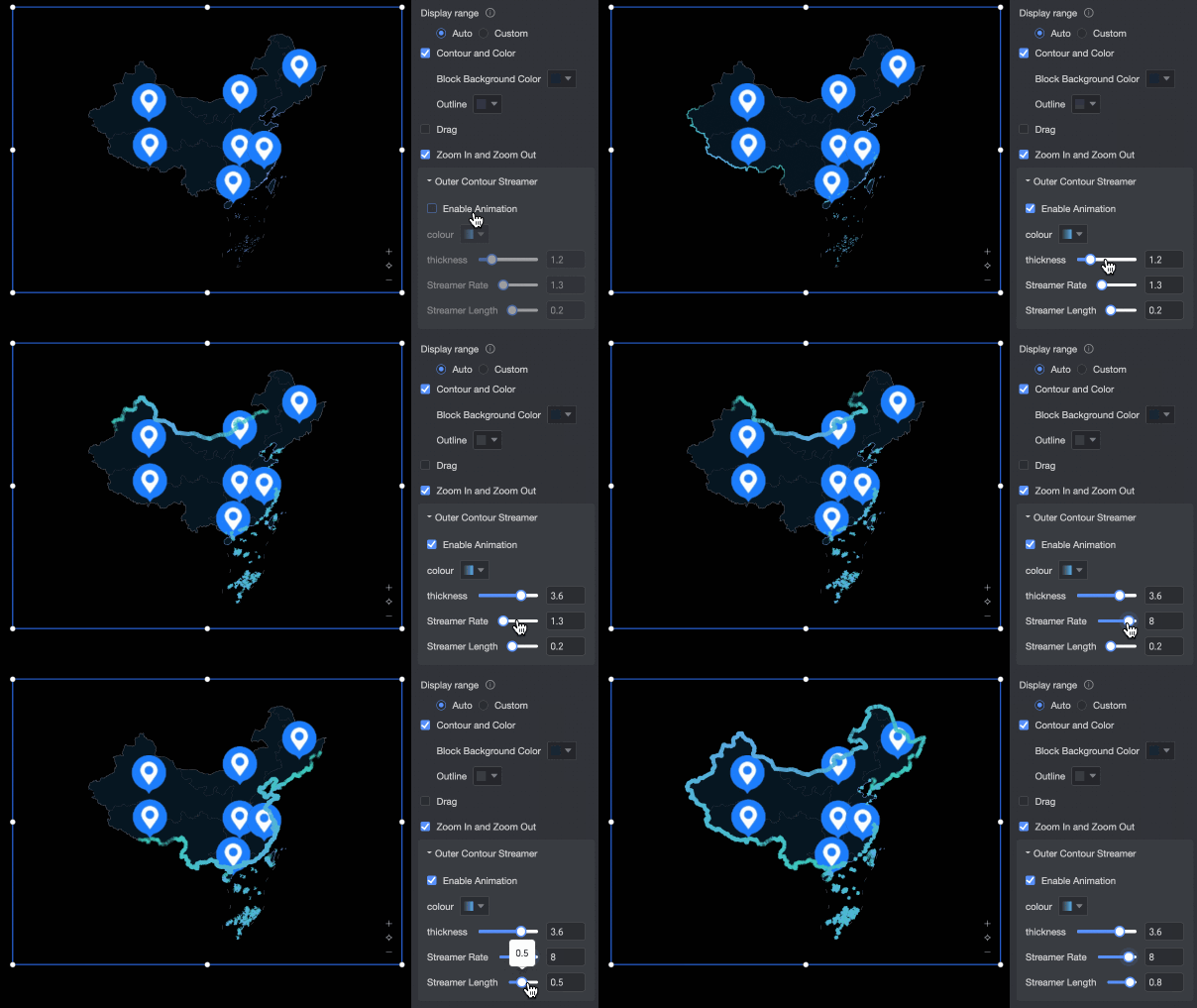
In the Outer Outline Streamer section, you can enable or disable this feature. If you enable this feature, you can configure the Streamer Color (Solid/Gradient), Thickness, Speed, and Length.
Base map
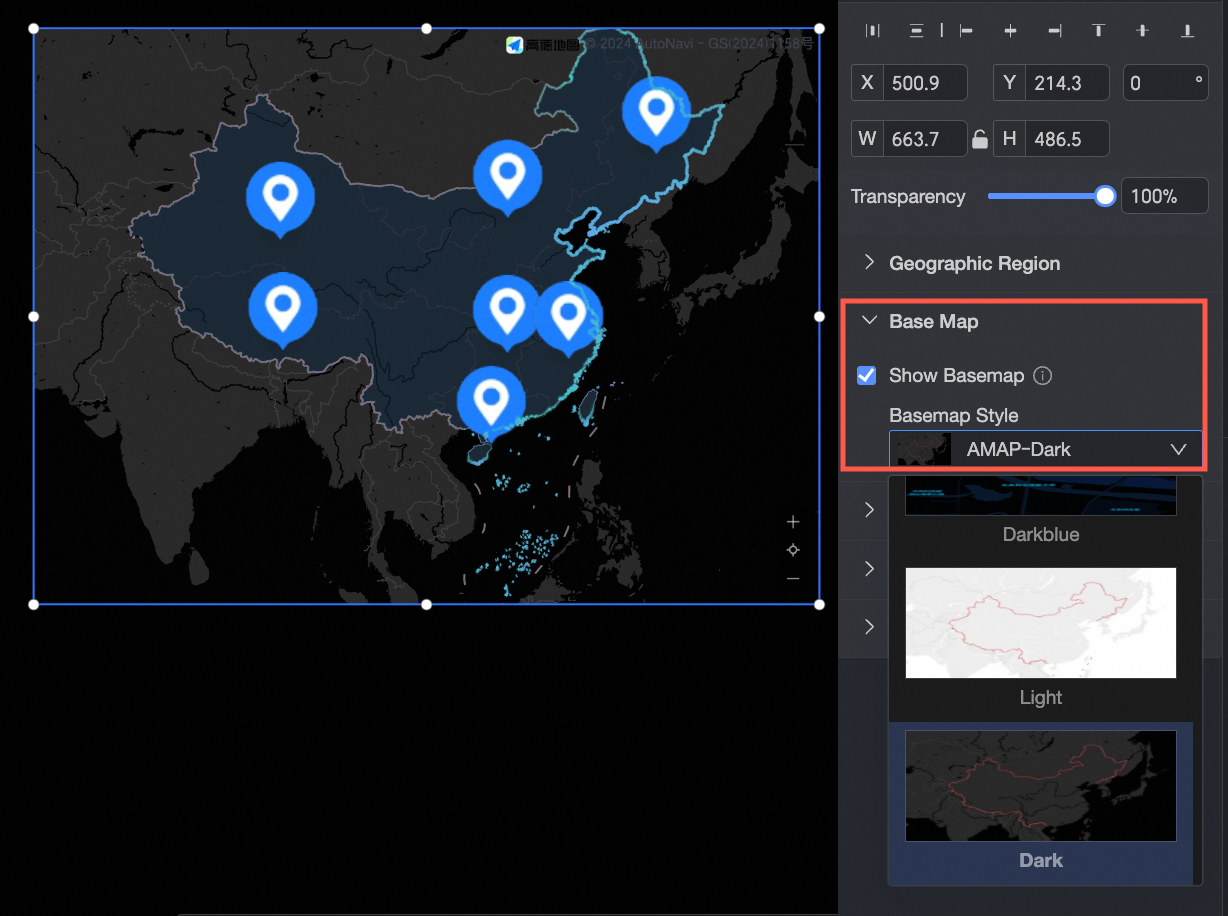
In the Display Base Map section, you can select one of the Gaode Map styles to use as the base map.
Symbol
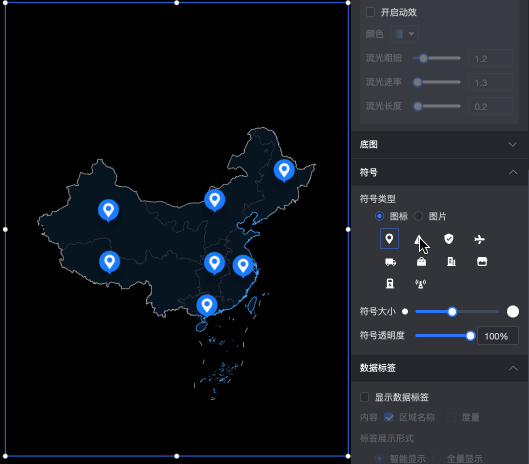
In the Symbol section, configure the Symbol Type, Symbol Size, and Symbol Opacity.
Symbol Type:
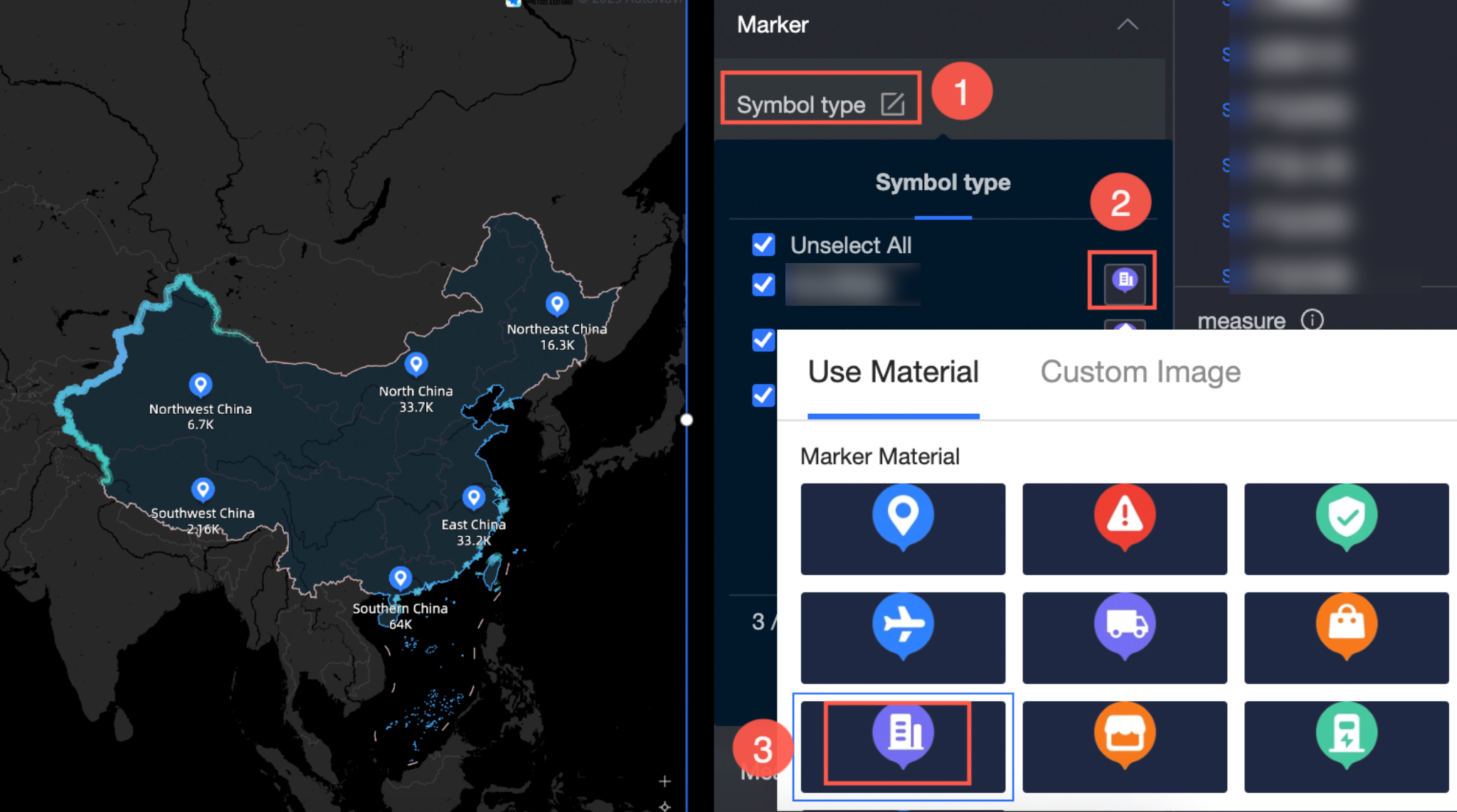
If you configured a field for Symbol Type/Dimension on the Fields tab, symbol styles are automatically generated based on the dimension values. You can modify the symbol styles in this section. In this example, Symbol Type is set to the Outlet Type field. Different symbol types are set for the two outlet types, directly-managed and franchised, in different regions. The following figure shows an example.
If you did not configure a field for Symbol Type/Dimension on the Fields tab, you can manually select an icon or upload an image link.
Symbol Size: Drag the slider to change the symbol size.

Symbol Opacity: Drag the slider to change the symbol opacity.

Data label
In the configuration section, you can configure the following settings for the widget:
Show Data Label:
If you create a map using the Area Name mode, you can display both the area name and the measure.
If you create a map using the Latitude and Longitude mode, you can display the latitude and longitude and the measure. If you have configured a Location Label/Dimension, you can also display the location label.
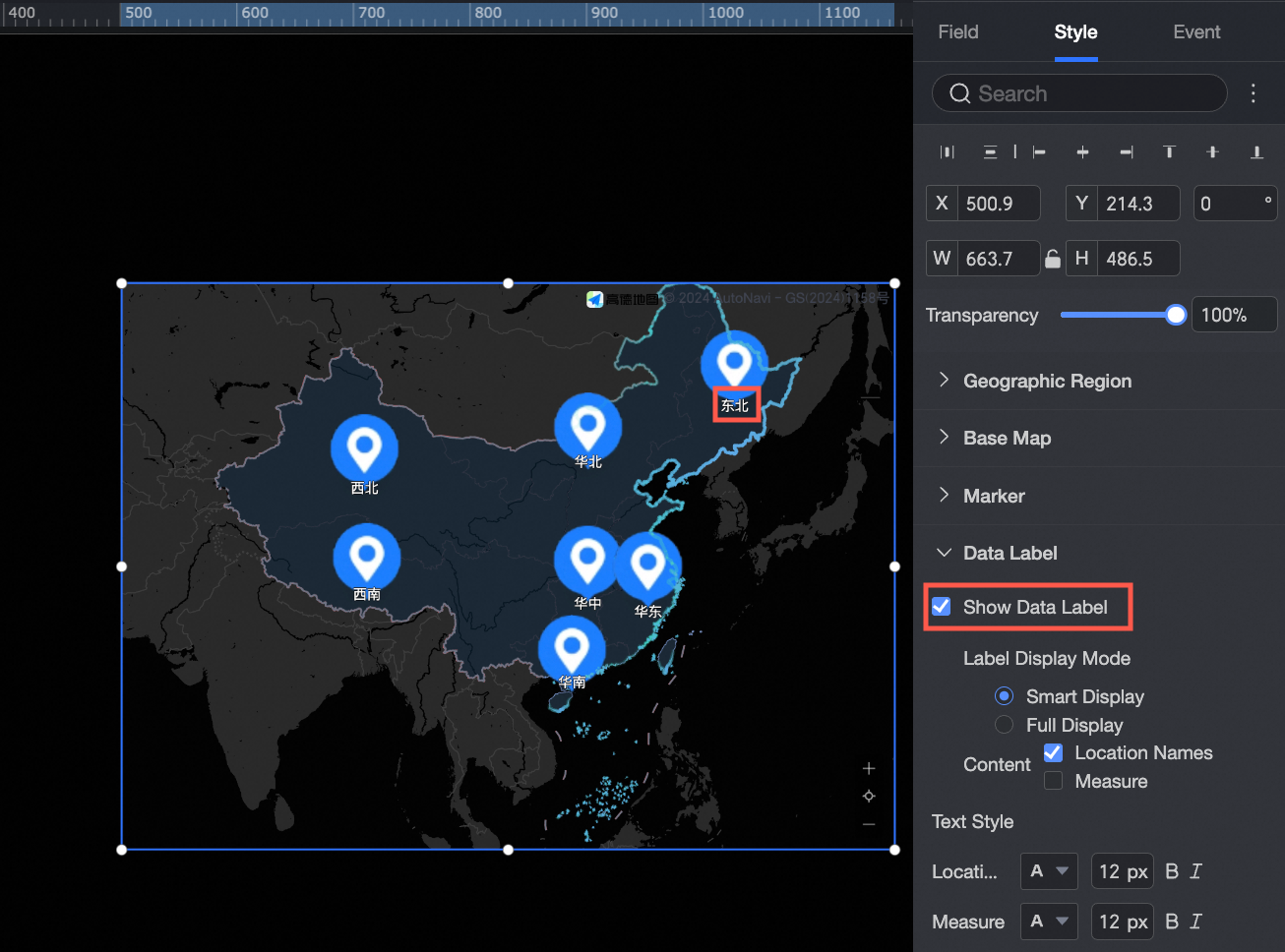
Label Display Mode: Smart Display and Full Display are supported. Smart Display is suitable for maps with many place names.
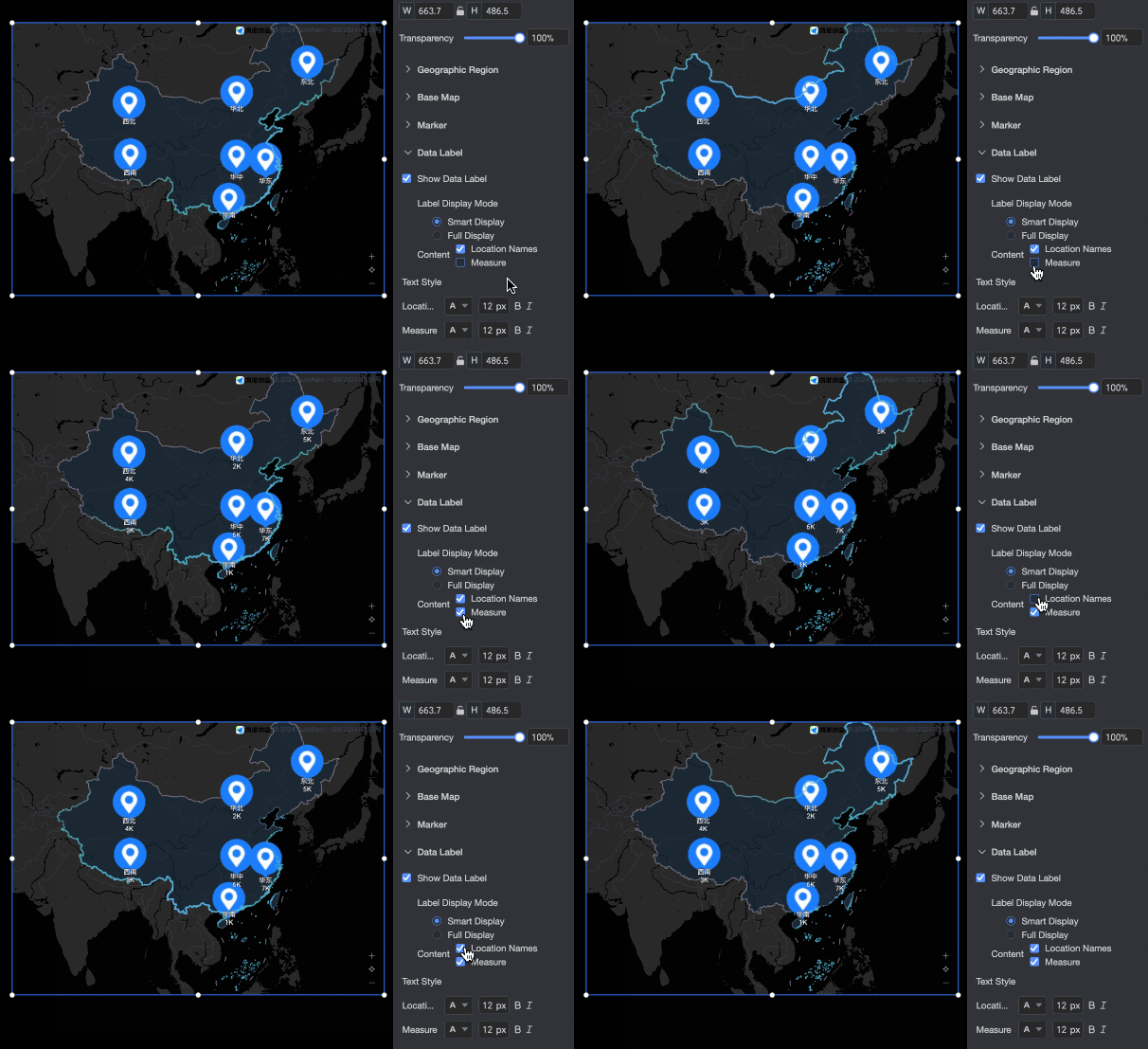
Text Style: Set the text style for the Area Name, Latitude and Longitude, and Measure data labels.

Tooltip
In the Tooltip section, you can configure the Background Color, Text, Enable Tooltip, and Carousel settings.
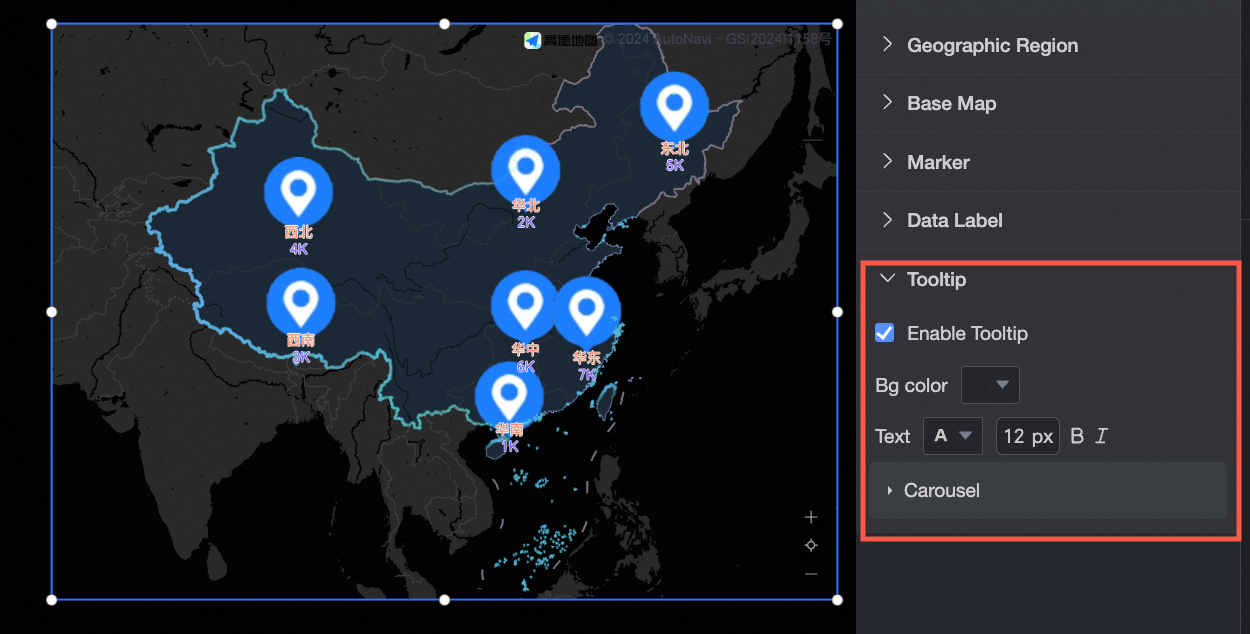
The Enable Tooltip option is enabled by default. The tooltip is displayed when you hover the mouse pointer over an area.

You can enable Auto Carousel. When this option is enabled, the tooltips are automatically displayed in a carousel. You can set the Duration and Interval for the carousel.

Configure chart events
Configuration item | Name | Configuration example | Description |
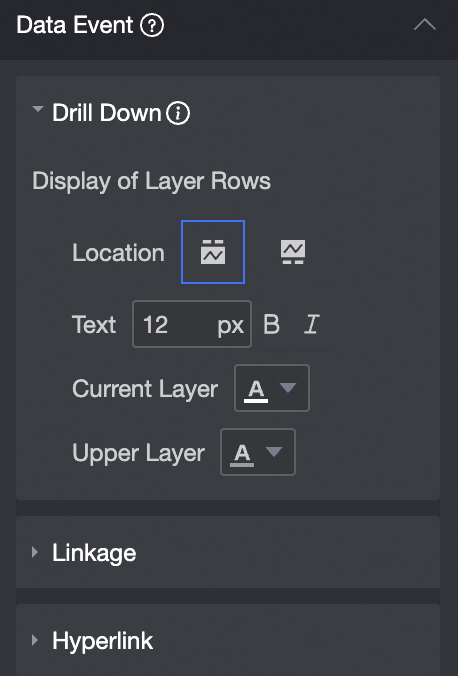
Data event | Drill Down |
| When you need to analyze a dimension at different levels, you can configure drilling for a dimension field. When you click the field, the level changes, which changes the granularity of the analysis. For more information, see Drill Down Settings. |
Filter Interaction | When the data you need to analyze is in different charts, you can use filter interactions to associate multiple charts for data analytics. For more information, see Filter Interaction Settings. | ||
Navigation | When the data you need to analyze is in multiple data visualization screens or dashboards, you can use hyperlinks to associate multiple reports for data analytics. Hyperlinks include parameter-based hyperlinks and external links. For more information, see Drill Down/Linkage/Hyperlink. | ||
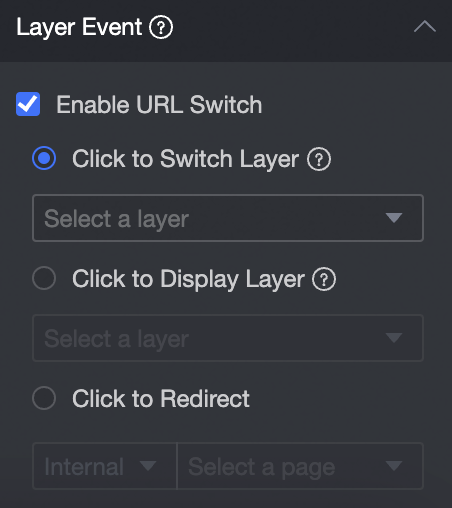
Layer event | Enable Link Redirection |
| For layer events, you can select Enable Link Redirection, Click to Pop Up Layer, or Click to Go to Page. For more information, see Set click events. |