To connect the Apache Doris database with Quick BI, add an Apache Doris data source. This enables data analysis and visualization within Quick BI. Connections to the Apache Doris database can be established through the public network or Alibaba Cloud VPC. This data source also supports connections to SelectDB and StarRocks. This topic describes the process of adding a user-created Apache Doris data source.
Prerequisites
Ensure your network meets the following requirements:
For connections over the public network, add Quick BI's IP address to the database whitelist. For more information, see Security groups.
For internal network connections, use one of the following methods:
Connect through Alibaba Cloud VPC if the Apache Doris database is deployed on Alibaba Cloud ECS.
Deploy a jump server and access the database via an SSH tunnel.
The Apache Doris database must be already created.
Obtain the username and password for the user-created Apache Doris database.
Limits
Support is provided for version 1.2.4.
Procedure
Log on to the Quick BI console.
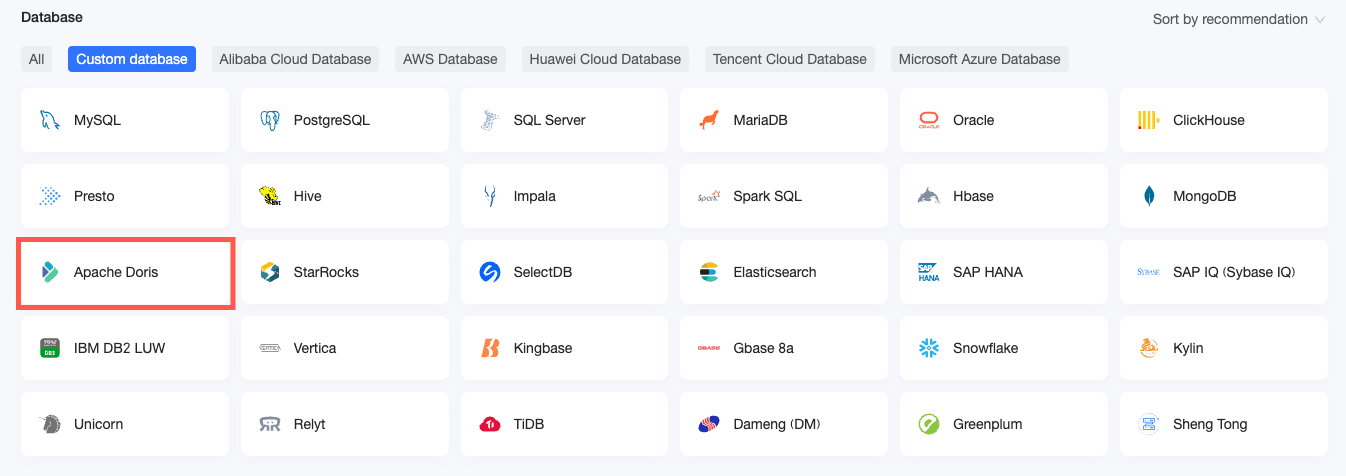
Follow the steps in the figure below to add a data source.
Navigate to the data source creation interface via the data source creation entry.
On the User-created Data Sources tab, select Apache Doris data source.
In the Configure Connection dialog box, configure the connection based on your specific business scenario.
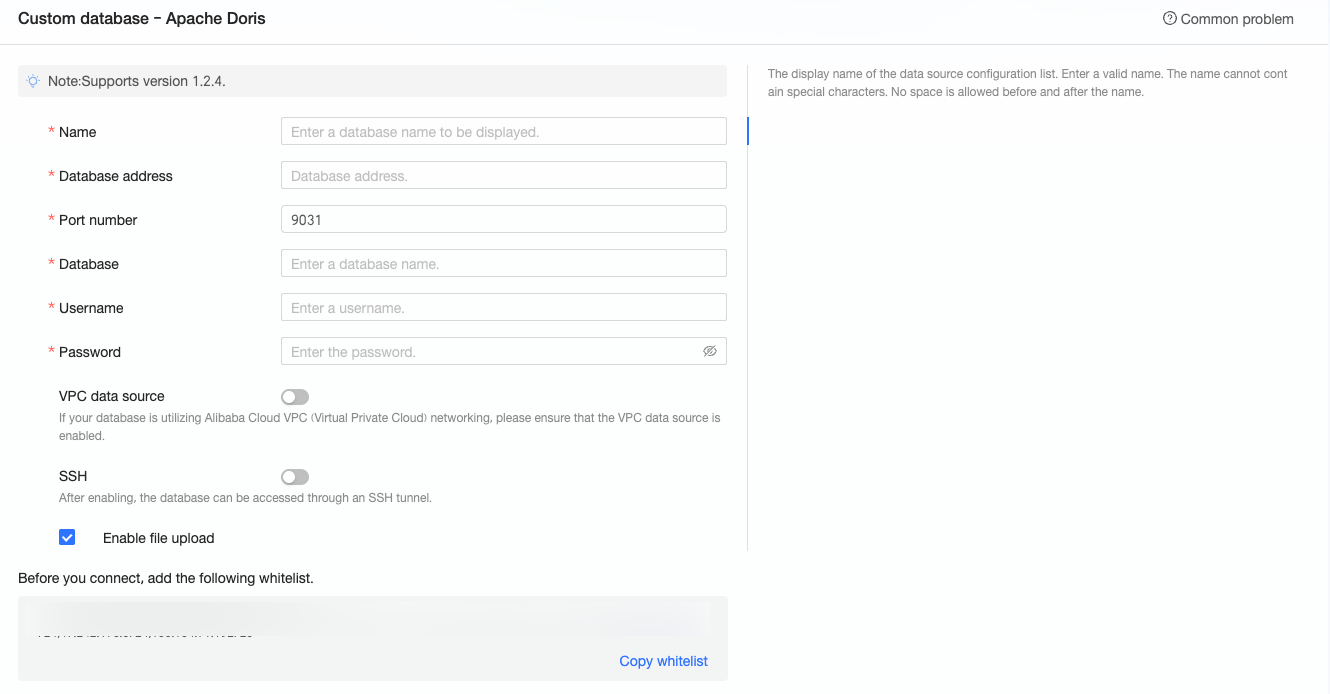
Name
Description
Display Name
The display name in the datasource config list. The name cannot contain special characters or start or end with spaces.
Database Address
The address where the Apache Doris database is deployed, including IP or domain name.
Port
The port corresponding to the address where the Apache Doris database is deployed.
Database
The database name customized when the Apache Doris database is deployed.
Username and Password
The username and password to log on to the Apache Doris database. Ensure that the username has create, insert, update, and delete permissions on tables in the database.
VPC Data Source
If you want to connect to the database over an Alibaba Cloud VPC, select VPC Data Source and configure the parameters that appear. If you select VPC Data Source, you must set Database Address and Port to the internal endpoint and port of the database.
If the database is deployed on an Alibaba Cloud ECS instance, select Instance. If the database is accessed through a Classic Load Balancer (CLB) instance, select CLB.
Instance
Purchaser AccessId: The AccessKey ID of the account that is used to purchase the instance.
NoteEnsure that the AccessKey ID has Read permission for the target instance. In addition, if the AccessKey ID has Write permission for the corresponding security group, the system automatically adds your IP address to the whitelist. Otherwise, you must manually add it. For more information, see Create a custom policy.
For more information, see Create an AccessKey.
Purchaser AccessKey: The AccessKey secret of the account that is used to purchase the instance.
For more information, see Create an AccessKey.
Instance ID: The ID of the ECS instance. Log on to the ECS console and find the instance ID on the Instances tab.
For more information, see View instance information.
Region: The region where the ECS instance resides. Log on to the ECS console and view the region in the upper-left corner.
For more information, see View instance information.
CLB
Purchaser AccessId: The AccessKey ID of the account that is used to purchase the CLB instance. Make sure that the account has the read permissions on the CLB instance. Log on to the Resource Access Management (RAM) console to obtain the AccessKey ID.
NoteMake sure that the account has the read permissions on the CLB instance.
For more information, see View the AccessKey information of a RAM user.
Purchaser AccessKey: The AccessKey secret that corresponds to the AccessKey ID. Log on to the RAM console to obtain the AccessKey secret.
For more information, see View the AccessKey information of a RAM user.
Instance ID: The ID of the CLB instance. Log on to the Server Load Balancer console and obtain the instance ID from the instance list.
Region: The region where the instance is located. Log on to the Server Load Balancer console to obtain the region from the upper-left corner of the Instance Management page.
SSH
If you select SSH, you need to configure the following parameters:
You can deploy a jump server and connect to the database over an SSH tunnel. To obtain the jump server information, contact O&M personnel or system administrators.
SSH Host: Enter the IP address of the jump server.
SSH Username: The username to log on to the jump server.
SSH Password: The password corresponding to the username to log on to the jump server.
SSH Port: The port of the jump server. Default value: 22.
For more information, see Use OpenSSH or Xshell.
Enable file upload entry
After enabling, file upload is supported.
Click Connection Test to verify the data source connectivity.

Once the test is successful, click OK to finalize the addition of the data source.
What to Do next
After the data source is created, proceed with dataset creation and data analysis.
To add data tables from the Apache Doris database or custom SQL to Quick BI, refer to creating and managing datasets.
For adding visualization charts and data analysis, refer to creating a dashboard and an overview of visualization charts.
For in-depth data analysis and drilling, refer to drill settings and display.