All Products
Search
Document Center

Object Storage Service:Using presigned URLs to download or preview files

Last Updated:Nov 10, 2025

OSS objects are private by default, and only the file owner can access them. However, file owners can generate shared links (presigned URLs) to authorize others to download or preview specific files online within a validity period.

image

How it works

The generation of presigned URLs relies on secret key encryption and parameter concatenation. The process is as follows:

  1. Permission verification: When you generate a presigned URL, you need to have the oss:GetObject permission for third parties to successfully download/preview files through the presigned URL.

  2. Local encryption: Based on AK/SK, encrypt and calculate the file path, expiration time, and other information to obtain a signature (x-oss-signature).

  3. Append signature: Add signature parameters (x-oss-date, x-oss-expires, x-oss-credential, etc.) as query strings to the file URL.

  4. Form the link: Compose the complete presigned URL.

    Presigned URL format

    https://BucketName.Endpoint/Object?signature parameters

    Complete example

    https://examplebucket.oss-cn-hangzhou.aliyuncs.com/exampleobject.txt?x-oss-process=image%2Fresize%2Cp_10&x-oss-date=20241115T095058Z&x-oss-expires=3600&x-oss-signature-version=OSS4-HMAC-SHA256&x-oss-credential=LTAI****************%2F20241115%2Fcn-hangzhou%2Foss%2Faliyun_v4_request&x-oss-signature=6e7a*********************************

For detailed generation process, see Signature Version 4 (Recommended).

Get file download links

Use the OSS default endpoint to generate a file download link with an expiration date (presigned URL).

Using the OSS console

You can log on to the OSS Management Console, go to the Files list of the target bucket, click the target file, and then click Copy File URL in the details panel on the right to obtain a temporary download link with a default validity period of 32400 seconds (9 hours).

Using Alibaba Cloud SDK

The following are code examples for generating file download links (presigned URLs) in common languages.

Java

For more information, see Download files using presigned URLs in Java.

import com.aliyun.oss.*;
import com.aliyun.oss.common.auth.*;
import com.aliyun.oss.common.comm.SignVersion;

import java.net.URL;
import java.util.Date;

public class Demo {
    public static void main(String[] args) throws Throwable {
        // In this example, the endpoint of the China (Hangzhou) region is used. Specify your actual endpoint. 
        String endpoint = "https://oss-cn-hangzhou.aliyuncs.com";
        // Obtain access credentials from environment variables. Before you run the sample code, make sure that the OSS_ACCESS_KEY_ID and OSS_ACCESS_KEY_SECRET environment variables are configured. 
        EnvironmentVariableCredentialsProvider credentialsProvider = CredentialsProviderFactory.newEnvironmentVariableCredentialsProvider();
        // Specify the name of the bucket. Example: examplebucket. 
        String bucketName = "examplebucket";
        // Specify the full path of the object. Example: exampleobject.txt. Do not include the bucket name in the full path of the object. 
        String objectName = "exampleobject.txt";
        // Specify the region in which the bucket is located. For example, if the bucket is located in the China (Hangzhou) region, set the region to cn-hangzhou. 
        String region = "cn-hangzhou";

        // Create an OSSClient instance. 
        // Call the shutdown method to release resources when the OSSClient is no longer in use.
        ClientBuilderConfiguration clientBuilderConfiguration = new ClientBuilderConfiguration();
        clientBuilderConfiguration.setSignatureVersion(SignVersion.V4);
        OSS ossClient = OSSClientBuilder.create()
                .endpoint(endpoint)
                .credentialsProvider(credentialsProvider)
                .clientConfiguration(clientBuilderConfiguration)
                .region(region)
                .build();

        try {
            // Specify the validity period of the presigned URL. Unit: milliseconds. In this example, the validity period is 1 hour. 
            Date expiration = new Date(new Date().getTime() + 3600 * 1000L);
            // Generate a presigned URL that allows HTTP GET requests. In this example, no additional request headers are specified. Other users can access the relevant content directly by using the browser. 
            URL url = ossClient.generatePresignedUrl(bucketName, objectName, expiration);
            System.out.println(url);
        } catch (OSSException oe) {
            System.out.println("Caught an OSSException, which means your request made it to OSS, "
                    + "but was rejected with an error response for some reason.");
            System.out.println("Error Message:" + oe.getErrorMessage());
            System.out.println("Error Code:" + oe.getErrorCode());
            System.out.println("Request ID:" + oe.getRequestId());
            System.out.println("Host ID:" + oe.getHostId());
        } catch (ClientException ce) {
            System.out.println("Caught an ClientException, which means the client encountered "
                    + "a serious internal problem while trying to communicate with OSS, "
                    + "such as not being able to access the network.");
            System.out.println("Error Message:" + ce.getMessage());
        } finally {
            if (ossClient != null) {
                ossClient.shutdown();
            }
        }
    }
}

Python

For more information, see Download files using presigned URLs in Python.

import argparse
import alibabacloud_oss_v2 as oss

# Create a command-line parameter parser and describe the purpose of the script.
parser = argparse.ArgumentParser(description="presign get object sample")

# Specify the --region parameter to indicate the region in which the bucket is located. This parameter is required.
parser.add_argument('--region', help='The region in which the bucket is located.', required=True)
# Specify the --bucket parameter to indicate the name of the bucket in which the object is stored. This parameter is required.
parser.add_argument('--bucket', help='The name of the bucket.', required=True)
# Specify the --endpoint parameter to indicate the endpoint of the region in which the bucket is located. This parameter is optional.
parser.add_argument('--endpoint', help='The domain names that other services can use to access OSS')
# Specify the --key parameter to indicate the name of the object. This parameter is required.
parser.add_argument('--key', help='The name of the object.', required=True)

def main():
    # Parse the command-line parameters to obtain the specified values.
    args = parser.parse_args()

    # From the environment variables, load the authentication information required to access OSS.
    credentials_provider = oss.credentials.EnvironmentVariableCredentialsProvider()

    # Use the default configuration to create a cfg object and specify the credential provider.
    cfg = oss.config.load_default()
    cfg.credentials_provider = credentials_provider
    
    # Set the region attribute of the cfg object to the region provided in the command line.
    cfg.region = args.region

    # If a custom endpoint is provided, update the endpoint attribute of the cfg object with the provided endpoint.
    if args.endpoint is not None:
        cfg.endpoint = args.endpoint

    # Use the preceding settings to initialize the OSSClient instance.
    client = oss.Client(cfg)

    # Initiate a request to generate a presigned URL.
    pre_result = client.presign(
        oss.GetObjectRequest(
            bucket=args.bucket,  # Specify the bucket name.
            key=args.key,        # Specify the object key.
        )
    )

    # Display the HTTP method, expiration time, and presigned URL.
    print(f'method: {pre_result.method},'
          f' expiration: {pre_result.expiration.strftime("%Y-%m-%dT%H:%M:%S.000Z")},'
          f' url: {pre_result.url}'
    )

    # Display the signed headers.
    for key, value in pre_result.signed_headers.items():
        print(f'signed headers key: {key}, signed headers value: {value}')

# Call the main function to start the processing logic when the script is directly run.
if __name__ == "__main__":
    main()  # Specify the entry point of the script. The control flow starts here.

Go

For more information, see Download files using presigned URLs in Go.

package main

import (
	"context"
	"flag"
	"log"
	"time"

	"github.com/aliyun/alibabacloud-oss-go-sdk-v2/oss"
	"github.com/aliyun/alibabacloud-oss-go-sdk-v2/oss/credentials"
)

// Specify the global variables.
var (
	region: string; // The region in which the bucket is located.
	bucketName string // The name of the bucket.
	objectName string // The name of the object.
)

// Specify the init function used to initialize command line parameters.
func init() {
	flag.StringVar(&region, "region", "", "The region in which the bucket is located.")
	flag.StringVar(&bucketName, "bucket", "", "The name of the bucket.")
	flag.StringVar(&objectName, "object", "", "The name of the object.")
}

func main() {
	// Parse command line parameters.
	flag.Parse()

	// Check whether the bucket name is empty.
	if len(bucketName) == 0 {
		flag.PrintDefaults()
		log.Fatalf("invalid parameters, bucket name required")
	}

	// Check whether the region is empty.
	if len(region) == 0 {
		flag.PrintDefaults()
		log.Fatalf("invalid parameters, region required")
	}

	// Check whether the object name is empty.
	if len(objectName) == 0 {
		flag.PrintDefaults()
		log.Fatalf("invalid parameters, object name required")
	}

	// Load the default configurations and specify the credential provider and region.
	cfg := oss.LoadDefaultConfig().
		WithCredentialsProvider(credentials.NewEnvironmentVariableCredentialsProvider()).
		WithRegion(region)

	// Create an OSS client.
	client := oss.NewClient(cfg)

	// Generate a presigned URL for the GetObject request.
	result, err := client.Presign(context.TODO(), &oss.GetObjectRequest{
		Bucket: oss.Ptr(bucketName),
		Key:    oss.Ptr(objectName),
	},
		oss.PresignExpires(10*time.Minute),
	)
	if err != nil {
		log.Fatalf("failed to get object presign %v", err)
	}

	log.Printf("request method:%v\n", result.Method)
	log.Printf("request expiration:%v\n", result.Expiration)
	log.Printf("request url:%v\n", result.URL)
	if len(result.SignedHeaders) > 0 {
		// If you specify request headers when you generate a presigned URL that allows HTTP GET requests, make sure that the request headers are included in the GET request initiated by using the presigned URL. This prevents request failures and signature errors.
		log.Printf("signed headers:\n")
		for k, v := range result.SignedHeaders {
			log.Printf("%v: %v\n", k, v)
		}
	}
}

Node.js

For more information, see Download files using presigned URLs in Node.js.

const OSS = require("ali-oss");

// Specify a function used to generate a presigned URL.
async function generateSignatureUrl(fileName) {
  // Obtain the presigned URL.
  const client = await new OSS({
      // Obtain access credentials from environment variables. Before you run the sample code, make sure that the OSS_ACCESS_KEY_ID and OSS_ACCESS_KEY_SECRET environment variables are configured. 
      accessKeyId: process.env.OSS_ACCESS_KEY_ID,
      accessKeySecret: process.env.OSS_ACCESS_KEY_SECRET,
      bucket: 'examplebucket',
      // Specify the region in which the bucket is located. For example, if your bucket is located in the China (Hangzhou) region, set the region to oss-cn-hangzhou.
      region: 'oss-cn-hangzhou',
      // Set secure to true and use HTTPS to prevent the generated download link from being blocked by the browser.
      secure: true,
      authorizationV4: true
  });

  return await client.signatureUrlV4('GET', 3600, {
      headers: {} // Specify the request headers based on the actual request headers.
  }, fileName);
}
// Call the function and pass in the name of the object.
generateSignatureUrl('yourFileName').then(url => {
  console.log('Generated Signature URL:', url);
}).catch(err => {
  console.error('Error generating signature URL:', err);
});

PHP

For more information, see Download files using presigned URLs in PHP.

<?php

// Include the autoload file to ensure that dependency libraries are correctly loaded.
require_once __DIR__ . '/../vendor/autoload.php';

use AlibabaCloud\Oss\V2 as Oss;

// Define the descriptions of command-line parameters.
$optsdesc = [
    "region" => ['help' => 'The region in which the bucket is located.', 'required' => True], // (Required) The region in which the bucket is located.
    "endpoint" => ['help' => 'The domain names that other services can use to access OSS.', 'required' => False], // (Optional) The endpoint.
    "bucket" => ['help' => 'The name of the bucket', 'required' => True], // (Required) The name of the bucket.
    "key" => ['help' => 'The name of the object', 'required' => True], // (Required) The name of the object.
];

// Convert the parameter descriptions to the long options format required by getopt.
// Add a colon (:) after each parameter to indicate that a value is required.
$longopts = \array_map(function ($key) {
    return "$key:";
}, array_keys($optsdesc));

// Parse the command-line arguments.
$options = getopt("", $longopts);

// Verify that all required parameters are provided.
foreach ($optsdesc as $key => $value) {
    if ($value['required'] === True && empty($options[$key])) {
        $help = $value['help']; // Obtain the help information for the parameter.
        echo "Error: the following arguments are required: --$key, $help" . PHP_EOL;
        exit(1); // If a required parameter is not provided, exit the program.
    }
}

// Extract values from the parsed parameters.
$region = $options["region"]; // The region in which the bucket is located.
$bucket = $options["bucket"]; // The name of the bucket.
$key = $options["key"];       // The name of the object.

// Load the access credential from the environment variable.
// Use EnvironmentVariableCredentialsProvider to read the Access Key ID and Access Key Secret from environment variables.
$credentialsProvider = new Oss\Credentials\EnvironmentVariableCredentialsProvider();

// Use the default configurations of the SDK.
$cfg = Oss\Config::loadDefault();
$cfg->setCredentialsProvider($credentialsProvider); // Set the credential provider.
$cfg->setRegion($region); // Set the region in which the bucket is located.
if (isset($options["endpoint"])) {
    $cfg->setEndpoint($options["endpoint"]); // If an endpoint is provided, set the endpoint.
}

// Create an OSS client instance.
$client = new Oss\Client($cfg);

// Create a GetObjectRequest object to download an object.
$request = new Oss\Models\GetObjectRequest(bucket:$bucket, key:$key);

// Call the presign method to generate a signed URL.
$result = $client->presign($request);

// Print the presign result.
// Output the signed URL. Users can use this URL to perform download operations.
print(
    'get object presign result:' . var_export($result, true) . PHP_EOL . // The details of the presign result.
    'get object url:' . $result->url . PHP_EOL                           // The signed URL, which is used to directly download the object.
);

.NET

For more information, see Download files using presigned URLs in .NET.

using Aliyun.OSS;
using Aliyun.OSS.Common;
// Specify the endpoint of the region in which the bucket is located. For example, if the bucket is located in the China (Hangzhou) region, set the endpoint to https://oss-cn-hangzhou.aliyuncs.com.
var endpoint = "https://oss-cn-hangzhou.aliyuncs.com";
// Obtain a credential from the environment variables. Before you run the sample code, make sure that the OSS_ACCESS_KEY_ID and OSS_ACCESS_KEY_SECRET environment variables are configured.
var accessKeyId = Environment.GetEnvironmentVariable("OSS_ACCESS_KEY_ID");
var accessKeySecret = Environment.GetEnvironmentVariable("OSS_ACCESS_KEY_SECRET");
// Specify the name of the bucket. Example: examplebucket.
var bucketName = "examplebucket";
// Specify the full path of the object. The full path cannot contain the bucket name. Example: exampledir/exampleobject.txt.
var objectName = "exampledir/exampleobject.txt";
// Specify the region in which the bucket is located. For example, if the bucket is located in the China (Hangzhou) region, set the region to cn-hangzhou.
const string region = "cn-hangzhou";

// Create a ClientConfiguration instance and modify the default parameters based on your requirements.
var conf = new ClientConfiguration();

// Specify the V4 signature.
conf.SignatureVersion = SignatureVersion.V4;

// Create an OSSClient instance.
var client = new OssClient(endpoint, accessKeyId, accessKeySecret, conf);
client.SetRegion(region);
try
{
    var metadata = client.GetObjectMetadata(bucketName, objectName);
    var etag = metadata.ETag;
    // Generate a presigned URL.
    var req = new GeneratePresignedUriRequest(bucketName, objectName, SignHttpMethod.Get)
      {
        // Set the validity period of the presigned URL. Default value: 3600. Unit: seconds.
        Expiration = DateTime.UtcNow.AddHours(1),
    };
    var uri = client.GeneratePresignedUri(req);
    // Print the generated presigned URL
    Console.WriteLine("Generated Signed URL: " + uri);
}
catch (OssException ex)
{
    Console.WriteLine("Failed with error code: {0}; Error info: {1}. \nRequestID:{2}\tHostID:{3}",
        ex.ErrorCode, ex.Message, ex.RequestId, ex.HostId);
}
catch (Exception ex)
{
    Console.WriteLine("Failed with error info: {0}", ex.Message);
}

Android

For more SDK information, see Download files using presigned URLs in Android.

// Specify the name of the bucket. Example: examplebucket. 
String bucketName = "examplebucket";
// Specify the full path of the source object. Do not include the bucket name in the full path. Example: exampleobject.txt. 
String objectKey = "exampleobject.txt";
String url = null;
try {
    // Generate a presigned URL to download the object. 
    GeneratePresignedUrlRequest request = new GeneratePresignedUrlRequest(bucketName, objectKey);
    // Set the validity period of the presigned URL to 30 minutes. 
    request.setExpiration(30*60);
    request.setMethod(HttpMethod.GET);
    url = oss.presignConstrainedObjectURL(request);
    Log.d("url", url);
} catch (ClientException e) {
    e.printStackTrace();
}

iOS

For more SDK information, see Download files using presigned URLs in iOS.

// Specify the name of the bucket. 
NSString *bucketName = @"examplebucket";
// Specify the name of the object. 
NSString *objectKey = @"exampleobject.txt";
__block NSString *urlString;
// Generate a presigned URL with a validity period for downloading the object. In this example, the validity period of the URL is 30 minutes. 
OSSTask *task = [client presignConstrainURLWithBucketName:bucketName
                                            withObjectKey:objectKey
                                               httpMethod:@"GET"
                                   withExpirationInterval:30 * 60
                                           withParameters:@{}];
[task continueWithBlock:^id _Nullable(OSSTask * _Nonnull task) {
    if (task.error) {
        NSLog(@"presign error: %@", task.error);
    } else {
        urlString = task.result;
        NSLog(@"url: %@", urlString);
    }
    return nil;
}];

C++

For more SDK information, see Download files using presigned URLs in C++.

#include <alibabacloud/oss/OssClient.h>
using namespace AlibabaCloud::OSS;

int main(void)
{
    /* Initialize information about the account that is used to access OSS. */
            
    /* Specify the endpoint of the region in which the bucket is located. For example, if the bucket is located in the China (Hangzhou) region, set the endpoint to https://oss-cn-hangzhou.aliyuncs.com. */
    std::string Endpoint = "yourEndpoint";
    /* Specify the region in which the bucket is located. For example, if the bucket is located in the China (Hangzhou) region, set the region to cn-hangzhou.   * /
    std::string Region = "yourRegion";
    /* Specify the name of the bucket. Example: examplebucket. */
    std::string BucketName = "examplebucket";
    /* Specify the full path of the object. Do not include the bucket name in the full path. Example: exampledir/exampleobject.txt. */ 
    std::string GetobjectUrlName = "exampledir/exampleobject.txt";

    /* Initialize resources, such as network resources. */
    InitializeSdk();

    ClientConfiguration conf;
    conf.signatureVersion = SignatureVersionType::V4;
    /* Obtain access credentials from environment variables. Before you run the sample code, make sure that the OSS_ACCESS_KEY_ID and OSS_ACCESS_KEY_SECRET environment variables are configured. */
    auto credentialsProvider = std::make_shared<EnvironmentVariableCredentialsProvider>();
    OssClient client(Endpoint, credentialsProvider, conf);
    client.SetRegion(Region);

    /* Specify the validity period of the pre-signed URL. The maximum validity period is 32,400. Unit: seconds. */
    std::time_t t = std::time(nullptr) + 1200;
    /* Generate a pre-signed URL. */
    auto genOutcome = client.GeneratePresignedUrl(BucketName, GetobjectUrlName, t, Http::Get);
    if (genOutcome.isSuccess()) {
        std::cout << "GeneratePresignedUrl success, Gen url:" << genOutcome.result().c_str() << std::endl;
    }
    else {
        /* Handle exceptions. */
        std::cout << "GeneratePresignedUrl fail" <<
        ",code:" << genOutcome.error().Code() <<
        ",message:" << genOutcome.error().Message() <<
        ",requestId:" << genOutcome.error().RequestId() << std::endl;
        return -1;
    }

    /* Release resources, such as network resources. */
    ShutdownSdk();
    return 0;
}

Ruby

For more SDK information, see Download files using presigned URLs in Ruby.

require 'aliyun/oss'

client = Aliyun::OSS::Client.new(
  # In this example, the endpoint of the China (Hangzhou) region is used. Specify your actual endpoint. 
  endpoint: 'https://oss-cn-hangzhou.aliyuncs.com',
  # Obtain access credentials from environment variables. Before you run the sample code, make sure that the OSS_ACCESS_KEY_ID and OSS_ACCESS_KEY_SECRET environment variables are configured. 
  access_key_id: ENV['OSS_ACCESS_KEY_ID'],
  access_key_secret: ENV['OSS_ACCESS_KEY_SECRET']
)
# Specify the name of the bucket. Example: examplebucket. 
bucket = client.get_bucket('examplebucket')

# Generate a presigned URL that is used to download the object and set its validity period to 3,600 seconds. 
puts bucket.object_url('my-object', true, 3600)

C

For more SDK information, see Download files using presigned URLs in C.

#include "oss_api.h"
#include "aos_http_io.h"
/* Specify the endpoint of the region in which the bucket is located. For example, if the bucket is located in the China (Hangzhou) region, set the endpoint to https://oss-cn-hangzhou.aliyuncs.com. */
const char *endpoint = "yourEndpoint";
/* Specify the name of the bucket. Example: examplebucket. */
const char *bucket_name = "examplebucket";
/* Specify the full path of the object. Do not include the bucket name in the full path. Example: exampledir/exampleobject.txt. */
const char *object_name = "exampledir/exampleobject.txt";
/* Specify the full path of the local file. */
const char *local_filename = "yourLocalFilename";

void init_options(oss_request_options_t *options)
{
    options->config = oss_config_create(options->pool);
    /* Use a char* string to initialize aos_string_t. */
    aos_str_set(&options->config->endpoint, endpoint);
    /* Obtain access credentials from environment variables. Before you run the sample code, make sure that the OSS_ACCESS_KEY_ID and OSS_ACCESS_KEY_SECRET environment variables are configured. */
    aos_str_set(&options->config->access_key_id, getenv("OSS_ACCESS_KEY_ID"));
    aos_str_set(&options->config->access_key_secret, getenv("OSS_ACCESS_KEY_SECRET"));
    /* Specify whether to use CNAME. The value 0 indicates that CNAME is not used. */
    options->config->is_cname = 0;
    /* Configure network parameters, such as the timeout period. */
    options->ctl = aos_http_controller_create(options->pool, 0);
}
int main(int argc, char *argv[])
{
    /* Call the aos_http_io_initialize method in main() to initialize global resources, such as network and memory resources. */
    if (aos_http_io_initialize(NULL, 0) != AOSE_OK) {
        exit(1);
    }
    /* Create a memory pool to manage memory. aos_pool_t is equivalent to apr_pool_t. The code that is used to create a memory pool is included in the APR library. */
    aos_pool_t *pool;
    /* Create a memory pool. The value of the second parameter is NULL. This value specifies that the pool does not inherit other memory pools. */
    aos_pool_create(&pool, NULL);
    /* Create and initialize options. This parameter includes global configuration information, such as endpoint, access_key_id, access_key_secret, is_cname, and curl. */
    oss_request_options_t *oss_client_options;
    /* Allocate memory resources in the memory pool to the options. */
    oss_client_options = oss_request_options_create(pool);
    /* Initialize oss_client_options. */
    init_options(oss_client_options);
    /* Initialize the parameters. */
    aos_string_t bucket;
    aos_string_t object;
    aos_string_t file;    
    aos_http_request_t *req;
    apr_time_t now;
    char *url_str;
    aos_string_t url;
    int64_t expire_time; 
    int one_hour = 3600;
    aos_str_set(&bucket, bucket_name);
    aos_str_set(&object, object_name);
    aos_str_set(&file, local_filename);
    expire_time = now / 1000000 + one_hour;    
    req = aos_http_request_create(pool);
    req->method = HTTP_GET;
    now = apr_time_now();  
    /* Specify the validity period. Unit: microseconds * /
    expire_time = now / 1000000 + one_hour;
    /* Generate a presigned URL. */
    url_str = oss_gen_signed_url(oss_client_options, &bucket, &object, expire_time, req);
    aos_str_set(&url, url_str);
    printf("Temporary download URL: %s\n", url_str);     
    /* Release the memory pool. This operation releases memory resources allocated for the request. */
    aos_pool_destroy(pool);
    /* Release the allocated global resources. */
    aos_http_io_deinitialize();
    return 0;
}

The generated presigned URL example is as follows:

https://examplebucket.oss-cn-hangzhou.aliyuncs.com/exampleobject.txt?x-oss-process=image%2Fresize%2Cp_10&x-oss-date=20241115T095058Z&x-oss-expires=3600&x-oss-signature-version=OSS4-HMAC-SHA256&x-oss-credential=LTAI****************%2F20241115%2Fcn-hangzhou%2Foss%2Faliyun_v4_request&x-oss-signature=6e7a*********************************************

Using the command line tool ossutil

For the example.txt object in the examplebucket bucket, generate a file download link (presigned URL) with a default validity period of 15 minutes using the following command.

ossutil presign oss://examplebucket/example.txt

For more examples of using ossutil to generate presigned URLs, see presign (Generate presigned URLs).

Using the graphical management tool ossbrowser

ossbrowser supports object-level operations similar to those supported by the console. Follow the ossbrowser interface to complete the operation of obtaining a presigned URL. For information about how to use ossbrowser, see Common operations.

Get online preview links for files

To generate links that support online preview (presigned URLs), you must first attach a custom domain name. After attaching the custom domain name, use it to generate presigned URLs.

Use the OSS console

  1. Log on to the OSS console.

  2. In the left-side navigation pane, click Buckets. On the Buckets page, click the name of the bucket.

  3. In the left-side navigation tree, choose Object Management > Objects.

  4. On the Objects page, click the name of the object.

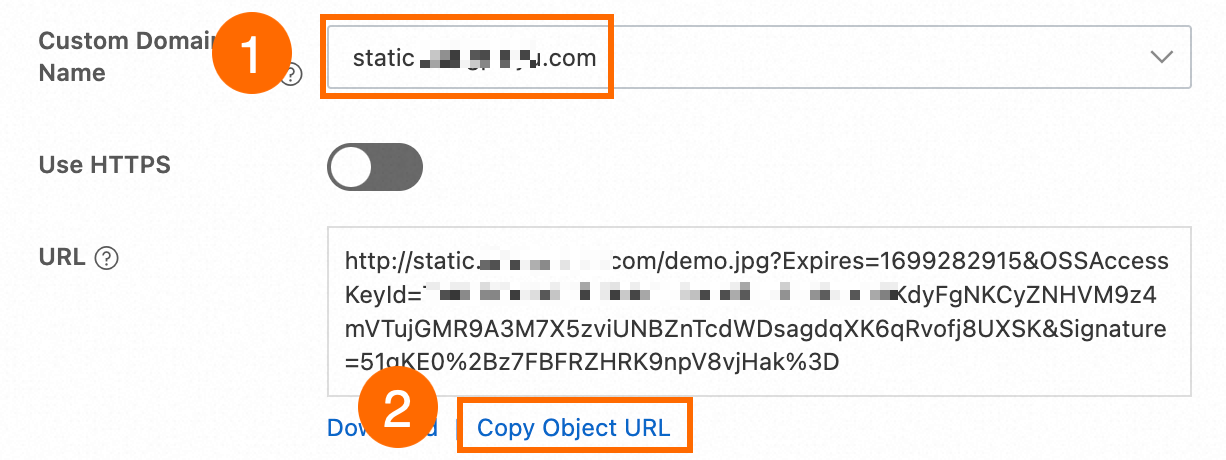
  5. In the View Details panel, select the custom domain name that is mapped to the bucket in the Custom Domain Name field, retain the default settings for other parameters, and then click Copy Object URL.

    2.png

Use ossbrowser

You can use ossbrowser to perform the same object-level operations that you can perform in the OSS console. You can follow the on-screen instructions in ossbrowser to obtain a presigned URL. For information about how to download ossbrowser, see Graphical management tool ossbrowser 1.0.

  1. Use the custom domain name to log on to ossbrowser.

  1. Obtain the URL of the object.

Use OSS SDKs

You can use the custom domain name to create an OssClient instance and generate a presigned URL.

Java

import com.aliyun.oss.*;
import com.aliyun.oss.common.auth.*;
import com.aliyun.oss.common.comm.SignVersion;
import com.aliyun.oss.model.GeneratePresignedUrlRequest;

import java.net.URL;
import java.util.Date;

public class Demo {
    public static void main(String[] args) throws Throwable {
        // Specify a custom domain name. Example: https://static.example.com. 
        String endpoint = "yourCustomEndpoint";
        // Specify the region in which the bucket is located. Example: cn-hangzhou.
        String region = "cn-hangzhou";
        // Specify the name of the bucket. Example: examplebucket.
        String bucketName = "examplebucket";
        // Specify the full path of the object. Do not include the bucket name in the full path. Example: exampledir/exampleobject.txt.
        String objectName = "exampleobject.txt";

        // Obtain access credentials from environment variables. Before you run the sample code, you must configure the environment variables.
        EnvironmentVariableCredentialsProvider credentialsProvider = CredentialsProviderFactory.newEnvironmentVariableCredentialsProvider();

        // Create an OSSClient instance.
        // Call the shutdown method to release resources when the OSSClient is no longer in use.
        ClientBuilderConfiguration clientBuilderConfiguration = new ClientBuilderConfiguration();
        // To enable CNAME, set this parameter to true.
        clientBuilderConfiguration.setSupportCname(true);
        // Explicitly declare the use of the V4 signature algorithm.
        clientBuilderConfiguration.setSignatureVersion(SignVersion.V4);
        OSS ossClient = OSSClientBuilder.create()
                .endpoint(endpoint)
                .credentialsProvider(credentialsProvider)
                .clientConfiguration(clientBuilderConfiguration)
                .region(region)
                .build();

        try {
            // Specify the validity period of the presigned URL. Unit: milliseconds. In this example, the validity period is set to 1 hour.
            Date expiration = new Date(new Date().getTime() + 3600 * 1000L);

            // Generate a presigned URL.
            GeneratePresignedUrlRequest request = new GeneratePresignedUrlRequest(bucketName, objectName, HttpMethod.GET);

            // Set the validity period of the URL.
            request.setExpiration(expiration);

            // Generate the presigned URL that allows HTTP GET requests.
            URL signedUrl = ossClient.generatePresignedUrl(request);
            // Display the presigned URL.
            System.out.println("signed url for getObject: " + signedUrl);
        } catch (OSSException oe) {
            System.out.println("Caught an OSSException, which means your request made it to OSS, "
                    + "but was rejected with an error response for some reason.");
            System.out.println("Error Message:" + oe.getErrorMessage());
            System.out.println("Error Code:" + oe.getErrorCode());
            System.out.println("Request ID:" + oe.getRequestId());
            System.out.println("Host ID:" + oe.getHostId());
        } catch (ClientException ce) {
            System.out.println("Caught an ClientException, which means the client encountered "
                    + "a serious internal problem while trying to communicate with OSS, "
                    + "such as not being able to access the network.");
            System.out.println("Error Message:" + ce.getMessage());
        } finally {
            if (ossClient != null) {
                ossClient.shutdown();
            }
        }
    }
}

PHP

<?php

// Include the autoload file to ensure that dependency libraries are correctly loaded.
require_once __DIR__ . '/../vendor/autoload.php';

use AlibabaCloud\Oss\V2 as Oss;

// Define the descriptions of command-line parameters.
$optsdesc = [
    "region" => ['help' => 'The region in which the bucket is located.', 'required' => True], // (Required) The region in which the bucket is located.
    "endpoint" => ['help' => 'The domain names that other services can use to access OSS.', 'required' => False], // (Optional) The endpoint.
    "bucket" => ['help' => 'The name of the bucket', 'required' => True], // (Required) The name of the bucket.
    "key" => ['help' => 'The name of the object', 'required' => True], // (Required) The name of the object.
];

// Convert the parameter descriptions to the long options format required by getopt.
// Add a colon (:) after each parameter to indicate that a value is required.
$longopts = \array_map(function ($key) {
    return "$key:";
}, array_keys($optsdesc));

// Parse the command-line arguments.
$options = getopt("", $longopts);

// Verify that all required parameters are provided.
foreach ($optsdesc as $key => $value) {
    if ($value['required'] === True && empty($options[$key])) {
        $help = $value['help']; // Obtain the help information for the parameter.
        echo "Error: the following arguments are required: --$key, $help" . PHP_EOL;
        exit(1); // If a required parameter is not provided, exit the program.
    }
}

// Extract values from the parsed parameters.
$region = $options["region"]; // The region in which the bucket is located.
$bucket = $options["bucket"]; // The name of the bucket.
$key = $options["key"];       // The name of the object.

// Load the access credential from the environment variable.
// Use EnvironmentVariableCredentialsProvider to read the Access Key ID and Access Key Secret from environment variables.
$credentialsProvider = new Oss\Credentials\EnvironmentVariableCredentialsProvider();

// Use the default configurations of the SDK.
$cfg = Oss\Config::loadDefault();
$cfg->setCredentialsProvider($credentialsProvider); // Set the credential provider.
$cfg->setRegion($region); // Set the region in which the bucket is located.
$cfg->setEndpoint(endpoint: "http://static.example.com"); // Set this parameter to your custom endpoint.
$cfg->setUseCname(true); // Set this parameter to use a CNAME.

// Create an OSS client instance.
$client = new Oss\Client($cfg);


// Create a GetObjectRequest object to download an object.
$request = new Oss\Models\GetObjectRequest(bucket:$bucket, key:$key);

// Call the presign method to generate a signed URL.
$result = $client->presign($request);

// Print the presign result.
// Output the signed URL. Users can use this URL to perform download operations.
print(
    'get object presign result:' . var_export($result, true) . PHP_EOL . // The details of the presign result.
    'get object url:' . $result->url . PHP_EOL                           // The signed URL, which is used to directly download the object.
);

Node.js

const OSS = require("ali-oss");

// Specify a function used to generate a presigned URL.
async function generateSignatureUrl(fileName) {
  // Obtain the presigned URL.
  const client = await new OSS({
      // Specify the custom domain name that you want to map to the bucket.
      endpoint: 'http://static.example.com', 
      // Obtain access credentials from environment variables. Before you run the sample code, make sure that the OSS_ACCESS_KEY_ID and OSS_ACCESS_KEY_SECRET environment variables are configured.
      accessKeyId: process.env.OSS_ACCESS_KEY_ID,
      accessKeySecret: process.env.OSS_ACCESS_KEY_SECRET,
      bucket: 'examplebucket',
      // Specify the region in which the bucket is located. For example, if your bucket is located in the China (Hangzhou) region, set the region to oss-cn-hangzhou.
      region: 'oss-cn-hangzhou',
      authorizationV4: true,
      cname: true
  });

  return await client.signatureUrlV4('GET', 3600, {
      headers: {} // Specify the request headers based on the actual request headers.
  }, fileName);
}
// Call the function and pass in the name of the object.
generateSignatureUrl('yourFileName').then(url => {
  console.log('Generated Signature URL:', url);
}).catch(err => {
  console.error('Error generating signature URL:', err);
});

Python

import argparse
import alibabacloud_oss_v2 as oss

# Create a command-line parameter parser and describe the purpose of the script.
parser = argparse.ArgumentParser(description="presign get object sample")

# Specify the --region parameter to indicate the region in which the bucket is located. This parameter is required.
parser.add_argument('--region', help='The region in which the bucket is located.', required=True)
# Specify the --bucket parameter to indicate the name of the bucket in which the object is stored. This parameter is required.
parser.add_argument('--bucket', help='The name of the bucket.', required=True)
# Specify the --endpoint parameter to indicate the endpoint of the region in which the bucket is located. This parameter is optional.
parser.add_argument('--endpoint', help='The domain names that other services can use to access OSS')
# Specify the --key parameter to indicate the name of the object. This parameter is required.
parser.add_argument('--key', help='The name of the object.', required=True)

def main():
    # Parse the command-line parameters to obtain the specified values.
    args = parser.parse_args()

    # From the environment variables, load the authentication information required to access OSS.
    credentials_provider = oss.credentials.EnvironmentVariableCredentialsProvider()

    # Use the default configuration to create a cfg object and specify the credential provider.
    cfg = oss.config.load_default()
    cfg.credentials_provider = credentials_provider
    
    # Specify the region attribute of the configuration object based on the command line parameters specified by the user.
    cfg.region = args.region

    # Specify the custom endpoint. Example: http://static.example.com
    cfg.endpoint = "http://static.example.com"
    
    # Enable CNAME record resolution.
    cfg.use_cname = True

    # Use the preceding settings to initialize the OSSClient instance.
    client = oss.Client(cfg)

    # Initiate a request to generate a presigned URL.
    pre_result = client.presign(
        oss.GetObjectRequest(
            bucket=args.bucket,  # Specify the bucket name.
            key=args.key,        # Specify the object key.
        )
    )

    # Display the HTTP method, expiration time, and presigned URL.
    print(f'method: {pre_result.method},'
          f' expiration: {pre_result.expiration.strftime("%Y-%m-%dT%H:%M:%S.000Z")},'
          f' url: {pre_result.url}'
    )

    # Display the signed headers.
    for key, value in pre_result.signed_headers.items():
        print(f'signed headers key: {key}, signed headers value: {value}')

# Call the main function to start the processing logic when the script is directly run.
if __name__ == "__main__":
    main()  # Specify the entry point of the script. The control flow starts here.

Go

package main

import (
	"context"
	"flag"
	"log"
	"time"

	"github.com/aliyun/alibabacloud-oss-go-sdk-v2/oss"
	"github.com/aliyun/alibabacloud-oss-go-sdk-v2/oss/credentials"
)

// Specify the global variables.
var (
	region     string // Region in which the bucket is located.
	bucketName string // Name of the bucket.
	objectName string // Name of the object.
)

// Specify the init function used to initialize command line parameters.
func init() {
	flag.StringVar(&region, "region", "", "The region in which the bucket is located.")
	flag.StringVar(&bucketName, "bucket", "", "The name of the bucket.")
	flag.StringVar(&objectName, "object", "", "The name of the object.")
}

func main() {
	// Parse command line parameters.
	flag.Parse()

	// Check whether the name of the bucket is specified.
	if len(bucketName) == 0 {
		flag.PrintDefaults()
		log.Fatalf("invalid parameters, bucket name required")
	}

	// Check whether the region is specified.
	if len(region) == 0 {
		flag.PrintDefaults()
		log.Fatalf("invalid parameters, region required")
	}

	// Check whether the object is specified.
	if len(objectName) == 0 {
		flag.PrintDefaults()
		log.Fatalf("invalid parameters, object name required")
	}

	// Load the default configurations and specify the credential provider and region.
	cfg := oss.LoadDefaultConfig().
		WithCredentialsProvider(credentials.NewEnvironmentVariableCredentialsProvider()).
		WithRegion(region).
		WithEndpoint("http://static.example.com").
		WithUseCName(true)

	// Create an OSS client.
	client := oss.NewClient(cfg)

	// Generate a presigned URL for the GetObject request.
	result, err := client.Presign(context.TODO(), &oss.GetObjectRequest{
		Bucket: oss.Ptr(bucketName),
		Key:    oss.Ptr(objectName),
		//RequestPayer: oss.Ptr("requester"), // Specify the identity of the requester.
	},
		oss.PresignExpires(10*time.Minute),
	)
	if err != nil {
		log.Fatalf("failed to get object presign %v", err)
	}

	log.Printf("request method:%v\n", result.Method)
	log.Printf("request expiration:%v\n", result.Expiration)
	log.Printf("request url:%v\n", result.URL)
	if len(result.SignedHeaders) > 0 {
		// If you specify request headers when you generate a presigned URL that allows HTTP GET requests, make sure that the request headers are included in the GET request initiated by using the presigned URL. This prevents request failures and signature errors.
		log.Printf("signed headers:\n")
		for k, v := range result.SignedHeaders {
			log.Printf("%v: %v\n", k, v)
		}
	}
}

Use ossutil

Use the custom domain name to generate a presigned URL for an object by running the presign command.

ossutil presign oss://examplebucket/exampleobject.txt --endpoint "http://static.example.com” --addressing-style "cname"

To enable the ossutil command to automatically use a custom domain name, instead of manually specifying it each time, add the custom domain name to the configuration file.

If the link still cannot be previewed, check the following configurations.

  • Is the Content-Type set appropriately?

    If the file's Content-Type does not match its actual type, the browser may not correctly identify and render the content, causing the file to be downloaded as an attachment. You can check How to set Content-Type (MIME)? to confirm whether the file name extension matches the Content-Type. If they do not match, refer to Manage object metadata for methods to modify the file's Content-Type.

  • Is Content-Disposition set to inline?

    If the file's Content-Disposition is set to attachment, the browser will force the file to download. Refer to Manage object metadata for methods to modify it to inline to support preview.

  • Has the CDN cache been refreshed?

    If you are not using CDN acceleration, you can ignore this item.

    If you use CDN to access OSS resources, you need to refresh the CDN cache after modifying file metadata. Otherwise, the old configuration may still be read, causing the preview to not take effect.

Get a forced download link for a file

If the current link (presigned URL) opens directly for preview in a browser, but you want it to download instead, you can use the following methods. Method 1 has higher priority than Method 2.

Method 1: One-time forced download

This only applies to the currently generated link. Implement this by setting the response-content-disposition parameter to attachment when generating the URL.

Java

Import the GeneratePresignedUrlRequest class.

import com.aliyun.oss.model.GeneratePresignedUrlRequest;

Use the GeneratePresignedUrlRequest method and set the response-content-disposition response header to attachment.

// Build a presigned URL for GET request
GeneratePresignedUrlRequest request = new GeneratePresignedUrlRequest(
    bucketName, objectName, HttpMethod.GET);

// Set forced download
request.getResponseHeaders().setContentDisposition("attachment");

Python

Add the response_content_disposition parameter in GetObjectRequest and set its value to attachment.

    # Generate a presigned GET request
    pre_result = client.presign(
        oss.GetObjectRequest(
            bucket=args.bucket,  # Specify the bucket name
            key=args.key,        # Specify the object key
            response_content_disposition="attachment",# Set to forced download
        )
    )

Go

Add the ResponseContentDisposition parameter in GetObjectRequest and set its value to attachment.

// Generate a presigned GET request with forced download behavior
result, err := client.Presign(context.TODO(), &oss.GetObjectRequest{
    Bucket:                     oss.Ptr(bucketName),
    Key:                        oss.Ptr(objectName),
    ResponseContentDisposition: oss.Ptr("attachment"), // Set to forced download
})

Complete sample code

Java

import com.aliyun.oss.*;
import com.aliyun.oss.common.auth.CredentialsProviderFactory;
import com.aliyun.oss.common.auth.EnvironmentVariableCredentialsProvider;
import com.aliyun.oss.common.comm.SignVersion;
import com.aliyun.oss.model.GeneratePresignedUrlRequest;

import java.net.URL;
import java.net.URLEncoder;
import java.util.Date;

public class Demo { 
    public static void main(String[] args) throws Throwable {
        //  Specify a custom domain name. Example: https://static.example.com. 
        String endpoint = "http://static.example.com";
        // Obtain access credentials from environment variables. Before you run the sample code, make sure that the OSS_ACCESS_KEY_ID and OSS_ACCESS_KEY_SECRET environment variables are configured. 
        EnvironmentVariableCredentialsProvider credentialsProvider = CredentialsProviderFactory.newEnvironmentVariableCredentialsProvider();

        // Specify the name of the bucket. Example: examplebucket. 
        String bucketName = "examplebucket";
        // Specify the full path of the object. Example: exampleobject.txt. Do not include the bucket name in the full path of the object. 
        String objectName = "exampleobject.txt";

        // Create an OSSClient instance. 
        // Call the shutdown method to release resources when the OSSClient is no longer in use.
        String region = "cn-hangzhou";
        ClientBuilderConfiguration clientBuilderConfiguration = new ClientBuilderConfiguration();
        // Note that if you use a custom domain name, you must set CNAME to true. 
        clientBuilderConfiguration.setSupportCname(true);

        // Explicitly declare the use of the V4 signature algorithm.
        clientBuilderConfiguration.setSignatureVersion(SignVersion.V4);
        OSS ossClient = OSSClientBuilder.create()
                .endpoint(endpoint)
                .credentialsProvider(credentialsProvider)
                .clientConfiguration(clientBuilderConfiguration)
                .region(region)
                .build();

        URL signedUrl = null;
        try {
            // Specify the validity period of the presigned URL. Unit: milliseconds. In this example, the validity period is 1 hour. 
            Date expiration = new Date(new Date().getTime() + 3600 * 1000L);

            // Specify the name of the object that you want to forcibly download. Example: homework.txt. 
            String filename = "homework.txt";

            // Generate a presigned URL. 
            GeneratePresignedUrlRequest request = new GeneratePresignedUrlRequest(bucketName, objectName, HttpMethod.GET);

            // Specify that the object is forcibly downloaded and specify the name of the downloaded object.
            request.getResponseHeaders().setContentDisposition("attachment;filename=" + URLEncoder.encode(filename,"UTF-8"));

            // Set the validity period of the request. 
            request.setExpiration(expiration);

            // Generate the presigned URL that allows HTTP GET requests. 
            signedUrl = ossClient.generatePresignedUrl(request);
            // Display the presigned URL. 
            System.out.println("signed url for getObject: " + signedUrl);
        } catch (OSSException oe) {
            System.out.println("Caught an OSSException, which means your request made it to OSS, "
                    + "but was rejected with an error response for some reason.");
            System.out.println("Error Message:" + oe.getErrorMessage());
            System.out.println("Error Code:" + oe.getErrorCode());
            System.out.println("Request ID:" + oe.getRequestId());
            System.out.println("Host ID:" + oe.getHostId());
        } catch (ClientException ce) {
            System.out.println("Caught an ClientException, which means the client encountered "
                    + "a serious internal problem while trying to communicate with OSS, "
                    + "such as not being able to access the network.");
            System.out.println("Error Message:" + ce.getMessage());
        }
    }

}

Python

import argparse
import alibabacloud_oss_v2 as oss

# Create a command-line argument parser and describe the purpose of the script.
parser = argparse.ArgumentParser(description="presign get object sample")

# Specify the --region parameter to indicate the region in which the bucket is located. This parameter is required.
parser.add_argument('--region', help='The region in which the bucket is located.', required=True)
# Specify the --bucket parameter to indicate the name of the bucket in which the object is stored. This parameter is required.
parser.add_argument('--bucket', help='The name of the bucket.', required=True)
# Specify the --endpoint parameter to indicate the endpoint of the region in which the bucket is located. This parameter is optional.
parser.add_argument('--endpoint', help='The domain names that other services can use to access OSS')
# Specify the --key parameter to indicate the name of the object. This parameter is required.
parser.add_argument('--key', help='The name of the object.', required=True)

def main():
    # Parse the command-line parameters.
    args = parser.parse_args()

    # Obtain access credentials from environment variables for authentication.
    credentials_provider = oss.credentials.EnvironmentVariableCredentialsProvider()

    # Use the default configuration to create a configuration object (cfg) and specify the credential provider.
    cfg = oss.config.load_default()
    cfg.credentials_provider = credentials_provider

    # Set the region attribute of the cfg object to the region in the parser.
    cfg.region = args.region

    # If a custom endpoint is provided, update the endpoint attribute of the cfg object with the provided endpoint.
    if args.endpoint is not None:
        cfg.endpoint = args.endpoint

    # Use the preceding configuration to initialize the OSSClient instance.
    client = oss.Client(cfg)

    # Initiate a request to generate a presigned URL.
    pre_result = client.presign(
        oss.GetObjectRequest(
            bucket=args.bucket,  # Specify the bucket name.
            key=args.key,        # Specify the object key.
            response_content_disposition="attachment;filename=test.txt",
        )
    )

    # Display the HTTP method, expiration time, and presigned URL.
    print(f'method: {pre_result.method},'
          f' expiration: {pre_result.expiration.strftime("%Y-%m-%dT%H:%M:%S.000Z")},'
          f' url: {pre_result.url}'
    )

    # Display the signed headers.
    for key, value in pre_result.signed_headers.items():
        print(f'signed headers key: {key}, signed headers value: {value}')

# Call the main function to start the processing logic when the script is directly run.
if __name__ == "__main__":
    main()  # Specify the entry point of the script. The control flow starts here.

Go

package main

import (
	"context"
	"flag"
	"log"

	"github.com/aliyun/alibabacloud-oss-go-sdk-v2/oss"
	"github.com/aliyun/alibabacloud-oss-go-sdk-v2/oss/credentials"
)

// Specify the global variables.
var (
	region     string // The region in which the bucket is located.
	bucketName string // The name of the bucket.
	objectName string // The name of the object.
)

// Specify the init function used to initialize command line parameters.
func init() {
	flag.StringVar(&region, "region", "", "The region in which the bucket is located.")
	flag.StringVar(&bucketName, "bucket", "", "The name of the bucket.")
	flag.StringVar(&objectName, "object", "", "The name of the object.")
}

func main() {
	// Parse the command line parameters.
	flag.Parse()

	// Check whether the bucket name is empty.
	if len(bucketName) == 0 {
		flag.PrintDefaults()
		log.Fatalf("invalid parameters, bucket name required")
	}

	// Check whether the region is empty.
	if len(region) == 0 {
		flag.PrintDefaults()
		log.Fatalf("invalid parameters, region required")
	}

	// Check whether the object name is empty.
	if len(objectName) == 0 {
		flag.PrintDefaults()
		log.Fatalf("invalid parameters, object name required")
	}

	// Load the default configurations and specify the credential provider and region.
	cfg := oss.LoadDefaultConfig().
		WithCredentialsProvider(credentials.NewEnvironmentVariableCredentialsProvider()).
		WithRegion(region)

	// Create an OSS client.
	client := oss.NewClient(cfg)

	// Generate a signed URL for the GetObject request.
	result, err := client.Presign(context.TODO(), &oss.GetObjectRequest{
		Bucket:                     oss.Ptr(bucketName),
		Key:                        oss.Ptr(objectName),
		ResponseContentDisposition: oss.Ptr("attachment;filename=test.txt"),
	},
	)
	if err != nil {
		log.Fatalf("failed to get object presign %v", err)
	}

	log.Printf("request method:%v\n", result.Method)
	log.Printf("request expiration:%v\n", result.Expiration)
	log.Printf("request url:%v\n", result.URL)
	if len(result.SignedHeaders) > 0 {
		//If you specify request headers when you generate a signed URL that allows HTTP GET requests, make sure that the request headers are included in the GET request initiated by using the signed URL.
		log.Printf("signed headers:\n")
		for k, v := range result.SignedHeaders {
			log.Printf("%v: %v\n", k, v)
		}
	}
}

Method 2: Universal forced download setting (via metadata)

After setting this once, all access to the file will be forced to download. This is implemented by modifying the Content-Disposition field in the file metadata.

Using the OSS console

In the OSS Management Console, find the target file, click Set File Metadata in the file details panel, set Content-Disposition to attachment, and then click OK to save.

In addition to console operations, you can also refer to Manage file metadata to set this field using the SDK or the command line interface ossutil.

If you also want to customize the file name displayed during download, see Customize the file name during download.

Get links to specific versions of files

Generate links (presigned URLs) for specific versions of files, applicable to buckets with versioning enabled.

Using the OSS console

  1. You can log on to the OSS Management Console, go to the Files tab of the target bucket, and switch Historical Version to Show in the upper-right corner of the page.

    image

  2. Find the target file, click the filename of the required historical version, and Copy the URL of this version file on the details page.

    image

Using Alibaba Cloud SDK

Java

Add the following key code:

// 1. Define the version ID variable
String versionId = "CAEQARiBgID8rumR2hYiIGUyOTAyZGY2MzU5MjQ5ZjlhYzQzZjNlYTAyZDE3****";

// 2. Create a query parameter Map
Map<String, String> queryParam = new HashMap<String, String>();
queryParam.put("versionId", versionId);

// 3. Add the version ID parameter to the request
request.setQueryParameter(queryParam);

Python

Add the version_id parameter to GetObjectRequest.

pre_result = client.presign(
    oss.GetObjectRequest(
        bucket=bucket_name,
        key=object_name,
        version_id='CAEQARiBgID8rumR2hYiIGUyOTAyZGY2MzU5MjQ5ZjlhYzQzZjNlYTAyZDE3****'  # Set the VersionId parameter 
    )
)

Go

Add the VersionId field to GetObjectRequest.

result, err := client.Presign(context.TODO(), &oss.GetObjectRequest{
    Bucket:    oss.Ptr(bucketName),
    Key:       oss.Ptr(objectName),
    VersionId: oss.Ptr("CAEQARiBgID8rumR2hYiIGUyOTAyZGY2MzU5MjQ5ZjlhYzQzZjNlYTAyZDE7****"), // Set VersionId
}, oss.PresignExpires(10*time.Minute))

Node.js

Add the queries parameter to signatureUrlV4.

const signedUrl = await client.signatureUrlV4('GET', 3600, {
  queries: {
    "versionId": 'CAEQARiBgID8rumR2hYiIGUyOTAyZGY2MzU5MjQ5ZjlhYzQzZjNlYTAyZDE7****'  // Add versionId parameter
  }
}, objectName);

PHP

In GetObjectRequest, add the versionId parameter.

// Add specific version parameter
$versionId = "yourVersionId"; // Replace with actual version number
$request = new Oss\Models\GetObjectRequest(bucket:$bucket, key:$key, versionId:$versionId);

Complete sample code

Java

import com.aliyun.oss.*;
import com.aliyun.oss.common.auth.*;
import com.aliyun.oss.common.comm.SignVersion;
import com.aliyun.oss.model.GeneratePresignedUrlRequest;
import java.net.URL;
import java.util.*;
import java.util.Date;

public class Demo {
    public static void main(String[] args) throws Throwable {
        // In this example, the endpoint of the China (Hangzhou) region is used. Specify your actual endpoint. 
        String endpoint = "https://oss-cn-hangzhou.aliyuncs.com";
        // Obtain access credentials from environment variables. Before you run the sample code, make sure that the OSS_ACCESS_KEY_ID and OSS_ACCESS_KEY_SECRET environment variables are configured. 
        EnvironmentVariableCredentialsProvider credentialsProvider = CredentialsProviderFactory.newEnvironmentVariableCredentialsProvider();
	// Specify the name of the bucket. Example: examplebucket. 
        String bucketName = "examplebucket";
        // Specify the full path of the object. Example: exampleobject.txt. Do not include the bucket name in the full path of the object. 
        String objectName = "exampleobject.txt";
        // Specify the version ID of the object. 
        String versionId = "CAEQARiBgID8rumR2hYiIGUyOTAyZGY2MzU5MjQ5ZjlhYzQzZjNlYTAyZDE3****";
        // Specify the region in which the bucket is located. For example, if the bucket is located in the China (Hangzhou) region, set the region to cn-hangzhou. 
        String region = "cn-hangzhou";

        // Create an OSSClient instance. 
        // Call the shutdown method to release resources when the OSSClient is no longer in use.
        ClientBuilderConfiguration clientBuilderConfiguration = new ClientBuilderConfiguration();
        clientBuilderConfiguration.setSignatureVersion(SignVersion.V4);        
        OSS ossClient = OSSClientBuilder.create()
        .endpoint(endpoint)
        .credentialsProvider(credentialsProvider)
        .clientConfiguration(clientBuilderConfiguration)
        .region(region)               
        .build();

        try {
            // Create a request. 
            GeneratePresignedUrlRequest generatePresignedUrlRequest = new GeneratePresignedUrlRequest(bucketName, objectName);
            // Set HttpMethod to GET. 
            generatePresignedUrlRequest.setMethod(HttpMethod.GET);
            // Specify the validity period of the presigned URL. Unit: milliseconds. In this example, the validity period is 1 hour. 
            Date expiration = new Date(new Date().getTime() + 3600 * 1000L);
            generatePresignedUrlRequest.setExpiration(expiration);
            // Specify the version ID of the object. 
            Map<String, String> queryParam = new HashMap<String, String>();
            queryParam.put("versionId", versionId);
            generatePresignedUrlRequest.setQueryParameter(queryParam);
            // Generate a presigned URL. 
            URL url = ossClient.generatePresignedUrl(generatePresignedUrlRequest);
            System.out.println(url);
        } catch (OSSException oe) {
            System.out.println("Caught an OSSException, which means your request made it to OSS, "
                    + "but was rejected with an error response for some reason.");
            System.out.println("Error Message:" + oe.getErrorMessage());
            System.out.println("Error Code:" + oe.getErrorCode());
            System.out.println("Request ID:" + oe.getRequestId());
            System.out.println("Host ID:" + oe.getHostId());
        } catch (ClientException ce) {
            System.out.println("Caught an ClientException, which means the client encountered "
                    + "a serious internal problem while trying to communicate with OSS, "
                    + "such as not being able to access the network.");
            System.out.println("Error Message:" + ce.getMessage());
        } finally {
            if (ossClient != null) {
                ossClient.shutdown();
            }
        }
    }
}

Python

import argparse
import alibabacloud_oss_v2 as oss

# Create a command-line parameter parser and describe the purpose of the script.
parser = argparse.ArgumentParser(description="presign get object sample")

# Specify the --region parameter to indicate the region in which the bucket is located. This parameter is required.
parser.add_argument('--region', help='The region in which the bucket is located.', required=True)
# Specify the --bucket parameter to indicate the name of the bucket in which the object is stored. This parameter is required.
parser.add_argument('--bucket', help='The name of the bucket.', required=True)
# Specify the --endpoint parameter to indicate the endpoint of the region in which the bucket is located. This parameter is optional.
parser.add_argument('--endpoint', help='The domain names that other services can use to access OSS')
# Specify the --key parameter to indicate the name of the object. This parameter is required.
parser.add_argument('--key', help='The name of the object.', required=True)

def main():
    # Parse the command-line parameters to obtain the specified values.
    args = parser.parse_args()

    # From the environment variables, load the authentication information required to access OSS.
    credentials_provider = oss.credentials.EnvironmentVariableCredentialsProvider()

    # Use the default configuration to create a cfg object and specify the credential provider.
    cfg = oss.config.load_default()
    cfg.credentials_provider = credentials_provider
    
    # Specify the region attribute of the configuration object based on the command line parameters specified by the user.
    cfg.region = args.region

    # If a custom endpoint is provided, update the endpoint attribute of the cfg object with the provided endpoint.
    if args.endpoint is not None:
        cfg.endpoint = args.endpoint

    # Use the preceding settings to initialize the OSSClient instance.
    client = oss.Client(cfg)

    # Initiate a request to generate a presigned URL.
    # The version_id parameter is optional. You need to specify this parameter only when the bucket that contains the object is versioned.
    pre_result = client.presign(
        oss.GetObjectRequest(
            bucket=args.bucket,  # Specify the bucket name.
            key=args.key,        # Specify the object key.
            version_id='yourVersionId'  # If applicable, specify the version ID of the object.
        )
    )

    # Display the HTTP method, expiration time, and presigned URL.
    print(f'method: {pre_result.method},'
          f' expiration: {pre_result.expiration.strftime("%Y-%m-%dT%H:%M:%S.000Z")},'
          f' url: {pre_result.url}'
    )

    # Display the signed headers.
    for key, value in pre_result.signed_headers.items():
        print(f'signed headers key: {key}, signed headers value: {value}')

# Call the main function to start the processing logic when the script is directly run.
if __name__ == "__main__":
    main()  # Specify the entry point of the script. The control flow starts here.

Go

package main

import (
	"context"
	"flag"
	"log"
	"time"

	"github.com/aliyun/alibabacloud-oss-go-sdk-v2/oss"
	"github.com/aliyun/alibabacloud-oss-go-sdk-v2/oss/credentials"
)

// Specify the global variables.
var (
	region: string; // The region in which the bucket is located.
	bucketName string // The name of the bucket.
	objectName string // The name of the object.
)

// Specify the init function used to initialize command line parameters.
func init() {
	flag.StringVar(&region, "region", "", "The region in which the bucket is located.")
	flag.StringVar(&bucketName, "bucket", "", "The name of the bucket.")
	flag.StringVar(&objectName, "object", "", "The name of the object.")
}

func main() {
	// Parse command line parameters.
	flag.Parse()

	// Check whether the bucket name is empty.
	if len(bucketName) == 0 {
		flag.PrintDefaults()
		log.Fatalf("invalid parameters, bucket name required")
	}

	// Check whether the region is empty.
	if len(region) == 0 {
		flag.PrintDefaults()
		log.Fatalf("invalid parameters, region required")
	}

	// Check whether the object name is empty.
	if len(objectName) == 0 {
		flag.PrintDefaults()
		log.Fatalf("invalid parameters, object name required")
	}

	// Load the default configurations and specify the credential provider and region.
	cfg := oss.LoadDefaultConfig().
		WithCredentialsProvider(credentials.NewEnvironmentVariableCredentialsProvider()).
		WithRegion(region)

	// Create an OSS client.
	client := oss.NewClient(cfg)

	// Generate a presigned URL for the GetObject request.
	result, err := client.Presign(context.TODO(), &oss.GetObjectRequest{
		Bucket:    oss.Ptr(bucketName),
		Key:       oss.Ptr(objectName),
		VersionId: oss.Ptr("yourVersionId"), // Specify the version ID.
	},
		oss.PresignExpires(10*time.Minute),
	)
	if err != nil {
		log.Fatalf("failed to get object presign %v", err)
	}
	log.Printf("get object presign result: %#v\n", result)
	log.Printf("get object url: %#v\n", result.URL)
}

Node.js

const OSS = require("ali-oss");

const client = await new OSS({
  // Obtain access credentials from environment variables. Before you run the sample code, make sure that the OSS_ACCESS_KEY_ID and OSS_ACCESS_KEY_SECRET environment variables are configured. 
  accessKeyId: process.env.OSS_ACCESS_KEY_ID,
  accessKeySecret: process.env.OSS_ACCESS_KEY_SECRET,
  bucket: 'examplebucket',
  // Specify the region in which the bucket is located. For example, if your bucket is located in the China (Hangzhou) region, set the region to oss-cn-hangzhou.
  region: 'oss-cn-hangzhou',
  // Set secure to true and use HTTPS to prevent the generated download link from being blocked by the browser.
  secure: true,
  authorizationV4: true
});


// Generate a presigned URL.
const signedUrl = await client.signatureUrlV4('GET', 3600, {
  queries:{
    // Specify the version ID of the object.
    "versionId":'yourVersionId'
  }
}, 'demo.pdf');

PHP

<?php

// Include the autoload file to ensure that dependency libraries are correctly loaded.
require_once __DIR__ . '/../vendor/autoload.php';

use AlibabaCloud\Oss\V2 as Oss;

// Define the descriptions of command-line parameters.
$optsdesc = [
    "region" => ['help' => 'The region in which the bucket is located.', 'required' => True], // (Required) The region in which the bucket is located.
    "endpoint" => ['help' => 'The domain names that other services can use to access OSS.', 'required' => False], // (Optional) The endpoint.
    "bucket" => ['help' => 'The name of the bucket', 'required' => True], // (Required) The name of the bucket.
    "key" => ['help' => 'The name of the object', 'required' => True], // (Required) The name of the object.
];

// Convert the parameter descriptions to the long options format required by getopt.
// Add a colon (:) after each parameter to indicate that a value is required.
$longopts = \array_map(function ($key) {
    return "$key:";
}, array_keys($optsdesc));

// Parse the command-line arguments.
$options = getopt("", $longopts);

// Verify that all required parameters are provided.
foreach ($optsdesc as $key => $value) {
    if ($value['required'] === True && empty($options[$key])) {
        $help = $value['help']; // Obtain the help information for the parameter.
        echo "Error: the following arguments are required: --$key, $help" . PHP_EOL;
        exit(1); // If a required parameter is not provided, exit the program.
    }
}

// Extract values from the parsed parameters.
$region = $options["region"]; // The region in which the bucket is located.
$bucket = $options["bucket"]; // The name of the bucket.
$key = $options["key"];       // The name of the object.

// Load the access credential from the environment variable.
// Use EnvironmentVariableCredentialsProvider to read the Access Key ID and Access Key Secret from environment variables.
$credentialsProvider = new Oss\Credentials\EnvironmentVariableCredentialsProvider();

// Use the default configurations of the SDK.
$cfg = Oss\Config::loadDefault();
$cfg->setCredentialsProvider($credentialsProvider); // Set the credential provider.
$cfg->setRegion($region); // Set the region in which the bucket is located.
if (isset($options["endpoint"])) {
    $cfg->setEndpoint($options["endpoint"]); // If an endpoint is provided, set the endpoint.
}

// Create an OSS client instance.
$client = new Oss\Client($cfg);

$versionId = "yourVersionId"; // The version number. This is an example value. Replace it with the actual version ID.

// Create a GetObjectRequest object to download an object.
$request = new Oss\Models\GetObjectRequest(bucket:$bucket, key:$key, versionId: $versionId);

// Call the presign method to generate a signed URL.
$result = $client->presign($request);

// Print the presign result.
// Output the signed URL. Users can use this URL to perform download operations.
print(
    'get object presign result:' . var_export($result, true) . PHP_EOL . // The details of the presign result.
    'get object url:' . $result->url . PHP_EOL                           // The signed URL, which is used to directly download the object.
);

Using ossutil

Generate a presigned URL for the example.txt object with version ID 123 in the examplebucket bucket.

ossutil presign oss://examplebucket/example.txt --version-id 123

Batch generate file links

It is recommended to use the command line interface ossutil, which can batch generate links for files in an entire folder.

Use command line interface ossutil

  • Generate presigned URLs with a default validity period of 15 minutes for all files in the folder directory of the examplebucke bucket.

    ossutil presign oss://examplebucket/folder/ -r
  • Generate presigned URLs with a default validity period of 15 minutes for files with the .txt extension in the folder directory of the examplebucket bucket.

    ossutil presign oss://examplebucket/folder/ -r --include "*.txt"
  • Generate presigned URLs with a default validity period of 15 minutes for all files in the examplebucket bucket.

    ossutil presign oss://examplebucket/ -r

For more information about generating presigned URLs using ossutil, see presign (Generate presigned URLs).

Use OSS console

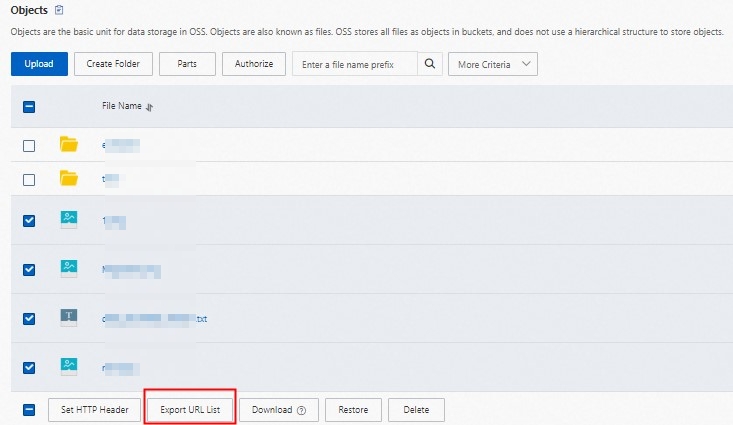
You can only export presigned URLs for files in the current directory. You cannot export presigned URLs for files in subdirectories.

  1. Select the object file, and then click Export URL List below.list

  2. In the configuration panel that appears, the default parameters are suitable for most scenarios and can be used without modification.

    Parameter description (optional)

    Parameter

    Description

    Use HTTPS

    By default, the HTTPS protocol is used to generate file URLs. If you want to use the HTTP protocol to generate file URLs, turn off the Use HTTPS switch.

    Validity Period

    When the object file is private, you need to set the validity period for the file URL.

    Valid values: 60 to 32400

    Unit: seconds

    Custom Domain Name

    If you want to ensure that third parties preview images or web files when accessing them, use the custom domain name attached to the bucket to generate signed URLs.

    This option can be configured only after a custom domain name is attached to the bucket.

    Accelerate Endpoint

    If third parties need to access files over long distances such as across countries or oceans, it is recommended to use the acceleration endpoint to generate URLs.

    This option can be configured only after transfer acceleration is enabled for the bucket.

  3. Click OK to download and save the generated URL list file.

Use Alibaba Cloud SDK

Use the GetBucket(ListObjects) operation to obtain all object names, and then generate presigned URLs for each object.

Custom download file name

Based on forced downloads, you can further specify the file name that users see when saving files. Method 1 has higher priority than Method 2.

Method 1: Set download file name for a single request

Specify a download file name for a single signed URL. You only need to add the response-content-disposition parameter set to attachment and include the filename parameter.

Java

Set the response-content-disposition parameter.

// Set the file name displayed when the client downloads, using "test.txt" as an example
String filename = "test.txt";
request.getResponseHeaders().setContentDisposition("attachment;filename=" + URLEncoder.encode(filename,"UTF-8"));

Python

Use the response_content_disposition parameter to customize the download file name as test.txt.

    # Generate a presigned GET request
    pre_result = client.presign(
        oss.GetObjectRequest(
            bucket=args.bucket,  # Specify the bucket name
            key=args.key,        # Specify the object key
            response_content_disposition="attachment;filename=test.txt",# Set the file name displayed when the client downloads, in this case "test.txt"
        )
    )

Go

Use the ResponseContentDisposition parameter to customize the download file name as test.txt.

// Generate a presigned GET request with forced download behavior
result, err := client.Presign(context.TODO(), &oss.GetObjectRequest{
    Bucket:                     oss.Ptr(bucketName),
    Key:                        oss.Ptr(objectName),
    ResponseContentDisposition: oss.Ptr("attachment;filename=test.txt"),//Set the file name displayed when the client downloads, in this case "test.txt"
})

Method 2: Universal setting (through metadata)

Modify metadata to set a unified default download name for all access. This is implemented by modifying the Content-Disposition field in the file metadata to attachment; filename="yourFileName", where yourFileName is your custom file name, such as example.jpg.

Set the validity period of a link

The validity period of a link (presigned URL) is set when it is generated and cannot be modified afterward. The link can be accessed multiple times during its validity period and becomes invalid after expiration.

Different generation methods support different maximum validity periods. Exceeding the limit will cause generation failure or access exceptions.

Maximum validity period of presigned URLs (optional reading)

The maximum validity period of a presigned URL depends on the signature version (V4 or V1) and the generation tool. V4 signature is recommended, with a maximum validity period of 7 days and higher security. Although V1 signature supports a longer validity period, it has lower security and is no longer maintained, so it is not recommended.

  • V4 signature (recommended): Uses relative time to represent the validity period, meaning "UTC time when the signature is generated + validity period" represents the expiration time of the presigned URL, with a maximum validity period of 604800 seconds (7 days).

  • V1 signature: Uses UNIX timestamp to represent the validity period, with a maximum of the largest time that can be represented by a timestamp. For more differences between V1 signature and V4 signature, see Comparison between V1 signature and V4 signature.

Note

If you generate a presigned URL through an STS Token, its validity period is limited by the validity period of the STS Token itself, which is at most 43200 seconds (12 hours).

The following shows the maximum validity periods when using different tools to generate presigned URLs.

Tool

Maximum validity period

Description

OSS SDK 2.0

V1: Long-term (timestamp limit)

V4: 604800 seconds (7 days)

Uses V4 by default, V1 can be specified.

When using V4 signature, exceeding the maximum validity period will result in an error.

OSS SDK 1.0

V1: Long-term (timestamp limit)

V4: 604800 seconds (7 days)

Uses V1 by default, V4 can be specified.

When using V4 signature, exceeding the maximum validity period will not result in an error.

ossutil 2.0

V1: Long-term (timestamp limit)

V4: 604800 seconds (7 days)

Uses V4 by default, V1 can be specified.

When using V4 signature, exceeding the maximum validity period will result in an error.

ossutil 1.0

V1: Long-term (timestamp limit)

V4: 604800 seconds (7 days)

Uses V1 by default, V4 can be specified.

When using V4 signature, exceeding the maximum validity period will not result in an error.

Console

32400 seconds (9 hours)

-

ossbrowser 2.0

32400 seconds (9 hours)

Only supports V4.

ossbrowser 1.0

32400 seconds (9 hours)

Only supports V1.

Using the OSS console

You can log on to the OSS Management Console, go to the Files list of the target bucket, click the target file and set the link validity period in the Expiration Time in the details panel on the right.

Using Alibaba Cloud SDK

Note

You need to have the oss:GetObject permission for third parties to successfully download files through the presigned URL. For specific authorization operations, see Grant custom permissions to RAM users. After generation, you can send the link to third parties who need to access the file.

You can set the expiration time of the presigned URL by modifying the expiration in the code.

Java

For more SDK information, see Download objects using presigned URLs in Java.

import com.aliyun.oss.*;
import com.aliyun.oss.common.auth.*;
import com.aliyun.oss.common.comm.SignVersion;

import java.net.URL;
import java.util.Date;

public class Demo {
    public static void main(String[] args) throws Throwable {
        // In this example, the endpoint of the China (Hangzhou) region is used. Specify your actual endpoint. 
        String endpoint = "https://oss-cn-hangzhou.aliyuncs.com";
        // Obtain access credentials from environment variables. Before you run the sample code, make sure that the OSS_ACCESS_KEY_ID and OSS_ACCESS_KEY_SECRET environment variables are configured. 
        EnvironmentVariableCredentialsProvider credentialsProvider = CredentialsProviderFactory.newEnvironmentVariableCredentialsProvider();
        // Specify the name of the bucket. Example: examplebucket. 
        String bucketName = "examplebucket";
        // Specify the full path of the object. Example: exampleobject.txt. Do not include the bucket name in the full path of the object. 
        String objectName = "exampleobject.txt";
        // Specify the region in which the bucket is located. For example, if the bucket is located in the China (Hangzhou) region, set the region to cn-hangzhou. 
        String region = "cn-hangzhou";

        // Create an OSSClient instance. 
        // Call the shutdown method to release resources when the OSSClient is no longer in use.
        ClientBuilderConfiguration clientBuilderConfiguration = new ClientBuilderConfiguration();
        clientBuilderConfiguration.setSignatureVersion(SignVersion.V4);
        OSS ossClient = OSSClientBuilder.create()
                .endpoint(endpoint)
                .credentialsProvider(credentialsProvider)
                .clientConfiguration(clientBuilderConfiguration)
                .region(region)
                .build();

        try {
            // Specify the validity period of the presigned URL. Unit: milliseconds. In this example, the validity period is 1 hour. 
            Date expiration = new Date(new Date().getTime() + 3600 * 1000L);
            // Generate a presigned URL that allows HTTP GET requests. In this example, no additional request headers are specified. Other users can access the relevant content directly by using the browser. 
            URL url = ossClient.generatePresignedUrl(bucketName, objectName, expiration);
            System.out.println(url);
        } catch (OSSException oe) {
            System.out.println("Caught an OSSException, which means your request made it to OSS, "
                    + "but was rejected with an error response for some reason.");
            System.out.println("Error Message:" + oe.getErrorMessage());
            System.out.println("Error Code:" + oe.getErrorCode());
            System.out.println("Request ID:" + oe.getRequestId());
            System.out.println("Host ID:" + oe.getHostId());
        } catch (ClientException ce) {
            System.out.println("Caught an ClientException, which means the client encountered "
                    + "a serious internal problem while trying to communicate with OSS, "
                    + "such as not being able to access the network.");
            System.out.println("Error Message:" + ce.getMessage());
        } finally {
            if (ossClient != null) {
                ossClient.shutdown();
            }
        }
    }
}

Python

For more SDK information, see Download objects using presigned URLs in Python.

import argparse
import alibabacloud_oss_v2 as oss

# Create a command-line parameter parser and describe the purpose of the script.
parser = argparse.ArgumentParser(description="presign get object sample")

# Specify the --region parameter to indicate the region in which the bucket is located. This parameter is required.
parser.add_argument('--region', help='The region in which the bucket is located.', required=True)
# Specify the --bucket parameter to indicate the name of the bucket in which the object is stored. This parameter is required.
parser.add_argument('--bucket', help='The name of the bucket.', required=True)
# Specify the --endpoint parameter to indicate the endpoint of the region in which the bucket is located. This parameter is optional.
parser.add_argument('--endpoint', help='The domain names that other services can use to access OSS')
# Specify the --key parameter to indicate the name of the object. This parameter is required.
parser.add_argument('--key', help='The name of the object.', required=True)

def main():
    # Parse the command-line parameters to obtain the specified values.
    args = parser.parse_args()

    # From the environment variables, load the authentication information required to access OSS.
    credentials_provider = oss.credentials.EnvironmentVariableCredentialsProvider()

    # Use the default configuration to create a cfg object and specify the credential provider.
    cfg = oss.config.load_default()
    cfg.credentials_provider = credentials_provider
    
    # Set the region attribute of the cfg object to the region provided in the command line.
    cfg.region = args.region

    # If a custom endpoint is provided, update the endpoint attribute of the cfg object with the provided endpoint.
    if args.endpoint is not None:
        cfg.endpoint = args.endpoint

    # Use the preceding settings to initialize the OSSClient instance.
    client = oss.Client(cfg)

    # Initiate a request to generate a presigned URL.
    pre_result = client.presign(
        oss.GetObjectRequest(
            bucket=args.bucket,  # Specify the bucket name.
            key=args.key,        # Specify the object key.
        )
    )

    # Display the HTTP method, expiration time, and presigned URL.
    print(f'method: {pre_result.method},'
          f' expiration: {pre_result.expiration.strftime("%Y-%m-%dT%H:%M:%S.000Z")},'
          f' url: {pre_result.url}'
    )

    # Display the signed headers.
    for key, value in pre_result.signed_headers.items():
        print(f'signed headers key: {key}, signed headers value: {value}')

# Call the main function to start the processing logic when the script is directly run.
if __name__ == "__main__":
    main()  # Specify the entry point of the script. The control flow starts here.

Go

For more SDK information, see Download objects using presigned URLs in Go.

package main

import (
	"context"
	"flag"
	"log"
	"time"

	"github.com/aliyun/alibabacloud-oss-go-sdk-v2/oss"
	"github.com/aliyun/alibabacloud-oss-go-sdk-v2/oss/credentials"
)

// Specify the global variables.
var (
	region: string; // The region in which the bucket is located.
	bucketName string // The name of the bucket.
	objectName string // The name of the object.
)

// Specify the init function used to initialize command line parameters.
func init() {
	flag.StringVar(&region, "region", "", "The region in which the bucket is located.")
	flag.StringVar(&bucketName, "bucket", "", "The name of the bucket.")
	flag.StringVar(&objectName, "object", "", "The name of the object.")
}

func main() {
	// Parse command line parameters.
	flag.Parse()

	// Check whether the bucket name is empty.
	if len(bucketName) == 0 {
		flag.PrintDefaults()
		log.Fatalf("invalid parameters, bucket name required")
	}

	// Check whether the region is empty.
	if len(region) == 0 {
		flag.PrintDefaults()
		log.Fatalf("invalid parameters, region required")
	}

	// Check whether the object name is empty.
	if len(objectName) == 0 {
		flag.PrintDefaults()
		log.Fatalf("invalid parameters, object name required")
	}

	// Load the default configurations and specify the credential provider and region.
	cfg := oss.LoadDefaultConfig().
		WithCredentialsProvider(credentials.NewEnvironmentVariableCredentialsProvider()).
		WithRegion(region)

	// Create an OSS client.
	client := oss.NewClient(cfg)

	// Generate a presigned URL for the GetObject request.
	result, err := client.Presign(context.TODO(), &oss.GetObjectRequest{
		Bucket: oss.Ptr(bucketName),
		Key:    oss.Ptr(objectName),
	},
		oss.PresignExpires(10*time.Minute),
	)
	if err != nil {
		log.Fatalf("failed to get object presign %v", err)
	}

	log.Printf("request method:%v\n", result.Method)
	log.Printf("request expiration:%v\n", result.Expiration)
	log.Printf("request url:%v\n", result.URL)
	if len(result.SignedHeaders) > 0 {
		// If you specify request headers when you generate a presigned URL that allows HTTP GET requests, make sure that the request headers are included in the GET request initiated by using the presigned URL. This prevents request failures and signature errors.
		log.Printf("signed headers:\n")
		for k, v := range result.SignedHeaders {
			log.Printf("%v: %v\n", k, v)
		}
	}
}

Node.js

For more SDK information, see Download objects using presigned URLs in Node.js.

const OSS = require("ali-oss");

// Specify a function used to generate a presigned URL.
async function generateSignatureUrl(fileName) {
  // Obtain the presigned URL.
  const client = await new OSS({
      // Obtain access credentials from environment variables. Before you run the sample code, make sure that the OSS_ACCESS_KEY_ID and OSS_ACCESS_KEY_SECRET environment variables are configured. 
      accessKeyId: process.env.OSS_ACCESS_KEY_ID,
      accessKeySecret: process.env.OSS_ACCESS_KEY_SECRET,
      bucket: 'examplebucket',
      // Specify the region in which the bucket is located. For example, if your bucket is located in the China (Hangzhou) region, set the region to oss-cn-hangzhou.
      region: 'oss-cn-hangzhou',
      // Set secure to true and use HTTPS to prevent the generated download link from being blocked by the browser.
      secure: true,
      authorizationV4: true
  });

  return await client.signatureUrlV4('GET', 3600, {
      headers: {} // Specify the request headers based on the actual request headers.
  }, fileName);
}
// Call the function and pass in the name of the object.
generateSignatureUrl('yourFileName').then(url => {
  console.log('Generated Signature URL:', url);
}).catch(err => {
  console.error('Error generating signature URL:', err);
});

PHP

For more SDK information, see Download objects using presigned URLs in PHP.

<?php

// Include the autoload file to ensure that dependency libraries are correctly loaded.
require_once __DIR__ . '/../vendor/autoload.php';

use AlibabaCloud\Oss\V2 as Oss;

// Define the descriptions of command-line parameters.
$optsdesc = [
    "region" => ['help' => 'The region in which the bucket is located.', 'required' => True], // (Required) The region in which the bucket is located.
    "endpoint" => ['help' => 'The domain names that other services can use to access OSS.', 'required' => False], // (Optional) The endpoint.
    "bucket" => ['help' => 'The name of the bucket', 'required' => True], // (Required) The name of the bucket.
    "key" => ['help' => 'The name of the object', 'required' => True], // (Required) The name of the object.
];

// Convert the parameter descriptions to the long options format required by getopt.
// Add a colon (:) after each parameter to indicate that a value is required.
$longopts = \array_map(function ($key) {
    return "$key:";
}, array_keys($optsdesc));

// Parse the command-line arguments.
$options = getopt("", $longopts);

// Verify that all required parameters are provided.
foreach ($optsdesc as $key => $value) {
    if ($value['required'] === True && empty($options[$key])) {
        $help = $value['help']; // Obtain the help information for the parameter.
        echo "Error: the following arguments are required: --$key, $help" . PHP_EOL;
        exit(1); // If a required parameter is not provided, exit the program.
    }
}

// Extract values from the parsed parameters.
$region = $options["region"]; // The region in which the bucket is located.
$bucket = $options["bucket"]; // The name of the bucket.
$key = $options["key"];       // The name of the object.

// Load the access credential from the environment variable.
// Use EnvironmentVariableCredentialsProvider to read the Access Key ID and Access Key Secret from environment variables.
$credentialsProvider = new Oss\Credentials\EnvironmentVariableCredentialsProvider();

// Use the default configurations of the SDK.
$cfg = Oss\Config::loadDefault();
$cfg->setCredentialsProvider($credentialsProvider); // Set the credential provider.
$cfg->setRegion($region); // Set the region in which the bucket is located.
if (isset($options["endpoint"])) {
    $cfg->setEndpoint($options["endpoint"]); // If an endpoint is provided, set the endpoint.
}

// Create an OSS client instance.
$client = new Oss\Client($cfg);

// Create a GetObjectRequest object to download an object.
$request = new Oss\Models\GetObjectRequest(bucket:$bucket, key:$key);

// Call the presign method to generate a signed URL.
$result = $client->presign($request);

// Print the presign result.
// Output the signed URL. Users can use this URL to perform download operations.
print(
    'get object presign result:' . var_export($result, true) . PHP_EOL . // The details of the presign result.
    'get object url:' . $result->url . PHP_EOL                           // The signed URL, which is used to directly download the object.
);

.NET

For more SDK information, see Download objects using presigned URLs in .NET.

using Aliyun.OSS;
using Aliyun.OSS.Common;
// Specify the endpoint of the region in which the bucket is located. For example, if the bucket is located in the China (Hangzhou) region, set the endpoint to https://oss-cn-hangzhou.aliyuncs.com.
var endpoint = "https://oss-cn-hangzhou.aliyuncs.com";
// Obtain a credential from the environment variables. Before you run the sample code, make sure that the OSS_ACCESS_KEY_ID and OSS_ACCESS_KEY_SECRET environment variables are configured.
var accessKeyId = Environment.GetEnvironmentVariable("OSS_ACCESS_KEY_ID");
var accessKeySecret = Environment.GetEnvironmentVariable("OSS_ACCESS_KEY_SECRET");
// Specify the name of the bucket. Example: examplebucket.
var bucketName = "examplebucket";
// Specify the full path of the object. The full path cannot contain the bucket name. Example: exampledir/exampleobject.txt.
var objectName = "exampledir/exampleobject.txt";
// Specify the region in which the bucket is located. For example, if the bucket is located in the China (Hangzhou) region, set the region to cn-hangzhou.
const string region = "cn-hangzhou";

// Create a ClientConfiguration instance and modify the default parameters based on your requirements.
var conf = new ClientConfiguration();

// Specify the V4 signature.
conf.SignatureVersion = SignatureVersion.V4;

// Create an OSSClient instance.
var client = new OssClient(endpoint, accessKeyId, accessKeySecret, conf);
client.SetRegion(region);
try
{
    var metadata = client.GetObjectMetadata(bucketName, objectName);
    var etag = metadata.ETag;
    // Generate a presigned URL.
    var req = new GeneratePresignedUriRequest(bucketName, objectName, SignHttpMethod.Get)
      {
        // Set the validity period of the presigned URL. Default value: 3600. Unit: seconds.
        Expiration = DateTime.UtcNow.AddHours(1),
    };
    var uri = client.GeneratePresignedUri(req);
    // Print the generated presigned URL
    Console.WriteLine("Generated Signed URL: " + uri);
}
catch (OssException ex)
{
    Console.WriteLine("Failed with error code: {0}; Error info: {1}. \nRequestID:{2}\tHostID:{3}",
        ex.ErrorCode, ex.Message, ex.RequestId, ex.HostId);
}
catch (Exception ex)
{
    Console.WriteLine("Failed with error info: {0}", ex.Message);
}

Android

For more SDK information, see Download objects using presigned URLs in Android.

// Specify the name of the bucket. Example: examplebucket. 
String bucketName = "examplebucket";
// Specify the full path of the source object. Do not include the bucket name in the full path. Example: exampleobject.txt. 
String objectKey = "exampleobject.txt";
String url = null;
try {
    // Generate a presigned URL to download the object. 
    GeneratePresignedUrlRequest request = new GeneratePresignedUrlRequest(bucketName, objectKey);
    // Set the validity period of the presigned URL to 30 minutes. 
    request.setExpiration(30*60);
    request.setMethod(HttpMethod.GET);
    url = oss.presignConstrainedObjectURL(request);
    Log.d("url", url);
} catch (ClientException e) {
    e.printStackTrace();
}

iOS

For more SDK information, see Download objects using presigned URLs in iOS.

// Specify the name of the bucket. 
NSString *bucketName = @"examplebucket";
// Specify the name of the object. 
NSString *objectKey = @"exampleobject.txt";
__block NSString *urlString;
// Generate a presigned URL with a validity period for downloading the object. In this example, the validity period of the URL is 30 minutes. 
OSSTask *task = [client presignConstrainURLWithBucketName:bucketName
                                            withObjectKey:objectKey
                                               httpMethod:@"GET"
                                   withExpirationInterval:30 * 60
                                           withParameters:@{}];
[task continueWithBlock:^id _Nullable(OSSTask * _Nonnull task) {
    if (task.error) {
        NSLog(@"presign error: %@", task.error);
    } else {
        urlString = task.result;
        NSLog(@"url: %@", urlString);
    }
    return nil;
}];

C++

For more SDK information, see Download objects using presigned URLs in C++.

#include <alibabacloud/oss/OssClient.h>
using namespace AlibabaCloud::OSS;

int main(void)
{
    /* Initialize information about the account that is used to access OSS. */
            
    /* Specify the endpoint of the region in which the bucket is located. For example, if the bucket is located in the China (Hangzhou) region, set the endpoint to https://oss-cn-hangzhou.aliyuncs.com. */
    std::string Endpoint = "yourEndpoint";
    /* Specify the region in which the bucket is located. For example, if the bucket is located in the China (Hangzhou) region, set the region to cn-hangzhou.   * /
    std::string Region = "yourRegion";
    /* Specify the name of the bucket. Example: examplebucket. */
    std::string BucketName = "examplebucket";
    /* Specify the full path of the object. Do not include the bucket name in the full path. Example: exampledir/exampleobject.txt. */ 
    std::string GetobjectUrlName = "exampledir/exampleobject.txt";

    /* Initialize resources, such as network resources. */
    InitializeSdk();

    ClientConfiguration conf;
    conf.signatureVersion = SignatureVersionType::V4;
    /* Obtain access credentials from environment variables. Before you run the sample code, make sure that the OSS_ACCESS_KEY_ID and OSS_ACCESS_KEY_SECRET environment variables are configured. */
    auto credentialsProvider = std::make_shared<EnvironmentVariableCredentialsProvider>();
    OssClient client(Endpoint, credentialsProvider, conf);
    client.SetRegion(Region);

    /* Specify the validity period of the pre-signed URL. The maximum validity period is 32,400. Unit: seconds. */
    std::time_t t = std::time(nullptr) + 1200;
    /* Generate a pre-signed URL. */
    auto genOutcome = client.GeneratePresignedUrl(BucketName, GetobjectUrlName, t, Http::Get);
    if (genOutcome.isSuccess()) {
        std::cout << "GeneratePresignedUrl success, Gen url:" << genOutcome.result().c_str() << std::endl;
    }
    else {
        /* Handle exceptions. */
        std::cout << "GeneratePresignedUrl fail" <<
        ",code:" << genOutcome.error().Code() <<
        ",message:" << genOutcome.error().Message() <<
        ",requestId:" << genOutcome.error().RequestId() << std::endl;
        return -1;
    }

    /* Release resources, such as network resources. */
    ShutdownSdk();
    return 0;
}

Ruby

For more SDK information, see Download objects using presigned URLs in Ruby.

require 'aliyun/oss'

client = Aliyun::OSS::Client.new(
  # In this example, the endpoint of the China (Hangzhou) region is used. Specify your actual endpoint. 
  endpoint: 'https://oss-cn-hangzhou.aliyuncs.com',
  # Obtain access credentials from environment variables. Before you run the sample code, make sure that the OSS_ACCESS_KEY_ID and OSS_ACCESS_KEY_SECRET environment variables are configured. 
  access_key_id: ENV['OSS_ACCESS_KEY_ID'],
  access_key_secret: ENV['OSS_ACCESS_KEY_SECRET']
)
# Specify the name of the bucket. Example: examplebucket. 
bucket = client.get_bucket('examplebucket')

# Generate a presigned URL that is used to download the object and set its validity period to 3,600 seconds. 
puts bucket.object_url('my-object', true, 3600)

C

For more SDK information, see Download objects using presigned URLs in C.

#include "oss_api.h"
#include "aos_http_io.h"
/* Specify the endpoint of the region in which the bucket is located. For example, if the bucket is located in the China (Hangzhou) region, set the endpoint to https://oss-cn-hangzhou.aliyuncs.com. */
const char *endpoint = "yourEndpoint";
/* Specify the name of the bucket. Example: examplebucket. */
const char *bucket_name = "examplebucket";
/* Specify the full path of the object. Do not include the bucket name in the full path. Example: exampledir/exampleobject.txt. */
const char *object_name = "exampledir/exampleobject.txt";
/* Specify the full path of the local file. */
const char *local_filename = "yourLocalFilename";

void init_options(oss_request_options_t *options)
{
    options->config = oss_config_create(options->pool);
    /* Use a char* string to initialize aos_string_t. */
    aos_str_set(&options->config->endpoint, endpoint);
    /* Obtain access credentials from environment variables. Before you run the sample code, make sure that the OSS_ACCESS_KEY_ID and OSS_ACCESS_KEY_SECRET environment variables are configured. */
    aos_str_set(&options->config->access_key_id, getenv("OSS_ACCESS_KEY_ID"));
    aos_str_set(&options->config->access_key_secret, getenv("OSS_ACCESS_KEY_SECRET"));
    /* Specify whether to use CNAME. The value 0 indicates that CNAME is not used. */
    options->config->is_cname = 0;
    /* Configure network parameters, such as the timeout period. */
    options->ctl = aos_http_controller_create(options->pool, 0);
}
int main(int argc, char *argv[])
{
    /* Call the aos_http_io_initialize method in main() to initialize global resources, such as network and memory resources. */
    if (aos_http_io_initialize(NULL, 0) != AOSE_OK) {
        exit(1);
    }
    /* Create a memory pool to manage memory. aos_pool_t is equivalent to apr_pool_t. The code that is used to create a memory pool is included in the APR library. */
    aos_pool_t *pool;
    /* Create a memory pool. The value of the second parameter is NULL. This value specifies that the pool does not inherit other memory pools. */
    aos_pool_create(&pool, NULL);
    /* Create and initialize options. This parameter includes global configuration information, such as endpoint, access_key_id, access_key_secret, is_cname, and curl. */
    oss_request_options_t *oss_client_options;
    /* Allocate memory resources in the memory pool to the options. */
    oss_client_options = oss_request_options_create(pool);
    /* Initialize oss_client_options. */
    init_options(oss_client_options);
    /* Initialize the parameters. */
    aos_string_t bucket;
    aos_string_t object;
    aos_string_t file;    
    aos_http_request_t *req;
    apr_time_t now;
    char *url_str;
    aos_string_t url;
    int64_t expire_time; 
    int one_hour = 3600;
    aos_str_set(&bucket, bucket_name);
    aos_str_set(&object, object_name);
    aos_str_set(&file, local_filename);
    expire_time = now / 1000000 + one_hour;    
    req = aos_http_request_create(pool);
    req->method = HTTP_GET;
    now = apr_time_now();  
    /* Specify the validity period. Unit: microseconds * /
    expire_time = now / 1000000 + one_hour;
    /* Generate a presigned URL. */
    url_str = oss_gen_signed_url(oss_client_options, &bucket, &object, expire_time, req);
    aos_str_set(&url, url_str);
    printf("Temporary download URL: %s\n", url_str);     
    /* Release the memory pool. This operation releases memory resources allocated for the request. */
    aos_pool_destroy(pool);
    /* Release the allocated global resources. */
    aos_http_io_deinitialize();
    return 0;
}

Using the command line tool ossutil

Generate a presigned URL with a validity period of 1 hour for the example.txt object in the examplebucket bucket.

ossutil presign oss://examplebucket/example.txt --expires-duration 1h

For more examples of generating presigned URLs using ossutil, see presign (Generate a presigned URL).

Using the graphical management tool ossbrowser

ossbrowser supports object-level operations similar to those supported by the console. Follow the ossbrowser interface guide to complete the operation of obtaining a presigned URL. For more information about how to use ossbrowser, see Common operations.

Get long-term valid links

You can obtain file URLs (links) without signatures and expiration time limits through the following two methods.

  • Method 1: Set the file to public-read (not recommended)

    Set the file ACL to "public-read" to obtain a permanently valid file URL. This configuration is simple and requires no additional tools. However, the file address is completely public, accessible by anyone, and vulnerable to malicious crawlers or traffic abuse. We recommend using this method with OSS hotlink protection (Referer whitelist), but there is still a risk of exposing the source.

  • Method 2: Provide public-read access through CDN (recommended)

    Keep the file private and implement public access through CDN. After enabling the private OSS bucket back-to-origin feature for CDN, you can access all resources in the private bucket through the CDN-accelerated domain name. The private authentication method of the original URL will become invalid. Compared with Method 1, OSS is not directly exposed, providing higher security and supporting acceleration and access control features. We recommend enabling CDN's Referer hotlink protection and URL signing to prevent link abuse.

How to construct long-term valid file URLs

You can construct file access addresses based on the domain name type.

Domain name type

URL format

Example

OSS default domain name

https://<BucketName>.<Endpoint>/<ObjectName>

For example, in a bucket named examplebucket in the China (Hangzhou) region, there is a folder named example containing a file named example.jpg.

  • Public network access URL: https://examplebucket.oss-cn-hangzhou.aliyuncs.com/example/example.jpg

  • Internal network access URL (for ECS instances in the same region): https://examplebucket.oss-cn-hangzhou-internal.aliyuncs.com/example/example.jpg

Custom domain name

https://<YourDomainName>/<ObjectName>

For example, if you have attached a custom domain name example.com to examplebucket in the China (Hangzhou) region, and the bucket contains a file example.jpg, the file URL would be https://example.com/example.jpg.

CDN-accelerated domain name

https://<CDN accelerated domain name>/<ObjectName>

For example, when the CDN-accelerated domain name is aliyundoc.com, to access a file image_01.jpg in the root directory, the file URL would be http://aliyundoc.com/image_01.jpg.

  • <BucketName>: The name of the bucket.

  • <ObjectName>: The full path of the file (such as folder/example.jpg).

  • <Endpoint>: The endpoint of the region.

  • <YourDomainName>: Your custom domain name. For more information, see Attach custom domain names to bucket default domain names.

  • <CDN accelerated domain name>: Your CDN-accelerated domain name.

Configure HTTPS protocol

The link protocol is determined by the endpoint. The default endpoint requires no configuration and directly supports HTTPS. When using a custom domain name, you must first complete certificate hosting before you can enable the HTTPS protocol.

  • OSS console: When generating a link, you can select the protocol in the details panel. HTTPS is the default protocol.

  • ossutil/SDK: This depends on the endpoint you set. If it begins with https://, HTTPS is used.

Garbled Chinese text when previewing .txt files

When previewing .txt files in a browser or OSS console, if Chinese characters appear as garbled text, it is usually because the file does not declare the correct encoding format. You can set the Content-Type field in the file metadata to text/plain;charset=utf-8, which forces the browser to display the content using the correct UTF-8 encoding.

  1. Log on to the OSS Management Console.

  2. Click Bucket List, and then click the name of the target bucket.

  3. In the navigation pane on the left, choose Files > File List.

  4. To the right of the target object, choose Set File Metadata.

  5. In the HTTP Standard Properties area, set Content-Type to text/plain;charset=utf-8.

  6. Click OK to save the settings.

Restrict access sources

Through configuring Referer hotlink protection, you can allow only specified websites to access OSS resources and reject requests from other sources.

For example, you can allow only access requests from your official website https://example.com, and requests from other sources will be denied.

Authorize third parties for more operations

In addition to signed URLs, Alibaba Cloud provides a more flexible temporary authorization method—STS temporary access credentials. If you want third parties to perform operations on OSS beyond downloading, such as listing and copying, we recommend that you learn about and use STS temporary access credentials. For more information, see Access OSS with STS temporary access credentials.

Process images

You can generate a presigned URL with image processing parameters to process images, such as resizing images and adding watermarks.