Alibaba Cloud Content Delivery Network (CDN) accelerates content delivery by caching resources at edge nodes close to end users, reducing latency and origin server load. It is a distributed network that stores copies of your origin content at globally distributed edge locations so that users retrieve data from the nearest node rather than traveling back to the origin server.
Alibaba Cloud operates 3,200+ points of presence (POPs) globally with 180 Tbps total bandwidth capacity. Within Chinese mainland, there are 2,300+ nodes covering all 31 provincial-level regions. Outside Chinese mainland (including Hong Kong and Macau), there are 900+ POPs across 70+ countries and regions. For details, see Point of presence distribution.
Why choose Alibaba Cloud CDN?
Alibaba Cloud CDN accelerates and distributes static resources to improve access speed for end users:
Extensive global network: Over 3,200 POPs provide nearby, same-carrier delivery to reduce latency caused by long-distance access and cross-carrier connectivity.
DNS-based scheduling: Continuously monitors node health and allocates the optimal access node based on user location and carrier network.
Hierarchical caching architecture: L1 (edge) and L2 (aggregation) node tiers improve cache hit rates and reduce origin server bandwidth.
Protocol and connection optimization: Reduces latency and improves transmission speed, particularly in weak network conditions.
Standard : Enables programmatic management and integration with existing tooling.
High-capacity bandwidth: Total network bandwidth reaches 180 Tbps to handle large-scale traffic spikes.
For more details, see Core advantages of Alibaba Cloud CDN.
How CDN works
CDN intercepts domain name resolution and routes user requests to the nearest CDN node. If the node has cached the requested resource, it serves the content directly without returning to the origin server.
Assume your acceleration domain is www.example.com. After CDN is enabled, a user request follows this sequence:
The user sends a DNS query for
www.example.comto their local DNS resolver.Local DNS checks its cache. If a record exists, it returns the IP address directly. Otherwise, it queries the authoritative DNS server for the domain.
The authoritative DNS returns a CNAME record that points to the Alibaba Cloud CDN scheduling system.
Local DNS queries the CDN scheduling system for the CNAME target.
The scheduling system evaluates the user's location, carrier network, and real-time node health to determine the optimal edge node, then returns its IP address.
Local DNS returns the node IP to the user.
The user sends the content request to the assigned CDN node:
Cache hit: The node returns the cached resource directly.
Cache miss: The node fetches the resource from the origin server, caches it according to the Configure CDN cache expiration, and returns it to the user.
Through the acceleration flow described above, CDN establishes a proxy access path between clients and the origin server. Public DNS resolves to CDN edge node IPs rather than the origin server's real IP address, which conceals the origin and prevents direct probing.
CDN can only hide origin server IPs that have not been exposed before CDN is enabled. If the origin server IP was already disclosed through other means (such as historical DNS records or direct IP access), CDN cannot retroactively conceal it. If the origin server IP has already been exposed, use Edge Security Acceleration (ESA) to enable Origin Protection, which restricts access to the origin server to ESA POPs.
Product architecture
The Alibaba Cloud CDN architecture consists of four systems that work together to deliver the request flow described above:
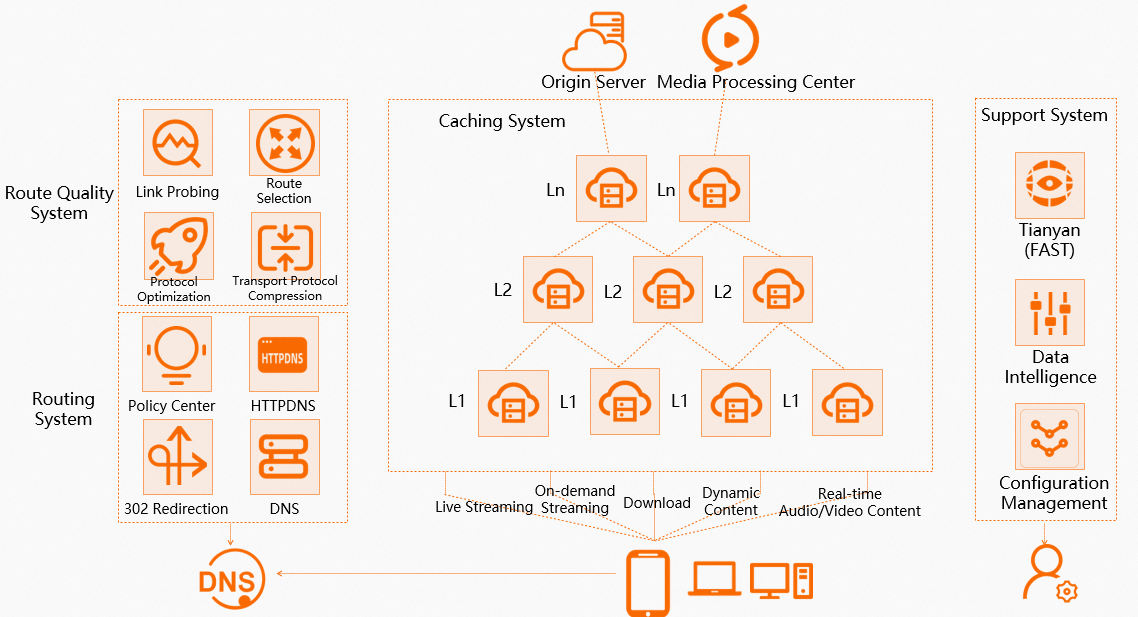
Link quality system: Monitors real-time load and health status of all nodes and links, feeding data to the scheduling system for optimal node assignment.
Scheduling system: Supports DNS, DNS-over-HTTPS (DoH), and 302 scheduling modes. Processes user requests through domain name DNS resolution.
Caching system: Implements a hierarchical L1/L2 cache architecture. Distributes content across edge and aggregation nodes to minimize origin bandwidth.
Support system: Provides resource monitoring (QPS, bandwidth, HTTP status codes), data analytics (Top URL, PV, UV), and configuration management (cache file types, query parameter handling).
Billing
CDN billing consists of basic service fees and value-added service fees:
Basic service: Choose between pay-by-data-transfer (default) or pay-by-bandwidth. Pay-by-data-transfer charges based on actual traffic consumed and is suitable for variable or unpredictable workloads. Pay-by-bandwidth charges based on peak bandwidth and is cost-effective for steady, high-traffic scenarios. For details, see Billing overview.
Value-added services: Includes static HTTPS requests, static QUIC requests, and real-time log delivery. For details, see Value-Added Service Billing.
For full pricing details, see CDN pricing.
DCDN service discontinuation
Starting from March 12, 2026, Dynamic Content Delivery Network (DCDN) no longer accepts new customer activations. If you were previously using DCDN, you can migrate to ESA.
Comparison among CDN, DCDN, and ESA
Comparison item | CDN | Dynamic Content Delivery Network (DCDN) | Edge Security Acceleration (ESA) |
Typical scenarios | Mobile app updates, game package distribution, video on demand (long and short videos), image and text websites. | Online stores, online payments, interactive chat, online education, global gaming, financial trading. | Gaming, e-commerce, finance, retail, and more. |
Coverage |
|
|
|
Acceleration method | Primarily static content acceleration. Caches resources such as images, videos, and files at edge nodes based on caching policies. Dynamic resources are fetched directly from the origin. | Supports both pure dynamic acceleration and dynamic-static hybrid acceleration. Dynamic resources are routed via intelligent path selection; static resources are cached at edge nodes. | Supports caching and acceleration for both dynamic and static resources. Features include cache prewarming, cold resource retention, and cache analysis. Anycast DNS integration enables global DNS resolution under 30ms. Layer 4 proxy supports multi-port and multi-protocol acceleration. |
Protocol support | Application layer: HTTP, HTTPS, QUIC. Network layer: IPv4, IPv6. | Application layer: HTTP, HTTPS, WebSocket. Transport layer: TCP, UDP. Network layer: IPv4, IPv6. | Application layer: HTTP, HTTPS, WebSocket. Transport layer: TCP, UDP. Network layer: IPv4, IPv6. |
Scheduling mode | DNS, DNS-over-HTTPS, 302 | DNS, DNS-over-HTTPS, 302 | DNS (high-performance), DNS-over-HTTPS, 302 |
Edge computing | EdgeScript for programmable CDN logic. Image processing. | EdgeRoutine for edge node deployment (A/B testing, preheating, etc.). Image processing. | Edge functions (JavaScript deployment at edge), edge storage (Key-Value store), edge containers (container-based elastic computing). |
Security | Referer anti-leech, URL authentication, IP blacklists/whitelists. | Basic WAF, DDoS defense, basic Bot protection. | Native WAF with custom rules, Tbps-level DDoS defense (Enterprise edition), Bot protection (H5 SDK, Android/iOS SDK), AI-powered origin protection. |
Log analysis | Offline logs, real-time log delivery. | Offline logs, real-time log delivery. | Traffic analysis, standard (offline) logs, real-time log delivery, instant log monitoring. |
Static content refers to files that return identical data across different requests, such as images, videos, static website assets (HTML, CSS, JS), software installation packages, APK files, and compressed archives. Dynamic content refers to data that differs between requests, such as server-side scripts (ASP, JSP, PHP, Perl, CGI), API endpoints, and database interaction requests.
For details on identifying static and dynamic resources, see Static and dynamic content.
Decision guidance
The geographic coverage of each product is the primary filter for most users:
Choose CDN when your audience is primarily in Chinese mainland and your content is mostly static (images, videos, downloads, website assets).
Choose ESA when you need global acceleration for dynamic content. DCDN (Dynamic Content Delivery Network) no longer accepts new customer activations as of March 12, 2026. For migration options, see the DCDN service discontinuation section above.
Choose ESA when you need global acceleration for dynamic content and edge computing capabilities (serverless functions, key-value storage, container workloads) alongside enterprise-grade security.
Resources
The following resources can help you manage and integrate Alibaba Cloud CDN:
: Web-based interface for managing acceleration domains, cache rules, and monitoring metrics.
API overview: RPC-style APIs supporting GET and POST requests for programmatic management.