Data Transmission Service (DTS) provides real-time incremental data synchronization from an ApsaraDB RDS for MySQL or instance to a self-managed MySQL database. The self-managed database is connected to Alibaba Cloud over Express Connect, VPN Gateway, or Smart Access Gateway.
Prerequisites
The self-managed MySQL database runs MySQL 5.1, 5.5, 5.6, 5.7, or 8.0.
NoteWe recommend that you use the same engine version for the ApsaraDB RDS for MySQL instance and the self-managed MySQL database.
The self-managed MySQL database is connected to a virtual private cloud (VPC) over Express Connect, VPN Gateway, or Smart Access Gateway. For more information, see Solutions for connecting an on-premises data center to Alibaba Cloud.
NoteAfter you connect the database to a VPC, you must also add the IP addresses of DTS servers to the access control list (ACL) of the network where your self-managed database is located. For more information, see Connect an on-premises data center to DTS using a VPN gateway.
Precautions
DTS uses read and write resources of the source and destination RDS instances during initial full data synchronization. This may increase the loads of the RDS instances. If the instance performance is unfavorable, the specification is low, or the data volume is large, database services may become unavailable. For example, DTS occupies a large amount of read and write resources in the following cases: a large number of slow SQL queries are performed on the source RDS instance, the tables have no primary keys, or a deadlock occurs in the destination RDS instance. Before data synchronization, evaluate the impact of data synchronization on the performance of the source and destination RDS instances. We recommend that you synchronize data during off-peak hours. For example, you can synchronize data when the CPU utilization of the source and destination RDS instances is less than 30%.
During initial full data synchronization, concurrent write operations cause table fragmentation on the destination instance. After the initial full data synchronization is complete, the tablespace of the destination instance is larger than that of the source instance.
Billing
| Synchronization type | Task configuration fee |
| Schema synchronization and full data synchronization | Free of charge. |
| Incremental data synchronization | Charged. For more information, see Billing overview. |
Synchronization limits
If a table to be synchronized in the source database has no primary key or UNIQUE constraint, duplicate data may be created in the destination database.
We recommend that you do not use gh-ost or pt-online-schema-change to perform DDL operations on objects during data synchronization. Otherwise, data synchronization may fail.
The tables to be migrated in the source database must have PRIMARY KEY or UNIQUE constraints and all fields must be unique. Otherwise, the destination database may contain duplicate data records.
Supported synchronization topologies
One-way one-to-one synchronization
One-way one-to-many synchronization
One-way cascade synchronization
One-way many-to-one synchronization
Two-way one-to-one synchronization
For more information about the synchronization topologies that are supported by DTS, see Synchronization topologies.
Supported SQL operations
Operation type | SQL statement |
DML | INSERT, UPDATE, DELETE, and REPLACE |
DDL |
|
Limits
Incompatibility with triggers
If you select a database as the object to synchronize and the database contains a trigger that updates a table, data inconsistency may occur. For more information about how to resolve this issue, see Configure a data synchronization or migration task for a source database that contains a trigger.
Limits on RENAME TABLE operations
RENAME TABLE operations may cause data inconsistency between the source and destination databases. For example, if only Table A is selected as the object to synchronize and is renamed Table B, Table B cannot be synchronized to the destination database. To prevent this situation, you can select the entire database in which Table A is located as the object to synchronize when you configure the data synchronization task.
Procedure
Purchase a data synchronization instance. For more information, see Purchase process.
NoteWhen you purchase the instance, set the source and destination instance types to MySQL and the synchronization topology to One-way Synchronization.
Log on to the DTS console.
NoteIf you are redirected to the Data Management (DMS) console, you can click the
 icon in the
  to go to the previous version of the DTS console.
In the left-side navigation pane, click Data Synchronization.
In the upper part of the Data Synchronization Tasks page, select the region in which the data synchronization task is created.
Find the data synchronization task and click Configure Task in the Actions column.
Configure the source and destination instances.
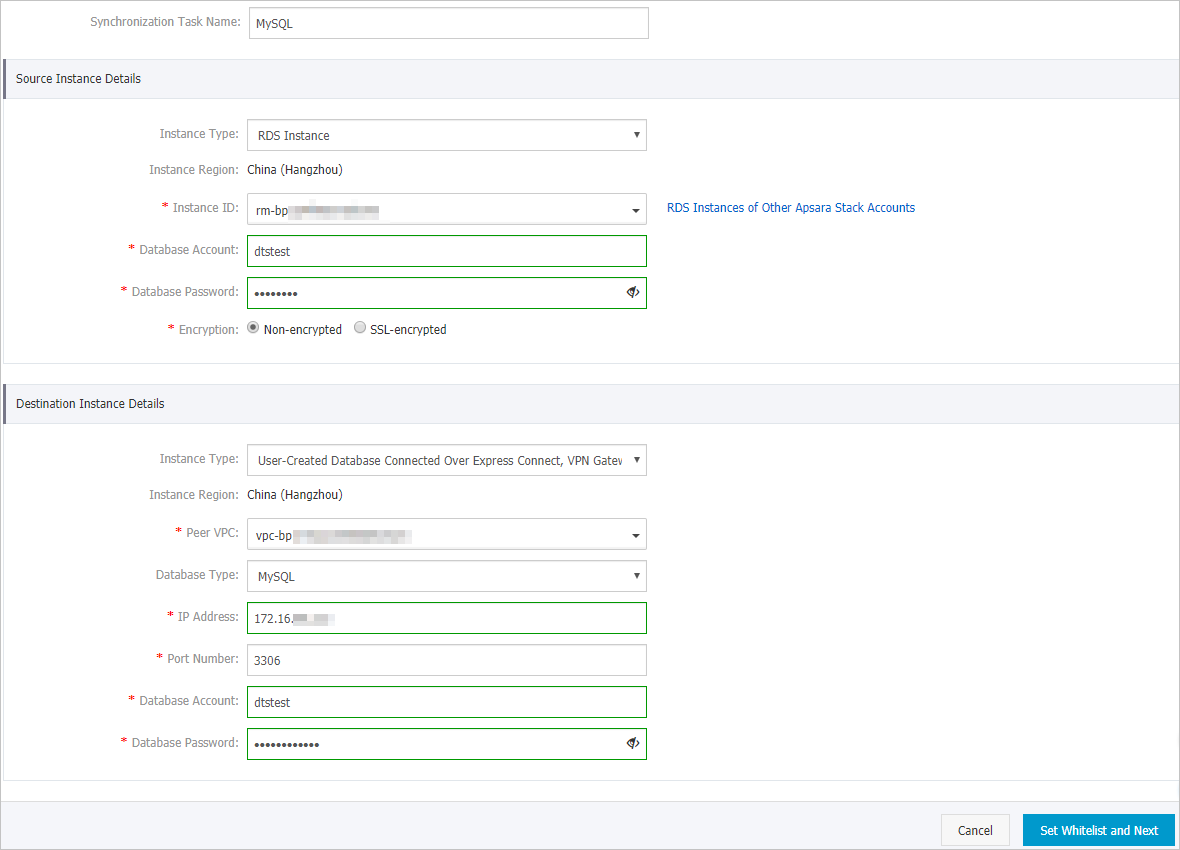
Category
Configuration
Description
N/A
Task Name
DTS automatically generates a task name. We recommend that you specify an informative name for easy identification. The task name does not have to be unique.
Source Instance Information
Instance Type
Select RDS Instance.
Instance Region
The region of the source instance that you selected when you purchased the data synchronization instance. This cannot be changed.
Instance ID
Select the ID of the source RDS instance.
Database Account
Enter the database account of the RDS instance.
NoteIf the database type of the RDS instance is MySQL 5.5 or MySQL 5.6, you do not need to configure Database Account or Database Password.
Database Password
Enter the password that corresponds to the database account.
Connection Method
Select Non-encrypted Connection or SSL Secure Connection. If you select SSL Secure Connection, you must first enable the SSL encryption feature for the RDS instance. For more information, see Set SSL encryption.
ImportantThe Encryption parameter is available only within regions in the Chinese mainland and the China (Hong Kong) region.
Destination Instance Information
Instance Type
Select Self-managed Database Connected Via A Leased Line, VPN Gateway, Or Smart Access Gateway.
Instance Region
The region of the destination instance that you selected when you purchased the data synchronization instance. This cannot be changed.
Peer VPC
Select the ID of the VPC that is connected to the self-managed database.
Database Type
The value is fixed as MySQL and cannot be changed.
IP Address
Enter the IP address of the server where the self-managed MySQL database is deployed.
Port
Enter the service port of the self-managed MySQL database. The default is 3306.
Database Account
Enter the database account of the self-managed MySQL database.
NoteThe account must have the REPLICATION CLIENT, REPLICATION SLAVE, and SHOW VIEW permissions, and the SELECT permission on all synchronization objects.
Database Password
Enter the password that corresponds to the database account.
In the lower-right corner of the page, click Set Whitelist and Next.
If the source or destination database is an Alibaba Cloud database instance, such as an ApsaraDB RDS for MySQL or ApsaraDB for MongoDB instance, DTS automatically adds the CIDR blocks of DTS servers to the IP address whitelist of the instance. If the source or destination database is a self-managed database hosted on an Elastic Compute Service (ECS) instance, DTS automatically adds the CIDR blocks of DTS servers to the security group rules of the ECS instance, and you must make sure that the ECS instance can access the database. If the self-managed database is hosted on multiple ECS instances, you must manually add the CIDR blocks of DTS servers to the security group rules of each ECS instance. If the source or destination database is a self-managed database that is deployed in a data center or provided by a third-party cloud service provider, you must manually add the CIDR blocks of DTS servers to the IP address whitelist of the database to allow DTS to access the database. For more information, see Add the CIDR blocks of DTS servers.
WarningIf the CIDR blocks of DTS servers are automatically or manually added to the whitelist of the database or instance, or to the ECS security group rules, security risks may arise. Therefore, before you use DTS to synchronize data, you must understand and acknowledge the potential risks and take preventive measures, including but not limited to the following measures: enhancing the security of your username and password, limiting the ports that are exposed, authenticating API calls, regularly checking the whitelist or ECS security group rules and forbidding unauthorized CIDR blocks, or connecting the database to DTS by using Express Connect, VPN Gateway, or Smart Access Gateway.
Select the synchronization policy and the objects to be synchronized
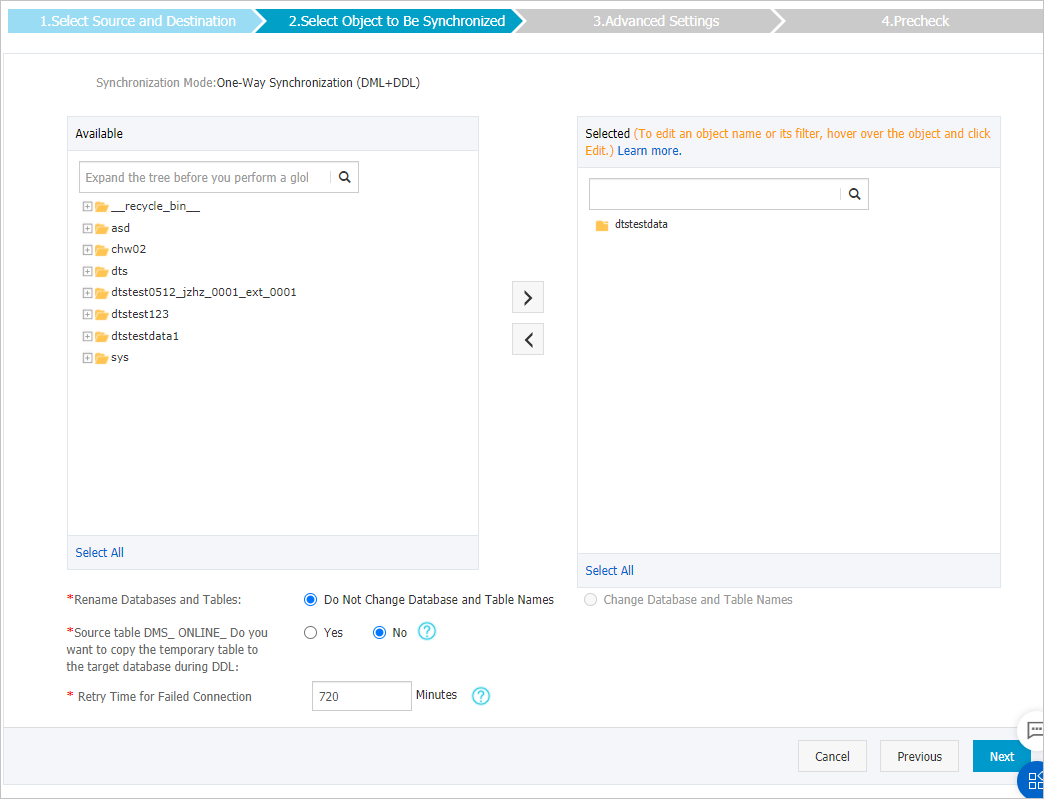
Parameter/Section
Description
Select Object to Be Synchronized
Select one or more objects from the Available section and click the
 icon to move the objects to the Selected section.
 You can select tables or databases as the objects to be synchronized.
NoteIf you select a database as the object to synchronize, all schema changes in the database are synchronized to the destination database.
By default, after an object is synchronized to the destination database, the name of the object remains unchanged. You can use the object name mapping feature to rename the objects that are synchronized to the destination database. For more information, see Rename an object to be synchronized.
Rename Databases and Tables
You can use the object name mapping feature to rename the objects that are synchronized to the destination instance. For more information, see Object name mapping.
Source table DMS_ONLINE_Do you want to copy the temporary table to the target database during DDL
If you use DMS to perform online DDL operations on the source database, you can specify whether to synchronize temporary tables generated by online DDL operations.
Yes: DTS synchronizes the data of temporary tables generated by online DDL operations.
NoteIf online DDL operations generate a large amount of data, the data synchronization task may be delayed.
No: DTS does not synchronize the data of temporary tables generated by online DDL operations. Only the original DDL data of the source database is synchronized.
NoteIf you select No, the tables in the destination database may be locked.
Retry Time for Failed Connection
By default, if DTS fails to connect to the source or destination database, DTS retries within the next 720 minutes (12 hours). You can specify the retry time based on your needs. If DTS reconnects to the source and destination databases within the specified time, DTS resumes the data synchronization task. Otherwise, the data synchronization task fails.
NoteWhen DTS retries a connection, you are charged for the DTS instance. We recommend that you specify the retry time based on your business needs. You can also release the DTS instance at your earliest opportunity after the source and destination instances are released.
In the lower-right corner of the page, click Next.
Complete the advanced settings for initial synchronization.
 Note
NoteDuring initial synchronization, DTS synchronizes the schemas and data of required objects from the source instance to the destination instance. The schemas and data are the basis for subsequent incremental synchronization.
Initial synchronization includes initial schema synchronization and initial full data synchronization. In most cases, you must select both Initial Schema Synchronization and Initial Full Data Synchronization.
In the lower-right corner of the page, click Precheck.
NoteBefore you can start the data synchronization task, DTS performs a precheck. You can start the data synchronization task only after the task passes the precheck.
If the task fails to pass the precheck, you can click the
 icon next to each failed item to view details.
 After you troubleshoot the issues based on the details, initiate a new precheck.
If you do not need to troubleshoot the issues, ignore the failed items and initiate a new precheck.
Close the Precheck dialog box after the following message is displayed: Precheck Passed. Then, the data synchronization task starts.
Wait until initial synchronization is completed and the data synchronization task enters the Synchronizing state.
You can view the status of the data synchronization task on the Synchronization Tasks page.
