By Global SMB Team, Alibaba Cloud
In today's economy, Small and Medium-sized Business (SMBs) or Small and Medium-sized Enterprises (SMEs) are operating in a reality where “doing more with less” isn't a cliché, but a daily mandate. Teams are expected to serve customers across an ever-growing mix of channels including AI, deliver faster responses, and personalize experiences at scale—all without proportional increases in people, budget, or time. Meanwhile, customer expectations continue to rise, skilled talent stays in short supply, and market shifts strike with little warning.
Earlier this year, Alibaba Cloud set out to understand how SMBs across the region are navigating this new reality. In November 2025, we surveyed 240 business decision-makers and leaders across sectors like fintech, edutech, retail, logistics, and AI-native companies, all running growing businesses of 50 to 500 employees, where every decision carries real weight.
What emerged wasn't a story of disruption or crisis. Instead, most SMBs are making smart, practical adjustments: tightening operations, redirecting resources, and adopting technologies that solve immediate, tangible problems. And, one pattern stood out across industries: SMBs are adopting AI and cloud because the benefits are now tangible and immediate. Business and technology leaders told us these tools are already reducing manual work, accelerating workflows, and helping them respond faster to customers. They also highlighted hurdles, such as difficulty integrating tools, limited technical resources, and uncertainty about where to begin. Those insights form the basis of the framework below: a three-phase roadmap showing how SMBs can adopt AI and cloud in a structured, manageable way throughout 2026.
SMBs across the region are moving past experimentation and into a more mature, results-driven phase of AI and cloud adoption. In fact, the new research from the SMB Growth Playbook shows that these three trends explain why a structured approach is now essential for SMBs.
● Trend 1: AI + cloud is the new baseline
96% of SMBs now view AI + cloud not as optional upgrades but as essential foundations for cutting costs, boosting productivity, and future-proofing their businesses. Rising customer expectations, growing data volumes, and increasing operational volatility have made manual processes or fixed-infrastructure approaches unsustainable.
● Trend 2: Asia's AI ecosystem is delivering immense value for global SMBs
92% of SMBs believe the next wave of AI innovation will emerge from Asia, because tools emerging from ecosystems like China prioritize usability, affordability, and real-world fit.
● Trend 3: SMBs don't just need tools, they need guidance to make them work
95% of SMBs say they will invest in new tools, but only if it adapts to their workflows. The goal isn't to overhaul how your team works; it's to empower them with tools that fit seamlessly into their daily reality.
With these shifts in mind, SMBs need a clear path that shows where to begin and how to progress without overwhelming their teams. The roadmap below breaks that journey into practical phases that help you move from early wins to long-term impact.
Goal: Focus on one high-impact, low-complexity use case where AI + cloud solve a known paint point for your company.
Where to begin:
● Cloud: Migrate one critical workload (eg customer database, website hosting) to a managed service (like RDS or OSS). Let cloud handle backups, scaling, and security patches.
● AI: Automate a repetitive, time-consuming task (eg tagging support tickets, generating product metadata, or summarizing meeting notes.)
The most successful SMBs start with a visible painpoint: something the team complains about regularly, where even a modest improvement frees up hours every week.
This could be as straightforward as migrating a frequently overloaded website to a cloud platform with auto-scaling, so it no longer crashes during a product launch. Or it might mean using a pre-built AI tool to handle a repetitive task — like tagging new product images, summarizing support tickets, or generating first-draft category descriptions.
What matters is starting small, using managed services (so you're not managing servers or training models), and setting a clear, short-term success metric.
Goal: Adapt AI and cloud tools to fit your existing workflows, not the other way around.
Where to begin:
● Cloud: Connect your core systems (ERP, CRM, POS, or internal tools) through APIs and event-driven services. Introduce basic automation like auto-scaling rules, scheduled jobs, and centralized monitoring.
● AI: Replace generic, off-the-shelf models with lightweight customizations: fine-tuned prompts, domain-specific datasets, or simple embeddings that reflect your business logic.
Once you've resolved one bottleneck, the next step is creating continuity: making your tools talk to each other and work the way your team already operates.
For most SMBs, this means integrating cloud services through APIs so data no longer lives in silos. A CRM update should instantly sync with your support platform; a new order should trigger an automated inventory check; a failed payment should alert your finance lead. These integrations are small on paper but compound quickly, removing manual handoffs that slow teams down.
On the AI side, this is when companies move beyond generic automation and start tailoring models to their content, tone, or operational rules. You don't need deep machine learning expertise to do this. Even simple steps like feeding a model examples of your brand voice dramatically improve output quality.
Goal: Use AI + cloud as force multipliers to create deeper efficiency, new revenue streams, and differentiated customer experiences.
Where to begin:
● Cloud: Introduce advanced services (data lakes, serverless compute, real-time analytics, or container orchestration) to support higher traffic, richer insights, and faster product iteration.
● AI: Deploy AI into higher-value workflows like forecasting, intelligent routing, personalization engines, or automated quality control. Build feedback loops so your models evolve with your data.
By this stage, the basics are stable: your systems are integrated, repetitive work is automated, and AI is embedded into daily operations. Phase 3 is about using that foundation to create real competitive advantage.
This often starts with data. Many SMBs introduce a central data lake or warehouse so sales, operations, marketing, and product teams all work off the same real-time insights. With cleaner data and cloud-native analytics, you can spot customer churn patterns earlier, forecast inventory more accurately, or identify hidden revenue opportunities.
This is also when AI moves from "helping with tasks" to "shaping decisions." Instead of simply summarizing support tickets, AI can analyze sentiment trends and alert you before SLA breaches occur. Instead of generating product descriptions, it can power personalization engines that tailor recommendations based on behavior, location, seasonality, or past purchases. And in operational environments like logistics, retail, or F&B, AI can automate routing, staffing plans, or quality checks with far more precision than manual methods.
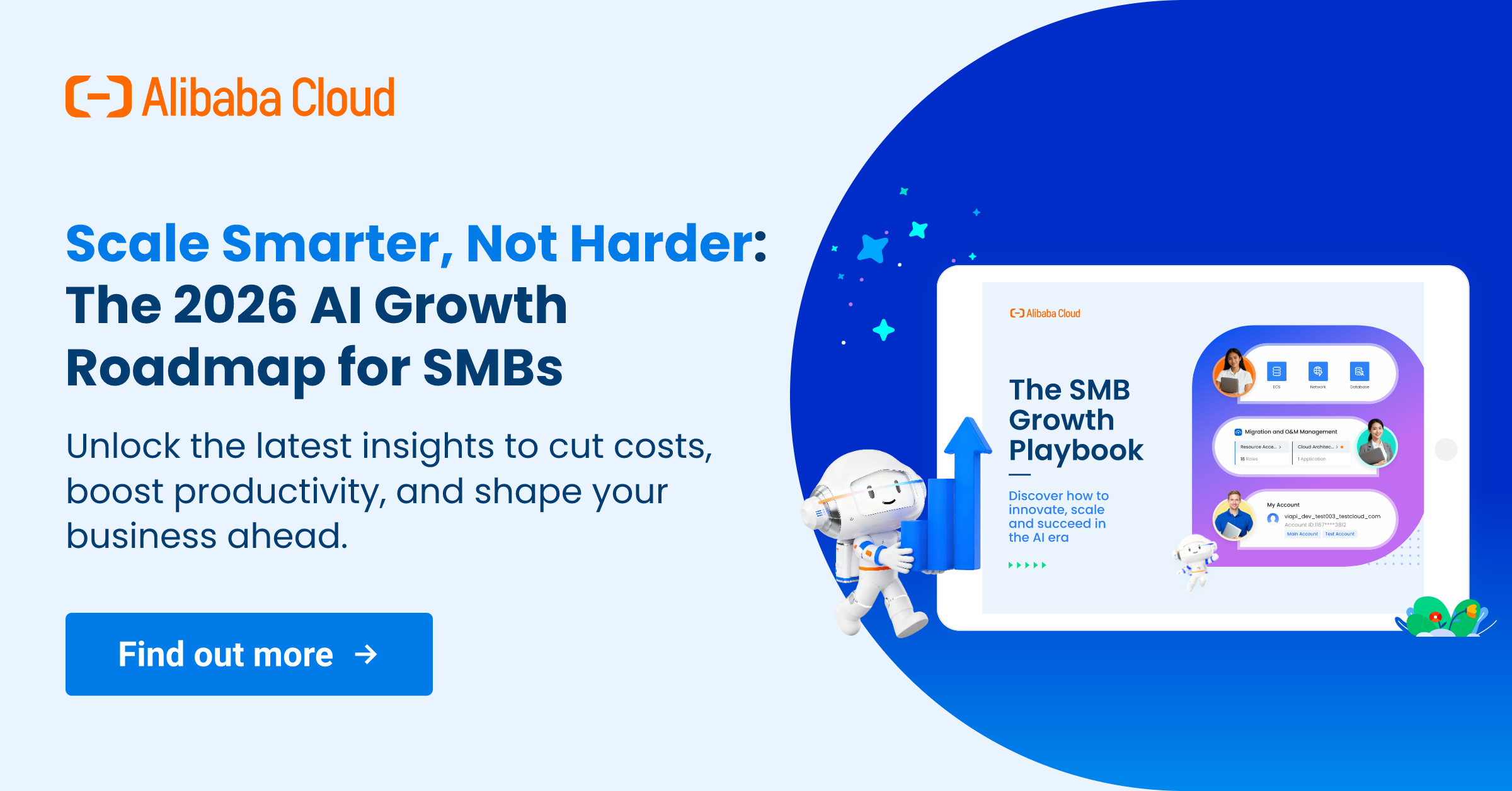
Agility and innovation are essential for sustainable growth. Discover the key trends shaping 2026 and learn how to build a smarter, more scalable business that doesn't just survive change but thrives in it.
How can this playbook help your business grow?
Inside this playbook, you'll find actionable strategies to:
ꔷ Understand the top trends, challenges, and opportunities shaping today's landscape
ꔷ Harness AI and cloud technology to cut costs and boost efficiency
ꔷ Build lean, high-impact tech stacks that maximize ROI without straining your budget
ꔷ Transform everyday operational hurdles into long-term competitive strengths
Download your free copy of The SMB Growth Playbook today and start turning insight into action.
Alibaba Qwen Wins “NeurIPS 2025 Best Paper Award” for Breakthrough in Attention Mechanisms

1,550 posts | 522 followers
FollowAlibaba Cloud Community - September 23, 2026
Alibaba Clouder - May 23, 2019
Alibaba Cloud Community - September 23, 2026
Alibaba Cloud Community - February 11, 2026
Alibaba Cloud Community - September 25, 2026
Alibaba Cloud Community - August 27, 2025
1,550 posts | 522 followers
Follow Token Plan
Build more, spend less. One plan, every modality.
Learn More QwenWork
QwenWork is dedicated to helping employees strengthen their professional competitiveness in the AI era and to enabling enterprises to improve organizational effectiveness.
Learn More Big Data Consulting for Data Technology Solution
Alibaba Cloud provides big data consulting services to help enterprises leverage advanced data technology.
Learn More Big Data Consulting Services for Retail Solution
Alibaba Cloud experts provide retailers with a lightweight and customized big data consulting service to help you assess your big data maturity and plan your big data journey.
Learn MoreMore Posts by Alibaba Cloud Community

