We introduce Qwen3-Coder-Next, an open-weight language model designed specifically for coding agents and local development. Built on top of Qwen3-Next-80B-A3B-Base, which adopts a novel architecture with hybrid attention and MoE, Qwen3-Coder-Next has been agentically trained at scale on large-scale executable task synthesis, environment interaction, and reinforcement learning, obtaining strong coding and agentic capabilities with significantly lower inference costs.
Rather than relying solely on parameter scaling, Qwen3-Coder-Next focuses on scaling agentic training signals. We train the model using large collections of verifiable coding tasks paired with executable environments, enabling the model to learn directly from environment feedback. This includes:
This recipe emphasizes long-horizon reasoning, tool usage, and recovery from execution failures, which are essential for real-world coding agents.
The figure below summarizes performance across several widely used coding agent benchmarks, including SWE-Bench (Verified, Multilingual, and Pro), TerminalBench 2.0, and Aider.
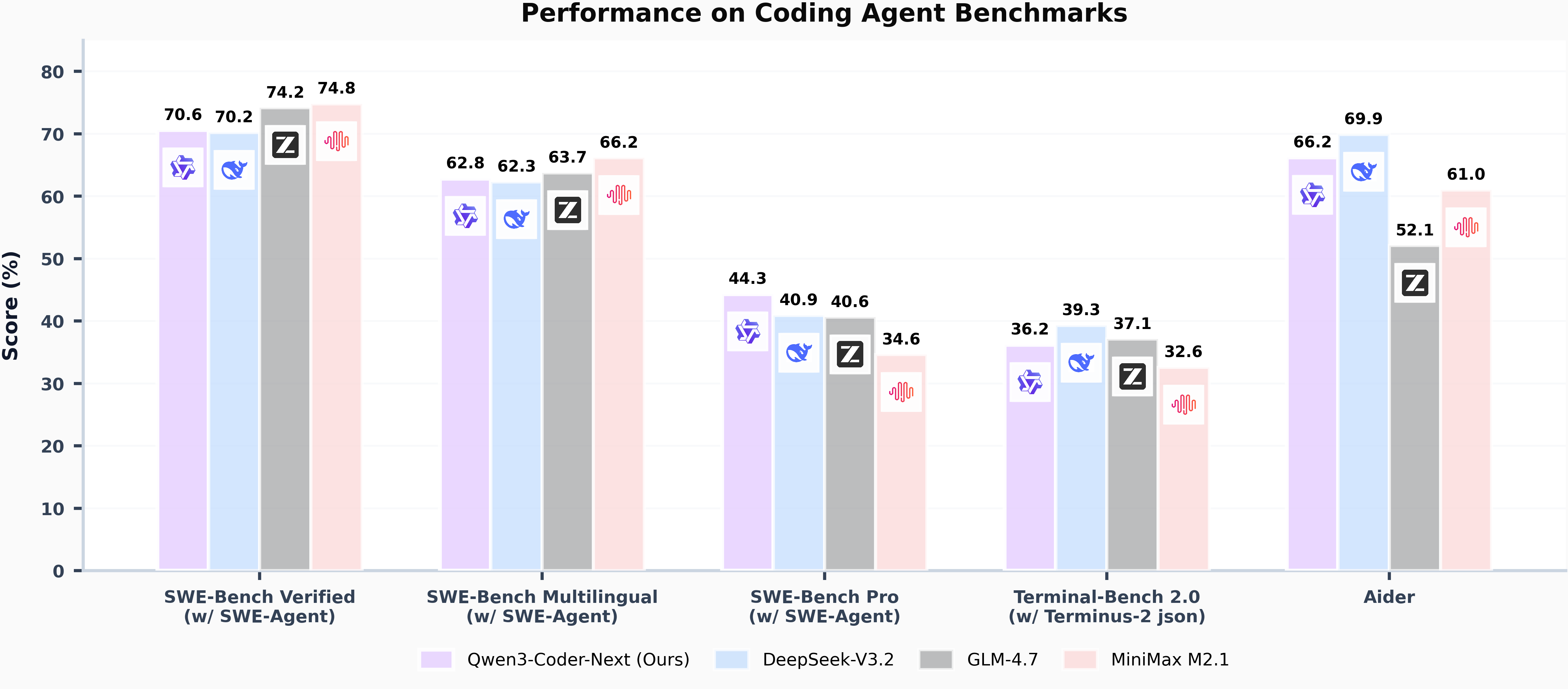
The figure demonstrates that:
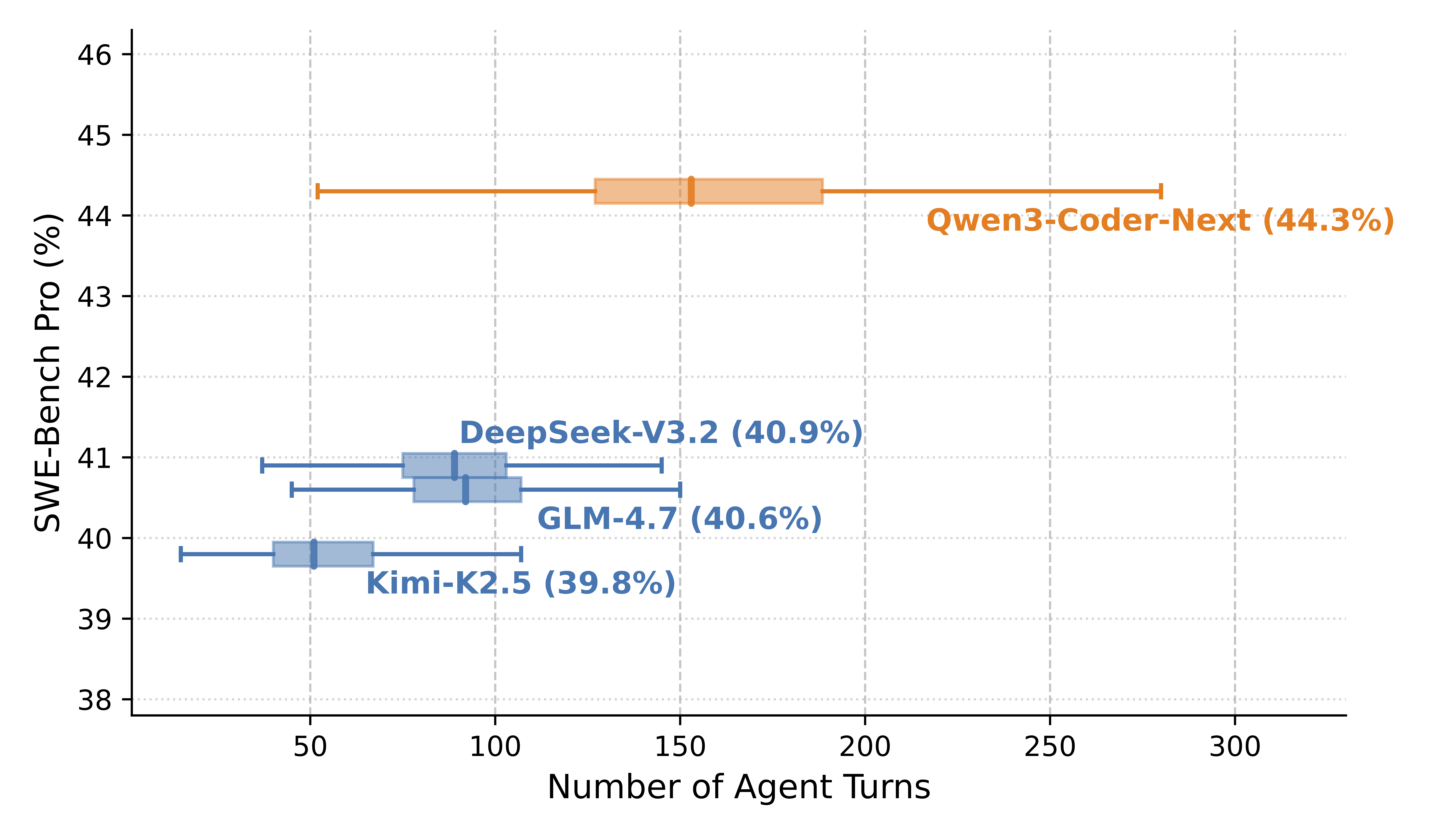
As shown in the figure below, Our model achieves strong results on SWE-Bench Pro by scaling the number of agent turns, providing evidence that the model excels at long-horizon reasoning in multi-turn agentic tasks.
This figure highlights how Qwen3-Coder-Next achieves an improved Pareto tradeoff between efficiency and performance.
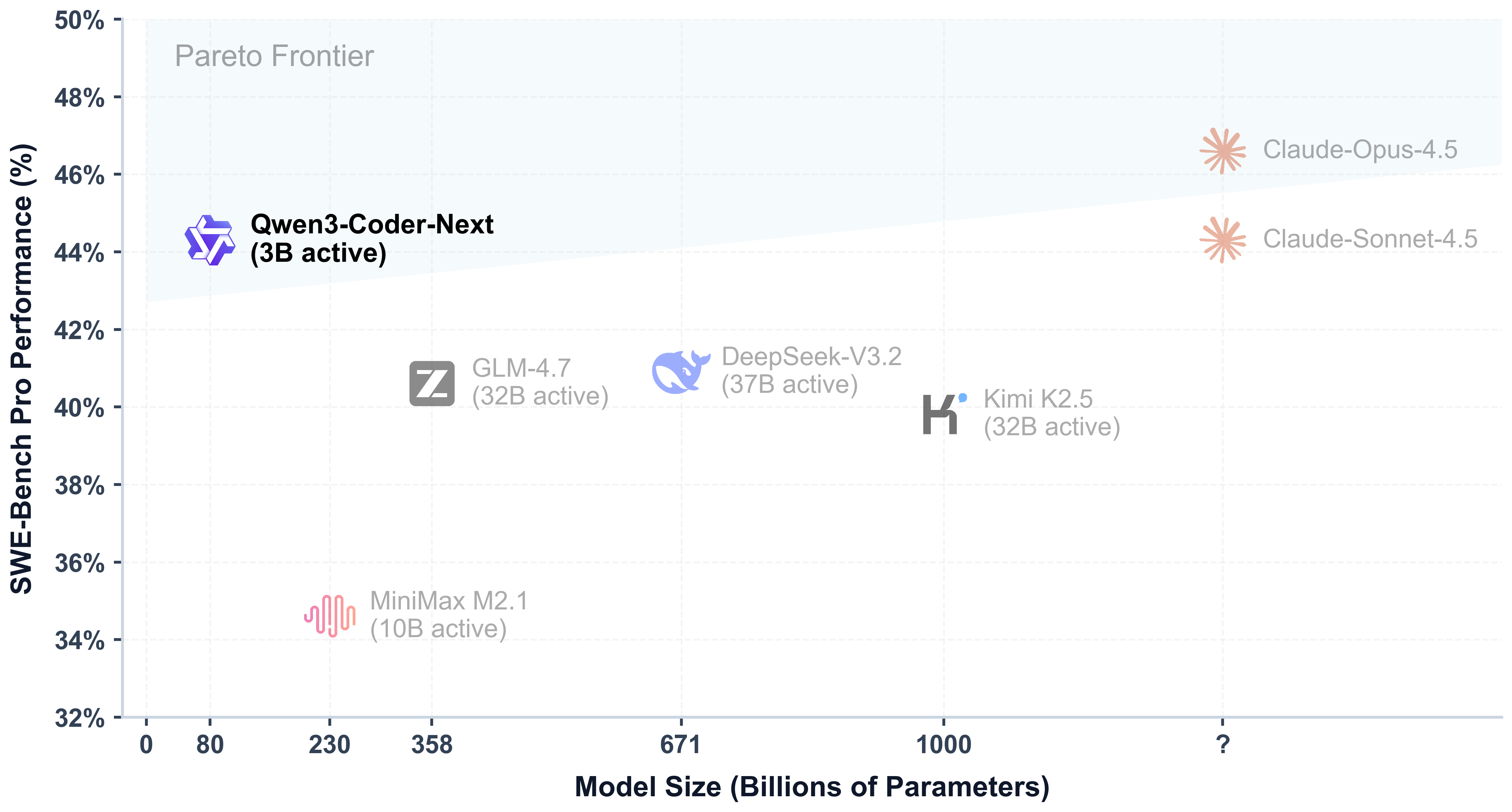
This comparison makes the efficiency story clear:
Qwen3-Coder-Next shows promising results on coding agent benchmarks, providing good speed and reasoning abilities for practical use. While it performs competitively—even compared to some larger open-source models—there is still much room for improvement.
Looking ahead, we believe strong agent skills—like using tools by itself, handling tough problems, and managing complex tasks—are key for better coding agents. Next, we plan to improve the model’s reasoning and decision-making, support more tasks, and update quickly based on how people use it.
If you find our work helpful feel free to give us a cite.
@techreport{qwen_qwen3_coder_next_tech_report,
  title        = {Qwen3-Coder-Next Technical Report},
  author       = {{Qwen Team}},
  url          = {https://github.com/QwenLM/Qwen3-Coder/blob/main/qwen3_coder_next_tech_report.pdf},
  note         = {Accessed: 2026-02-03}
}Alibaba Brings Cloud-Based AI Innovation to the Olympic Winter Games Milano Cortina 2026

1,540 posts | 516 followers
FollowAlibaba Cloud Community - February 5, 2026
Alibaba Cloud Community - January 27, 2026
Alibaba Cloud Community - August 27, 2026
Alibaba Cloud Community - April 2, 2026
Alibaba Cloud Community - July 23, 2026
Alibaba Cloud Community - April 17, 2026
1,540 posts | 516 followers
Follow QwenWork
QwenWork is dedicated to helping employees strengthen their professional competitiveness in the AI era and to enabling enterprises to improve organizational effectiveness.
Learn More Token Plan
Build more, spend less. One plan, every modality.
Learn More
Alibaba Cloud Model Studio
A one-stop generative AI platform to build intelligent applications that understand your business, based on Qwen model series such as Qwen-Max and other popular models
Learn More Qwen
Qwen
Full-range, open-source, multimodal, and multi-functional
Learn MoreMore Posts by Alibaba Cloud Community

