By Wangchen
"If you're not the Model, you're the Harness."
This is a viewpoint raised by Langchain, which emphasizes the importance of Harnesses in the process of building Agents. Friends who have worked in backend development or designed distributed systems are certainly very familiar with glue code and middleware. Before diving into the main text of this article, let's combine two familiar concepts to further deepen our understanding of Harnesses.
Although all three belong to the engineering domain, the problems they aim to solve and their solution paradigms are completely different. For Harness, the mastery layer is usually not represented as a clean, researchable object. Mastery logic is highly coupled within the controller code, such as prompts, tool adapters, parsing rules, validation scripts, artifact paths, retry logic, and context strategies. A seemingly minor change in the mastery layer can simultaneously alter calling boundaries, tool intermediaries, state carriers, validation gates, and stop semantics. This makes the mastery layer difficult to inspect, port, compare, and ablate, even though the mastery pattern itself is often the truly reusable part of the system. This sounds somewhat contradictory—difficult to master yet reusable. However, I believe friends engaged in Harness engineering design can feel the uniqueness of Harness engineering.
Recently, I read a technical paper titled "Natural-Language Agent Harnesses," from which I benefited greatly. The paper revolves around the research topic: "Can this reusable design pattern of the agent mastery layer be represented as an executable natural language object, transforming the incidental glue around the model into a scientifically represented object?" and provides its research methodology. Interested friends can read the original paper; this article attempts to provide a simple interpretation.
Modern language model agents have become multi-step execution systems. They use tools, maintain state, recover from failures, validate intermediate results, and sometimes delegate work to other agents. These behaviors are organized by an external harness layer, which has a significant impact on measured performance. Similar concerns have also emerged in recent work on agent scaffolding, workflow generation, long-context execution, multi-agent orchestration, and tool-use agents.
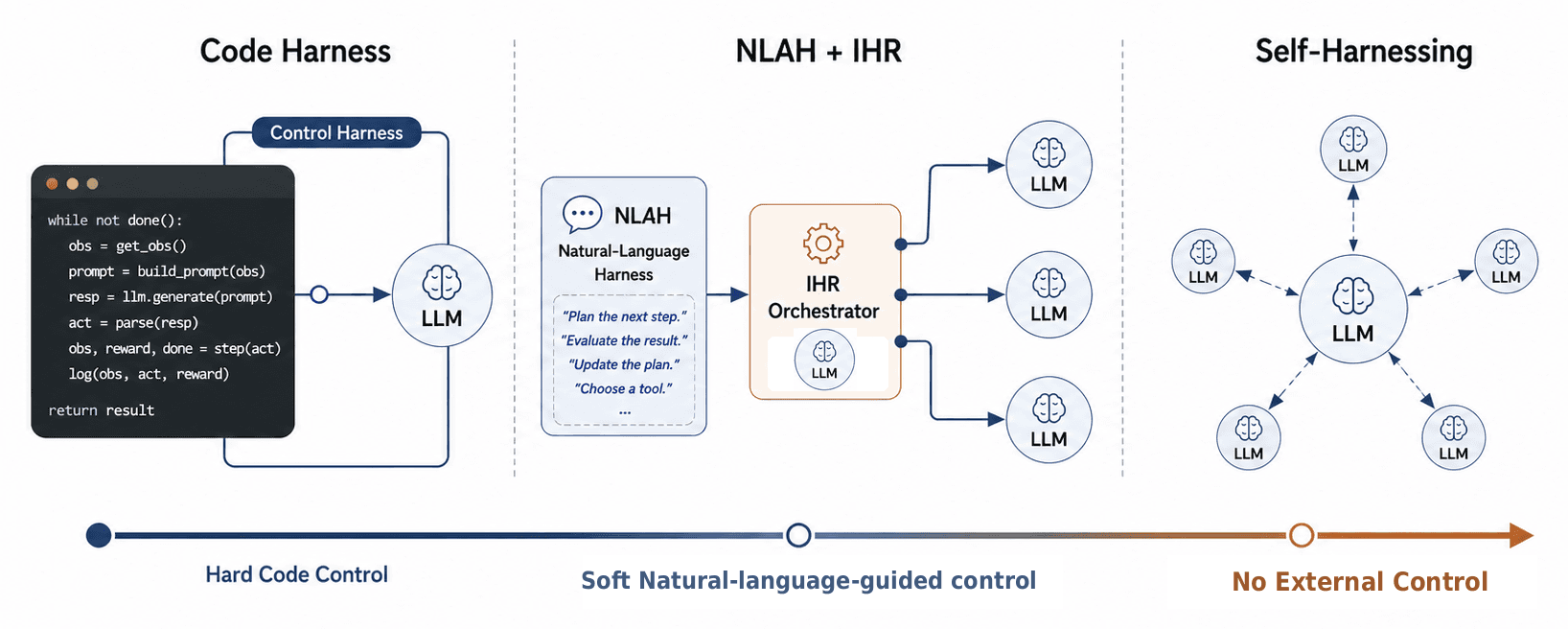
Figure 1: Three ways to control an agent run.
Its spectrum ranges from "restrictive harness" to "no external harness" (i.e., self-harnessing); from left to right, external control weakens, and model autonomy strengthens. Among them:
The paper mainly focuses on the second point, externalizing the harness strategy from code into executable natural language objects:
Within this setup, natural language carries the strategy, while code and the runtime carry the precise mechanisms, such as tool execution, parsing, sandboxing, and logging.
The core contributions of the paper are:
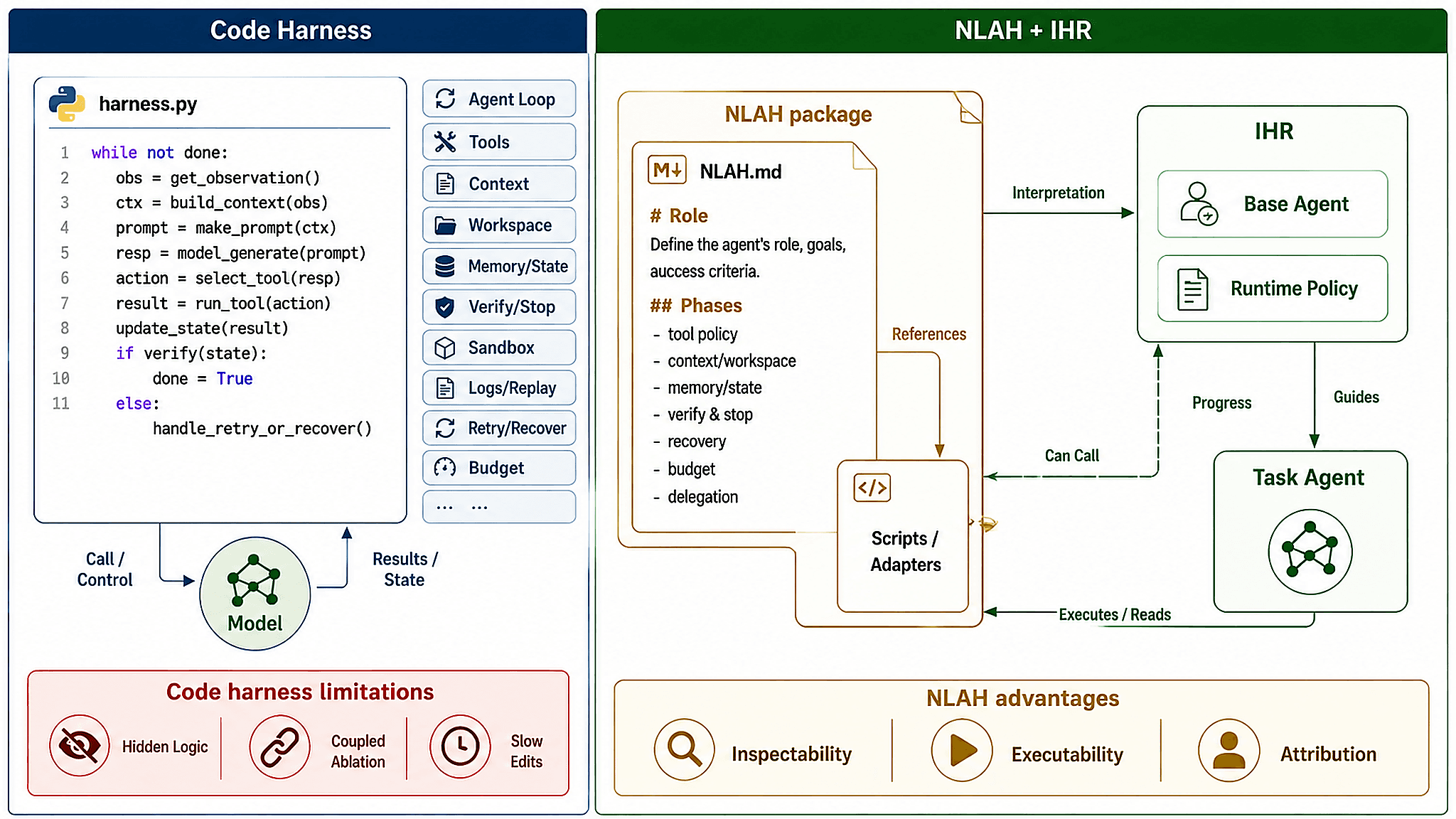
Figure 2: The NLAH+IHR framework.
This can be considered a new paradigm for building Harnesses. To use an analogy: the base agent is the horse, the runtime strategy is the rider, the natural language harness document is the road map for today's trip (which can be changed), and the scripts and adapters are traffic lights and checkpoints (deterministic rules) along the way.
Once the core architecture is established, we need to design the evaluation methodology.
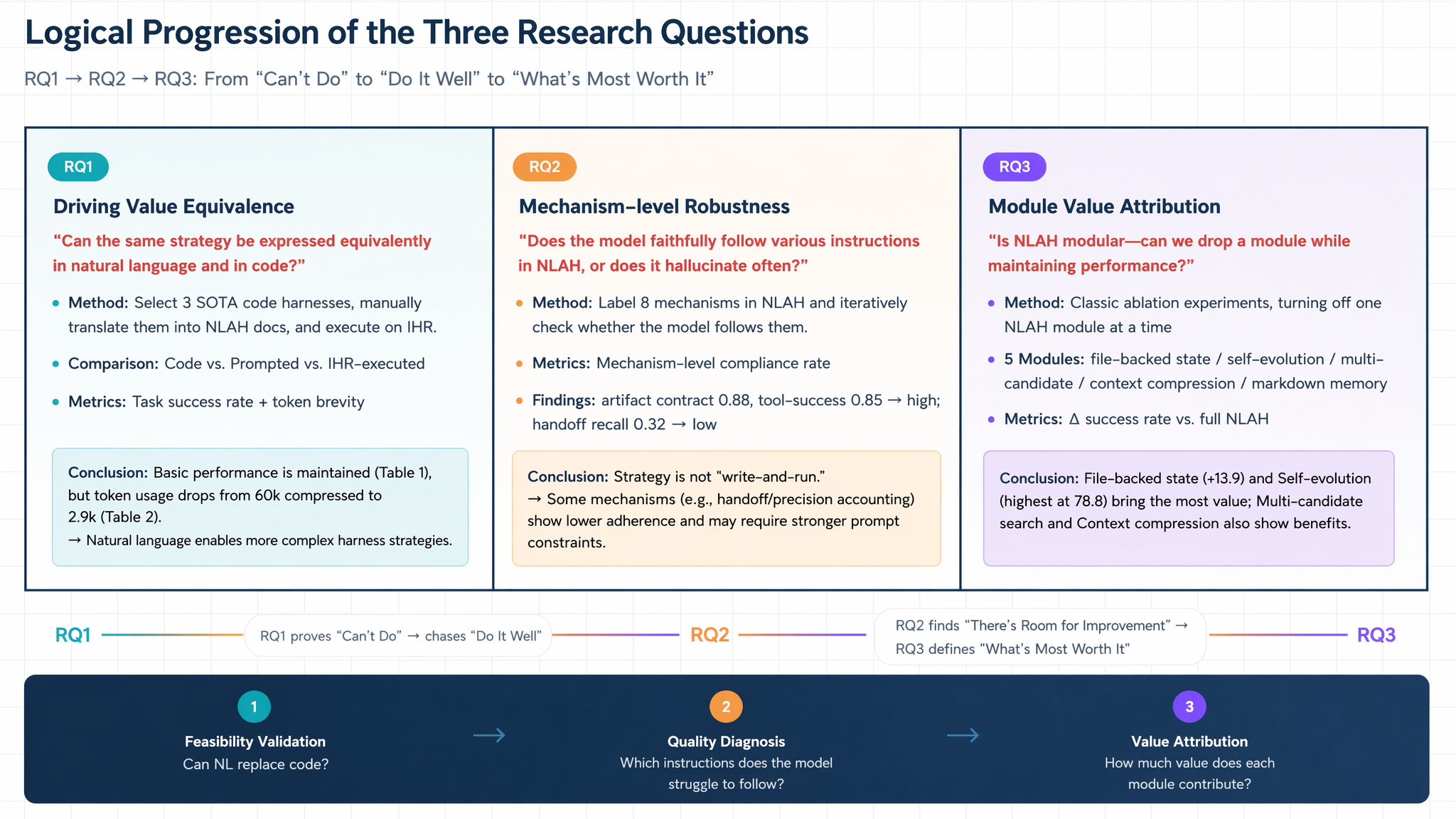
Can NLAH shape observable agent behavior while maintaining task performance?
RQ1 compares three implementations of the same harness concept, ordered by how directly the harness layer can control execution:
Across three benchmarks—SWE-bench Verified, Terminal-Bench 2.0, and OSWorld—the IHR-executed NLAH achieved performance comparable to the code harness layer, while significantly compressing static readable strategies (for example, Live-SWE dropped from 60,100 tokens of code to a 2.9k-token NLAH; MHTBA dropped from 10,500 to 0.8k). The tradeoff is a higher token/invocation overhead for the current prototype runtime.
After RQ1 demonstrated that natural language can effectively carry harness strategies, the paper asks a further, more detailed question: How faithful is the model actually to each mechanism written in the document when executing NLAH?
To do this, they decomposed and labeled the instructions in an NLAH into 8 categories of observable harness mechanisms, such as deliverable contracts, tool success gating, phase handoffs, and stop conditions. They then ran the IHR on three benchmark tasks to compare "what the document required" against "what the model actually did" on a step-by-step basis, calculating a adherence rate for each category of mechanism.
The findings were "mixed, with significant differences": contract-based, instantly verifiable mechanisms had high adherence because these instructions have clear boundaries and the model can self-check at each step. On the other hand, mechanisms relying on cross-phase, cross-sub-agent coordination showed layout lower adherence. This finding of "uneven execution quality" provided the motivation for the module ablation in RQ3.
Because NLAH is intentionally written with a structure that separates phases from mechanisms and maintains clear module boundaries, each functional module corresponds to a piece of text in the document that can be independently added or removed. This makes it possible, for the first time, to conduct classic ablation experiments at the strategy level rather than the code level.
The paper uses a leave-one-out approach, turning off only one module in the NLAH at a time (such as file-backed state persistence, self-evolution, multi-candidate search, context compression, markdown memory, etc.) while keeping the rest unchanged, and then measuring the change in success rate relative to the complete NLAH. The entire process requires editing only the document without modifying any underlying code, cleanly attributing each module's contribution individually.
Ablation revealed highly polarized module values, showing that some seemingly useful designs are actually negative assets: file-backed state persistence was the most stable positive contributor (Δ approx. +2.6 / +13.9), showing that allowing the agent to externalize intermediate states to files is far more reliable than relying on context memory. The self-evolution module brought the highest absolute performance (Live-SWE 78.8 / 52.8), but at the cost of significantly increased token consumption. Conversely, multi-candidate search actually harmed performance (distracting the model and being expensive), context compression was harmful on both tasks (saving tokens but losing critical information), and markdown memory performed inconsistently, with gains depending on the task. The overall conclusion is: with harness modules, "more is not always better." Effective engineering practices should prioritize retaining externalized states, use self-evolution cautiously, and actively eliminate negative-utility modules such as multi-candidate search and context compression. This also, for the first time, turned the question of "which harness designs to keep" into one that can be answered with experimental data.
The paper also mentions the limitations and risks of this paradigm. The limitation is the impreciseness of natural language. Since NLAHs are editable natural language strategies, semantically important constraints might be under-defined, interpreted differently by different models, or diluted when rewritten. Therefore, the paper retains precise mechanisms in code and treats executed behaviors as something that must be tested through actual runs rather than inferred solely from text.
The risk is that while externalizing harness modules can reduce development costs, improve comparability, and encourage the reuse of robust workflows, portable harness logic and scripts might also lower the barrier for distributing hazardous workflows. Because the harness layer mediates tool use, artifact handling, and delegation, they could introduce new attack surfaces for prompt injection, malicious tool grafting, or supply chain contamination. Deployment should be accompanied by provenance tracking, auditing, access control, and sandbox isolation.

768 posts | 60 followers
FollowAlibaba Cloud Community - July 6, 2026
Alibaba Cloud Community - August 3, 2026
Alibaba Cloud Community - May 21, 2026
Alibaba Cloud Community - August 24, 2026
Alibaba Cloud Native Community - March 25, 2026
Alibaba Cloud Community - September 27, 2025
768 posts | 60 followers
Follow Token Plan
Build more, spend less. One plan, every modality.
Learn More QwenWork
QwenWork is dedicated to helping employees strengthen their professional competitiveness in the AI era and to enabling enterprises to improve organizational effectiveness.
Learn More
Alibaba Cloud Model Studio
A one-stop generative AI platform to build intelligent applications that understand your business, based on Qwen model series such as Qwen-Max and other popular models
Learn More Qwen
Qwen
Full-range, open-source, multimodal, and multi-functional
Learn MoreMore Posts by Alibaba Cloud Native Community

