Urban health systems produce significant volumes of data every day, including hospital admissions, pharmacy records, environmental sensor readings, and demographic registries. But volume alone means nothing. Data sitting in fragmented systems produces reporting, not decisions. The question is not whether cities have the information. It is whether they have the infrastructure to act on it.
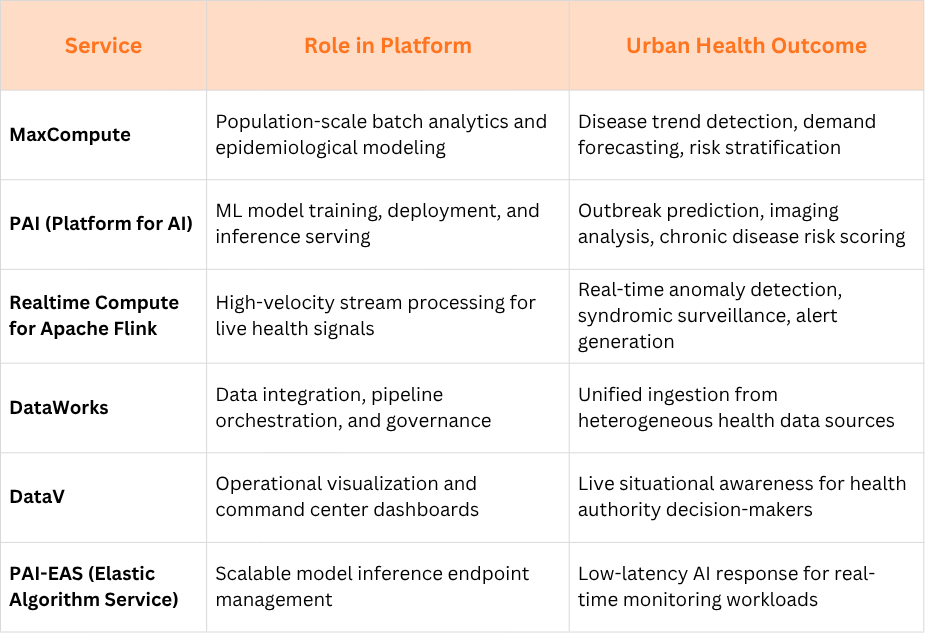
When integrated and analysed at scale, this data can surface disease trends before they become outbreaks, flag environmental risk before communities feel the impact, and place actionable intelligence in front of health officials while intervention is still viable. This article examines how Alibaba Cloud's MaxCompute, Platform for AI (PAI), Realtime Compute for Apache Flink, and DataV form the analytical and visualization foundation for urban health monitoring and how DataWorks, PAI-EAS, RAM, and ActionTrail complete the platform from data ingestion through to governance and compliance.
The Alibaba Cloud urban health monitoring architecture operates across four integrated layers: data ingestion, batch and stream processing, AI/ML modeling, and real-time visualization. Each layer is built to scale with urban data volumes while maintaining the low-latency response that time-sensitive public health scenarios demand.
Platform for AI (PAI) provides end-to-end machine learning services covering data preprocessing, feature engineering, model training, prediction, and evaluation within a single managed environment. In the urban health monitoring context, PAI is the layer where processed data is transformed into predictive intelligence that health authorities can act on.
DataV is a data visualization tool that uses real-time data-driven dashboards to present and assist in data analysis, providing the operational interface through which health decision-makers interact with platform output. DataV connects to databases, including Alibaba Cloud's AnalyticDB and ApsaraDB for RDS, and supports API connectivity with dynamic requests, allowing processed outputs from MaxCompute, Flink, and PAI inference endpoints to be surfaced through a unified dashboard environment.
For government and public sector deployments, DataV supports the display of real-time data for city management, public safety, and traffic monitoring to enhance the efficiency of public services. In the urban health monitoring context, this translates to several operational display configurations.
DataV's GIS capabilities enable rapid interpretation of spatial data to understand relationships, patterns, and trends supporting geographic heat maps that display disease incidence density by district, updated at configurable intervals. Time-series trend panels can show the trajectory of monitored health indicators against historical baselines and threshold bands. Resource utilization displays can surface real-time hospital bed occupancy, ICU availability, and pharmacy inventory levels across a municipal health network. Alert panels can present model outputs, outbreak probability scores, environmental risk indices, and high-risk cohort identification results in a format accessible to health administrators.
DataV's ecosystem integration and multi-source data access capabilities support Alibaba Cloud and various open-source data sources, enabling health monitoring data to be consumed by downstream systems through API connections without requiring manual data transfer between platforms.
Health data is among the most sensitive categories of personal information managed by public institutions. The Alibaba Cloud urban health monitoring architecture incorporates security and compliance controls at each layer of the platform.
Storage encryption using AES-256 is supported across MaxCompute, with encryption in transit enforced across DataWorks pipeline transfers and DataV API connections using TLS protocols. Role-based access control through Alibaba Cloud RAM ensures that data access is restricted by function analysts' access to aggregate datasets; clinicians access individual records within their defined scope. ActionTrail monitors and records all operations across Alibaba Cloud account activity, providing immutable audit logs that support compliance auditing and security analysis.
DataWorks supports static, dynamic, and engine-based data masking, enabling analysts to work with sensitive health datasets in controlled development and analysis environments without exposing underlying personal information. Alibaba Cloud holds ISO 27001, SOC 2 Type 2, SOC 3, and CSA STAR certifications, providing the compliance foundation required for government and public health authority procurement contexts.
Processing health data in an urban context does not only involve data gathering; rather, it entails massive computing power for analyzing populations and translating complex inputs through sophisticated artificial intelligence capabilities. For the insights to become meaningful enough to drive action on the ground, there is also a need for visualizations that could transform raw health data into specific steps to be taken by public health authorities. Alibaba Cloud provides a technically sound response by combining four powerful services in one platform: MaxCompute, PAI, Realtime Compute for Apache Flink, and DataV.
For municipal governments and public health authorities evaluating cloud infrastructure for urban health programs, Alibaba Cloud's integrated platform represents a technically substantive response to one of the most demanding data processing environments in public administration.
Building a Production-Grade IoT Data Pipeline on Alibaba Cloud

126 posts | 2 followers
FollowPM - C2C_Yuan - April 22, 2026
Kalpesh Parmar - May 11, 2026
Alibaba Cloud Big Data and AI - July 17, 2026
Qiyang Duan - May 28, 2020
Farah Abdou - October 23, 2024
Alibaba Clouder - June 29, 2020
126 posts | 2 followers
Follow Big Data Consulting for Data Technology Solution
Alibaba Cloud provides big data consulting services to help enterprises leverage advanced data technology.
Learn More MaxCompute
Conduct large-scale data warehousing with MaxCompute
Learn More Big Data Consulting Services for Retail Solution
Alibaba Cloud experts provide retailers with a lightweight and customized big data consulting service to help you assess your big data maturity and plan your big data journey.
Learn More QwenWork
QwenWork is dedicated to helping employees strengthen their professional competitiveness in the AI era and to enabling enterprises to improve organizational effectiveness.
Learn MoreMore Posts by PM - C2C_Yuan

