Privileged access is the credential category most consequential to security posture and least suited to traditional access management. SSH keys on engineer laptops, root passwords in messaging apps, and database accounts whose owners have changed teams are each a path into production that neither identity providers nor network controls fully account for. Policy and periodic rotation do not scale with workforce turnover or audit demand.
Privileged Access Management places an instrumented intermediary between operators and target infrastructure. Operators authenticate against the intermediary; it holds the target credentials, brokers the session, records what happens, and enforces the conditions of access. Alibaba Cloud Bastionhost implements this model as a managed service.
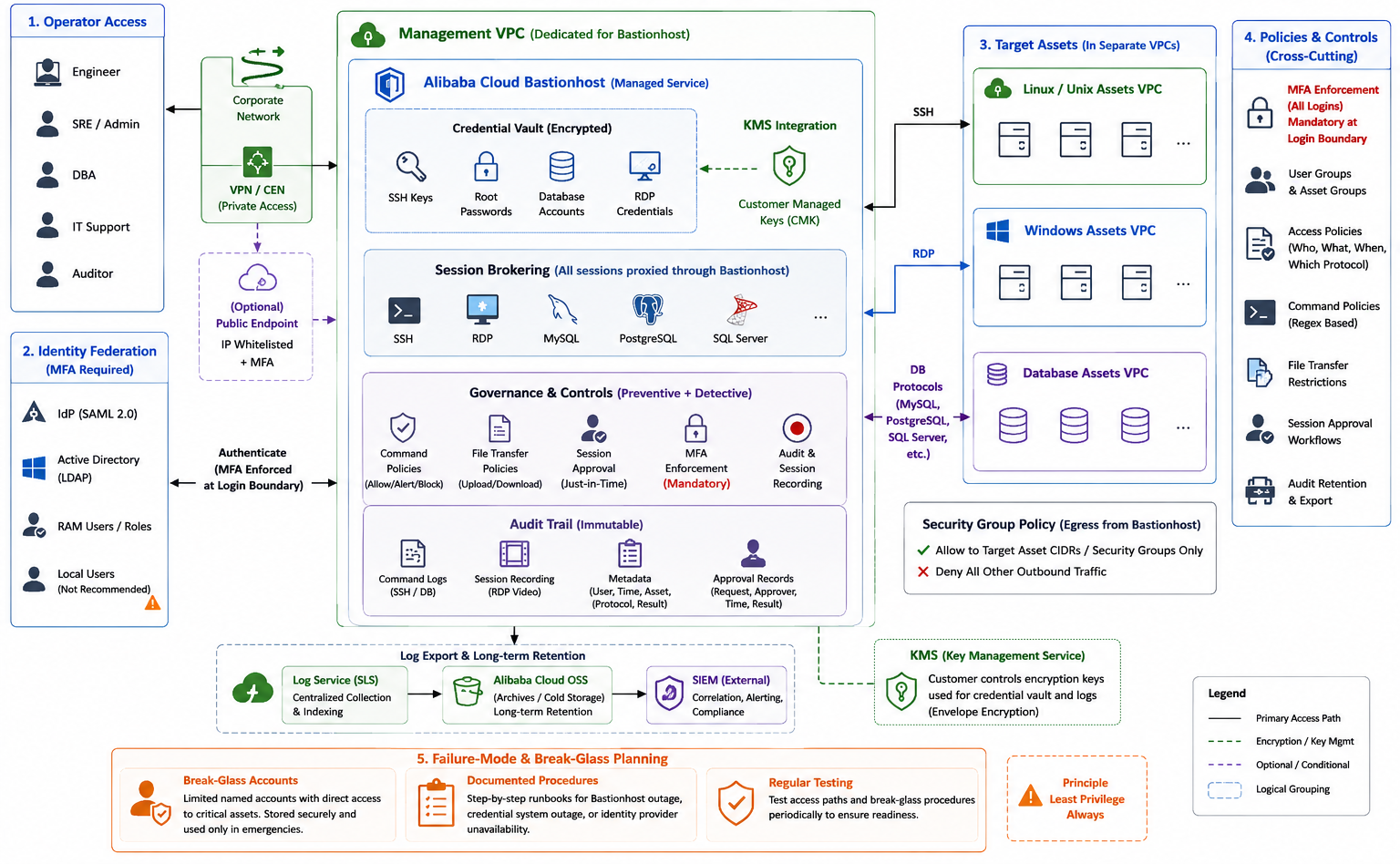
Figure 1: Privileged access architecture with Alibaba Cloud Bastionhost.
The capability that separates Bastionhost from an ordinary jump host is credential vaulting. Target credentials, SSH keys, root passwords, database account passwords, and RDP credentials are stored encrypted and never disclosed to the operator. When a session is initiated, Bastionhost retrieves the credentials, completes the connection, and presents the operator with a terminal or graphical session. The operator authenticates to Bastionhost using their own identity; the target credential remains opaque.
Two consequences follow. Target credentials can be rotated daily or weekly because no human needs to know the current value. And offboarding becomes a single action: disable the Bastionhost identity, and every path that the operator held to production closes simultaneously. For regulatory regimes that demand customer-managed key control, KMS integration provides envelope encryption of the vault, bringing encryption keys under the customer's lifecycle policy rather than the service's.
Bastionhost supports operator identities from RAM users and roles, from external identity providers via SAML 2.0, or from Active Directory via LDAP. Local users are supported, but operationally weakest; they introduce a parallel credential lifecycle that audit teams will flag as drift from the central identity store. The correct default is to treat Bastionhost as a relying party of the enterprise identity provider, not as an identity source.
MFA should be enforced at the login boundary regardless of upstream source. Native support covers TOTP, SMS, and email factors; for federated logins, the upstream IdP's policy is honoured. Every recorded session assumes it corresponds to an authenticated human; disabling the second factor for any administrator account, even temporarily, invalidates the forensic value of recordings produced during the lapse.
Authorisation operates through user groups bound to asset groups through access policies, each specifying which group may access which assets, over which protocol, during which windows, with what command restrictions. Adding a new ECS instance to an existing asset group automatically applies the group's policy essential as fleets grow past the point where per-host review is tractable.
Every interactive session, an SSH terminal, RDP desktop, and database client are established through Bastionhost, with full input and output recorded for replay. SSH and database sessions produce searchable command logs; RDP sessions produce video. Both can be exported to OSS where retention requirements exceed the in-service window.
Recording alone is forensic. Command policies convert it into a preventive control: regular-expression patterns matched against operator input during an SSH session trigger one of three actions: allow, alert, or block. Blocking destructive commands at the broker (rm -rf against production paths, DROP TABLE against tagged database assets, privilege escalation outside maintenance windows) stops the action before it reaches the target. Patterns should be authored with awareness of evasion through aliases, base64-encoded payloads, and shell expansion; the broker is one layer of defence, not the only one.
Graphical sessions cannot be filtered at the command level, but file transfer policies determine whether the operator may upload to or download from the target. Disabling clipboard sharing and file transfer for RDP sessions to sensitive Windows servers closes the exfiltration paths most commonly exploited during operator account compromise.
Session approval workflows extend the model to just-in-time access. High-sensitivity asset groups can require explicit approval before a session is established, binding the request, approver, time of approval, and resulting session into a single audit record. The chain of evidence frameworks, such as ISO 27001 and SOC 2, expect privileged access events.
Bastionhost requires reachability to target assets, but should not be reachable from operator workstations on the public internet without a controlled entry path. The recommended topology places it in a management VPC with security group rules permitting inbound access only from a corporate VPN gateway or Cloud Enterprise Network attachment, and outbound access only to target asset VPCs. Public IP assignment should be avoided where VPN access is feasible; where unavoidable, the public endpoint should be IP-whitelisted to known operator ranges.
Capacity sizing must account for incident response load, not steady-state administration. Incident response is when concurrent operator volume spikes and when access control matters most. For multi-region operations, deploying an instance per region rather than backhauling through a single instance reduces latency and contains blast radius.
The topology must also contemplate Bastionhost's own failure. Break-glass procedures should be documented and tested: a small number of named emergency accounts with direct access to critical assets, held in a sealed credential vault outside Bastionhost, with their use triggering immediate alerting and mandatory post-incident review.
Bastionhost is most accurately understood not as a network appliance with logging attached, but as the binding point between an enterprise identity system and the privileged credentials that would otherwise be distributed across a workforce. Its security value emerges from the combined effect of credential vaulting, federated identity, brokered sessions, and forwarded audit, and erodes quickly when any one is bypassed for convenience. Local users to avoid SAML configuration, shared accounts to avoid per-engineer onboarding, MFA disabled for troubleshooting, command policies left unconfigured because authoring them is tedious, and each is a documented pattern by which deployments lose effectiveness without losing their formal configuration.
Three integration patterns are worth examining once the baseline is in place: KMS envelope encryption of the vault for customer-managed key control; Cloud Config rules detecting target assets onboarded into the account but not registered with Bastionhost; and Function Compute webhooks bound to session approval events for audit linkage into external change management systems.
Disclaimer: The views expressed herein are for reference only and don't necessarily represent the official views of Alibaba Cloud.
Volumetric Attack Mitigation with Alibaba Cloud Anti-DDoS Pro
Cloud-Native Threat Detection with Alibaba Cloud Security Center

120 posts | 2 followers
FollowAlibaba Clouder - January 27, 2021
PM - C2C_Yuan - June 3, 2024
Alibaba Clouder - August 6, 2020
Alibaba Clouder - December 16, 2020
JDP - March 31, 2022
Alibaba Cloud Community - August 12, 2024
120 posts | 2 followers
Follow Simple Log Service
An all-in-one service for log-type data
Learn More Security Center
A unified security management system that identifies, analyzes, and notifies you of security threats in real time
Learn More Security Solution
Alibaba Cloud is committed to safeguarding the cloud security for every business.
Learn More Alibaba Cloud InCountry Service (ACIS)
Expand your business to China quickly and efficiently while complying with applicable local rules and regulations
Learn MoreMore Posts by PM - C2C_Yuan

