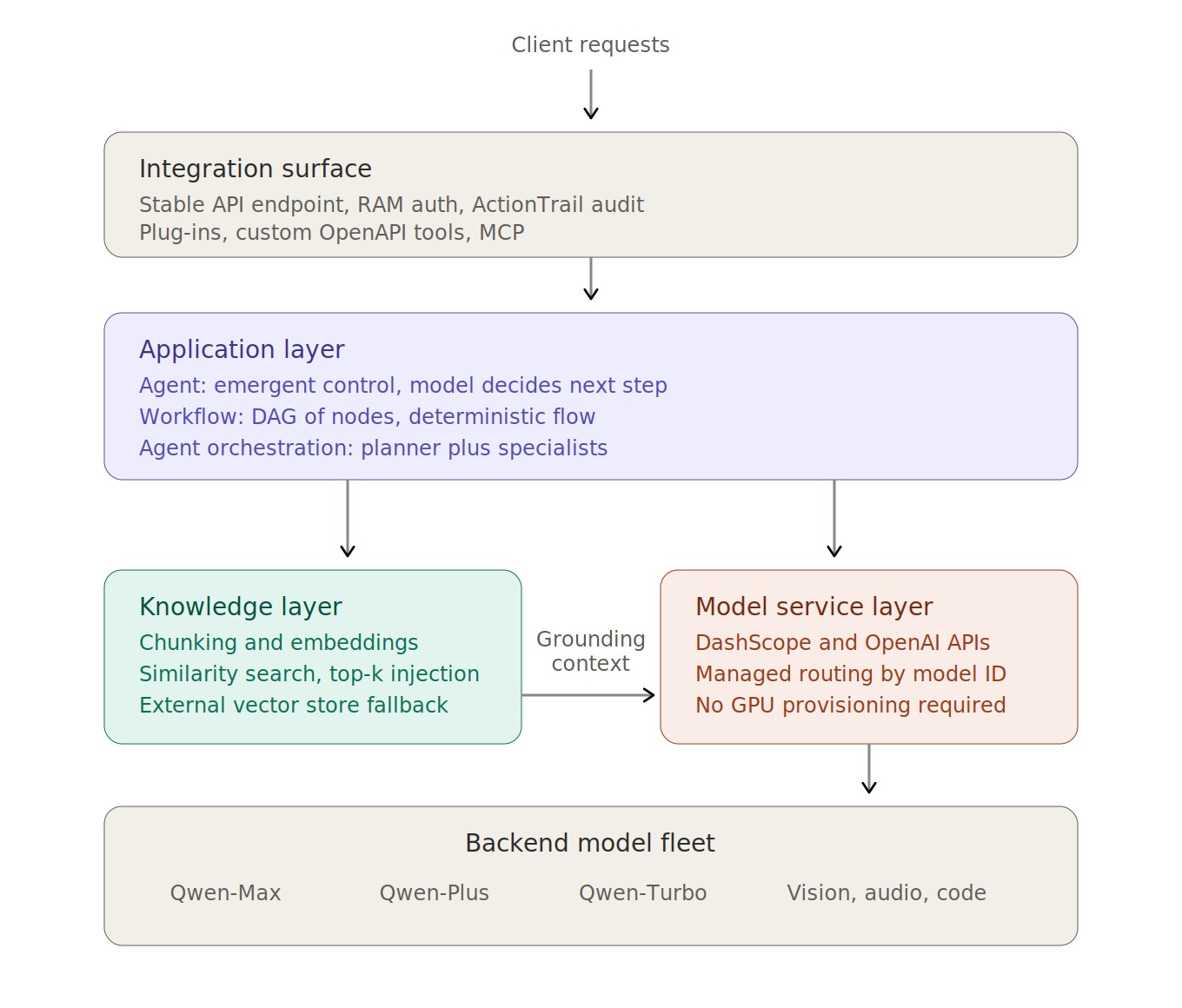
The paper explores the architectural elements of Alibaba Cloud Model Studio, which include the model service layer, application layer, knowledge layer, and the integration surface layer, which enables building of production-grade generative AI applications without managing the underlying inference infrastructure.
Generative AI applications are generally created by combining a language model, a prompt template, the capability of searching private datasets, external tools, and either chat or workflow UIs. Combining all these elements into a functional application involves complexity related to managing the model deployment service, the vector search service, the orchestration of the search process, and the API gateway itself.
The Alibaba Cloud Model Studio incorporates all these into a single managed service that is accessible via a single API. Getting familiar with the internal workings of this product makes it clear at which point Model Studio would be more appropriate than PAI-EAS, Analytic DB, or Function Compute in the overall cloud-native architecture.
__
Model service layer
The inference layer manages the inference of large language models via a standardised API at the bottom. This platform serves the whole Qwen model series, including text, vision, audio, and code models, as well as some third-party models. Inference calls will be dispatched to different backends according to the model ID included in the call, without having to provision the computing resources and GPU management.
There are two API endpoints for users to choose from. Firstly, there is a Dash Scope API that provides all features related to the Qwen models. Secondly, there is a similar API interface compared to the one provided by the OpenAI platform. Applications using the SDK provided by OpenAI can change their backends by just changing the base endpoint and credentials.
Choice of model is an important design consideration. Qwen-Max performs well for multi-step reasoning and more complex agentic processes in which output quality matters more than price per token. Qwen-Plus offers a balanced performance in terms of quality, speed, and price for conversational and generative tasks that do not require too much complexity. Qwen-Turbo values speed and price above all else.
What does it actually take to run a generative AI application in production? Usually: a model server, a vector database, retrieval logic, a tool layer, and an API gateway — each with its own scaling story. Alibaba Cloud Model Studio bundles all of these behind a single API. This post unpacks its four-layer architecture and explains when it's the right choice.
Application layer
Above the model service lies an orchestration level that defines two categories of constructs: agent applications and workflow applications. This distinction arises from the nature of two distinct control flow strategies.
An agent application represents a conversation wherein the model decides on the responses, when to invoke tools, and how to use retrieved knowledge. The agent is set up with a system prompt, selected model, optional knowledge bindings, and a set of plug-ins to use. The control flow is emergent and works best for tasks wherein it is impossible to predict ahead of time what the response will be.
The workflow application, on the other hand, specifies a directed acyclic graph composed of nodes performing certain actions, namely invoking a model, conditional branching, code execution, retrieving knowledge, or calling an external API. The edges determine the flow of data between nodes. The flow control is deterministic and observable and would be suitable for tasks such as building a document classification pipeline or doing summarisation.
The concept of agent orchestration is an extension of the agent design pattern to multi-agent designs. The planning agent breaks down the request into smaller sub-requests, which are allocated to individual agents, and the consolidation agent integrates the intermediate responses. The use of the agent orchestration design pattern allows for queries to be handled beyond the scope of one context window.
__
Knowledge layer
The retrieval-augmented generation capability is baked in as a first-class entity and not an add-on feature. A knowledge base takes in documents to upload, generates chunks, embeds those chunks to create embeddings, and saves the embeddings in an internal index. Enterprise formats like PDF, Microsoft Word, plain text, and Markdown files are among the types of document formats supported; for visual inputs, image-aware knowledge bases are used.
Once a knowledge base is attached to the agent or invoked at any workflow node, query input prompts a similarity query, and the top hits are injected into the context of the model as the grounding data. The retrieval depth and the relevance threshold are two settings that can impact the performance of answers as well as context window utilisation, which needs to be evaluated before launch.
In cases where the retrieval demands surpass the capacity of the managed knowledge base, which normally happens when there are a lot of documents or when vector-based search in addition to lexical search is needed, Model Studio can work in tandem with third-party vector storage like Analytic DB for PostgreSQL and Hologres.
Integration surface
Outward interfaces fall into two categories: API integration for embedding Model Studio applications into existing systems, and plug-in integration for extending applications with external capabilities.
Every application receives a stable endpoint accepting streaming or non-streaming requests. Authentication uses API keys scoped to RAM roles configured per workspace and audited through Action Trail. The same endpoint pattern serves agent applications, workflow applications, and direct model calls, simplifying client code addressing multiple application types.
Plug-ins extend application capability beyond the model’s parametric knowledge. Built-in plug-ins cover common operations such as web search, code execution, and image generation. Custom plug-ins are registered through an OpenAPI specification and an endpoint, after which the model invokes them through function calling. Support for the Model Context Protocol enables standardised connection to external tool servers that comply with the protocol.
__
Closing observations
Model Studio performs best when the workload takes advantage of its multiple abstraction layers. Workloads that involve managed model serving, built-in RAG capabilities, and standardised tool usage benefit from a faster development cycle. Workloads involving customised models and training or inference requirements that cannot be met by PAI-EAS will find Model Studio more suitable.
There are three important factors that one should consider when adopting Qwen models. Firstly, model selection should not automatically adopt the highest-capability model in the Qwen suite because the cost per token varies greatly among these models, depending on capabilities. Secondly, one should calibrate the knowledge base to perform well against representative queries before adopting it in production. Lastly, the type of application should align with determinism needs: agents for open conversation tasks; workflow for repeatable structured tasks; agent orchestration for decomposable tasks.
__
Disclaimer: The views expressed herein are for reference only and don’t necessarily represent the official views of Alibaba Cloud.
Multi-Step Orchestration on Alibaba Cloud Serverless Workflow

115 posts | 2 followers
FollowFarah Abdou - December 1, 2025
Farruh - March 22, 2024
Farruh - October 1, 2023
Alibaba Cloud Community - January 4, 2026
Alibaba Cloud Indonesia - April 14, 2025
Ashish-MVP - April 8, 2025
115 posts | 2 followers
Follow Qwen
Qwen
Full-range, open-source, multimodal, and multi-functional
Learn More Token Plan
Build more, spend less. One plan, every modality.
Learn More
Alibaba Cloud Model Studio
A one-stop generative AI platform to build intelligent applications that understand your business, based on Qwen model series such as Qwen-Max and other popular models
Learn More Alibaba Cloud for Generative AI
Accelerate innovation with generative AI to create new business success
Learn MoreMore Posts by PM - C2C_Yuan

