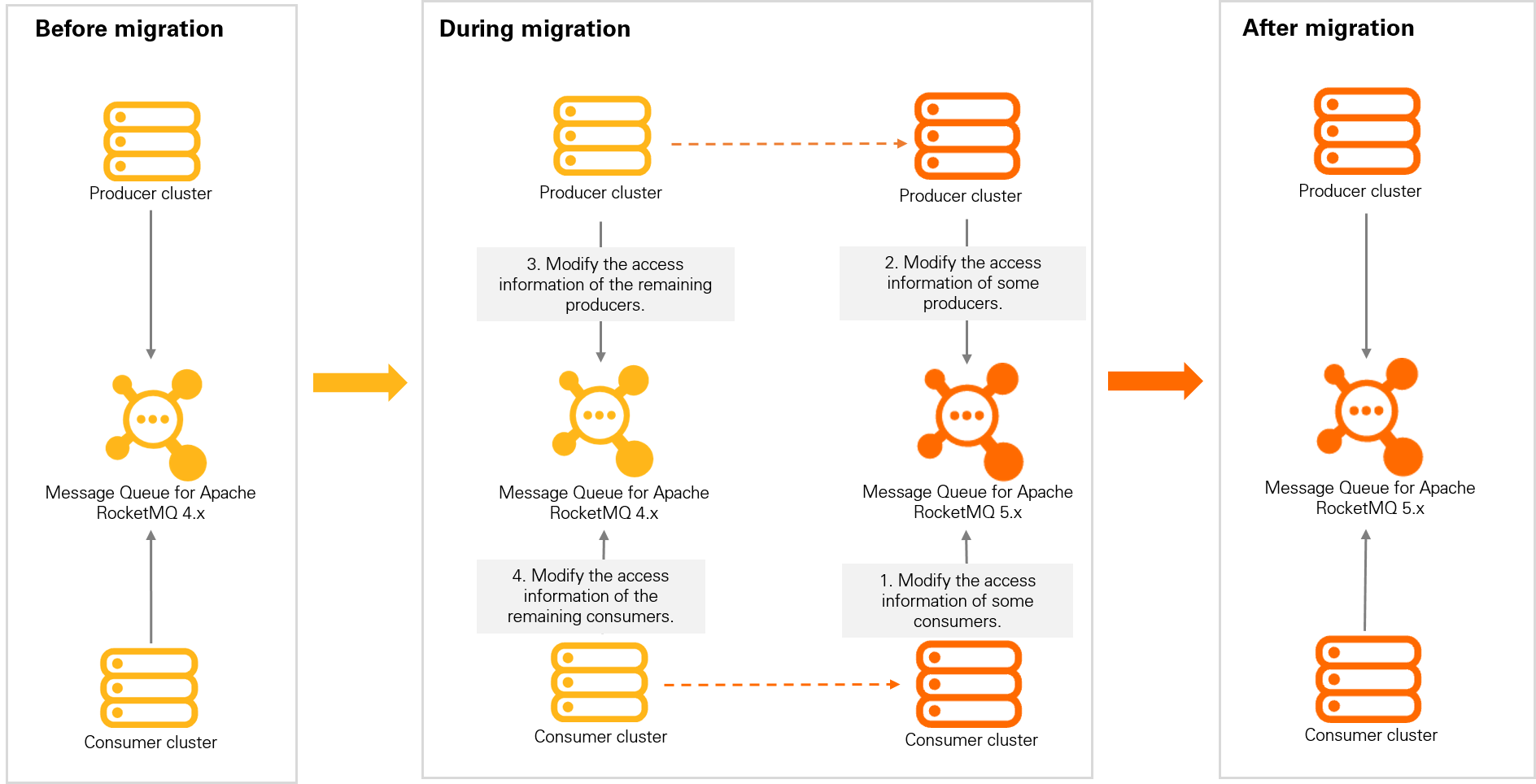
ApsaraMQ for RocketMQ adalah platform terdistribusi dari Alibaba Cloud yang dibangun di atas Apache RocketMQ. Platform ini menyediakan solusi terpadu untuk memproses pesan, event, dan aliran dengan latensi rendah, konkurensi tinggi, ketersediaan tinggi, serta keandalan tinggi. Seiring dirilisnya Apache RocketMQ 5.0, ApsaraMQ for RocketMQ menawarkan versi sisi server v5.x yang lebih stabil dan andal. Topik ini menjelaskan perbedaan dan kompatibilitas antara versi sisi server v5.x dan v4.x dari ApsaraMQ for RocketMQ.
Keunggulan v5.x
Dibandingkan dengan versi sisi server sebelumnya, ApsaraMQ for RocketMQ v5.x menawarkan keunggulan berikut:
Arsitektur yang lebih canggih
Mengadopsi arsitektur pesan yang memisahkan penyimpanan dari komputasi. Sumber daya penyimpanan dan komputasi dapat diskalakan secara horizontal dan independen sesuai kebutuhan. Arsitektur ini mendukung operasi dan pemeliharaan (O&M) yang efisien dan elastis serta menyediakan kemampuan berskala besar berkinerja tinggi.
Hambatan pengembangan yang lebih rendah
Mendukung akses melalui kit pengembangan perangkat lunak klien (SDK) yang sepenuhnya kompatibel dengan Apache RocketMQ. SDK ini juga kompatibel dengan semua versi SDK dan operasi API sebelumnya.
Mendukung akses aman dalam Virtual Private Cloud (VPC). Anda dapat melakukan migrasi ke cloud hanya dengan mengubah titik akhir, tanpa perlu mengubah kode apa pun.
Hambatan O&M yang lebih rendah
Menyediakan solusi seperti elastisitas otomatis dan lingkungan pengujian ringan untuk mengatasi tantangan umum, termasuk penilaian kapasitas online, pengelolaan lalu lintas layanan elastis selama jam sibuk dan tidak sibuk, serta pemeliharaan lingkungan grayscale harian. Hal ini menurunkan hambatan O&M secara keseluruhan dan mengurangi risiko.
Biaya yang lebih fleksibel
Melalui optimasi teknologi infrastruktur cloud, sumber daya komputasi untuk mengirim dan menerima pesan mendukung kapasitas terjadwal maupun burst elastis untuk lonjakan lalu lintas. Dengan demikian, Anda tidak perlu menyediakan buffer besar untuk lalu lintas burst.
Penyimpanan pesan menggunakan model bayar sesuai penggunaan. Model ini menawarkan keunggulan signifikan dalam hal elastisitas dibandingkan dengan disk yang dipasang, yang tidak dapat diskalakan ke bawah.
Model penagihan yang lebih komprehensif
Menawarkan tier layanan yang lebih lengkap dan mendukung kedua model penagihan, yaitu langganan dan bayar sesuai penggunaan.
Versi SDK
Tabel berikut menjelaskan versi SDK dan dukungan fitur untuk ApsaraMQ for RocketMQ.
Pada tabel, ✅ menunjukkan bahwa fitur didukung, sedangkan ❌ menunjukkan bahwa fitur tidak didukung.
Item Perbandingan | ||||||
Protokol | Protokol gRPC v2 | Protokol Remoting | Protokol Remoting | Protokol Remoting | Protokol gRPC v1 | Protokol HTTP |
Instans yang dapat diakses | Instans seri v5.x |
|
|
| Instans seri v4.x | Instans seri v4.x |
Rekomendasi | SDK gRPC 5.x direkomendasikan.
|
|
| |||
Mengirim pesan normal, terurut, transaksional, dan terjadwal | ✅ | ✅ | ✅ | ✅ | ✅ | ✅ |
Konsumsi konkuren | ✅ | ✅ | ✅ | ✅ | ✅ | ✅ |
Konsumsi terurut | ✅ | ✅ | ✅ | ✅ | ✅ | ✅ |
✅ | ❌ | ❌ | ❌ | ❌ | ❌ | |
Konsumsi siaran | ❌ | ✅ | ✅ | ✅ | ❌ | ❌ |
Konsumsi aliran (terhubung ke Flink, dll.) | ❌ | ✅ | ✅ | ❌ | ❌ | ❌ |
Jejak pesan | ✅ | ✅ | Didukung pada v4.5.2 dan versi setelahnya | ✅ | ✅ | ❌ |
✅ | ❌ | ❌ | ❌ | ❌ | ❌ | |
✅ | Hanya didukung untuk instans seri v5.x | ❌ | ❌ | ❌ | ❌ | |
Kompatibilitas fitur antara v4.x dan v5.x
ApsaraMQ for RocketMQ instans v5.x dioptimalkan berdasarkan pengalaman produksi dengan pelanggan perusahaan berskala besar. Perilaku beberapa fitur dalam proses pengiriman dan penerimaan pesan telah disesuaikan. Akibatnya, konfigurasi parameter dan perilaku fitur mungkin berbeda dalam beberapa skenario. Perbedaan ini umumnya tidak memengaruhi proses utama pengiriman dan penerimaan pesan. Jika Anda meningkatkan instans v4.x yang ada ke v5.x, Anda harus mengevaluasi risikonya sesuai kebutuhan.
Perbedaan spesifik dalam perilaku fitur adalah sebagai berikut:
Perbedaan Fitur | v4.x | v5.x | Deskripsi |
Tunda maksimum untuk pesan terjadwal | 40 hari |
Untuk informasi selengkapnya, lihat Kuota dan batas. | Parameter penundaan yang sangat panjang dapat menyebabkan risiko stabilitas sistem. Jangan mengatur penundaan terlalu lama. Gunakan pengatur waktu pendek untuk mensimulasikan skenario bisnis. Untuk informasi lebih lanjut, lihat Pesan terjadwal dan tertunda. Jika Anda melakukan migrasi instans v4.x yang ada dan tunda maksimum tidak memenuhi kebutuhan Anda, ajukan tiket. untuk konsultasi. |
Dukungan protokol HTTP | Didukung | Tidak didukung | v5.x saat ini tidak mendukung protokol HTTP. Jika instans v4.x yang ada menggunakan protokol HTTP, tunda peningkatan tersebut. |
Kebijakan otorisasi RAM | Tautan data + tautan kontrol | Mendukung tautan kontrol, tetapi kebijakan otorisasi berbeda dari v4.x |
|
Routing pesan global | Didukung | Gunakan fitur Global Replicator. | Global Replicator mendukung beberapa jenis instans termasuk open source, Alibaba Cloud 4.x, dan Alibaba Cloud 5.x, serta menyediakan kemampuan sinkronisasi pesan dan kemajuan konsumsi lintas wilayah dan lintas instans. |
Batasan jenis pesan | Tidak ada batasan | Batasan ketat | Di v5.x, jenis pesan dipisahkan ke dalam topik untuk O&M dan pemrosesan independen. Sistem memvalidasi secara ketat jenis pesan yang dikirim terhadap jenis pesan yang didefinisikan untuk topik tersebut. Jika validasi gagal, permintaan pengiriman pesan ditolak, dan dikembalikan pengecualian ketidakcocokan jenis. Untuk informasi lebih lanjut, lihat Batasan perilaku topik. |
Batasan pembelian
ApsaraMQ for RocketMQ instans v5.x dapat dibeli dan diaktifkan oleh semua pengguna.
Pembelian instans ApsaraMQ for RocketMQ v4.x dibatasi hanya untuk pengguna yang sudah ada. Kami menyarankan Anda meningkatkan instans Anda ke v5.x. Jika ingin meningkatkan, ajukan tiket.
Peningkatan dari v4.x ke v5.x
Anda tidak dapat melakukan peningkatan langsung dari instans v4.x ke v5.x. Untuk meningkatkan, Anda harus membeli instans v5.x dan secara bertahap memigrasikan lalu lintas layanan Anda ke instans baru tersebut. Gambar berikut menunjukkan proses migrasi.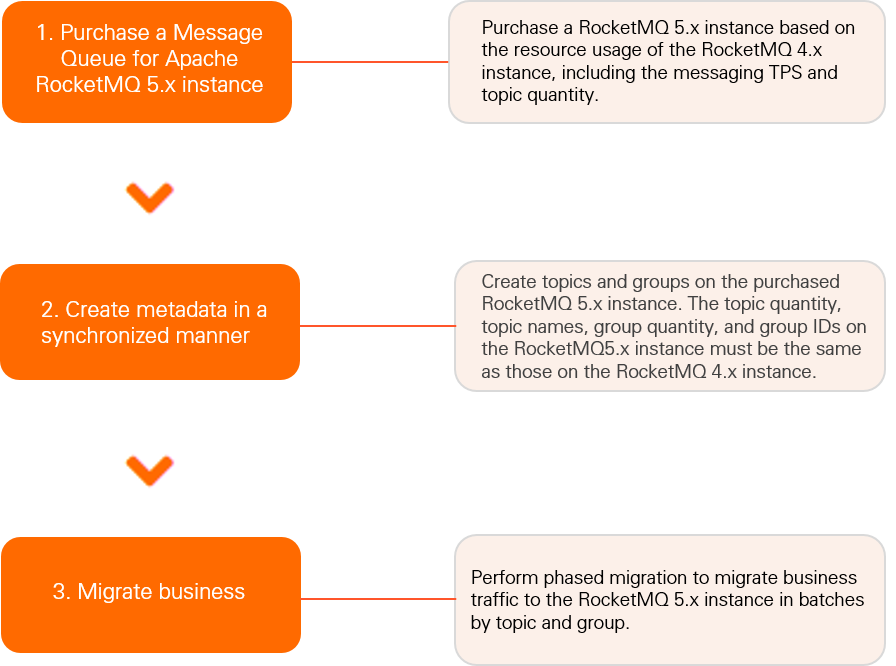
Seperti yang ditunjukkan pada gambar, pada langkah kedua, Anda dapat menggunakan fitur impor dan ekspor topik serta grup untuk membuat metadata secara cepat. Untuk informasi lebih lanjut, lihat Impor atau ekspor topik dan Impor atau ekspor grup.
Saat memigrasikan layanan Anda, Anda dapat menerapkan solusi dual-read, dual-write, dan rilis bertahap seperti yang ditunjukkan pada gambar berikut.