ApsaraVideo VOD supports digital rights management (DRM) encryption technologies that are commonly used in the industry. You can add and manage DRM certificates and enable DRM encryption in the ApsaraVideo VOD console to ensure the security of your copyrighted video content.
Limits
DRM solution | Mobile device | Browser |
widevine | Android | Chrome, Firefox 47 and later, Microsoft Edge, and Opera |
fairplay | iOS | Safari |
Features
DRM encryption: ApsaraVideo VOD supports Widevine and FairPlay DRM encryption.
Certificate management: You can manage FairPlay certificates in the ApsaraVideo VOD console.
DRM-based playback: You can use ApsaraVideo Player to decrypt and play DRM-encrypted videos.
Benefits
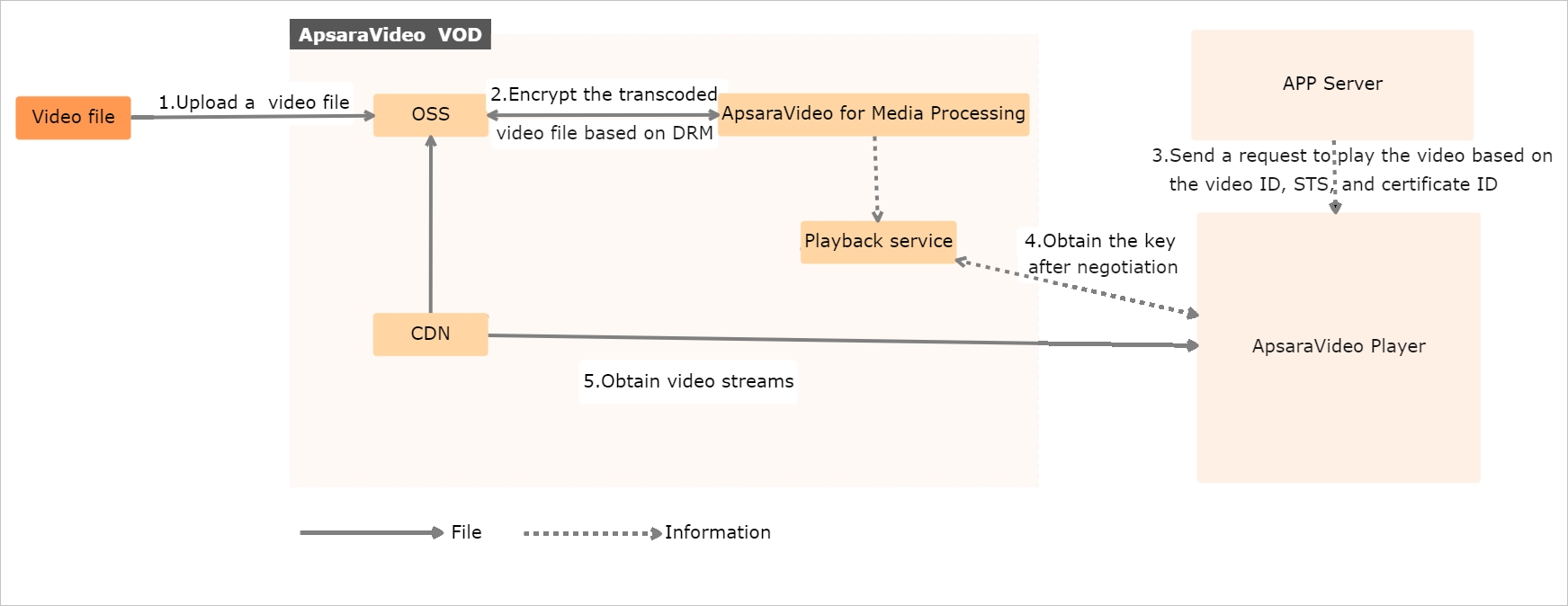
Comprehensive features: ApsaraVideo VOD allows you to manage DRM certificates, issue DRM licenses, encrypt videos based on DRM, and decrypt and play DRM-encrypted videos.
Cost efficiency: ApsaraVideo VOD generates only one output file that supports Widevine and FairPlay DRM encryption in each transcoding task. This reduces the transcoding and storage costs. You are charged for using DRM encryption based on the pay-as-you-go billing method without minimum fees.
High security, stability, and concurrency: ApsaraVideo VOD ensures the secure storage of your copyrighted video content by using refined permission management and system security settings. In addition, the distributed service architecture meets the high-concurrency requirements of your business.
Architecture
Billing
DRM encryption is implemented during video transcoding. You are charged only for transcoding when you transcode a video. You are charged for DRM encryption every time a device requests a license to play a DRM-encrypted video. For more information about billing, see DRM encryption.