Security Center sends alert notifications through Message Center. By default, only the primary account contact receives them. Add dedicated security contacts so the right teams can respond to incidents promptly.
Step 1: Configure security message recipients in Message Center
Add contacts to receive security notifications by email or internal message.
-
Log on to the Message Center console.
-
In the left-side navigation pane, choose .
-
In the upper-right corner, click Manage Contacts. On the message recipient management page, click Add Receiver in the upper-right corner. Enter the required information, such as name and email address, and then click Save.
-
Name: Name of the message recipient. Maximum 20 characters.
-
Email: Email address for receiving notifications.
-
Position: Job title of the contact.
ImportantContacts must complete verification before receiving notifications. The system sends a verification message to the specified email address. Follow the instructions in the message to complete verification.
-
-
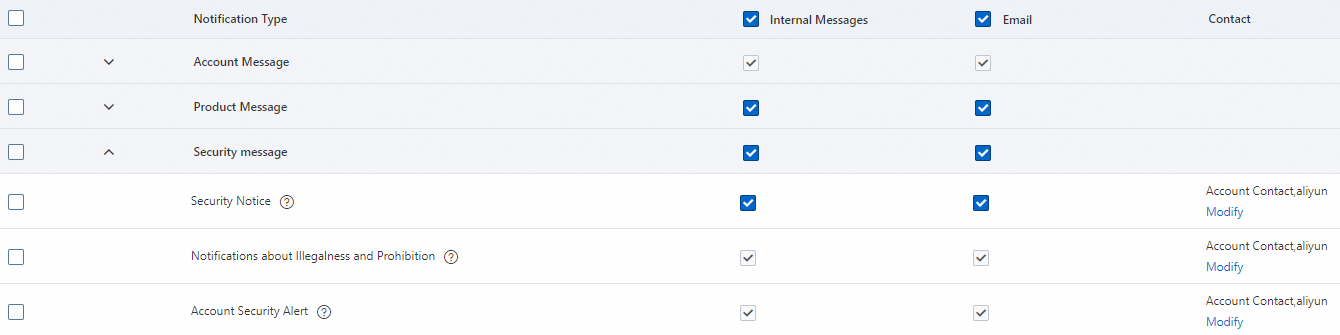
Return to the Message Settings page, find Security message, and click Modify in the Common Settings column for the target message type. This takes you to the Modify Message Receiving Configurations page.
Note-
Security Notice: Covers Security Center, Anti-DDoS, and Web Application Firewall. Subscribing to Security Notice applies to all related products.
Examples: security alerts, web tampering alerts, container microsegmentation alerts, and AccessKey leak notifications (Security Center); DDoS attack notifications (Anti-DDoS); domain ICP filing issues and Security Control events (Web Application Firewall).
-
For broader security coverage, also subscribe the contact to Illegal and Prohibited Content Notification and Account Security Alert.
-
Illegal and Prohibited Content Notification: Notifies about penalties for illegal activities on Alibaba Cloud resources.
-
Account Security Alert: Sends security alerts for your Alibaba Cloud account and RAM users, such as AccessKey leak risks.
-
-
-
On the Contact tab, select the checkbox for the contact and click Save.
-
In the subscription list, select the checkboxes in the Internal Messages, Email, and Text Messages columns to enable multiple notification methods.
If the new contact's name appears in the Contact column of the subscription list, the contact was added successfully. The configuration takes effect immediately.
Step 2: Configure notification settings in Security Center
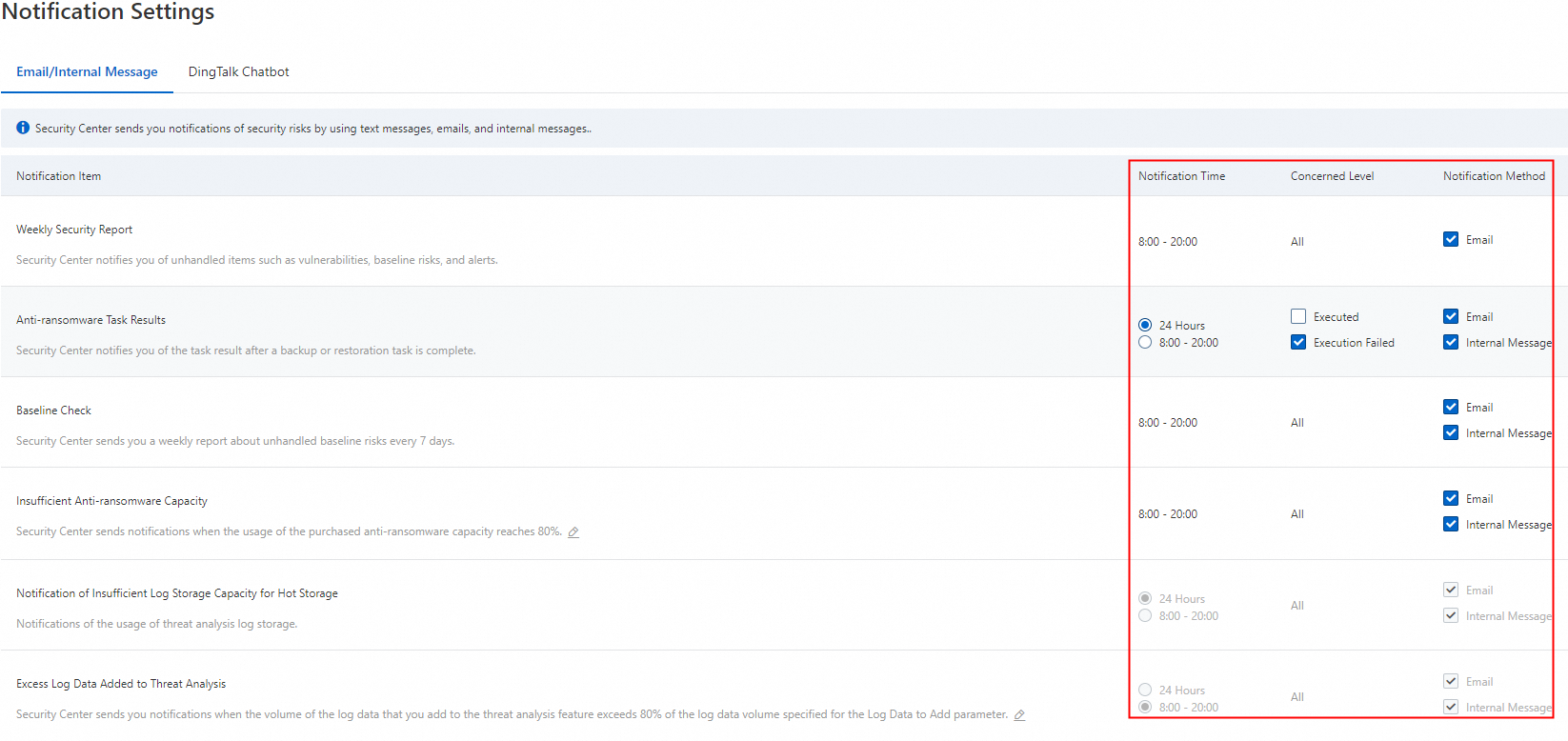
After subscribing a contact to Security Notice in Message Center, configure notification methods and frequency in Security Center. Configure notifications by text message, email, and internal message.
-
If you select only Internal Messages as the notification method for Security Notice, but select both Internal Message and Email for Baseline Check in the page of Security Center, the contact will receive only Internal message notifications.
-
To receive email notifications for a specific item, the contact must also be subscribed to Email for the Security Notice message type in Message Center.
References
-
Security Center supports DingTalk chatbot notifications. Configure DingTalk chatbot notifications.
-
Anti-DDoS provides alert notifications through CloudMonitor and Log Service. Set alerts for attack events in Anti-DDoS Basic and Anti-DDoS Origin.
-
Web Application Firewall provides notifications through CloudMonitor and Log Service. Configure alerting.