Overview
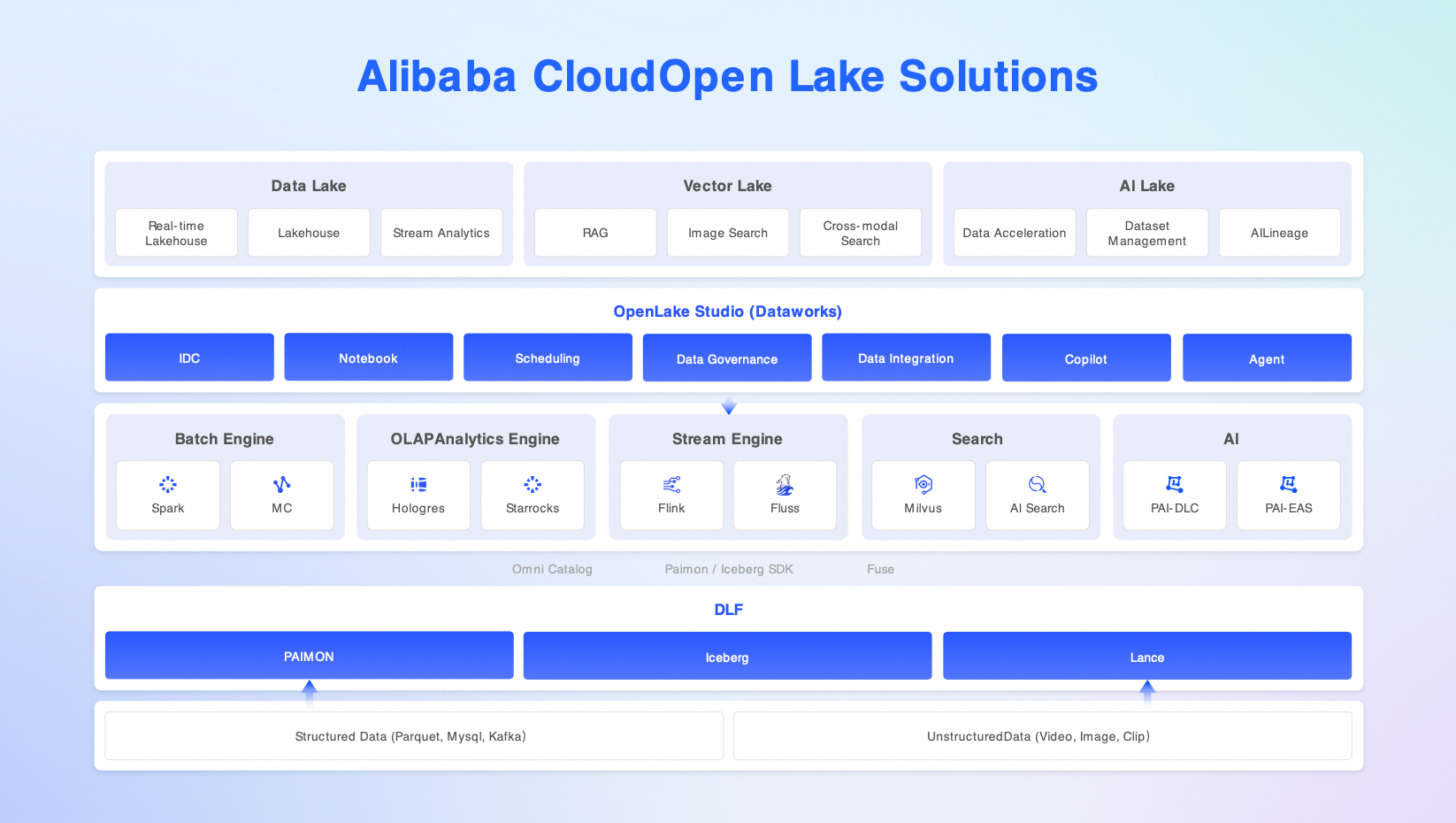
Alibaba Cloud OpenLake is an open lakehouse platform for big data, search, and artificial intelligence (AI). Built on Data Lake Formation (DLF), it unifies structured, semi-structured, unstructured, and vector data under one metadata catalog. This Agentic Data architecture lets one copy of data serve multiple engines with global search and end-to-end governance.
OpenLake supports open table formats such as Apache Paimon (Paimon), Apache Iceberg (Iceberg), and Lance. It covers the full workflow from data ingestion, feature engineering, and vectorization to retrieval-augmented generation (RAG), model training, and inference — delivering high-performance, low-cost, highly available, and easy-to-manage multimodal data infrastructure.
OpenLake serves industries such as Internet, finance, retail, manufacturing, education, and autonomous driving that need to process multimodal data and build AI-native applications.
Benefits
Open standards that eliminate data silos
-
Compatible with open table formats (Paimon, Iceberg, Lance) and file standards (Parquet, ORC, Avro, CSV).
-
Integrates with Spark, Flink, Trino, StarRocks, Hologres, and MaxCompute, eliminating data migration and format conversion costs.
-
DLF Omni Catalog unifies five data types — structured, semi-structured, unstructured, vector, and streaming — so you ingest once and use anywhere.
High-performance multi-engine collaboration
-
Spark, Flink, StarRocks, Hologres, and MaxCompute access the same lake data without redundant copies.
-
The DLF metadata service ensures consistent permissions, schema sync, and transaction isolation across engines.
-
Batch, streaming, interactive, and AI workloads share one storage layer, improving resource utilization and efficiency.
-
Supports high-concurrency, low-latency mixed workloads that combine T+1 batch processing with second-level real-time analytics.
Unified development and governance
-
OpenLake Studio integrates with DataWorks to provide Notebook, SQL IDE, and visual scheduling in one interface.
-
Centralized metadata, permissions, lineage, orchestration, and quality monitoring enable governance from day one.
-
Large-scale, high-concurrency task scheduling ensures enterprise-grade SLAs and stability.
-
The full data pipeline is traceable, auditable, and supports rollbacks for compliance.
Data, search, and AI integration
-
Combines structured tables, unstructured files (images, audio, video, documents), and vector data in one multimodal lakehouse.
-
Natively supports SQL, full-text search (OpenSearch, Elasticsearch), and vector search (Milvus, PgVector).
-
Provides a searchable, governable data pipeline for large language model (LLM) RAG and intelligent agents.
-
Streamlines the workflow from data ingestion, feature engineering, and vectorization to retrieval augmentation and model inference, accelerating AI application delivery.
Core features
|
Feature |
Description |
Documentation |
|
Unified metadata and table management |
Uses DLF to provide a unified catalog for Paimon, Iceberg, Lance, Parquet, and other formats. |
|
|
Storage cost optimization |
Reduces storage costs using OSS intelligent tiering, compression, and lifecycle policies. |
|
|
Real-time lake and stream integration |
Flink, Streaming Storage Fluss, and DLF enable data ingestion in seconds and data visibility in minutes. |
|
|
Enterprise-grade high-performance engines |
Integrates Serverless Spark, Flink, Hologres, MaxCompute, and other cloud-native engines. |
What is EMR Serverless Spark, What is Realtime Compute for Apache Flink, What is Hologres, What is MaxCompute |
|
Collaborative development for big data and AI |
OpenLake Studio with Notebook, SQL, and visual scheduling. |
|
|
Agent and Copilot integration |
OpenLake Agent and MCP protocol enable multimodal intelligent agents to access the lakehouse directly. |
Architecture solutions
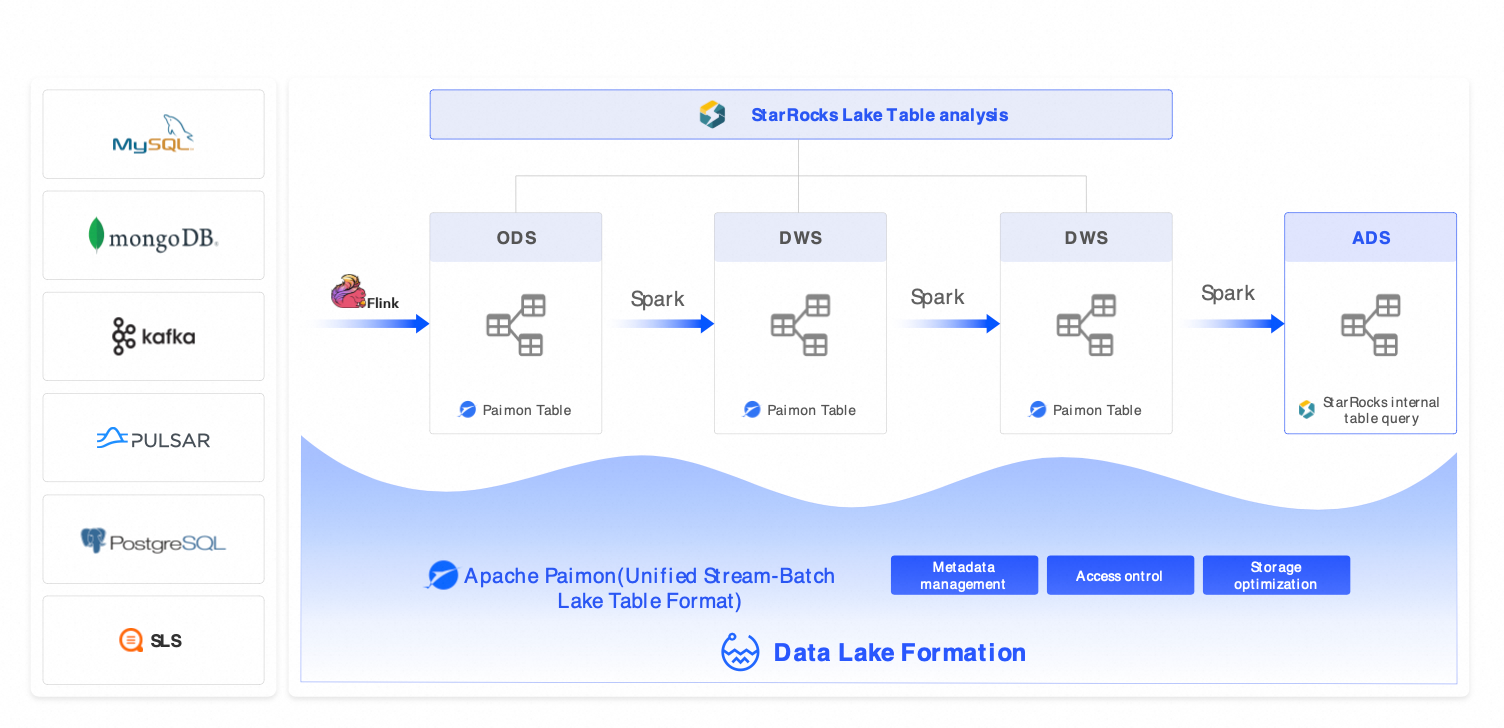
Solution 1: Classic lakehouse architecture (Serverless Spark + StarRocks + DLF)
-
Scenarios: T+1 batch processing for cost-effective, fully managed analytics: reports, business intelligence, and user personas.
-
Components: EMR Serverless Spark (batch processing) + StarRocks (sub-second queries) + DLF (unified metadata).
-
Alternative solutions: AWS Redshift + Glue, Databricks (batch processing), Hive + Presto.
-
Benefits: 30%+ cost reduction, 3–5x query performance, fully managed.
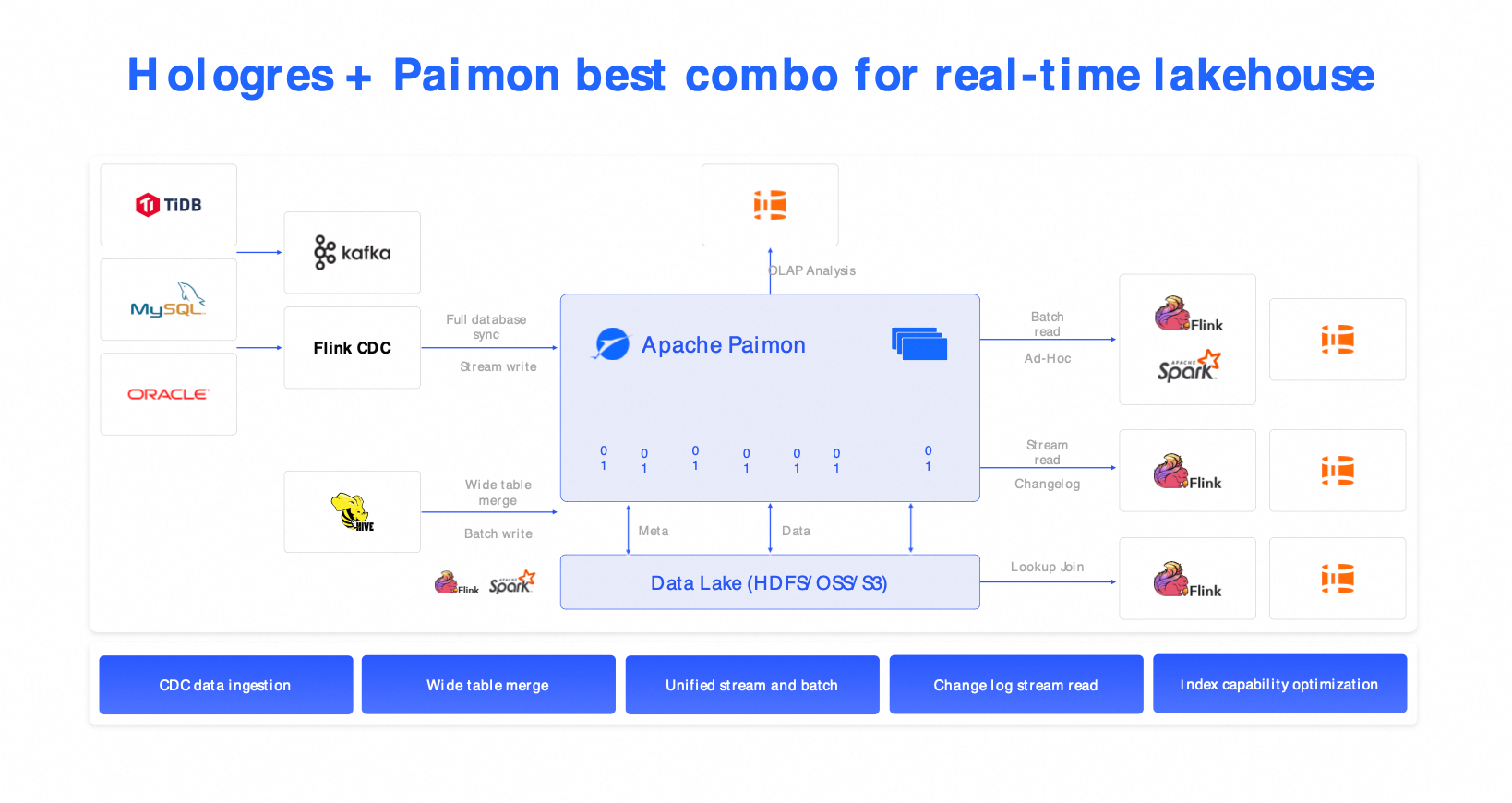
Solution 2: Streaming lakehouse architecture (Flink + Hologres + DLF)
-
Scenarios: Near-real-time analytics with second-to-minute latency: risk control, ad monitoring, and IoT monitoring.
-
Components: Flink (streaming ETL) + Hologres (real-time serving) + DLF (cross-engine collaboration).
-
Alternative solutions: Kafka + ClickHouse + Hive, AWS Kinesis + Redshift.
-
Benefits: End-to-end data visibility within 10 minutes, sub-second query latency.
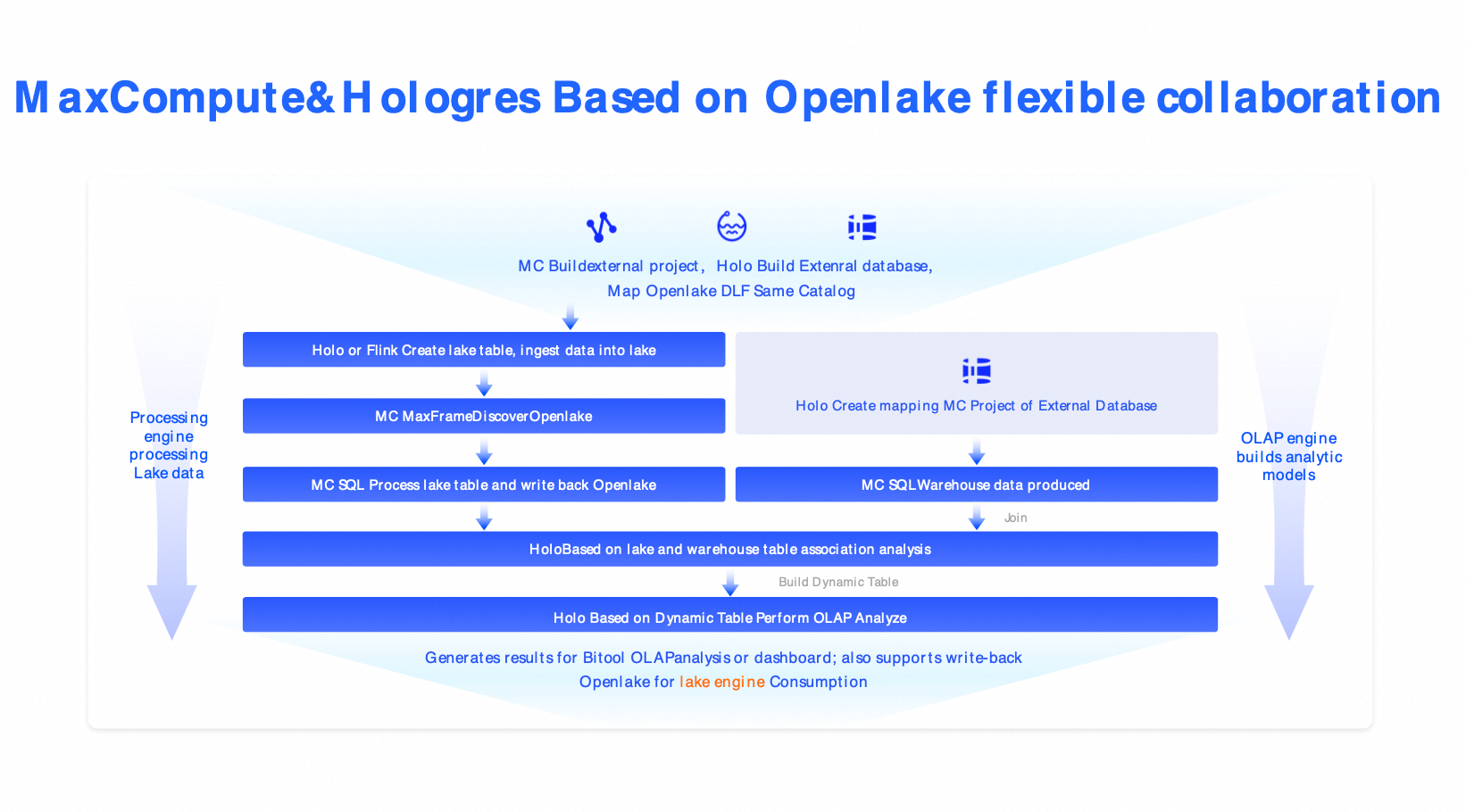
Solution 3: Cloud-native lakehouse architecture (MaxCompute + Hologres + DLF)
-
Scenarios: For finance, government, and other industries with strict security, compliance, and scale requirements.
-
Components: MaxCompute (petabyte-scale batch processing) + Hologres (millisecond writes) + DLF (governance).
-
Alternative solutions: Snowflake, Azure Synapse, Databricks commercial editions.
-
Benefits: Enterprise-grade security, elastic scaling, RPO=0, and RTO < 30 minutes.
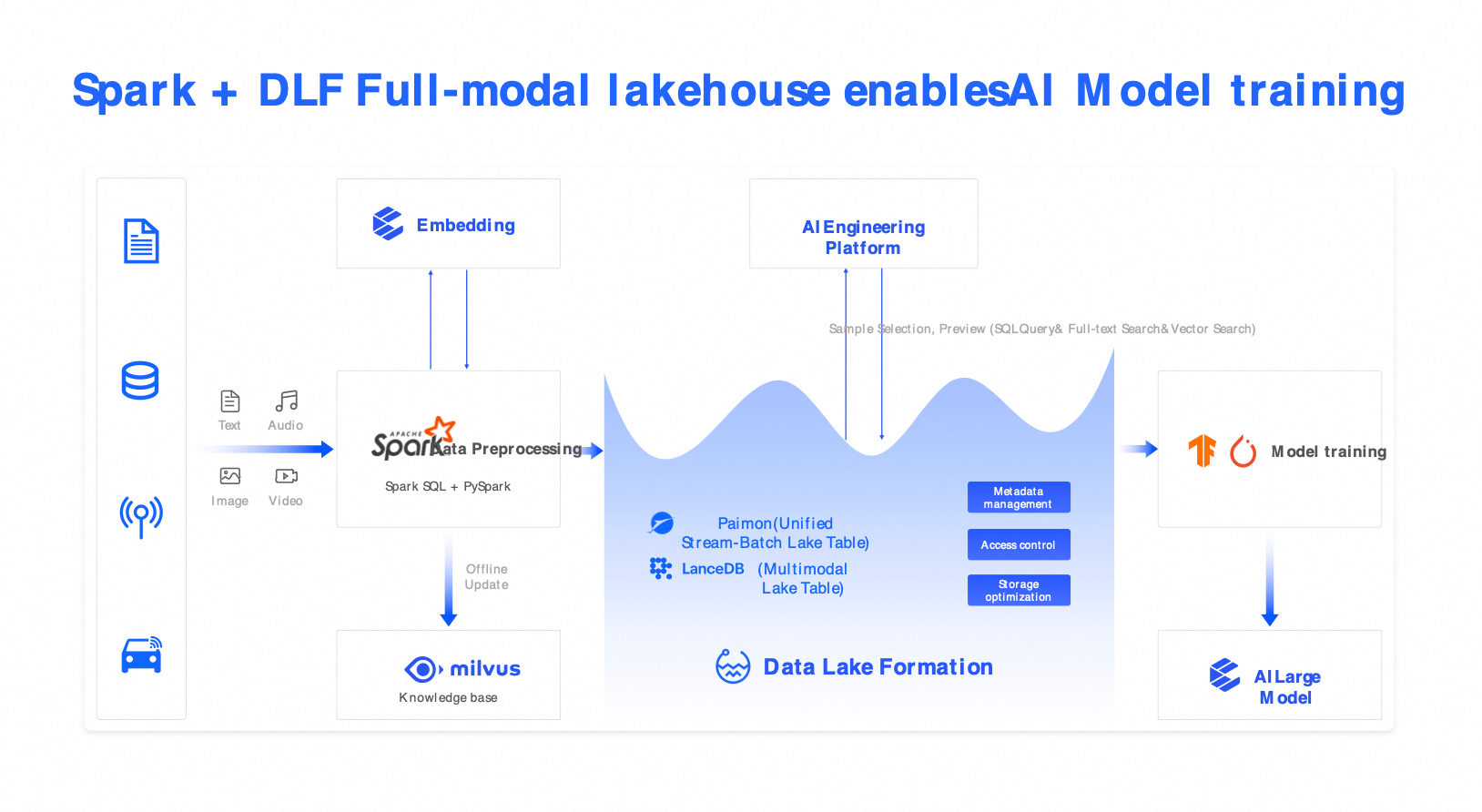
Solution 4: Omni-modal vector lake (Spark + Milvus + DLF)
-
Scenarios: AI training, multimodal semantic search, RAG, intelligent customer service, and autonomous driving perception data management.
-
Components: Spark (multimodal pre-processing), Milvus (vector search), and DLF (unified catalog).
-
Capabilities: Hybrid search across text, images, audio, and video with combined SQL and vector queries.
-
Benefits: 5x sample selection efficiency and high-quality LLM fine-tuning.