NAS uses pay-as-you-go billing by default. You can purchase NAS resource plans to deduct storage capacity costs, and you can purchase additionally. After a resource plan expires or its quota is exhausted, the excess usage is automatically billed on a pay-as-you-go basis.
Resource plan types
|
Resource plan |
Description |
|
General-purpose NAS resource plan |
Offsets storage fees for Storage Usage of General-purpose NAS (Capacity/Performance)①, IA storage class usage, or Archive Storage usage. |
|
Extreme NAS resource plan |
Offsets provisioned capacity fees for Extreme NAS (Standard/Advanced). |
① This billable item covers data stored in Capacity, Advanced, and Performance NAS file systems.
Offset factors
These offset factors apply only to Chinese mainland regions. For other regions, use the calculator and select a region to view its factors.
General-purpose NAS resource plan
General-purpose NAS (Capacity/Advanced/Performance) file systems use the Standard storage class by default. With a lifecycle management policy enabled, data matching the policy rules moves to the IA storage class or Archive Storage.
|
File storage class |
Billable item |
Billable item code |
Resource plan capacity consumed per GiB of storage capacity (coefficient) |
Description |
|
Standard storage |
Storage Usage of General-purpose NAS (Capacity/Performance) |
VolumeSize |
|
|
|
IA storage class |
Storage Usage of IA Storage Class |
VolumeIASize |
0.37 |
0.37 GiB of plan capacity offsets 1 GiB of IA storage usage (including recycle bin). |
|
Archive Storage |
Storage Usage of Archive Storage Class |
VolumeArchiveSize |
0.17 |
0.17 GiB of plan capacity offsets 1 GiB of Archive Storage usage (including recycle bin). |
Extreme NAS resource plan
|
Storage specification |
Billable item |
Billable item code |
Resource plan capacity consumed per GiB of storage capacity (coefficient) |
Description |
|
Standard |
Extreme provisioned capacity |
size |
1 |
1 GiB of plan capacity offsets 1 GiB of Extreme NAS provisioned capacity. |
|
Advanced |
Extreme provisioned capacity |
size |
Purchase recommendations
Before purchasing a resource plan, note the following:
-
Different file system types and storage types have different deduction coefficients. Select an appropriate resource plan specification based on the file system type that you actually use. For more information about deduction coefficients, see Deduction coefficients.
-
If you have enabled the lifecycle management feature, some data is automatically moved to Infrequent Access (IA) storage or Archive storage. The deduction coefficient for Infrequent Access (IA) storage is 0.37, and the deduction coefficient for Archive storage is 0.17. This means that the resource plan deducts IA and Archive storage more efficiently. Select a resource plan specification after a comprehensive evaluation.
-
A resource plan is not automatically renewed after it expires (unless you have enabled auto-renewal). After the resource plan expires, billing automatically switches to pay-as-you-go. Pay attention to the expiration time of your resource plan and renew or repurchase it in a timely manner.
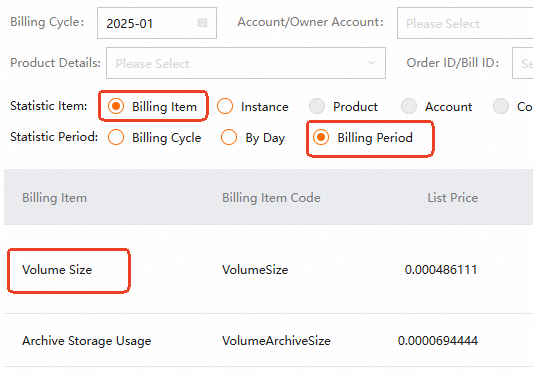
Check the billable item in your billing details to determine the matching plan type. Each type maps to specific billable items in Resource plan types.
For example, if your bill shows Storage Usage of General-purpose NAS (Capacity/Performance), purchase a General-purpose NAS resource plan.
Offset limitations
-
NAS resource plans can only deduct NAS service costs and cannot be used to deduct costs across products.
-
Each type of resource plan can only deduct the capacity costs of the corresponding file system. For more information, see Resource plan types.
-
A NAS region-specific resource plan only deducts the capacity costs of the corresponding file system within the specified region. For more information, see Offset regions.
-
After a resource plan expires or its quota is exhausted, the excess usage is automatically billed on a pay-as-you-go basis.
Offset regions
NAS offers region-specific resource plans. Check the Purchase NAS Resource Plan page for available regions.
Region-specific plans offset capacity fees only within the purchased region and cannot be shared across regions.
For example, a China (Hangzhou) plan offsets fees only for file systems in that region.
Offset order
Multiple resource plans of the same type are applied in this order:
-
Plans expiring earliest are applied first. Plans with the same expiration date are applied in purchase order.
Example: Plans A, B, and C in China (Hangzhou). C expires first; A and B expire together but A was purchased first. Offset order: C, A, B.
-
After a plan is exhausted, excess usage is billed pay-as-you-go.
If your account has a resource plan, a Storage Capacity Unit (SCU), and a storage plan, capacity is offset in the order shown below.
Supported operations
|
Resource plan |
|||||
|
General-purpose NAS resource plan |
Supported |
Supported |
Supported |
Supported |
Supported |
|
Extreme NAS resource plan |
Supported |
Supported |
Supported |
Supported |
Supported |