The DataAnalysis module in DataWorks includes a built-in visualization tool that turns SQL query results into charts. This tutorial walks you through querying user persona data from MaxCompute and configuring four charts: a stacked bar chart and three pie charts.
Prerequisites
Before you begin, ensure that you have:
Processed the source data using DataWorks DataStudio. For details, see Process data
A MaxCompute data source configured in your workspace
Permission to query the data source. If not, go to Security Center > Security policy > Data query and analysis control > Queryable data source, find your data source, and click Authorization in the Operation column. For details, see Security Center
Chart types covered
This tutorial demonstrates the following chart types:
| Chart type | Use case |
|---|---|
| Stacked horizontal bar chart | Numbers of registered members by province |
| Pie chart | Distribution of member page views by age |
| Pie chart | Distribution of page views by gender |
| Pie chart | Page views by gender and zodiac sign |
Open SQL query
Log on to the DataWorks console.
In the top navigation bar, select your region.
In the left-side navigation pane, choose Data Analysis and Service > DataAnalysis, then click Go to DataAnalysis.
In the left-side navigation pane of DataAnalysis, click SQL Query.
Set up a data source and run a query
Create a temporary file.
If this is your first time on the SQL Query page, or no SQL file is open, click Create SQL Query.
If an SQL file is already open, click the
 icon to create a new temporary file.
For more about SQL Query, see SQL Query (Legacy).
On the temporary file's edit page, select your workspace, engine type, and data source. This tutorial uses a MaxCompute data source.
Enter the following SQL statement and click the
 icon to run the query. This queries all columns from the
 ads_user_info_1dtable for a specific partition.-- If the target partition is not found, run: show partitions ads_user_info_1d select * from ads_user_info_1d where dt='data timestamp';
Configure charts
After the query completes, click the  icon in the left panel to switch to chart view. To open the full chart editor, click the
  icon in the upper-right corner.
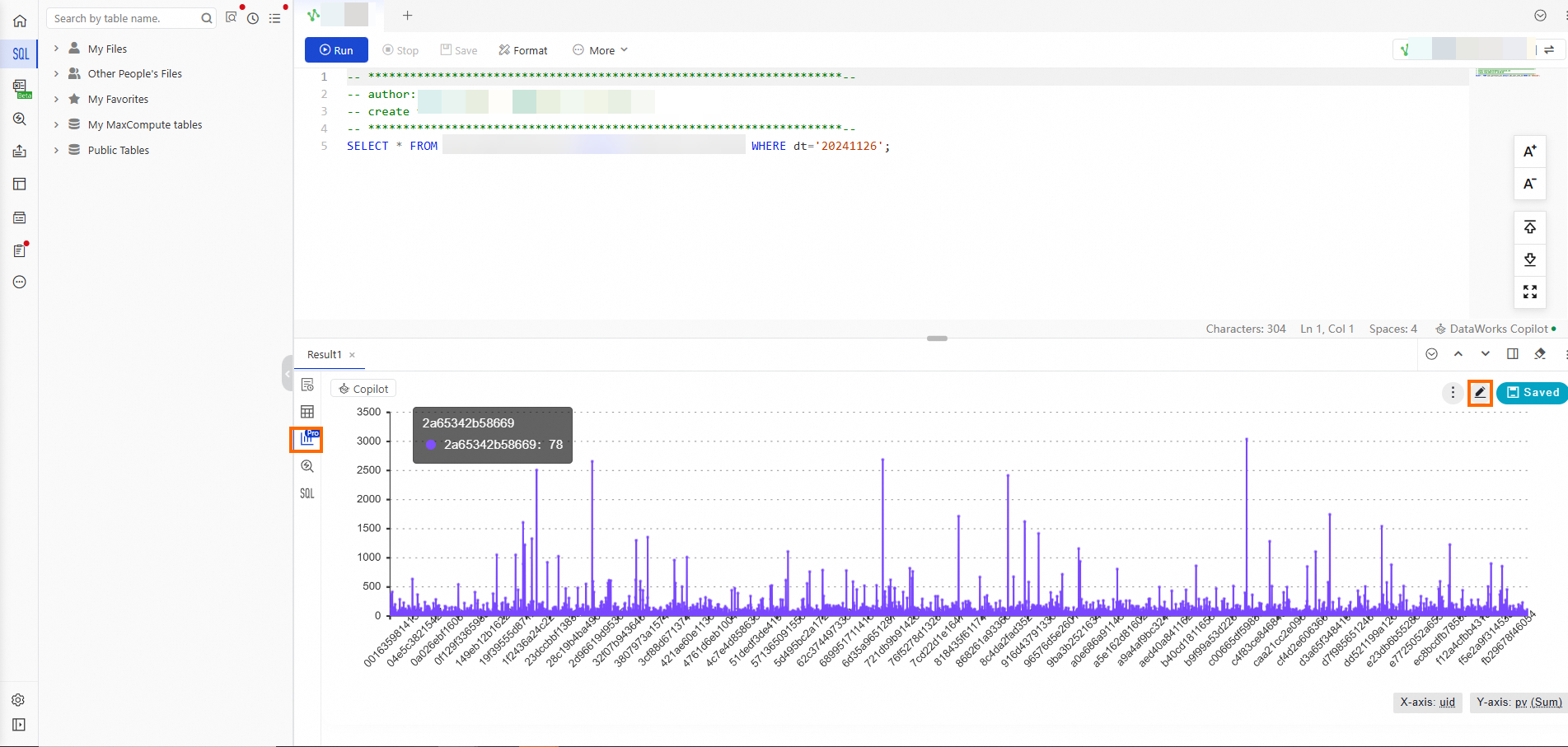
Each chart follows the same workflow: set a title, choose a chart type, assign data fields, and save.
Registered members by province
This chart shows the number of distinct registered members per province as a stacked horizontal bar chart.
Configuration summary:
| Setting | Value |
|---|---|
| Chart type | Stacked Hori Bar Chart |
| X-axis field | uid — Aggregation: Distinct |
| Y-axis field | region |
| X-axis title | Number of Registered Members |
| Y-axis title | Province |
Steps:
Double-click the default chart title and enter a new title.
In the right-side panel, choose Style > Chart morph > Stacked Hori Bar Chart.
In the left-side panel, click Data and assign the fields:
Drag uid to X-axis. From the X-axis drop-down, choose Aggregation > Distinct.
Drag region to Y-axis.
Rename the axis titles:
In the right-side panel, click Style > Global Settings > Detailed > Detailed > Chart Styles.
Click Axis Title for the X-axis and change the title from uid to Number of Registered Members.
Click Axis Title for the Y-axis and change the title from region to Province.
Click Save in the upper-right corner.


Member page views by age
This chart shows the distribution of total page views across age groups as a pie chart.
Configuration summary:
| Setting | Value |
|---|---|
| Chart type | Pie Chart |
| Type field | age_range |
| Value field | pv — Aggregation: Sum |
Steps:
Double-click the default chart title and enter a new title.
In the right-side panel, choose Style > Chart morph > Pie Chart.
In the left-side panel, click Data and assign the fields:
Drag age_range to Type.
Drag pv to Value. From the Value drop-down, choose Aggregation > Sum.
Click Save in the upper-right corner.


Member page views by gender
This chart shows the distribution of total page views by gender as a pie chart.
Configuration summary:
| Setting | Value |
|---|---|
| Chart type | Pie Chart |
| Type field | gender |
| Value field | pv — Aggregation: Sum |
Steps:
Double-click the default chart title and enter a new title.
In the right-side panel, choose Style > Chart morph > Pie Chart.
In the left-side panel, click Data and assign the fields:
Drag gender to Type.
Drag pv to Value. From the Value drop-down, choose Aggregation > Sum.
Click Save in the upper-right corner.


Page views by gender and zodiac sign
This chart breaks down page views by gender and zodiac sign, using gender on the X-axis and zodiac sign as the trace dimension.
Configuration summary:
| Setting | Value |
|---|---|
| Chart type | Pie Chart |
| X-axis field | gender |
| Y-axis field | pv — Aggregation: Sum |
| Trace field | zodiac |
| X-axis title | Gender |
| Y-axis title | Page Views |
Steps:
Double-click the default chart title and enter a new title.
In the right-side panel, choose Style > Chart morph > Pie Chart.
In the left-side panel, click Data and assign the fields:

Drag gender to X-axis.
Drag pv to Y-axis. From the Y-axis drop-down, choose Aggregation > Sum.
Drag zodiac to Trace.
Rename the axis titles:
In the right-side panel, click Style > Global Settings > Chart Information > Detailed > Chart Styles.
Click Axis Title for the X-axis and change the title from gender to Gender.
Click Axis Title for the Y-axis and change the title from pv to Page Views.
Click Save in the upper-right corner.


What's next
After saving your charts, share or revisit them from the DataAnalysis home page.
Click Save in the upper-right corner of any chart to save and share it.

To view saved charts, go to the DataAnalysis page and click the
 icon in the sidebar.