This paper introduces the meaning of each configuration items of China's national boundary.
Chart style
China National Border is a sub-component of the basic flat map 3.0. It supports independent styles, data, and interaction configurations, including the style of the national border and the geo-labeling style. 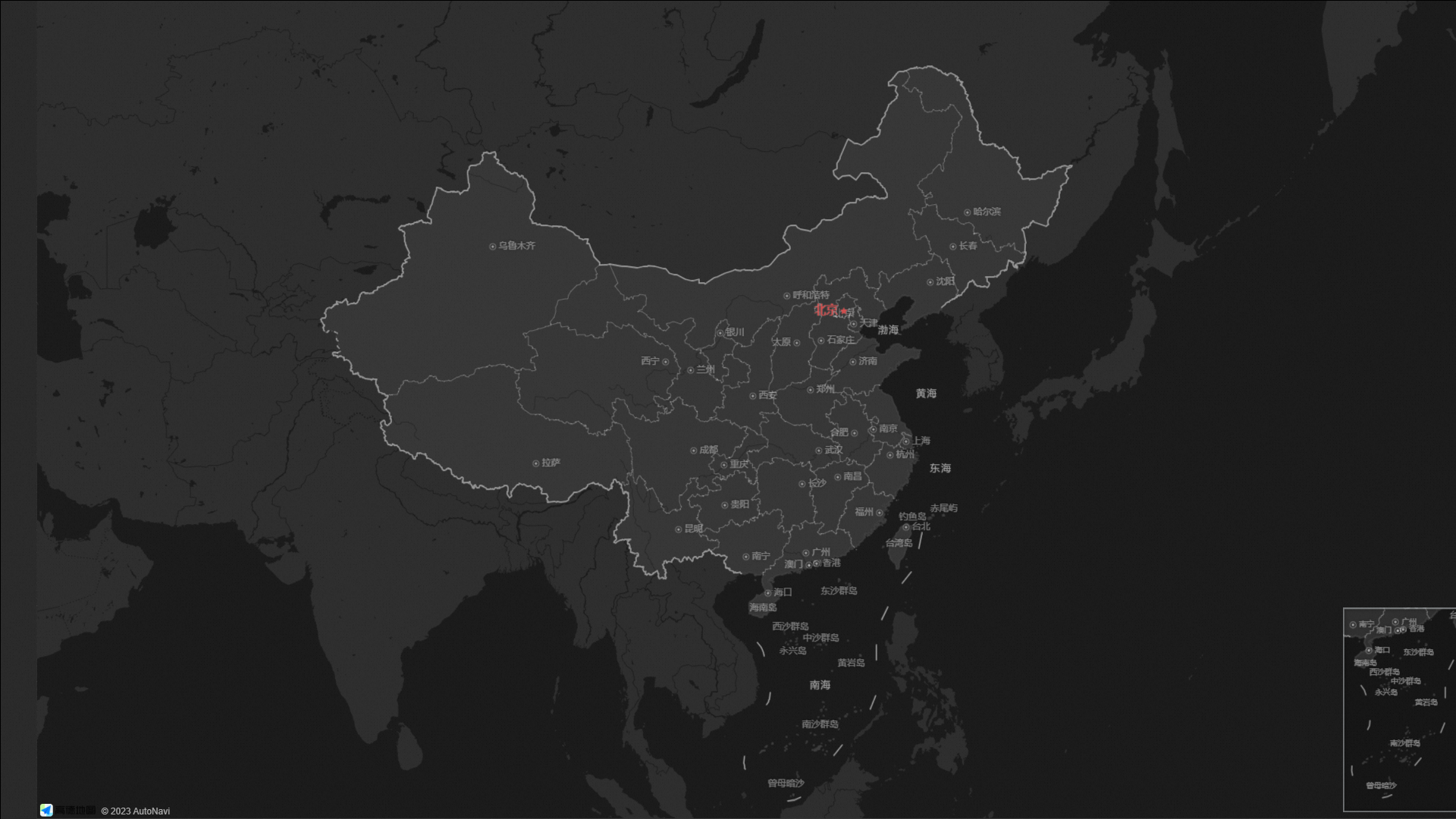
Style Panel 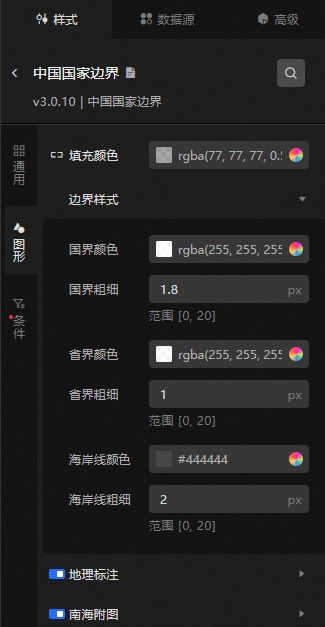
Search Configuration: Click the Search configuration items icon
 in the upper-right corner of the Style panel. In the Search Configuration panel, enter the name of the configuration items that you want to search for and locate the configuration items. Fuzzy match is supported. For more information, see Search configuration items.
 Universal: the universal configuration items for setting China's national borders.
Metric
description
Visible Level
This parameter specifies the visibility level of the national border of China. The national border of China is visible within the specified level range, but not visible outside the level.
Opacity
The opacity value of the Chinese national border. Valid values: 0 to 100. Unit: %. The larger the value, the more opaque the layer.
Graphic: Set the graphic configuration items of China's national boundaries.
Metric
description
Fill Color
For more information about how to configure the color pattern of area blocks in the map of different countries, see Color mapper instructions.
Border Style
Set the style of the border of the China map, including the color and thickness of the national border, the color and thickness of the provincial border, and the color and thickness of the coastline.
Geography
Set the label style of the geographical location in the China map, including the color of the label icon and the style of the text in the icon. Click the
 icon on the left side of Geo Labels to control the display of Geo Labels.
 Attached in Hainan
Set the style of the drawings in Hainan, China, including the land color and ocean color in the Hainan area, the color of the border line of the drawings, the thickness of the border line of the drawings, the distance of the drawings from the rightmost and bottom boundaries of the assembly, and the overall zoom-in ratio of the drawings Value. Click the
icon on the left of Hainan Drawing to control the display of Hainan Drawing. Condition: the description of the condition style.
Conditional Style: Click the
 or
or  icon to add or remove a conditional style. Click the
  or
or  icon to configure the arrangement style of multiple conditional styles. Click the
  icon to copy the selected conditional style configuration and add a conditional style with the same configuration. For more information about how to configure a conditional tree, see Usage notes.
 Fill Color: the color of the Chinese border. Click the
icon to the left of Fill Color to control the color of the Chinese national border.
Data Sources panel 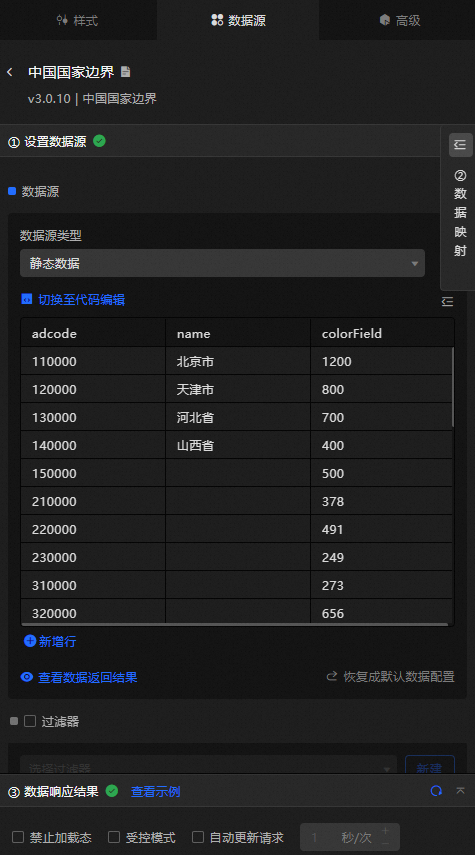
Column | Description |
| The adcode number of the region, which can be obtained by DataV.GeoAtlas. |
| (Optional) The name of the region. |
| (Optional) The value of the region. |
| (Optional) The color mapping field for the region. |
Configure data items | Description |
Data sources | You can use the code editor or visual editor to view the data fields contained in the widget. You can also modify the data type to flexibly configure the component data. |
Data Mapping | If you need to customize chart field configurations, you can set different field mapping content in the Data Mapping module and field mapping these content to the corresponding fields of the widget. This allows you to match data without modifying the fields in the data source. You can also click the |
Configure a filter | Turn on Filter, select an existing data filter or create a data filter, and configure a data filter script to filter data. For more information, see Manage data filters. |
Data Response Result | The Data Response Result section displays widget data in real time. If the data source of the widget changes, this section displays the latest data. If the system response is delayed, you can click the |
Forbid Loading | If you select the check box, you will not see the loaded content during component initialization when you update the component and preview the data kanban. If you select the check box, the opposite is true. By default, the status is deselected. |
Controlled Mode | If you select the check box, the component does not request data in the initialized state, and only requests data by using global variables or the method configured in Blueprint Editor. If you clear the check box, you can use automatic update to request data. By default, the status is deselected. |
Auto Data Request | Select the check box to manually enter the time frequency of polling to set dynamic polling. If you clear the page, the page is not automatically updated. You need to manually refresh the page or use Blueprint Editor and global variable events to trigger a request to update data. |
 icon to configure the field style.
  icon on the right to view the data response result. You can also click the
  icon on the right to obtain the latest data of the widget. You can also click View Example to view an example of the response result of the current component.
 Advanced Panel
This widget does not support interaction events.
Blueprint Interaction
Click the
 icon in the upper-left corner to go to the Blueprint page.
 On the Layer Nodes tab, add the widget to the main canvas.
View blueprint configuration parameters.
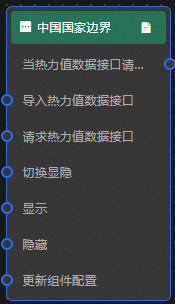
Event
Event
Description
When the heat value data interface request is completed
The event is triggered with the processed JSON data after a data interface request is responded and processed by a filter. For more information about specific data examples, see the Data Response Result section of the Data Source tab in the right-side configuration panel of the canvas editor.
Action
Action
Description
Request Heat Value Interface
This action is performed to request the server data again. The data sent by an upstream data processing node or layer node is used as a parameter. For example, if the API data source is
https://api.testand the data transferred to the Request Heat Value Data Interface is{ id: '1'}, the final request interface ishttps://api.test?id=1.Import heat value data
After data of a widget is processed in accordance with its drawing format, the widget is imported for redrawing. You do not need to request server data again. For more information about specific data examples, see the Data Response Result section of the Data Source tab in the right-side configuration panel of the canvas editor.
Switch Display /Display
Specifies whether to show or hide a widget. No parameters are required.
Display
Display the widget. For more information, see Data example.
{
  "animationType": "",// The animation method. Valid value: fade. If you do not specify this parameter, no animation is generated.
  "animationDuration": 1000,// The animation delay. Unit: ms.
  "animationEasing": ""// animation curve
}
Hide
Hide the component. For more information, see Data example.
{
  "animationType": "",// The animation method. Valid value: fade. If you do not specify this parameter, no animation is generated.
  "animationDuration": 1000,// The animation delay. Unit: ms.
  "animationEasing": ""// animation curve
}
Update component configurations
Style configurations of widgets are dynamically updated. In the Style panel, click Copy Configuration to Clipboard to obtain the configuration data of the widget. After that, change the style field for the data processing node in Blueprint Editor.