A fallback mechanism defines an alternative action when a service call fails. If a microservice fails or becomes unavailable, the mechanism calls a backup service to handle requests, ensuring system stability and availability. For example, if a service endpoint is unavailable, you can use a fallback mechanism to forward requests to a backup service version. This ensures client requests are handled without errors or interruptions. ASM supports this mechanism through the fallback parameter in a VirtualService. This topic describes how to use the fallback mechanism in ASM.
Prerequisites
You have an ASM instance of Enterprise Edition or Ultimate Edition, version 1.17.2.22 or later. For more information, see Create an ASM instance.
NoteIf your ASM instance is earlier than version 1.17, update the instance to 1.17.2.22 or later, or submit a ticket for technical support. For more information about how to update an instance, see Upgrade an ASM instance.
An ACK cluster has been added to the ASM instance. For more information, see Add a cluster to an ASM instance.
The Bookinfo sample is deployed. For more information, see Deploy an application in a cluster associated with an ASM instance.
The sidecar version on the data plane is 1.17 or later.
NoteYou can view the sidecar version of each business pod on the Instances Status page on the ASM console. For more information, see Upgrade management.
Configuration
This topic uses the reviews service from the Bookinfo sample application as an example. When the productpage service accesses the v1, v2, and v3 versions of the reviews service, if the v3 version is unavailable, the fallback mechanism routes requests to the v2 version. This prevents the service from returning a 503 error.
You can click Configuration file to download the YAML files used in this topic.
Step 1: Access the Bookinfo sample
Create a file named
reviews.yamlwith the following content to declare thev1,v2, andv3versions of thereviewsservice.apiVersion: networking.istio.io/v1alpha3 kind: DestinationRule metadata: name: reviews spec: host: reviews subsets: - name: v1 labels: version: v1 - name: v2 labels: version: v2 - name: v3 labels: version: v3In your KubeConfig environment, run the following command to deploy the DestinationRule.
kubectl apply -f reviews.yamlUse one of the following methods to obtain the IP address of the ingress gateway.
Method 1: Run the following command.
kubectl get svc -n istio-system istio-ingressgateway -o jsonpath='{.status.loadBalancer.ingress[0].ip}'Method 2: Obtain the IP address of the ingress gateway from the Ingress Gateway page on the ASM console. For more information, see Obtain the endpoint of an ASM gateway.
In a browser, visit
http://${YourGatewayIp}/productpage.${YourGatewayIp}is the gateway IP that you obtained in the previous step. You can identify the version by the value of Reviews served by or the stars. Version v1 has no stars, version v2 has black stars, and version v3 has red stars.For example, the value reviews-v2 indicates version
v2, which displays black stars.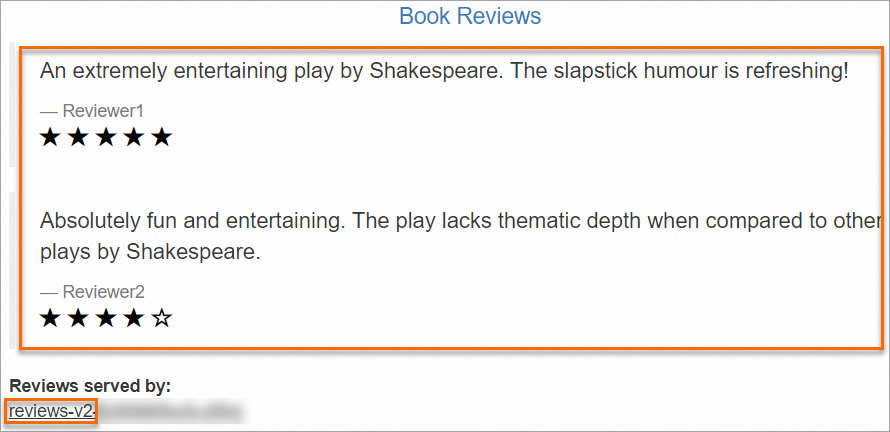
Refresh the page multiple times. Requests are now load-balanced across the
v1,v2, andv3versions of thereviewsservice.
Step 2: Define a route and fallback rule
Create a file named
reviews-route-fallback-sample1.yamlwith the following content.apiVersion: networking.istio.io/v1beta1 kind: VirtualService metadata: name: reviews-route namespace: default spec: hosts: - reviews http: - route: - destination: host: reviews subset: v3 fallback: target: host: reviews subset: v2In your KubeConfig environment for the ASM instance, run the following command to deploy the route and fallback rule for the
reviewsservice.kubectl apply -f reviews-route-fallback-sample1.yamlIn a web browser, visit
http://${YourGatewayIp}/productpageand keep refreshing the page.You will see that requests are consistently routed to the
v3version of thereviewsservice. After refreshing, the page shows that the book review service is provided by reviews-v3, and the review includes red star ratings.Simulate a failure of the
reviews-v3version by scaling its replicas to 0:kubectl scale deployment reviews-v3 --replicas=0In your browser, visit
http://${YourGatewayIp}/productpageand repeatedly refresh the page.You will see that requests correctly fall back to the
v2version of thereviewsservice. You can verify that a fallback occurred by adding fallback-related fields to the custom access log format and then checking the logs.
Step 3: Configure fallback with weighted routing
Run the following command to make the
reviews-v3version available again.kubectl scale deployment reviews-v3 --replicas=1Create a file named
reviews-route-fallback-sample2.yamlwith the following content to modify thereviews-routedefinition.apiVersion: networking.istio.io/v1beta1 kind: VirtualService metadata: name: reviews-route namespace: default spec: hosts: - reviews http: - route: - destination: host: reviews subset: v3 fallback: target: host: reviews subset: v2 weight: 50 - destination: host: reviews subset: v2 fallback: target: host: reviews subset: v1 weight: 50 retries: attempts: 0Run the following command to deploy the new route and fallback rule for the
reviewsservice.kubectl apply -f reviews-route-fallback-sample2.yamlIn your browser, visit
http://${YourGatewayIp}/productpageand repeatedly refresh the page.You will see that requests are routed to the
v2andv3versions of thereviewsservice at a 50:50 ratio. In this example, retries are disabled to make the result clearer.Run the following command to scale the replicas of
v3to 0 and verify that its fallback rule works as expected.kubectl scale deployment reviews-v3 --replicas=0Refresh the
productpagepage multiple times. You will see that requests are consistently routed to thev2version, which is the expected behavior.Run the following command to scale the replicas of
v2to 0.kubectl scale deployment reviews-v2 --replicas=0If you repeatedly refresh the productpage page, you will find that it fails to access the reviews service about 50% of the time. The other 50% of the time, requests are sent to the v2 version. Because the v2 version is unhealthy, these requests fall back to the v1 version. After you run the command and access the BookInfo application's product page, the reviews section displays the red error title Error fetching product reviews! and the message
Sorry, product reviews are currently unavailable for this book.. This indicates that the product reviews service becomes unavailable after the reviews-v2 replicas are scaled down to 0.Run the following command to view the logs.
kubectl logs -f deployment/productpage-v1 -c istio-proxy --tail=10Expected output:
{
    "authority":"reviews:9080",
    "authority_for":"reviews:9080",
    "bytes_received":"0",
    "bytes_sent":"19",
    "downstream_local_address":"192.168.255.46:9080",
    "downstream_remote_address":"172.16.0.252:47738",
    "duration":"0",
    "fallback_path":"outbound|9080|v3|reviews.default.svc.cluster.local:outbound|9080|v2|reviews.default.svc.cluster.local",
    "fallback_final_cluster_name":"-",
    "fallback_result":"fallback cluster is unhealthy",
    "istio_policy_status":"-",
    "method":"GET",
    "path":"/reviews/0",
    "protocol":"HTTP/1.1",
    "request_id":"b207a764-b6d7-4ef8-bc71-59f264c3****",
    "requested_server_name":"-",
    "response_code":"503",
    "response_flags":"UH",
    "route_name":"-",
    "start_time":"2023-05-30T07:32:08.999Z",
    "trace_id":"a40c32a7b2cf****",
    "upstream_cluster":"outbound|9080|v3|reviews.default.svc.cluster.local",
    "upstream_host":"-",
    "upstream_local_address":"-",
    "upstream_service_time":"-",
    "upstream_transport_failure_reason":"-",
    "user_agent":"Mozilla/5.0 (Macintosh; Intel Mac OS X 10_15_7) AppleWebKit/537.36 (KHTML, like Gecko) Chrome/113.0.X.X Safari/537.36",
    "x_forwarded_for":"-"
}
You can see 503 logs for
productpage-v1. Based on thereviews-routeweighted routing configuration, 50% of requests fromproductpageare routed to the v3 version of the reviews service. Because the v3 version is unavailable, the sidecar (istio-proxy) attempts to fall back from v3 to the v2 version based on a fallback rule. Because the v2 version is also unhealthy, the request is sent to the v3 version. You can confirm this by checking the"upstream_cluster":"outbound|9080|v3|reviews.default.svc.cluster.local"field.