This topic recommends a cost-governance workflow for common scenarios and summarizes cost optimization strategies for mainstream application types. Because strategies differ by application type and business architecture, it describes the cost optimization process and typical optimization scenarios in ACK.
Cost optimization procedures
ACK cost optimization follows FinOps principles:
-
Set financial units and governance cycles for your business.
-
Set cost baselines for your business.
-
Design cost optimization solutions based on the following figure.
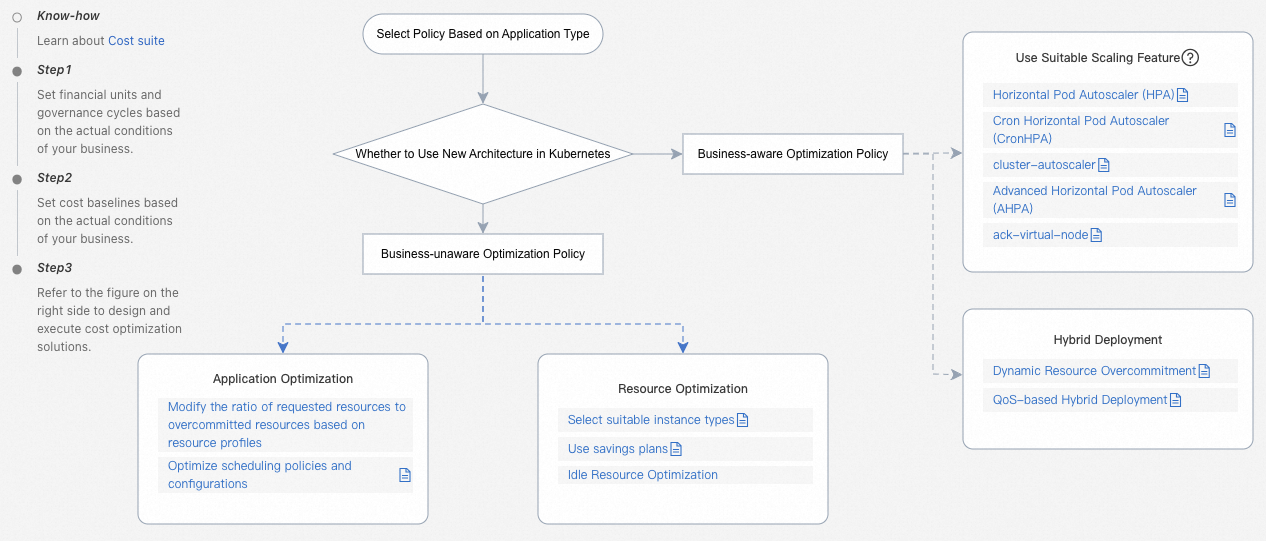
Common scenarios
Each cloud-native phase presents different cost optimization opportunities.
Migration of core infrastructure to the cloud
Before migrating applications, migrate or reconfigure your architecture for cloud-native technologies. Budget and cost governance are critical in this phase:
-
Use cost insights to assess your business system capacity.
-
Select appropriate instance types for infrastructure resources.
-
Reduce costs for essential infrastructure with savings plans.
Migration of applications to the cloud
During cloud-native transformation, use Kubernetes features such as auto scaling and hybrid deployment to improve availability and stability. Kubernetes scales deployment units in response to workload changes, automatically adjusting resource requests based on business needs.
Reliability on the cloud
After adopting a cloud-native architecture, choose cost governance strategies based on your scenario:
-
Periodic workload fluctuations
When workloads follow predictable patterns, such as daily traffic peaks at 09:00 and 17:00, use cost insights to monitor trends and scale accordingly to maintain availability and reduce costs.
-
Frequent application iterations
Emerging businesses iterate applications frequently, making accurate resource sizing difficult early on. Use cost insights to monitor resource costs and resource profiling to choose appropriate resource specifications.