Firm T is a pioneer in China’s shared power-bank sector. Since launching the country’s first public charging cabinet in 2014, it has become one of the “Big Four” brands, once holding 36 % of the national market. The company operates more than 2 million devices across 290+ cities, serving shopping malls, street kiosks and franchise partners that together generate millions of rentals each day. With competition in the ultra-convenient “last-metre” market intensifying, its leadership recognised that real-time, trusted data—not device density alone—would decide who wins the next phase of growth.
“Previously, once a dashboard was built, the entire analytics chain simply stopped there. What Quick BI sparks in my imagination is the ability for every employee in the company to enjoy continuous self-service analytics.”
—— CTO of Firm T

Rapid expansion left Firm T’s data scattered across legacy systems, forcing analysts to stitch together static spreadsheets with inconsistent metrics. Ad-hoc reports could not keep pace with frontline requests triggered by daily traffic swings, and BI developers were mired in repetitive custom builds. Thousands of franchise operators lacked timely insights on mobile, while maintaining multi-level access control manually was untenable. These shortcomings slowed decisions, raised costs and eroded confidence in data just as competitive pressure in the shared-power-bank market intensified.

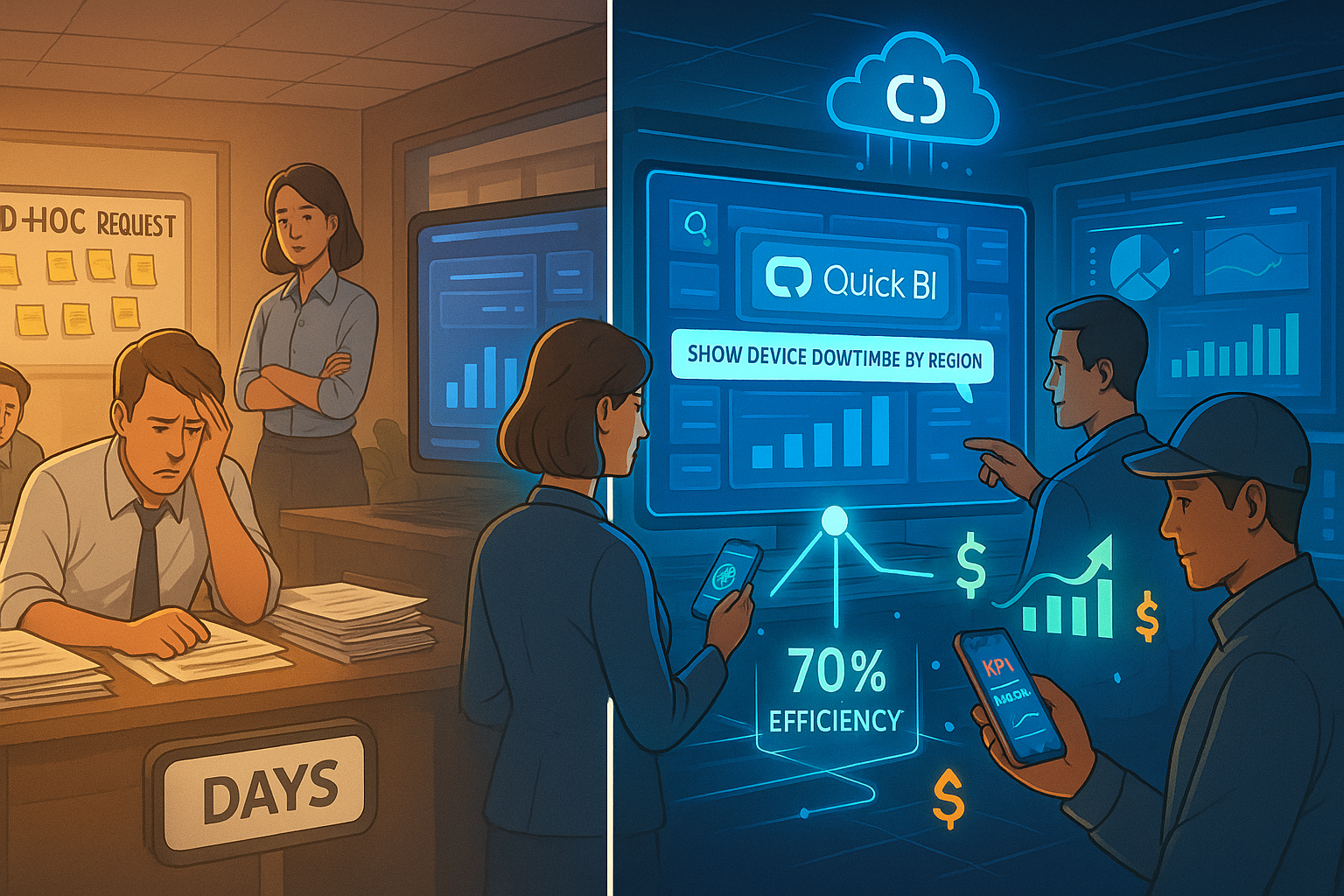
Firm T partnered with Alibaba Cloud to build a real-time warehouse and deploy Quick BI as the unified analytics layer. Through intuitive modelling and ready-made templates, business teams now assemble dashboards in minutes. Quick BI’s NLQ Copilot converts natural-language questions into charts, empowering non-technical staff. Role-, column- and row-level security is defined once in a hierarchical manager, synchronised automatically with HR records whenever employees join, move or depart.

The project ran in agile three-week sprints: first ingesting data from charging cabinets, CRM and finance; next, co-designing more than 200 domain dashboards with marketing, franchise and operations units; and finally releasing a mobile app that serves interactive reports via WeCom and lightweight browsers. Scenario-based video tutorials and usage-log monitoring drove continuous adoption and optimisation across headquarters and field teams.
End-to-end analysis cycles shrank from weeks to days, and collaboration efficiency between data and business units rose by roughly 70 %. Today 70–80 % of employees log in to Quick BI for self-service exploration, while frontline staff act on KPI alerts pushed directly to their phones. Ad-hoc report tickets to the BI team have fallen sharply, freeing analysts for higher-value modelling. With unified metrics and live dashboards, managers quickly spot under-performing devices, trigger maintenance orders and refine franchise expansion plans, translating data agility into faster revenue growth and tighter cost control.
How 2Dfire Transformed Restaurant Analytics with Cloud-Native BI
Alibaba Cloud Celebrates 10 Years in Singapore with New Data Centers and AI Global Competency Center

1,546 posts | 519 followers
FollowAlibaba Cloud Project Hub - November 7, 2025
Alibaba Cloud Community - June 17, 2025
Alibaba Cloud Native Community - March 30, 2026
Alibaba Clouder - December 21, 2020
Alibaba Cloud Community - July 11, 2025
Alibaba Cloud Community - June 6, 2025
1,546 posts | 519 followers
Follow Big Data Consulting Services for Retail Solution
Alibaba Cloud experts provide retailers with a lightweight and customized big data consulting service to help you assess your big data maturity and plan your big data journey.
Learn More QwenWork
QwenWork is dedicated to helping employees strengthen their professional competitiveness in the AI era and to enabling enterprises to improve organizational effectiveness.
Learn More Token Plan
Build more, spend less. One plan, every modality.
Learn More
Alibaba Cloud Model Studio
A one-stop generative AI platform to build intelligent applications that understand your business, based on Qwen model series such as Qwen-Max and other popular models
Learn MoreMore Posts by Alibaba Cloud Community

