2Dfire is a fast-growing Chinese SaaS provider that equips tens of thousands of restaurants with cloud point-of-sale, QR ordering, membership and supply-chain apps. Born in the mobile-payment boom, it helps small eateries digitalise every touchpoint—from kitchen tickets to loyalty rewards—via handheld 4G devices and cloud dashboards. As China’s catering sector tightened after the pandemic, 2Dfire pivoted from pure POS to a broader data-intelligence strategy, launching a Big-Data Center to convert billions of transactions into real-time insight for head-office managers, franchisees and suppliers. To realise that goal, the firm needed an enterprise-grade BI layer that was secure, low-code and restaurant-friendly.
“After completing a POC we chose Quick BI—the cloud-native tool won the highest market recognition for usability, open integration and security, enabling us to deliver data value to clients with minimal engineering effort.”
—— Ding Lu, Director of Big Data Department

Before Quick BI, 2Dfire’s analysts juggled four siloed internal platforms and scattered MySQL clusters. Dashboard requests demanded hard-coded SQL and manual Excel stitching, stretching a 30-person team and inflating costs. Complex ad-hoc reports for chain headquarters took days, while real-time store alerts were impossible. Data-security risks grew as exports moved between departments, and bespoke visuals for key accounts proved unsustainable. The result: mounting backlogs, sluggish decisions and customer frustration during peak dining hours.
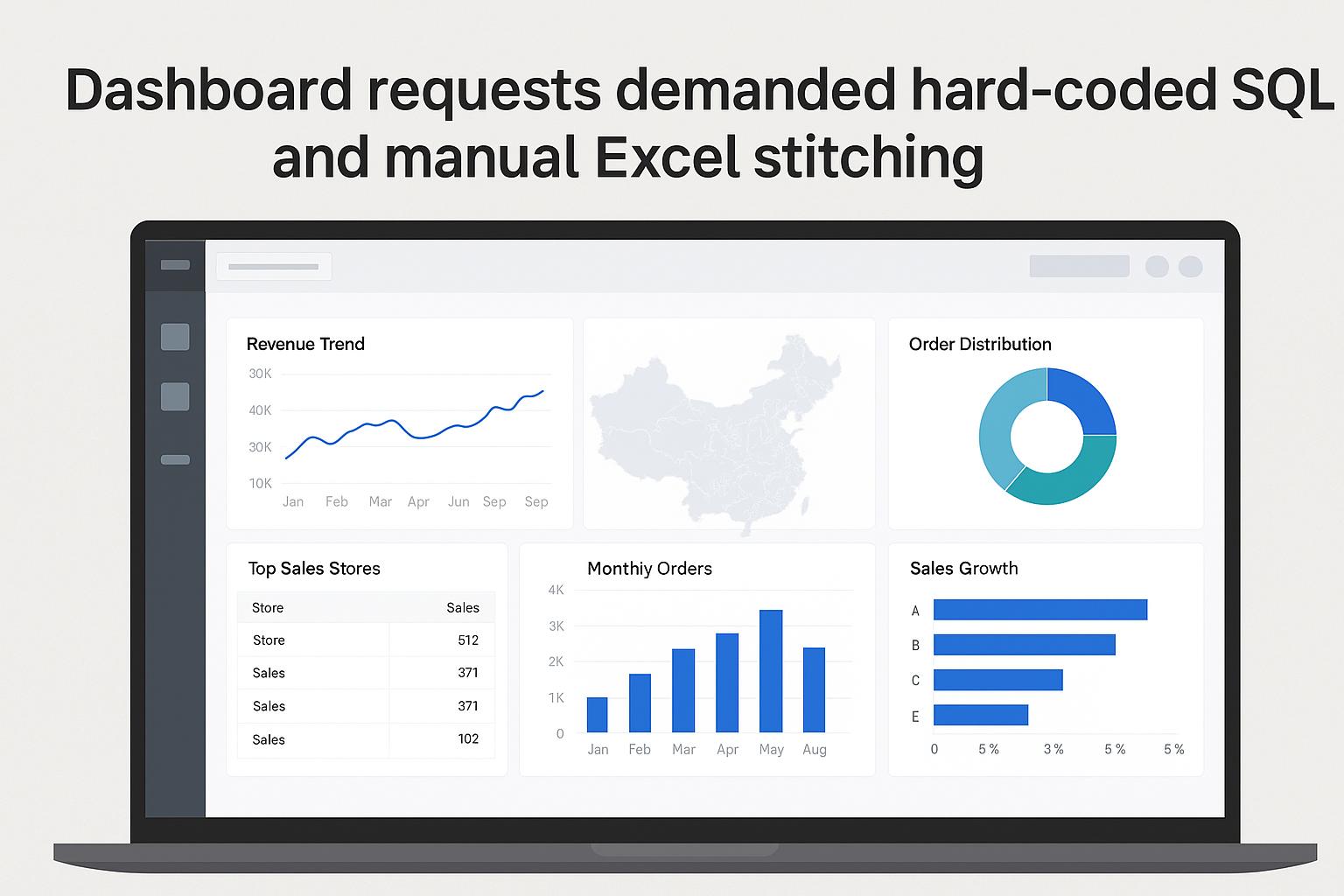
2Dfire first consolidated order, SKU, membership and IoT data into a MaxCompute lakehouse, then deployed Quick BI as the single analytics front-end. Restaurant-ready dashboard templates, a drag-and-drop canvas and 400-plus Excel-style functions let business teams build reports without SQL. Row-level security and role-based access protected turnover figures, while the SaaS embedding SDK surfaced white-label analytics inside merchant portals and mobile apps.
AI modules deepened value: an NLP work-order classifier analysed ticket text to recommend fixes, and Auto-Forecast widgets used gradient boosting to predict daily covers, guiding prep and staffing. Implementation followed three agile sprints—data modelling, security hardening, business rollout—each ending with stakeholder demos for rapid feedback. Open REST APIs synchronised account rights so report edits, deletions and theme changes propagated instantly across all tenant environments.

Within six months 2Dfire slashed big-data infrastructure costs by over CNY 1 million annually and trimmed its BI team from 30 to 12 engineers. Automated dashboards cut report turnaround from five days to two hours; the NLP classifier boosted work-order resolution 70 %. Restaurant clients now access self-service sales and marketing insights, driving a 25 % rise in paid analytics subscriptions. Embedded security controls eliminated unauthorised data exports, satisfying audits and reinforcing merchant trust. Quick BI turned data from an operational bottleneck into a scalable revenue engine, positioning 2Dfire as a digital frontrunner in China’s catering industry.

Winning the Last-Metre Race: How a Shared Charging Giant Scaled with Quick BI

1,546 posts | 518 followers
FollowAlibaba Cloud Community - May 25, 2026
Anna cloud communication - January 16, 2025
Alibaba Cloud Community - June 1, 2026
Alibaba Cloud Community - April 30, 2026
Alibaba Cloud Community - June 24, 2025
Alibaba Cloud Project Hub - January 19, 2021
1,546 posts | 518 followers
Follow Big Data Consulting Services for Retail Solution
Alibaba Cloud experts provide retailers with a lightweight and customized big data consulting service to help you assess your big data maturity and plan your big data journey.
Learn More QwenWork
QwenWork is dedicated to helping employees strengthen their professional competitiveness in the AI era and to enabling enterprises to improve organizational effectiveness.
Learn More Token Plan
Build more, spend less. One plan, every modality.
Learn More
Alibaba Cloud Model Studio
A one-stop generative AI platform to build intelligent applications that understand your business, based on Qwen model series such as Qwen-Max and other popular models
Learn MoreMore Posts by Alibaba Cloud Community

