Let’s be honest: enterprise AI projects rarely fail because the language model can’t write a convincing essay.
They fail because the solution doesn’t fit the actual workflow, hits a data wall, triggers a security audit, or simply doesn’t move the business needle.
Getting AI out of the sandbox and into production requires a specific kind of teamwork. Enter the dynamic duo of enterprise AI deployment: the Solutions Architect (SA) and the Forward Deployed Engineer (FDE).
While their day-to-day tasks look different, they share one goal: turning raw AI capabilities into systems that actually work in the messy real world.
To see how this partnership plays out, let’s look at a practical scenario: A Malaysian university wants to build a multilingual AI assistant using Alibaba Cloud’s Qwen models to help students, save lecturers time, and automate admin queries—without leaking sensitive data or blowing up the IT budget.
Here is the exact playbook an SA and an FDE use to tackle this together.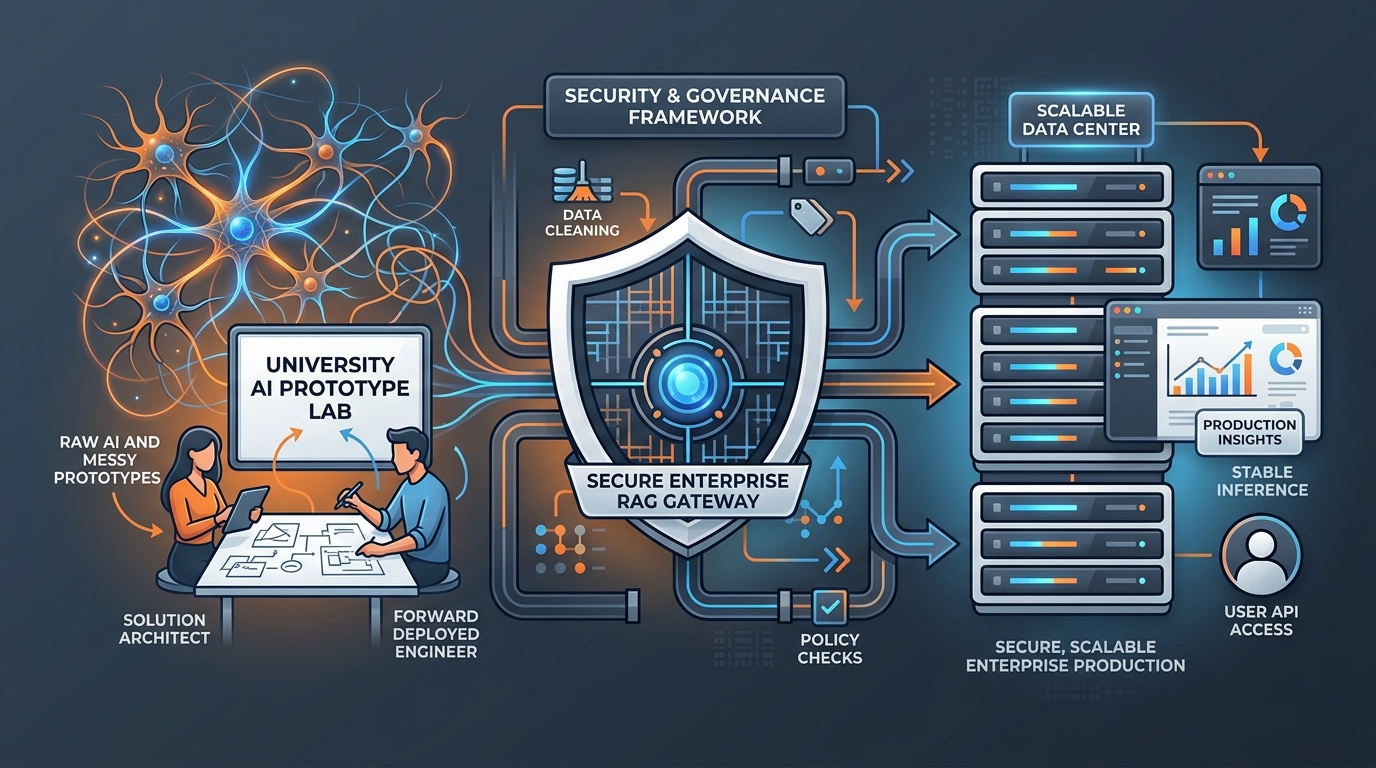
The Architect Draws the Map; The FDE Drives the Car
An AI Solutions Architect looks way past the model itself. Their job starts with the business problem and ends with a technical blueprint that is secure, scalable, and economically viable.
For our university, the SA is sitting down with the CIO, the registrar, and IT admins, asking the hard questions:
Based on those answers, the SA evaluates the right Qwen models, designs the Retrieval-Augmented Generation (RAG) pipeline, sets up access controls, and plans for scale. They also plan for failure: What happens if the model hallucinates a grade? What if a cloud service hiccups? The SA makes sure the overall approach is defensible.
The Forward Deployed Engineer (FDE) is boots on the ground. They don’t just hand over a diagram and walk away; they work directly in the customer’s environment to build, break, and fix the solution.
The SA might say, "The assistant should answer questions using the university's rulebook."
The FDE has to figure out how. Can we actually extract text from those messy, multi-column PDFs? Is the retrieval system pulling the right clauses, or is it getting confused by outdated metadata? If the system pulls the wrong document, the FDE digs in. Is it a chunking issue? A bad embedding model?
The Short Version: The SA defines the technical direction. The FDE turns that direction into working code and uses real-world friction to refine the design.
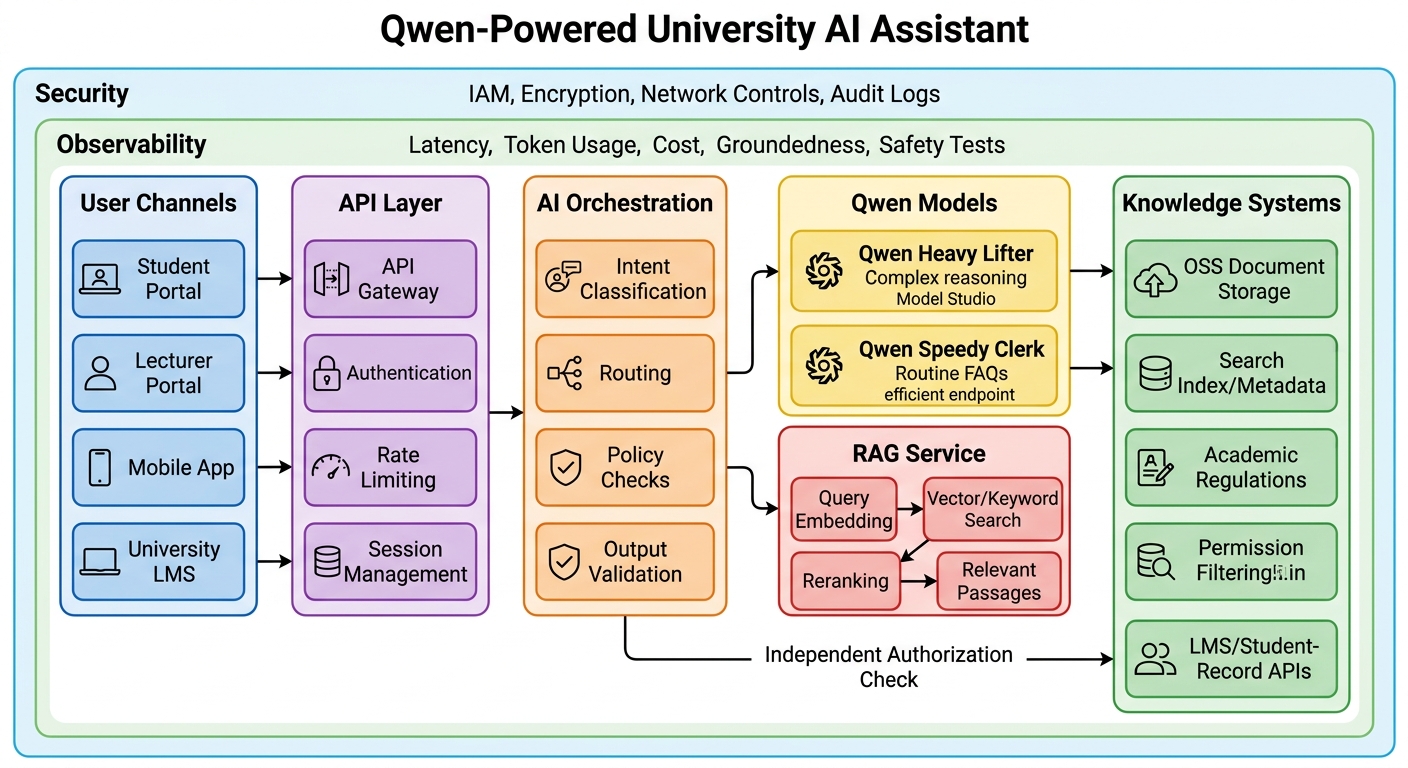
The Blueprint: A Reference Architecture for Qwen-Powered AI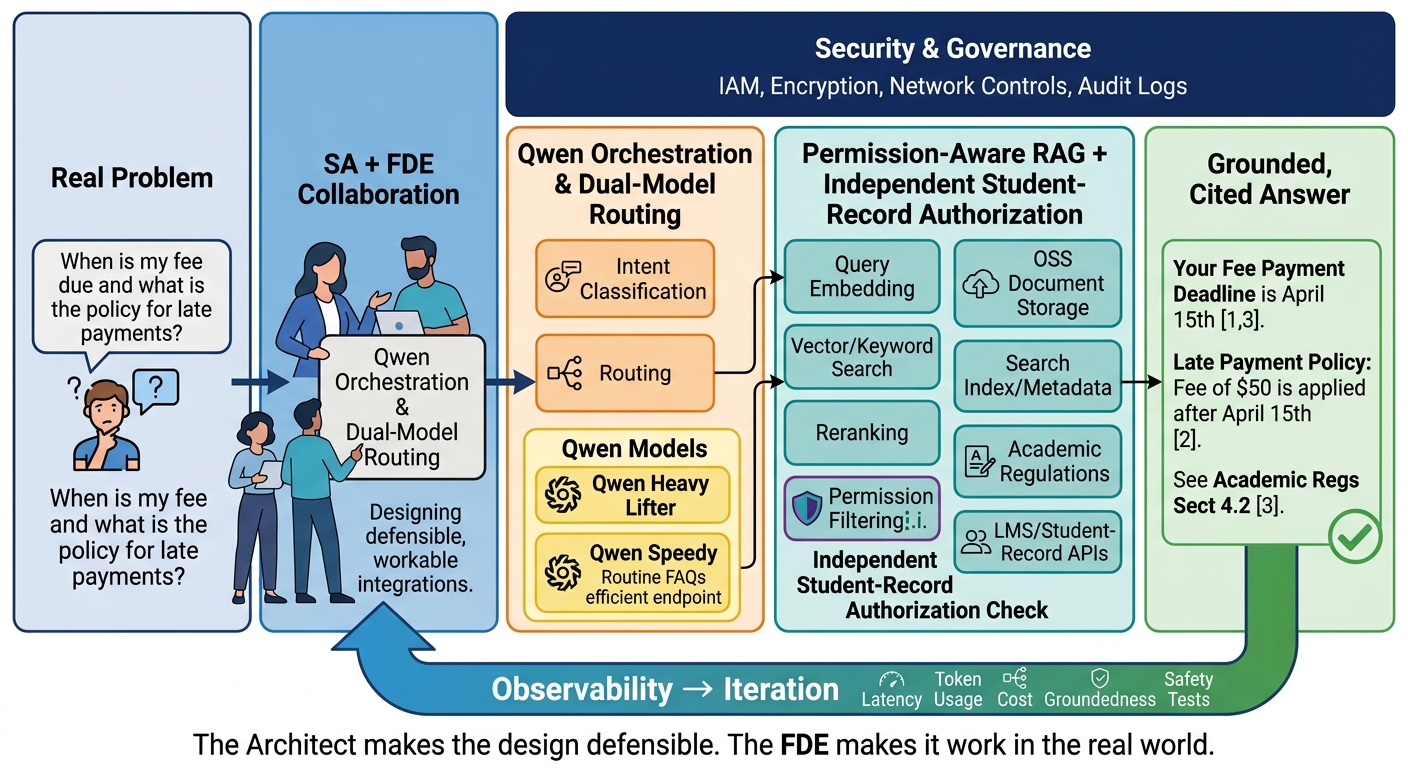
To make this concrete, here is a logical reference architecture showing how the university's apps, Qwen, the RAG pipeline, and security controls actually fit together. (Bookmark this for your next enterprise AI design session).
The Speedy Clerk (4B): Handles routine FAQs, classification, and summaries using a smaller, benchmarked model to save costs.
(The orchestration service dynamically routes to the right model based on complexity, latency, and budget).
Architecture Note: This is a logical reference architecture. Exact services, model IDs, supported regions, and network boundaries must always be validated during actual implementation.
How the SA and FDE Tackle This Stack
| Architecture Layer | Solutions Architect (The Strategist) | Forward Deployed Engineer (The Builder) |
|---|---|---|
| User Channels & APIs | Defines integration and identity patterns | Connects the portal and LMS, debugs auth flows |
| Orchestration & Qwen | Sets model-selection and routing strategy | Implements API calls, retries, and output validation |
| RAG & Data | Defines retrieval, permission, and governance design | Builds ingestion, indexing, retrieval, and citations |
| Security | Defines security boundaries and acceptance criteria | Implements controls and actively tests access restrictions |
| Observability | Defines production SLOs and cost limits | Instruments metrics, analyzes failures, and optimizes |
Crucial Design Decision: The student-record API must enforce authorization independently of Qwen. The model should never receive unrestricted access to student data, and it should never be allowed to decide its own permissions. The application layer handles the keys; the LLM just handles the text.
Where the Rubber Meets the Road: A Real-World Query
Here’s a perfect example of why you need both roles. A student asks the bot:
"I failed my prerequisite module. Am I eligible to register for next semester's exam?"
It sounds simple, but answering it correctly is a minefield. The answer depends on general academic regulations, specific program rules, exceptions, and the student’s actual transcript.
The SA defines the boundaries: The bot must use authoritative regulations, it cannot guess personal eligibility, and it must strictly respect data privacy.
The FDE builds the workflow:
The system retrieves the general academic regulations via the RAG pipeline.
Qwen drafts a response based on those rules, complete with citations.
Crucially, if the system needs to check the student's specific transcript, the app calls an authorized backend service, but only after verifying the student's identity and permissions at the API gateway.
If the data is ambiguous, the bot doesn’t guess. It explains the limitation and routes the student to the registrar.
This highlights a golden rule of enterprise AI: The language model generates the text, but the surrounding application enforces the business rules and permissions.
Shipping is Just the Beginning
A demo that works perfectly on five curated questions is not ready for production. Production means dealing with ambiguous queries, missing info, mixed-language prompts, and users trying to jailbreak the bot.
Before going live, the FDE runs the gauntlet. They test edge cases, measure latency, and track token consumption. The SA checks if the results meet the business and security targets.
They might set baseline goals like:
If the bot gives a wrong answer, the team has to figure out why. Did the LLM hallucinate, or did the RAG pipeline retrieve an outdated policy from 2019? You can't just "fix the prompt" if your retrieval is broken.
Once it passes the tests, the SA finalizes the production design (capacity, disaster recovery, cost management), and the FDE wires up the automated tests and observability tools. It’s a continuous loop of improvement.
Why Qwen for This Stack?
Why look at Alibaba Cloud’s Qwen for this scenario?
Practically speaking, Qwen offers a versatile family of models with varying sizes. This is perfect for the SA's goal of routing complex queries to heavier models and simple ones to lighter, cheaper models. More importantly for a diverse student body, Qwen has exceptionally strong multilingual capabilities, handling English, Bahasa Malaysia, and Chinese natively and fluently.
If the university is already running on Alibaba Cloud, using Qwen via Model Studio or PAI (Platform for AI) drastically simplifies data governance, security, and infrastructure integration.
The Pragmatic Advice: Don't just pick a model because of the logo. The FDE needs to benchmark Qwen against other options using the university's actual documents and test cases. The "best" model is simply the one that hits your quality, latency, and cost targets without compromising on security.
The Bottom Line
Enterprise AI is so much more than wrapping an LLM in a chat UI. It’s about understanding the business, integrating messy data, enforcing strict security, and obsessing over the details.
The Solutions Architect ensures the vision is secure, scalable, and makes financial sense. The Forward Deployed Engineer ensures it actually works when a student asks a tricky question in mixed Mandarin and English at 2 AM.
At the end of the day, the Architect makes the design defensible, and the FDE makes it work in the real world. Together, they don't just build impressive AI demos—they build systems that deliver actual, measurable value.
Let’s Chat in the Comments!
Have you been building enterprise AI with Qwen? What’s the biggest hurdle you’ve faced moving from prototype to production? Drop your thoughts below, or share this article with your engineering team!
ferdinjoe - September 28, 2026
dahara1 - July 22, 2026
Alibaba Cloud Big Data and AI - June 18, 2026
plavookac - February 13, 2026
Alibaba Cloud Community - May 24, 2024
Alibaba Cloud Native Community - March 19, 2026
 Platform For AI
A platform that provides enterprise-level data modeling services based on machine learning algorithms to quickly meet your needs for data-driven operations.
Learn More Qoder
From Assisted to Autonomous — Adapting to Every Programming Need
Learn More Alibaba Cloud for Generative AI
Accelerate innovation with generative AI to create new business success
Learn More Qwen
Full-range, open-source, multimodal, and multi-functional
Learn MoreMore Posts by ferdinjoe


