Seven Showcases at Alibaba Cloud: Exploring AI-Native R&D Organization in Practice
AI is rewriting the software R&D process, and it has pushed R&D organizations to the frontier of change. As a result, the term “AI-native organization” has become a hot topic — but hype is not the reason we are speaking up now.
The practice carried out by the Alibaba Cloud CTO Line, the group's product and R&D organization, around the business North Star has already produced some partial results, and is beginning to expose harder questions: once AI-native practice enters deep water, single-point efficiency gains and local optimization are far from enough. An R&D team is never an isolated system — it is embedded in the business, the organization, and industry collaboration. Rather than wait for settled answers, we decided to share real progress, confusion, and open questions while the exploration is still under way. We hope to validate and inspire each other with more R&D organizations, and to help turn “AI-native R&D organization” from an attention-grabbing concept into a new organizational paradigm.
This article offers a brief recap of the Apsara Conference forum “AI-Native R&D Organization,” summarizing some of the most interesting viewpoints and useful practices. Given space constraints, it reviews the forum from an organizational perspective; the seven implementation practices will each be covered in separate articles.
Interim Observations from a Large R&D Organization's AI-Native Practice
Tang Hong, Vice President of Product & Engineering, Alibaba Cloud, reviewed the technology changes of recent years, starting with the pace of change. He walked through a timeline: at the end of 2022, ChatGPT showed everyone that general-purpose pre-trained models could solve many problems, without building a separate narrow model for every domain. After reasoning models emerged, models could do more than converse — they began to think longer and help people solve actual problems. Then, as tools and memory were connected, Agents began to do real work: analyzing goals, making plans, executing tasks, reading tool feedback, and then correcting and iterating based on the results.
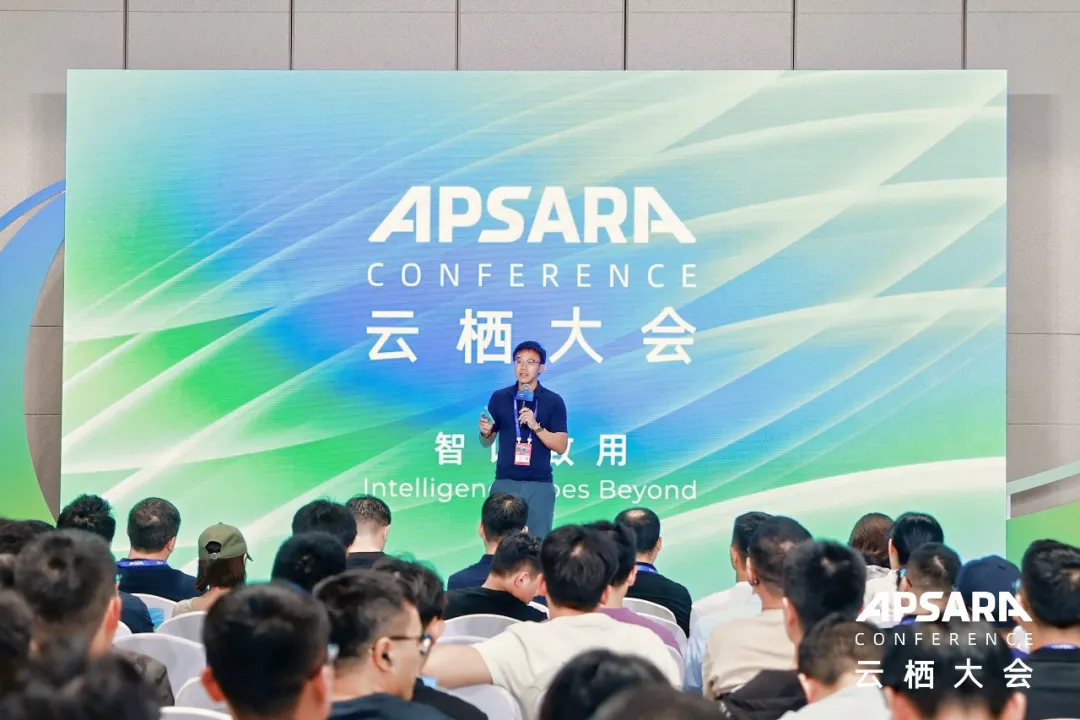
(Photo: Tang Hong, Vice President of Product & Engineering, Alibaba Cloud)
Tang Hong summarized today's agentic computing paradigm as “model + harness + context”: the model is responsible for understanding, judgment, and real-time decisions; the context provides a comprehensive, unified, and continuously updated picture; the harness is responsible for the Agent's autonomous operation and continuous evolution. As this paradigm becomes clearer, model capabilities continue to improve, and compute becomes cheaper, then Agents will enter every part of production, step by step. The question then becomes: How do we make good use of Agent capabilities and turn potential productivity into reality?
Over the past three months, the Alibaba Cloud CTO Line launched a round of AI Native exploration aimed at R&D organizations. Tang Hong stressed that this exploration was not about solving one specific technical problem, nor about creating a particular product, but about the organization itself — how to use AI to solve organizational and collaboration problems and create real value.
Based on this round of exploration, he offered three judgments. First, the real watershed is when Agents enter the production chain. Second, AI Native is not simply about cost reduction — true, “cost reduction comes first,” but what matters more is a leap to a new competitive dimension. Third, AI Native will go through three stages. The first is tool-native: individuals become proficient with Agent tools. The second is workflow-native: tasks that used to take many steps are connected end to end by Agents wherever possible. The long-term goal is organization-native: namely, the entire organization works in an AI-native way. Tang Hong also stressed that technology is developing fast and that his team is still exploring. They would not claim that the forum offered standard answers; instead, they preferred to take the chance to challenge and validate one another, and to spark more ideas.
Cai Liang, Head of Organization Development, CTO Organization, explained the starting point of this exploration from an organizational perspective. He mentioned the early typing pools and punch-card rooms: in every era, organization and management responded to the technical conditions and capability supply at the time. In his view, technological change shifts what capabilities are scarce, and the division of labor in organizations must adjust accordingly.
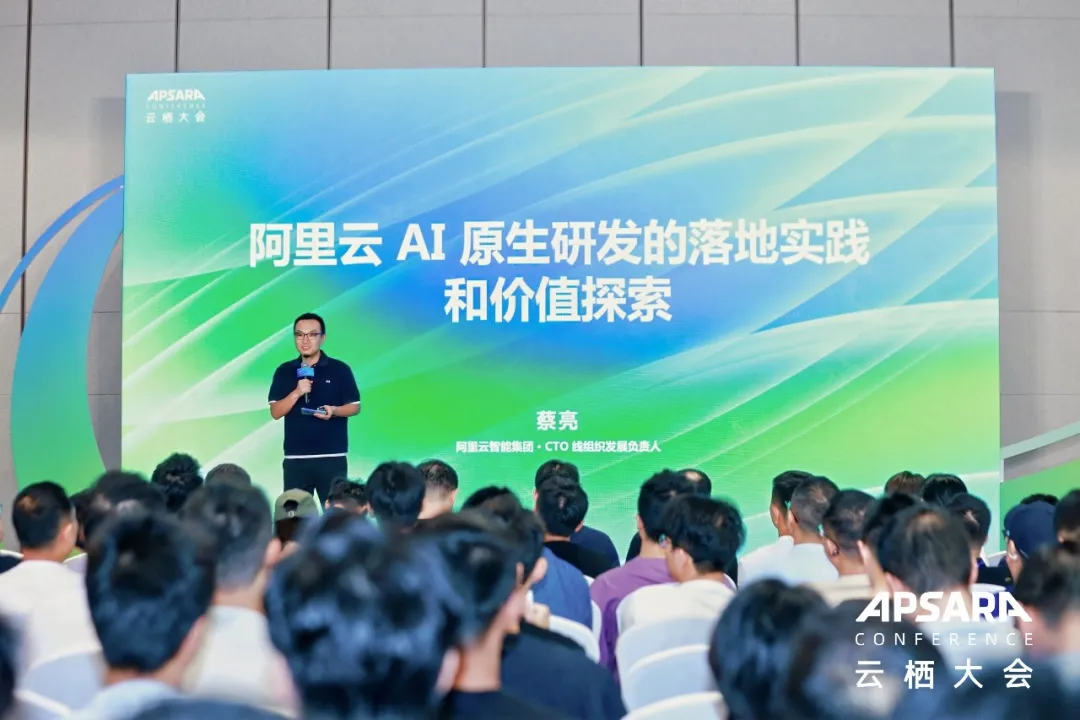
(Photo: Cai Liang, Head of Organization Development, CTO Organization)
In his view, AI has not eliminated the scarcity of individual capability, collaboration, and management — but it has added a boundary that never existed before: for the first time, humans must work alongside non-human intelligent agents. As Agents begin to take on tasks, how to establish the new contract remains an open question, and one that will go through a continuous process of exploration and construction.
This exploration divides problems into two categories. One is “growth” problems: optimizing to the extreme within the existing framework, continuing to examine the entire chain of requirements, product, design, development, testing, release, and operations, and identifying every opportunity to improve. The other is “evolution” problems: subverting and rebuilding everything between AI capabilities and customer value.
This exploration adopted a “North Star, leeway, sandbox” approach. The North Star goal is essential: it mobilizes and inspires AI-native transformation and innovation, while determining which innovations deserve continued investment. Leeway means that innovation does not have to wait for management systems to be fully ready, and teams are allowed to cross existing role boundaries during the experimental stage. Finally, the sandbox provides a supporting environment for experimentation while minimizing impact on the main production chain. Observation metrics are used for tracking and comparison, not for performance evaluation. The aim is a “discovering new species” model that reduces distorted behavior driven by excessive local optimization of metrics.
The selection criteria for the showcases included entering production scenarios, having observable business results, and having the potential for reuse.
After several months of experimentation, some partial results emerged. For example, one project cut end-to-end processing time from two hours to 5 minutes. Another completed dozens of requirements within two weeks, shortened the release cycle from 40 days to 2 days, and distilled more than a dozen production-grade Skills. These numbers do not represent overall performance; which practices from the showcases can be reused still needs further validation. The interim practice brought two kinds of change: first, core assets began to be restructured — from the artifacts themselves to the conditions that support trustworthy regeneration. Second, the platform-level requirements for the next stage have gradually converged into three directions.
• First, make sure tasks execute reliably. Around Harness and “spec-as-code,” build out execution constraints and runtime governance, multi-Agent orchestration, automated validation and acceptance, and set acceptance thresholds with hard standards.
• Second, continuously accumulate experience. Promote the assetization of tools, Skills, and MCP; connect experience distillation, evaluation, and version evolution into a closed loop; and continue exploring the self-evolution of capabilities.
• Third, bring collaboration into the organization. In regard to multi-Agent orchestration and “Agents entering the organization,” continue addressing role elevation and mixed teaming, Agent identity and permissions, Human + Agent collaboration, end-to-end observability and efficiency analysis, and rational selection of Agent scenarios.
Panel: A New Contract Between People and AI
The panel was moderated by Cai Liang, Head of Organization Development, CTO Organization. The three guests were: Tang Hong, Vice President of Product & Engineering, Head of CTO Office, Alibaba Cloud; Han Hongyuan, Vice President of Alibaba Cloud Intelligence Group and General Manager of Solutions for the Public Cloud Business Unit; and Bian Sikang, Head of Product and Operations for LingGuang at Ant Group and an AAIF Ambassador.
This forum was unusual in placing the roundtable ahead of the seven practice topics, to set the context and give the audience a stronger sense of immersion.
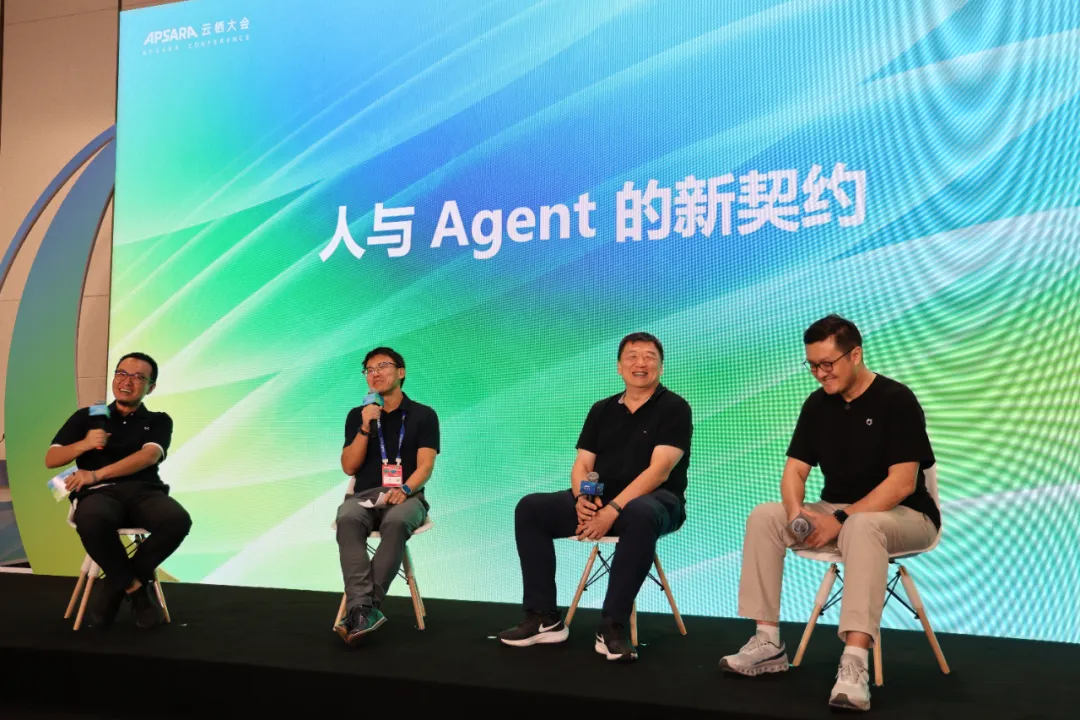
Starting from Personal Practice
Cai Liang: The first question goes to Hong. You are an AI Native practitioner and also part of the management of an R&D organization of more than six thousand people. How do you practice AI Native yourself? What help and value does it actually bring you?
Tang Hong: Let me first say that we tried to rehearse this conversation, but just like model output, it was very unstable every time, so we decided to improvise. This is the first time I've heard this question. I started writing code in middle school, and later went through the PC, internet, mobile internet, and cloud computing eras. What I feel deeply today is that the passion for writing code has returned to what it was in middle school, at graduation, and when I first started working.
When a new technology era arrives, the first thing is to stay humble and truly learn it. Technology seems to spiral upward — each round shows traces of the past, but each rise also brings qualitative change. If you ask what AI Native is, I think you have to first use it yourself, try to change the way you solve problems, and then change the way the people around you do so. Only by truly getting into these issues will you know what AI Native is.
Cai Liang: Hong has already “jumped in.” Han, why don't you tell us about yourself.
Han Hongyuan: I may be the only person here who doesn't write code. I've never treated writing code as a full-time job, but I'm the one who ultimately takes what the code produces to customers.
There are at least three terms related to code: coding, programming, and software development. They may all ultimately land on coding, but they differ greatly. Writing code does not equal having software — at most, it might be a program.
Real software has lots of functional and non-functional requirements. Many tools today are called coding agents, because coding is the process of implementing the workload; but there are far too many things in software that coding cannot solve on its own. Whether a piece of code can become truly deliverable, sellable, and sustainably operable software is still an open question.
Cai Liang: Hong says he wants to go first; Han is asking whether you're laying bricks or building a cathedral. Sikang, what about you?
Bian Sikang: Laying bricks — you can build a cathedral, or you can build a marketplace.
This year there is a kind of anxiety aimed at programmers: some people who've never written software and don't really understand it suddenly run over and say that the code you create is worthless. But code has always been only a part of the entire software service — it's more like the raw material. To turn code into good software, and good software into good services, there is still a long industrial chain.
So I remain bullish on SaaS in the long term. Customers' specific needs won't disappear just because code becomes cheaper. Han has met customers I haven't, so I can't claim to understand those customers; that would be arrogant. What may really change is how software is delivered.
I like this turn of phrase: SaaS is still SaaS, which you can also read as “Service as Software.” The cost of coding has gone down, but other exit criteria and evaluation requirements may actually go up. The raw material looks the same, but the architecture, the decoration, and the entire industrial chain will change, and the demand for professional capability won't decrease.
When Code Gets Cheap, What Remains Scarce?
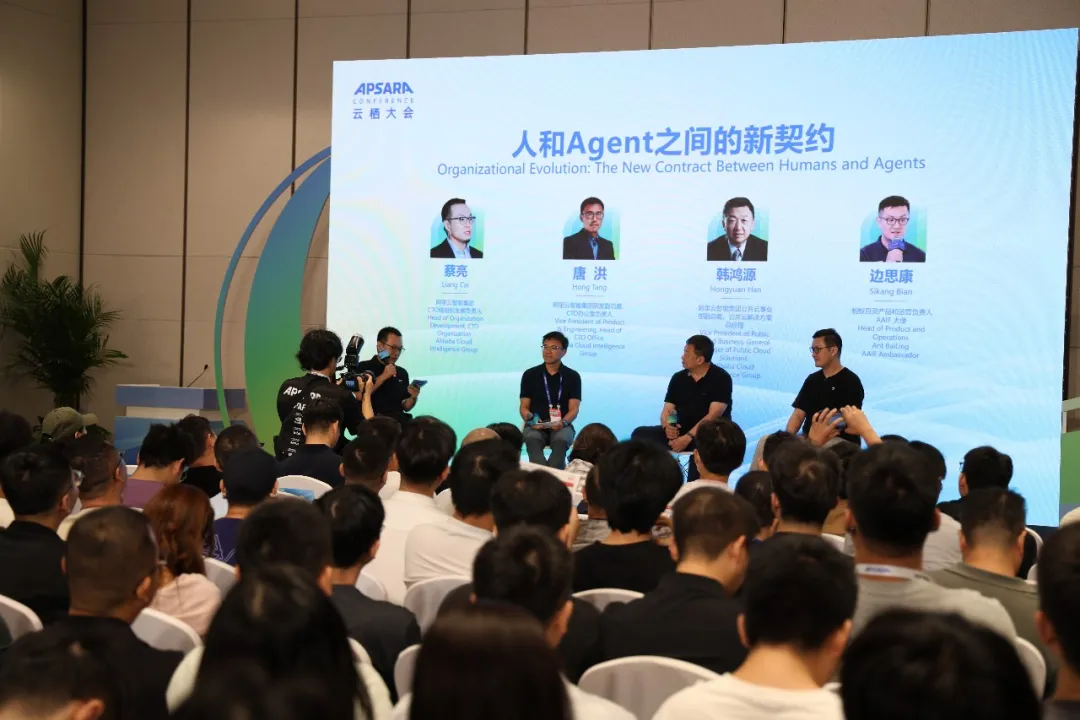
Cai Liang: We were just talking about laying stones versus building a cathedral. But cathedrals come in many types too: Alibaba Cloud builds PaaS, kernels, and basic software, while other teams may build application software. Will different types of R&D organizations be affected by AI in different ways? Han, you go first this time.
Han Hongyuan: The previous word that “native” modified was cloud native. People argued about it for a long time, but at least there were criteria like the Twelve-Factor App. Today, when we say AI Native, it seems we haven't yet found any suitable criteria like that.
If I have to pick a direction, it would be this: let AI do everything it can inside the organization — but the North Star metrics can't decline.
The difference between software and a program comes largely from operation, verification, and repeated validation. Requirements and tests have never covered all the problems in the production environment, and AI today may not be able to either. So some programs can become “daily throwaways,” but I don't believe actual software can. Software must go through a complete lifecycle from design to production to verification, and must undergo enough real operation before it can mature.
Non-functional requirements, architectural governance, and the ability to keep evolving matter far more than getting the code written, especially for low-level infrastructure software.
Cai Liang: If most of the cost of developing software used to come from the development team, and now code generation is getting cheaper, do you think the scarcity of capabilities and capability requirements have changed in the Alibaba Cloud CTO Line?
Tang Hong: They certainly have. Code generation getting cheaper has, in turn, exposed new problems.
Traditional waterfall software processes assume that labor is the biggest expense, so rework must be avoided as much as possible, and there are round after round of design reviews and specification reviews. Now software iteration is getting faster and faster; if the process is still clunky, the earlier stages will become the new bottleneck.
In the past, many things relied on organizational division of labor, on people exercising control, and then on people handing off. But human handoffs are usually slower than machines. Product managers start doing R&D work, and R&D starts doing product work, because as long as they are two different entities, their views may differ, and coordination comes with a cost.
Here is a real example: in the past, front- and back-end libraries were separated — first the back end shipped a version, then the front end connected after understanding the semantics. When change was slow, there was no problem. Today both sides are iterating quickly; the back end has moved far ahead, while the front end may not be able to connect at all. So the best approach may instead be to put the code in the same repository and change everything all together.
Further in the future, the definition of software may also need to change. From punch cards and assembly language to high-level languages, software has always served as the bridge between human intent and machine execution. In the future, there may be a form of expression that's more reliable than natural language and different from traditional programming languages, enabling Agents to complete tasks more accurately.
So the definition of software, software engineering, and the role of people in software may all undergo large-scale change. Many questions today have no answers, but I am quite optimistic: where there are problems, there are opportunities.
Cai Liang: What we make isn't code — we want software; and not just software, but service, and even the customer's smile.
Bian Sikang: Every time a technology cycle begins, things get reorganized. Before big data, there were no data analysts or data scientists in today's sense. These new roles came from new technology, but the problems they solve have not fundamentally changed: customers still need to know how to better run their business and how to handle supply and demand.
We shouldn't let the arrival of opportunity lull us into thinking that Vibe Coding can build an entire enterprise-grade system. Good performance engineers and security engineers are still professionals formed through years of training. Future workloads will change — REST APIs may become tokens, and system design will change — but professional issues like structure, security, and performance won't disappear.
What will really change is delivery on the customer side, and customers' imagination of new things. Sometimes customers cannot clearly articulate what they want; creative people need to produce new works first, so everyone realizes “Oh, so you can do it that way, too.” Age may not be the most important thing; what matters more is staying open and using the scientific method to keep making new discoveries.
Cai Liang: Today we keep saying “experts do expert work,” but the boundaries between specialties seem to be blurring. We used to have technical committees, defined domains, and job standards, but all of that is increasingly hard to pin down. Customer needs are changing, tools are changing — so is expertise still valuable? And where does it actually apply?
Tang Hong: In the past people often asked which kinds of intelligence AI could conquer and which were uniquely human. Later someone used the metaphor of seawater and islands: human expertise is like islands, and the range AI can cover is like the sea level. As the sea level keeps rising, fewer and fewer “expert islands” remain above the surface.
Today AI is still not good enough at product design, interaction, and complex non-functional design, but you can clearly see it improving. Some previously difficult system problems can also be solved jointly through language, tools, and engineering systems. AI does not solve everything out of thin air, but if you give it the right tools it can enter a bigger number of professional domains.
This means experts will not simply disappear, but the bar for experts will keep getting higher.
But I think people still have one thing that's genuinely their own: a product is ultimately for people to use, so whether it feels comfortable and is easy to use comes down to personal taste and product sense. That may be a capability that's very hard to replace.
Cai Liang: Then we'll “wait and see” on that conclusion. By your logic, it may just be a matter of time.
Deterministic Software and Non-Deterministic Models
Cai Liang: Han, from the customer's perspective, is everyone at the same stage now? They all say they're exploring, but actual progress varies greatly.
Han Hongyuan: Some of the benefits of the changes are already visible. Product people entering development, and developers entering product — this kind of overlap helps collaboration. Many previous obstacles in software R&D were caused by poor connections; if you never enter each other's domain, you'll never have a really smooth connection.
But there's another problem: models are changing fast, and everyone says they may absorb the capabilities around them. Software has always craved determinism and feared uncertainty; now models have brought uncertainty straight into the system.
I have always held the view that if you write an AI application and, after a new generation of models is released, that application can't make any use of the model's enhanced capabilities, then you should ask yourself whether you are really using AI. Your system should not lock the model to an old version.
But conversely, you cannot conclude that AI can already replace people from start to finish just because coding capability has improved. For example, MySQL has complete documentation, clear interfaces, and many well-known problems. Is anyone today using AI to rewrite a better MySQL and truly replace it? Not that I know of.
A compiler can finish in a single run, but a database has to run continuously. For infrastructure software, it hasn't been fully verified whether AI can write it all at once and keep it running reliably over the long term. So on this matter, I lean conservative.
Cai Liang: The more others depend on you, the more important stability becomes. We depend on the systems below us, and the users above depend on us.
Han Hongyuan: That's right. Lots of software looks far less complex than it actually is.
Bian Sikang: Han and I did not coordinate in advance, but his point about MySQL reminded me of a conversation. I said MySQL is infrastructure, and my manager at the time said: “Stop right there — MySQL is not infrastructure, it's an application.” Because what he worked on was containers and operating systems.
That goes to show that the infrastructure we live on today did not exist before a certain era; beneath it, it has its own infrastructure. So right now we may be at a very rough-and-ready stage.
A model is inherently unstable. You give it a prompt, and it returns something strange — sometimes that isn't a bug but a defining property of the model. It's like an irregular brick, or even more like cement. It brings problems that need solving, but for many people it's also a chance to rediscover, create, and build.
The same goes for harness engineering. Once simple problems are solved, the next stage of problems will require more testing, and testing itself must face uncertainty.
Software is deterministic, but the human world is not. In the past we used software to converge part of the uncertainty into deterministic processes; nowadays, using a non-deterministic model to respond to customers' uncertain needs means redesigning this middle layer.
My understanding of “Service as Software” still holds: abstract the deterministic parts into Building Blocks, then stack them with models and Context to respond to customers' uncertain needs. It may be more a change of perspective than a complete overturning. Engineers still have the chance to readjust and re-adapt; I don't think this is merely a question of “who will be eliminated.”
What Should R&D Organizations Change First?
Cai Liang: One last question. If, to move toward AI Native, you could only add or remove one mechanism, what would it be?
Tang Hong: I can't answer that question really well, because the mechanisms in an organization are interlocking — if you replace just one piece, it may not fit back into the whole puzzle.
If I have to name the most important change, it's this: believe that AI Native is actually coming. Everything can be broken, everything can be changed. All rules may change — but you can't tear down every rule and cut the road off entirely. You have to find an evolution path: break one thing here, change one thing there, but at least one road stays passable.
For example, today software boundaries have to be defined really clearly: inputs, outputs, parameters, versions, forward compatibility, backward compatibility. But in the Agent era, some people are researching whether APIs can be negotiated: I first ask what you can do, then search and choose — services talk to each other like people do.
Not all software has to be like this. Where abstraction is particularly certain, RPC and MySQL may not need it. But once uncertainty rises, some boundaries may change.
So if you believe that the future will definitely get here someday, and you see it conflicting with current rules, first examine whether the current rules can be broken.
Cai Liang: In other words, stay open-minded. When you see something new conflict with past experience, don't instinctively react to prove it shouldn't happen.
Han Hongyuan: I'll say two things. First, what R&D organizations need to change most is breaking down functional boundaries. There must be more overlap; AI can help you expand into areas that were previously outside your responsibilities. With more overlap, communication gets smoother.
Second, software must go through lots of operation and verification; that's where maturity has to come from. If the code, interfaces, and external contracts are all unstable, then there will be no way to repeat verification; without repeatable verification, every run may reintroduce risk. Many non-functional problems only surface after entering the production environment and being validated in plenty of customer environments.
Cai Liang: That sounds like two opposite views: on one hand, break the boundaries; on the other hand, stabilize the contract.
Han Hongyuan: During development, break people's functional boundaries; when truly entering system-level operation, the contract can only be adjusted gradually. You cannot build a Windows system end to end today — Windows still needs to be built in layers.
Cai Liang: Got it. Boundaries should no longer be tied to people, but where the boundaries move to and what carries them — there is no time to expand on that today.
Bian Sikang: I'm not sure if this counts as a mechanism. If you ask me what to do less of, I'd say: spend less time asking “Why doesn't this exist yet?” and “Is this my business?”
The characteristic of the Chaotic Era is that some things simply don't exist. So, you can go write it, go create it. Organizational boundaries evolve over the long term, and there must be transitional states in between. Rather than keep debating whether something is mine, it's better to first ask: the business and customer problem still isn't solved — is there anything else I can do?
If you ask what to do more of, I choose “tools.” There is a shortage of new tools, and also a shortage of new quote-unquote “atomic capabilities.”
When an Agent writes an email, it may call Gmail or Alibaba Mail, but it usually won't use IMAP to build an email system from scratch. A well-designed tool wrapper can be seen, roughly, as a kind of atomic capability. Future middleware may come from the rebuilding of these atomic capabilities.
Too little of this is being done right now. In the past, engineers were not necessarily encouraged to do such things because they seemed too minor; but today, they might be harder and more important, because lots of capabilities have to be re-abstracted.
Cai Liang: All right, let's end that topic here.
Seven Showcases: Practices and Problems in Production Scenarios
The forum covered seven dimensions — product design, code review, code repair, R&D collaboration, operations evaluation, cross-functional collaboration, and product operations — explaining what work Agents take on in different production stages, what people are still responsible for, and what new problems emerged after implementation. Given space constraints, the following seven practices are not covered in detail; seven separate articles will follow.
Product Design Evolution: End-to-End AI-Native Practice from Human-Led to Human-AI Collaboration
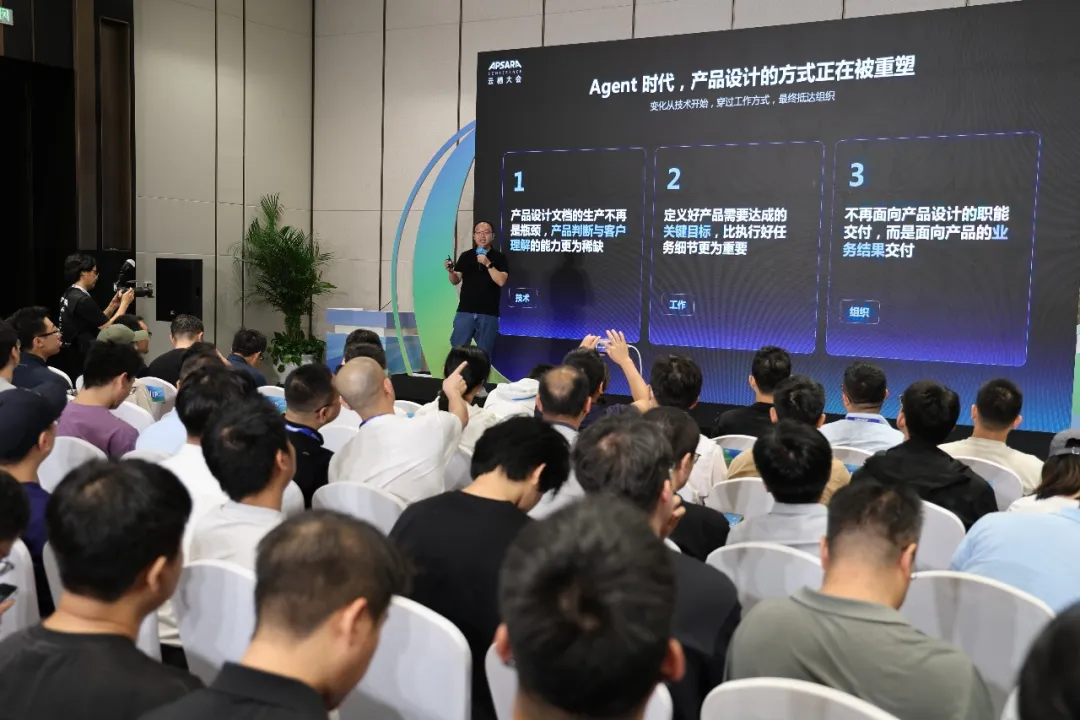
(Photo: Zhong Yaorong, Product Management Director, Alibaba Cloud Intelligence Group)
In practice, we increasingly feel that producing product design documents is no longer the bottleneck; what is truly scarce is product judgment and understanding customer needs. So we did not just build a PRD-generating tool; we re-examined the complete value chain of product design and built an underlying knowledge system that runs through the whole chain.
At present, about two-thirds of requirements no longer need to be manually reviewed. Value-judgment accuracy is now above 90%, requirement response time has dropped by 45%, and backlog processing efficiency has increased by more than 50%. About 80% of PRDs are now generated by AI, and the time to produce an end-to-end product experience assessment has been cut from 4 hours to 30 minutes.
Code Review Evolution: From General Review to Domain Expert — the Kitta Code Review Agent in Practice
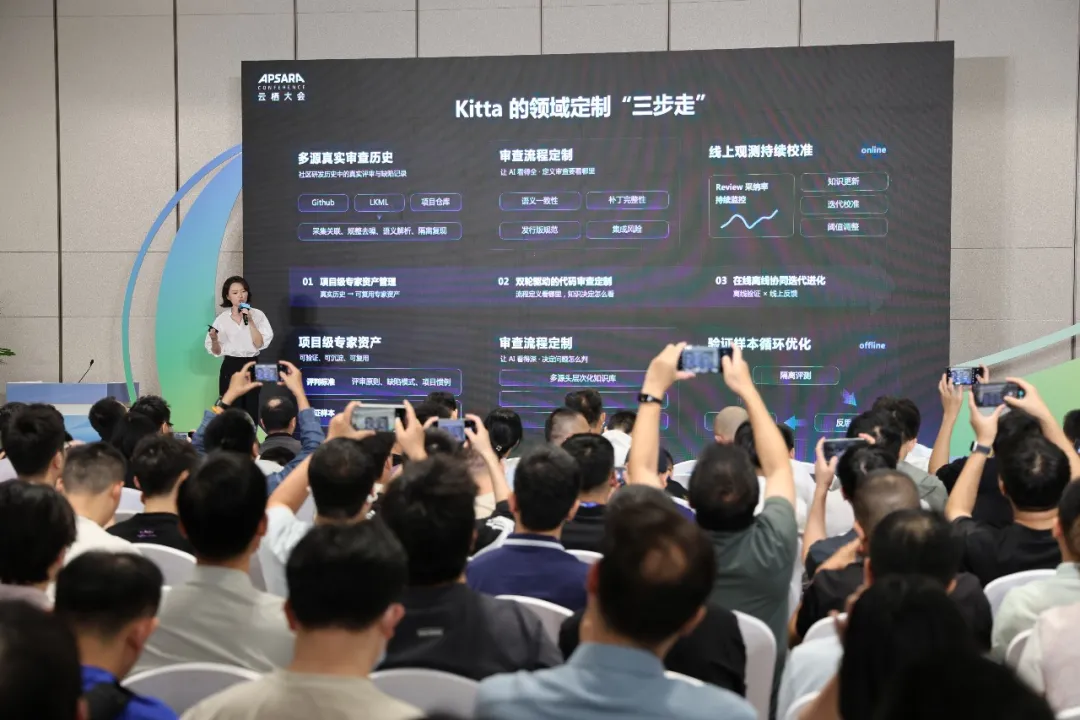
(Photo: Zhou Yuanhang, Technical Expert, Alibaba Cloud Intelligence Group)
The data offers an early warning: the total number of CVE reports in the software industry grew by 394%, high-severity vulnerabilities grew by 811%; code bug rates rose by 9%, average PR size increased by 154%, and review time increased by 91%. In the OpenAnolis community, the monthly merged PR volume of the two main kernel release versions grew 8.9-fold over the past two years. Therefore, AI-native R&D cannot stop at using AI to write code; it also needs to build an Agentic CI that runs through code production, verification, and delivery — and code review is the first quality gate. Once we truly got started with large open-source projects, we found that AI can understand a piece of code, but not necessarily a whole project. It does not understand the domain knowledge, development practices, and workflow rules that a project has formed over time, nor when it should remind people and when it should hold back.
To address these problems, we built Kitta in three steps: first, we extracted review principles, typical defect patterns, and project conventions from the real history of GitHub, LKML, and project repositories; then customized for different projects' R&D contexts with a two-layer approach — “the process defines where to look, knowledge decides how to look”; and finally we continuously calibrated through offline evaluation and real online behavior.
At present, Kitta has achieved a 17–30% improvement in review quality across six domains, and already serves the ANCK kernel release in the OpenAnolis community, having reviewed a total of more than 70,000 patches, with gate accuracy of 97% and a code merge rate of 62%.
Code Repair Evolution: From Alerts to Auto-Repair — PolarDB-X's Loop Engineering Practice
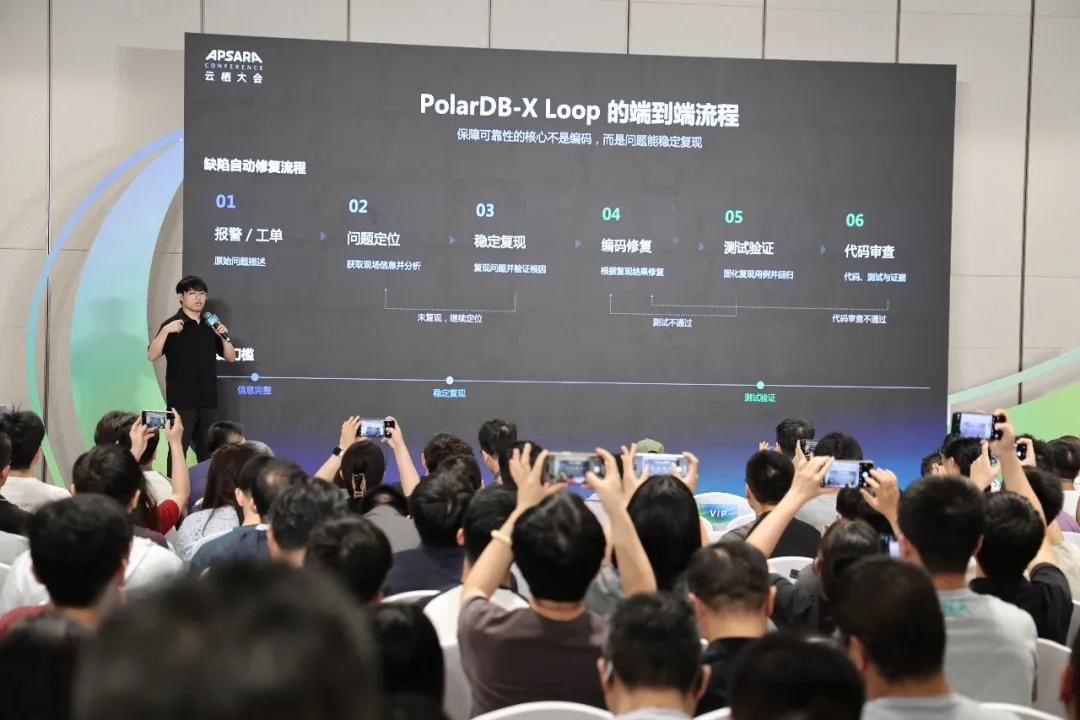
(Photo: Sheng Taotao, Senior R&D Engineer, Alibaba Cloud Intelligence Group)
I once handled a bug where the actual change was only two lines of code, but checking the logs, watching the monitoring dashboards, and analyzing the problem took a whole day. To reproduce the problem, I could only squeeze in repeated debugging between meetings, and altogether it took close to a whole week. Later on I still had to add test cases and follow up on code review. If AI only helped me write those two lines, it would save very little time. What we want to hand over to AI is the whole process from alert to repair delivery.
To this end, we used existing APIs and CLIs to let the Agent autonomously query monitoring data, logs, instance topology, and other information. For legacy platforms that lack ready-made tools, we had the Agent refer to existing implementations, analyze web requests and authentication methods, and then wrap the functionality we need into a CLI. For runtime verification, we re-implemented a JDB CLI suitable for Agent calls based on the Java debugging interface, supporting structured returns, session management, and breakpoints on specified threads. At the same time, we turned large Heap Dump analysis into a service, and provided two kinds of reproduction environments: PolarDB-X Zero second-level temporary instances and full Kubernetes clusters.
At present, this process runs continuously in the cloud: every alert first gets a round of analysis and handling from the Agent; within six months, we identified and recorded more than 200 defects from tens of thousands of alerts, over 70% of which could be stably reproduced and were repaired by the Agent before entering review. These practices gave us three engineering insights: R&D systems must be callable, R&D processes must be verifiable, and tasks must be able to run continuously in the cloud 24/7.
R&D Collaboration Evolution: From Coding Efficiency to End-to-End Delivery — Human-Agent Collaboration at Cloud Communications
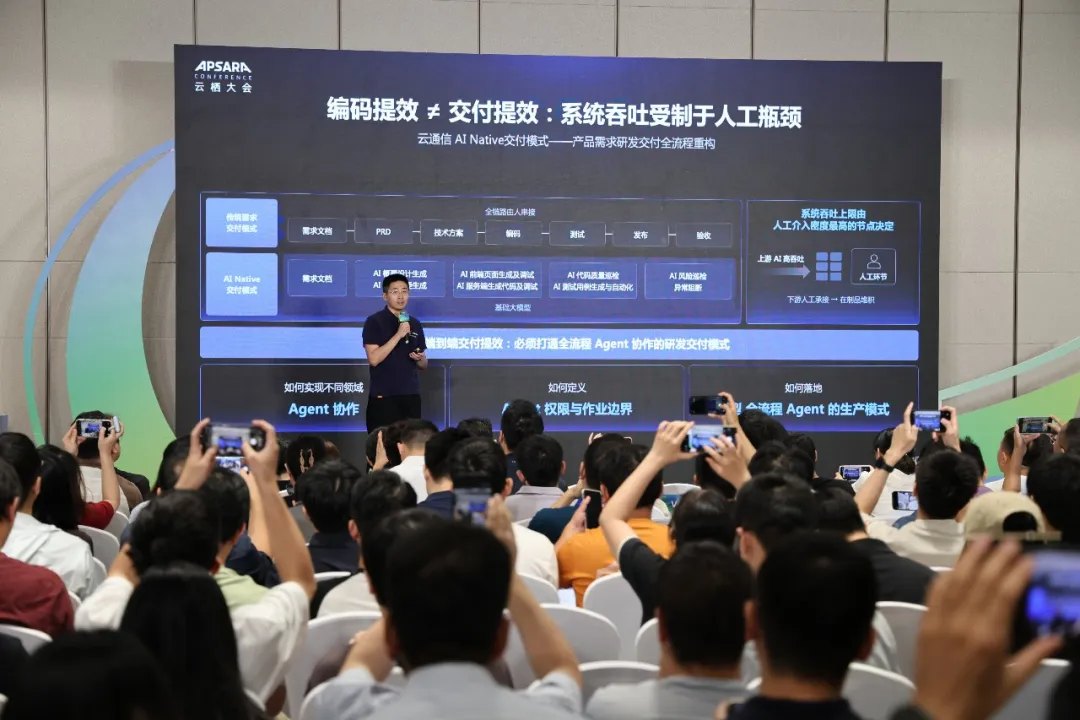
(Photo: Zhao Bin, Senior R&D Engineer, Alibaba Cloud Intelligence Group)
In traditional R&D, coding is only one step among requirements, design, testing, release, and acceptance. When coding speed increases substantially while the surrounding links still rely on people to connect them, work merely piles up faster at the next manual node. So we shifted the goal from point-level coding efficiency to end-to-end delivery. The first thing to solve is how Agents work with each other.
At present, this automated delivery pipeline driven by cloud digital avatars can run 24/7 and already covers four business lines: domestic SMS, intelligent voice, intelligent scheduling, and international SMS. A single avatar can handle three to four requirements in parallel, and about two-thirds of the simple requirements that pass the gate can be closed end to end automatically. After each delivery, we also audit the process, artifacts, and Agent execution, and write effective experience back into the knowledge base. We also took detours: rushing to put models in, underestimating the complexity of domain slang and historical knowledge, and being misled by context hallucinations.
Full-Domain Ops Evolution: From Manual Fault Injection to Scaled Production — STAROps Benchmark Practice
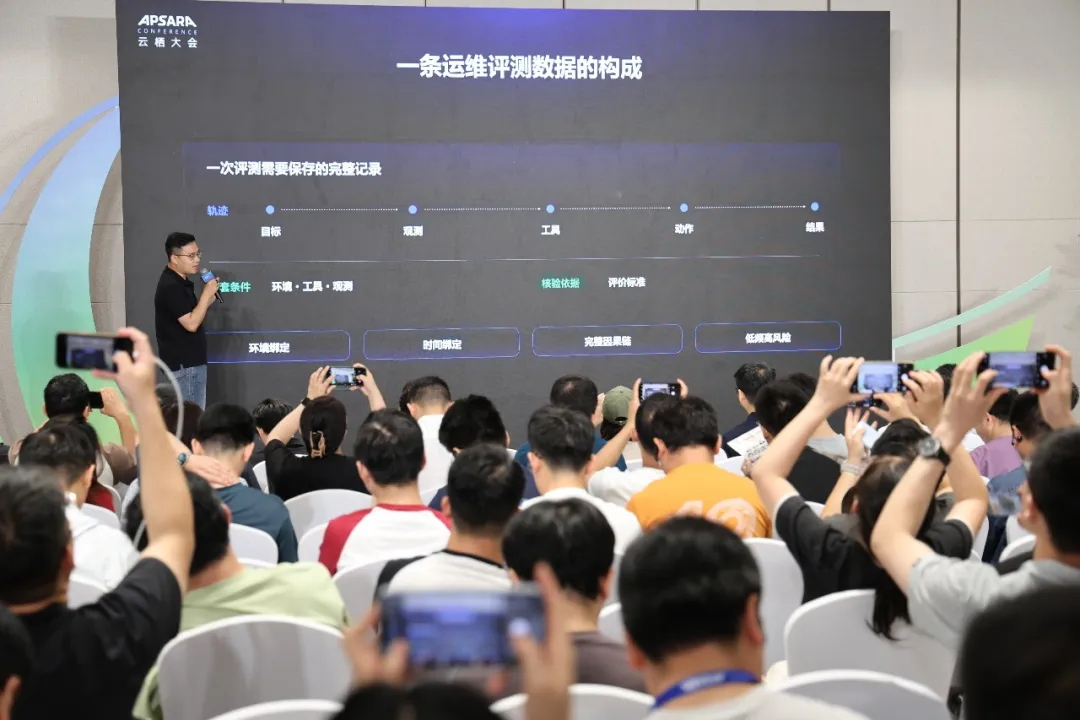
(Photo: Lou Haibin, Technical Expert, Alibaba Cloud Intelligence Group)
We believe a complete set of operations evaluation data should contain the execution trajectory, supporting conditions, and verification evidence, while achieving environment binding, time binding, and a complete causal chain. STAROps uses four Agents that split up the work: ScenarioAgent selects topics, EnvironmentAgent builds environments, BuildAgent injects faults and extracts evidence, and SupervisorAgent performs quality checks. People are responsible for setting goals, defining acceptance criteria, and final review. Real problems that occurred online can also be reconstructed into evaluation sets through mechanism restoration, equivalent replay, and signal alignment. We check every piece of data from five aspects: quality, coverage, discrimination, scale, and freshness.
At present, the platform has accumulated more than 1,400 pieces of evaluation data; the root-cause evaluation set grew more than tenfold in six months, from 58 items in March to 838 in September, covering more than 100 types of root-cause faults. Fault injection is only one step in the process; what is truly difficult is ensuring that every piece of data is verifiable, retainable, and can keep running. Only by doing this well can improvements in intelligent operations capability have a trustworthy basis for measurement.
Organization Evolution: Organizational Restructuring Behind the Self-Evolving Agentic SOC Security Product
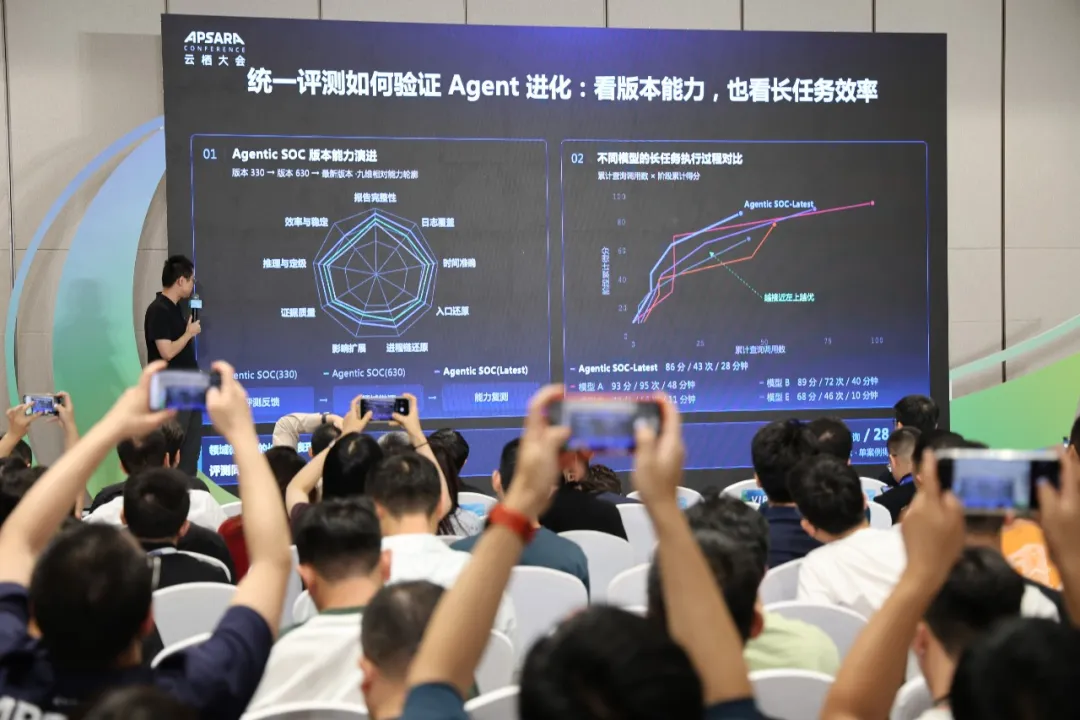
(Photo: Ren Yi, Senior Security Expert, Alibaba Cloud Intelligence Group)
As more and more improvements are completed autonomously by Agents, people need to set four kinds of boundaries in advance: goals, quality, permissions, and stop conditions. After the technical loop was up and running, we also began to adjust the organization: integrating product, R&D, and security into one team, with one Owner per requirement responsible from goal definition to result acceptance, and product experience, engineering delivery, and security outcomes advanced in parallel against the same set of standards. The traditional serial schedule of about 51 days was thereby shortened to about 14 days. Job boundaries also began to extend forward and backward based on outcomes, but this does not mean everyone does everything. Tasks with clear standards that can be evaluated and rolled back are executed by Agents and approved by humans; cross-domain but risk-controllable tasks are closed by the Owner with the help of Agents; while high-risk, highly ambiguous, or irreversible tasks are still led by professionals. In the interim data, the average requirement cycle dropped from 50.9 days to 13.8 days, in-window throughput rose from 63.9% to 98.9%, and ARR more than doubled.
Our takeaway is that restructuring technology alone is not enough. When Agents already run with the final result as the goal, the organization also needs to re-establish shared goals, unified acceptance, end-to-end accountability, and a clear division of risk, with the same results in mind.
Product Operations Evolution: Growth Practice from Process-Driven to an Agent Digital-Human Team
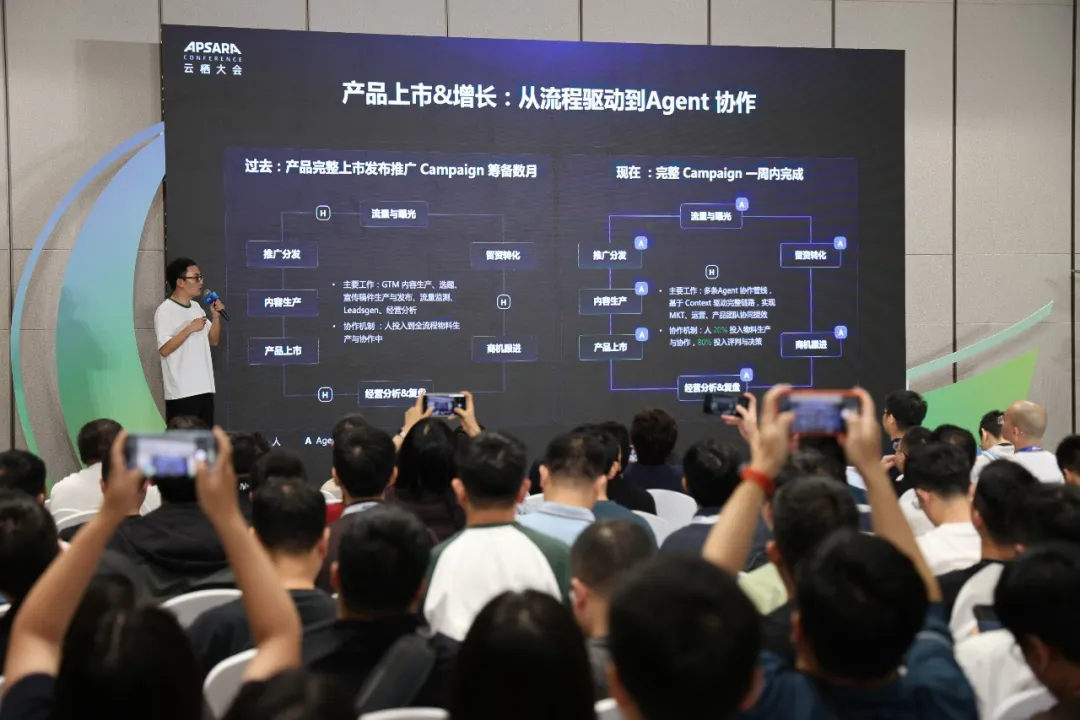
(Photo: Wang Xizheng, Senior Product Operations Expert, Alibaba Cloud Intelligence Group)
We believe product launch and growth have also entered the Agentic era. Research by Gartner and Salesforce predicts that by 2028 the share of marketing work handled by AI will grow from the current 16% to 36%. AI adoption is rising in content production, GEO optimization, lead acquisition, and other areas, but new problems emerge as well — for example, traffic attribution becomes harder, and content updates often cannot keep up with product iteration.
Our response is to shift from process-driven to Agent collaboration. In the past, a complete marketing campaign often took several months to prepare; now it can be run within a week. How people allocate their energy has also changed: in the past people's energy went mainly into material production; now about 20% goes into production collaboration and 80% into judgment and decision-making. We formed an Agent digital-employee team for marketing growth, comprising two people, one Leader Agent, and six Worker Agents. The Worker Agents are responsible for content topic selection, content creation, lead management, business analysis, product knowledge, and traffic optimization, jointly operating four main pipelines — the full product launch process, new feature releases, lead management, and data analysis — and collaborating with more than 100 roles across product, R&D, architects, and operations, achieving roughly 10x efficiency.
Still in the Early Stage
The seven showcases took different paths. Cloud Communications tied part of the responsibility to employees' digital avatars; Agentic SOC tried to have one Owner run through the original functional boundaries; Kitta and STAROps focused more on evidence, gates, and repeatable evaluation; and the product and operations teams adjusted their work rhythm and division of labor.
These cases all involve how processes and responsibilities should be adjusted in sync after Agents enter production. Each team is still defining goals, permissions, acceptance, and accountability separately; at present there is no unified approach. From the existing cases, teams are beginning to put more energy into problem definition, context quality, result acceptance, and responsibility division, and are trying to organize individual experience into Context, Skill, Eval, Harness, or platform capabilities. Whether these practices can be reused across teams still requires more production data to verify.
A single forum is not enough to draw conclusions. The next seven feature articles will take a closer look at each showcase, covering the problem background, process adjustments, gate settings, failure handling, and current boundaries.
Read previous post:
Read next post:
Agent Tasks 10.71% Faster, Memory Footprint 21.60% Lower | Introducing Alibaba Cloud Linux 4
-

-
OpenAnolis
128 posts | 6 followers
Follow
Comments
-
-
OpenAnolis
128 posts | 6 followers
Follow
Related Products
-
 YiDA Low-code Development Platform
A low-code development platform to make work easier
Learn More -
 mPaaS
Help enterprises build high-quality, stable mobile apps
Learn More -
 Offline Visual Intelligence Software Packages
Offline SDKs for visual production, such as image segmentation, video segmentation, and character recognition, based on deep learning technologies developed by Alibaba Cloud.
Learn More -
 Elastic Desktop Service
A convenient and secure cloud-based Desktop-as-a-Service (DaaS) solution
Learn More
More Posts by OpenAnolis
- Agent Tasks 10.71% Faster, Memory Footprint 21.60% Lower | Introducing Alibaba Cloud Linux 4
- Anolis SkillHub Picks: I Explained Our Engineering Rules a Hundred Times — So I Turned Them into a Skill
- Anolis SkillHub Picks: Deploy and Manage a PG Cluster in One Sentence
- Ten Years of Typing vmstat, Packed Into One AI Skill | Anolis SkillHub Picks
- People and Agents Finally Share One CLI — Announcing ANOLISA v1.0
- SkillFS: Governing Dozens of Agent Skills with a File System
- When AI Transitions from 'Conversation' to 'Collaboration,' Who Will Manage the Working Memory of Millions of Tokens?
- STAROps Intelligent Host Inspection: A 24/7 AI Doctor for Your ECS Instances
- Low GPU Utilization You Can't Explain? Try This Zero-Intrusion AI Profiling Tool