Agent Tasks 10.71% Faster, Memory Footprint 21.60% Lower | Introducing Alibaba Cloud Linux 4
By Hang Li and Yuanhe Shu
At scale, the cost of running agents goes beyond model calls. It also includes starting and running hundreds or thousands of isolated environments that execute tools and validate code. Alibaba Cloud Linux 4 (Alinux 4) now ships system-level optimizations built for Agent workloads, improving task turnaround from the operating system up, cutting the host memory footprint, and holding tail latency steadier over long runs.
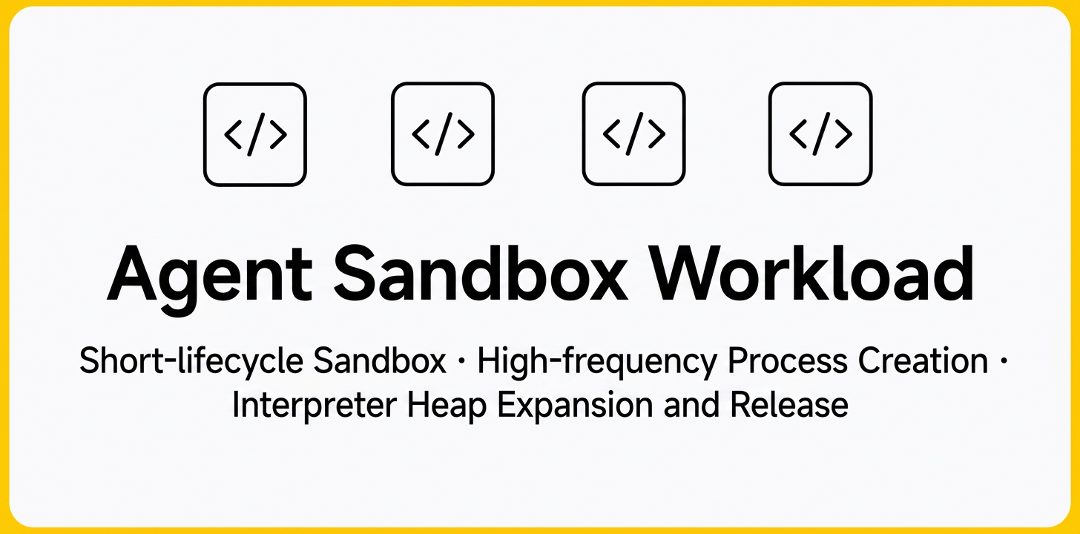
Over the past year, Agents have taken on far more: answering questions, then calling tools, generating code, installing dependencies, running tests, and finally completing a workflow on their own. Compared with traditional online services, Agent workloads have one distinctive trait. They are not a single long-lived process ticking along steadily; they repeatedly create processes, allocate and free memory on interpreter heaps, and run compilation and test jobs.
That shift creates new infrastructure problems. One Agent looks lightweight. At high concurrency, cold starts, memory fluctuations, and tail latency become more pronounced. The longer a node runs and the more fragmented its memory becomes, the easier it is for tool calling to go from "occasionally a bit slow" to an entire batch of tasks held hostage by its slowest few instances. At that point, adding more computing power does not fully fix things: the total resource pool has not shrunk, but the way those resources get used has changed.
Alibaba Cloud Linux 4 answers that shift by rethinking the relationship between Agents and the operating system. The OS is no longer just a general-purpose base that carries applications; it actively recognizes workloads characterized by short lifecycles, many processes, and high-frequency memory allocation. This release has a single core goal: run more Agent tasks, more reliably, on the same compute resources.
Choosing the right huge page size for the workload
Traditional huge pages cut the management overhead of memory access, but they depend on large blocks of contiguous memory. On a fresh node under light load, that approach usually works well. As a node stays up over time, contiguous memory gets carved up, fixed-size huge pages become harder and harder to obtain, and the system may fall back to finer-grained memory management. For Agent sandboxes that constantly fork processes and build anonymous heaps, that regression shows up directly as tail latency in tool calling.
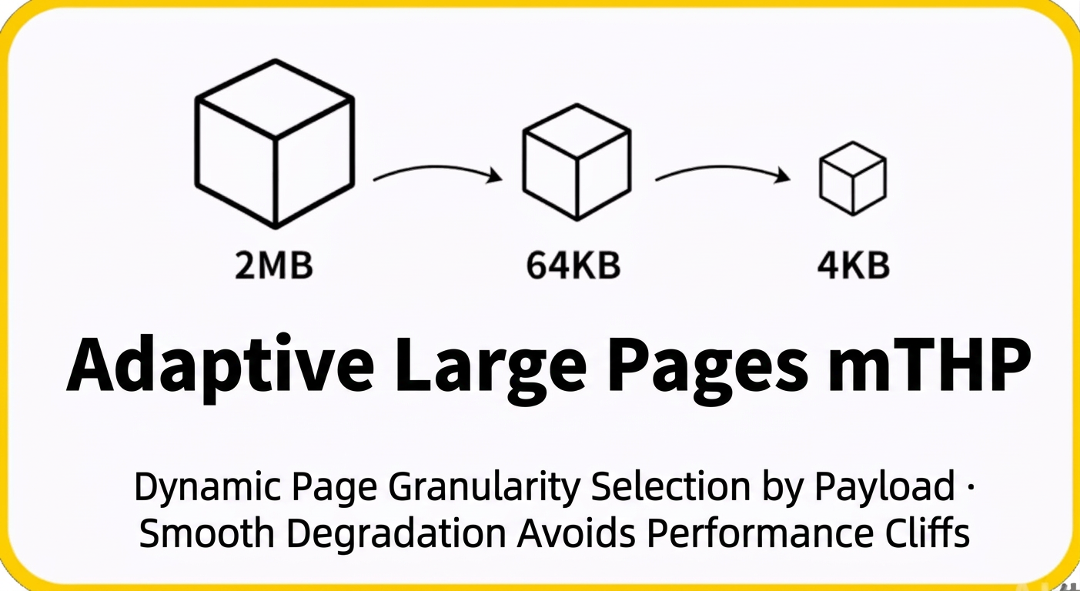
Alibaba Cloud Linux 4 introduces adaptive multi-size transparent huge pages (mTHP) for different working sets. Instead of committing to one page size, it picks the granularity that fits current available memory and workload characteristics: high efficiency while memory is plentiful, and a smooth step down when contiguous space runs short, avoiding the performance cliff that comes from dropping straight from huge pages to base pages.
The value here is not one more kernel parameter. It is that a trade-off among performance, memory, and stability that used to be tuned by hand now becomes a choice the system makes dynamically.
Agent coding tasks complete 10.71% faster
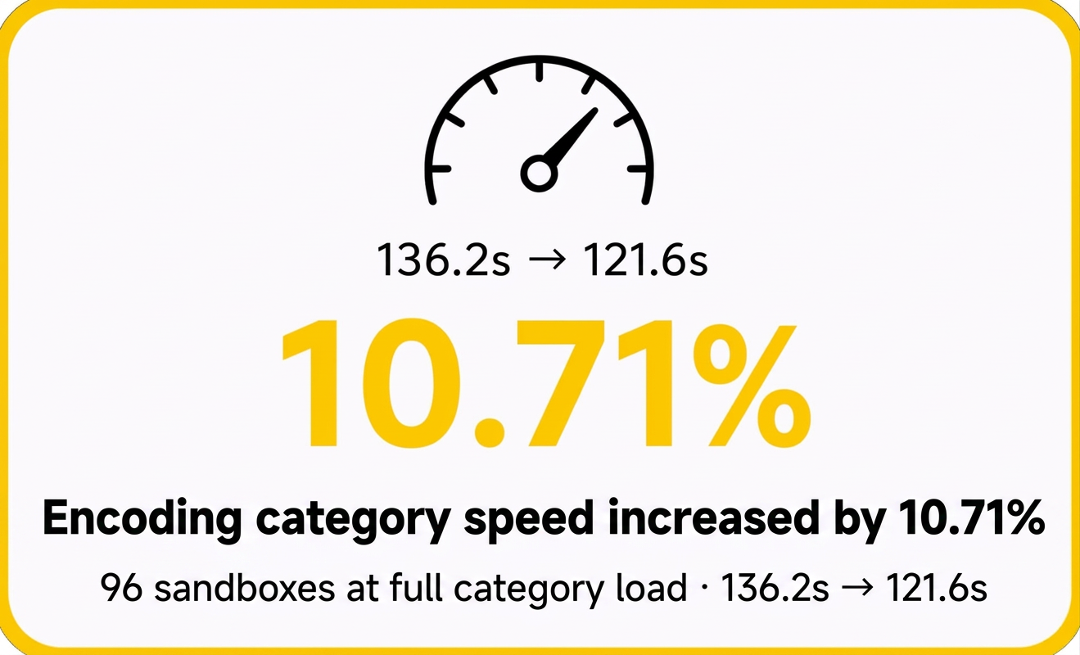
The team built a synthetic workload modeled on an agent coding workflow: on a 192-core bare metal server, 96 2C2G agent sandboxes run at full load, with each concurrent Agent continuously invoking Python child processes, creating and releasing large numbers of interpreter objects, and compiling code. With the same sandbox resource allocations and concurrency level, and relative to Ubuntu 24.04 LTS (kernel 6.8, default configurations), Alibaba Cloud Linux 4 (kernel 6.6, default configurations) cuts completion time for the whole batch of tasks from 136.2s to 121.6s, a reduction of 10.71%. The same batch of tasks finishes earlier, a clear turnaround gain for this class of process-creation, interpreter-heap, and compile-intensive work.
For an Agent platform, this kind of gain matters more than shaving a few milliseconds off a single request. Agents typically run multiple rounds of tool calling back to back, and waiting at any one step accumulates along the workflow. When dozens of sandboxes run at once, batch completion time directly shapes how fast the whole workflow turns over.
Host memory footprint down 21.60%
Memory is the other cost center for an Agent platform. Sandboxes are typically provisioned with fixed resource allocations for isolation and security, but their real working sets fluctuate constantly with tool calls. Run many sandboxes in parallel and memory fragmentation plus duplicated page-management overhead push host pressure higher still.
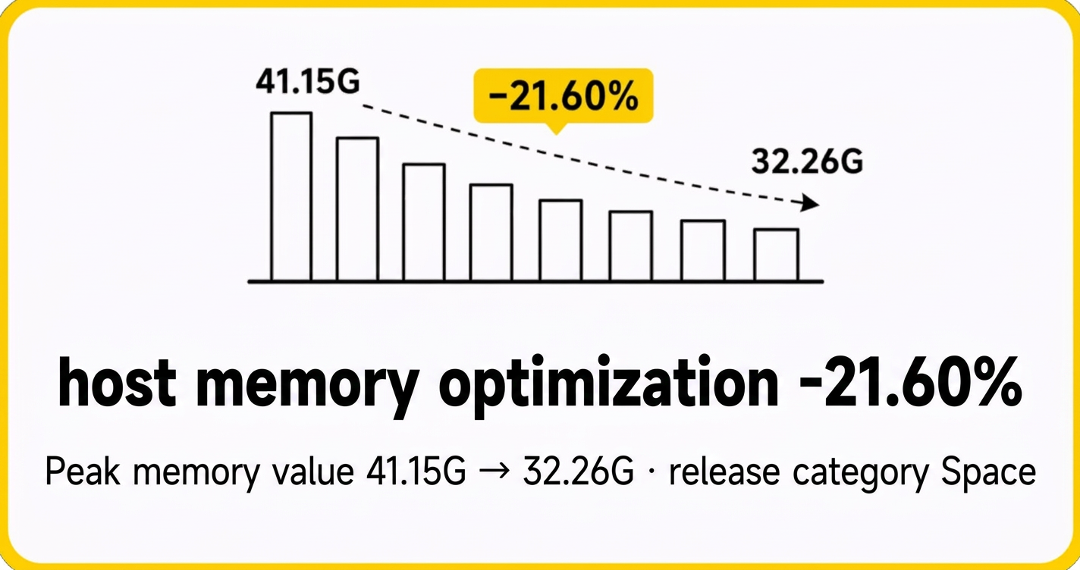
In the same environment, Alibaba Cloud Linux 4 reduces peak host memory footprint from 41.15 G to 32.26 G, a drop of 21.60%. The memory freed up this way can go to the page cache, to other tenants, or to colocated workloads, and it also helps infrastructure teams choose a more sensible memory configuration for the same task size.
Note that memory savings do not automatically translate into a proportional increase in the number of virtual machines of the same specification. When the CPU is already fully loaded, the main benefit is lower memory pressure and more room for colocation, not a way past the instance ceiling the CPU sets.
Beyond synthetic scenarios: back to real workloads
An Agent coding workload reliably reproduces high-frequency process creation and interpreter-heap churn. Alongside it, we also evaluated Alibaba Cloud Linux 4 on several real-world workloads and selected portions of public benchmarks.
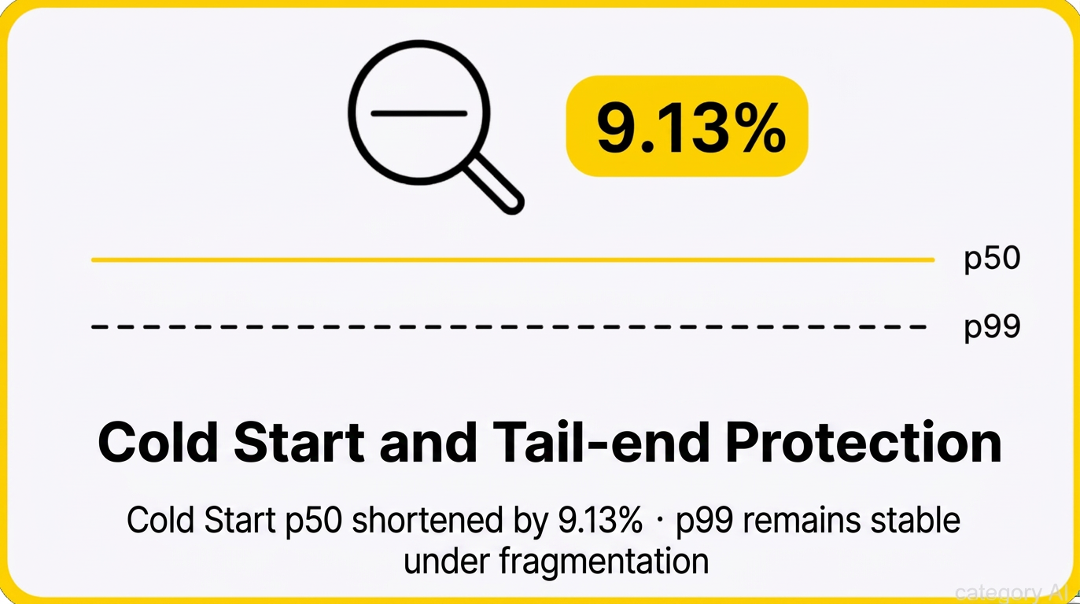
In a real workload where sandboxes concurrently start Python web services, p50 cold start time, measured from process start to the first health check response, drops 9.13%. For Python services that need to scale quickly and for Agent platforms that use Python as their main tool execution environment, this means new sandboxes can reach the active state faster.
Tail latency under induced memory fragmentation
On a production platform, what users actually feel is usually that one tool call that suddenly slows down after node memory has gradually fragmented.
We injected varying degrees of memory fragmentation into the sandboxes to simulate the aged state a node may reach after running for a long time. While memory was healthy, p99 task execution time was essentially the same before and after the optimizations; once contiguous memory was progressively exhausted, p99 without the optimizations rose to more than three times its earlier level, while memory-optimized Alibaba Cloud Linux 4 stayed within a relatively stable range.
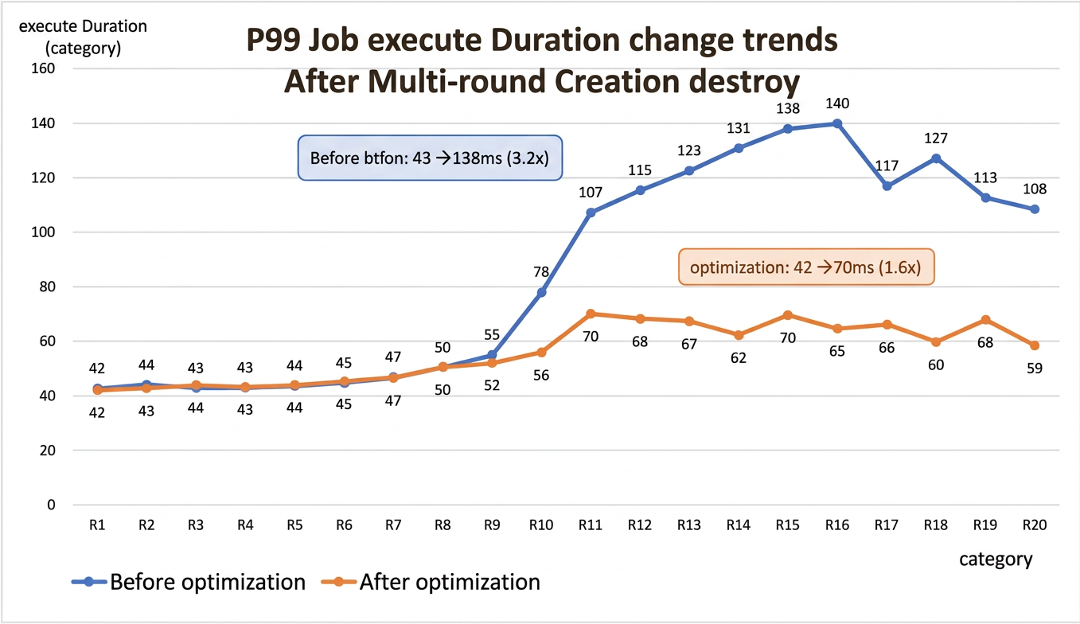
Taken together, Alibaba Cloud Linux 4 is more than a one-off "better benchmark score"; it also shows the potential to protect long-running systems: it adds no extra burden while a node is healthy, and as fragmentation deepens, it works to keep Agent tool calls from falling off a tail-latency cliff.
What the operating system contributes to agent workloads
Large Language Models (LLMs) decide what an Agent can do. The operating system decides whether those capabilities can run at scale, at controllable cost, with a stable experience.
This Alinux 4 release focuses back on a plainer question: when an enterprise starts running dozens, hundreds, or more agent sandboxes at the same time, can every unit of CPU and memory be turned into task output more effectively?
No single metric answers that. The same batch of Agent tasks finishes earlier. The host frees up more memory for colocation and for peaks. Stability stays more controllable as sandboxes are created and destroyed over and over. Together, the three point to one clear product direction: improve task turnaround and memory efficiency so that the same resources deliver more useful Agent work.
Looking ahead, Alinux 4 will keep evolving around high-density operation, fast startup, memory efficiency, and long-cycle stability for agent sandboxes, working alongside cloud compute, container, and AI platforms to turn invisible system-level optimization into task throughput and infrastructure efficiency that enterprises can measure.
Note: These optimizations are enabled by default in the Alibaba Cloud Linux 4 release of September 15, 2026; you will see the benefits once your kernel version is kernel-6.6.102-8 or later.
Read previous post:
Seven Showcases at Alibaba Cloud: Exploring AI-Native R&D Organization in Practice
-

-
OpenAnolis
128 posts | 6 followers
Follow
Comments
-
-
OpenAnolis
128 posts | 6 followers
Follow
Related Products
-
 Alibaba Cloud Linux
 is a free-to-use, native operating system that provides a stable, reliable, and high-performance environment for your applications.
Learn More -
 Elastic High Performance Computing
A HPCaaS cloud platform providing an all-in-one high-performance public computing service
Learn More -
 Remote Rendering Solution
Connect your on-premises render farm to the cloud with Alibaba Cloud Elastic High Performance Computing (E-HPC) power and continue business success in a post-pandemic world
Learn More -
 Elastic High Performance Computing Solution
High Performance Computing (HPC) and AI technology helps scientific research institutions to perform viral gene sequencing, conduct new drug research and development, and shorten the research and development cycle.
Learn More
More Posts by OpenAnolis
- Seven Showcases at Alibaba Cloud: Exploring AI-Native R&D Organization in Practice
- Anolis SkillHub Picks: I Explained Our Engineering Rules a Hundred Times — So I Turned Them into a Skill
- Anolis SkillHub Picks: Deploy and Manage a PG Cluster in One Sentence
- Ten Years of Typing vmstat, Packed Into One AI Skill | Anolis SkillHub Picks
- People and Agents Finally Share One CLI — Announcing ANOLISA v1.0
- SkillFS: Governing Dozens of Agent Skills with a File System
- When AI Transitions from 'Conversation' to 'Collaboration,' Who Will Manage the Working Memory of Millions of Tokens?
- STAROps Intelligent Host Inspection: A 24/7 AI Doctor for Your ECS Instances
- Low GPU Utilization You Can't Explain? Try This Zero-Intrusion AI Profiling Tool